SUBSCRIBE TO OUR FREE NEWSLETTER
Daily news & progressive opinion—funded by the people, not the corporations—delivered straight to your inbox.
5
#000000
#FFFFFF
To donate by check, phone, or other method, see our More Ways to Give page.
Daily news & progressive opinion—funded by the people, not the corporations—delivered straight to your inbox.
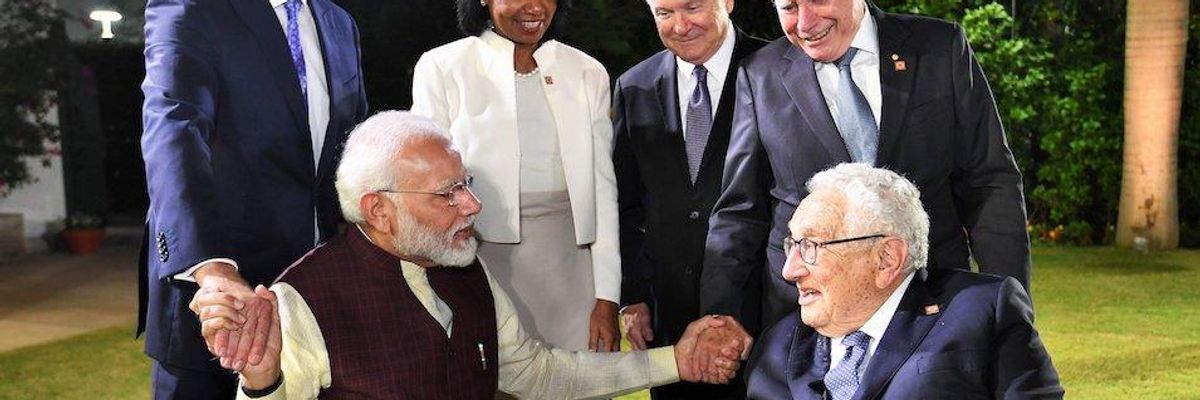
Modi and Kissinger are joined by friends. (Photo: Narendra Modi/Twitter)
As Indian Prime Minister Narendra Modi rubbed shoulders with Henry Kissinger and other former world leaders in India on Tuesday, Reps. Pramila Jayapal and Ilhan Omar questioned State Department officials on U.S. support for the Modi regime during a hearing on Capitol Hill.
Omar took particular aim at the Modi government's recent moves to strip Muslims in the country's northeast state of Assam and the building of camps in the region that critics of the Indian government fear may be used to house those decided as non-citizens by the regime.
"At what point do we no longer share values with India?" Omar asked assistant secretary of state for South Asia Alice Wells. "Are we waiting for the Muslims in Assam to be put in those camps?"
Wells, in reply, said that the U.S. was satisfied that the decisions by the Modi government were legitimate due to the fact that they were legal under Indian law.
"As a democracy, we respect other democracies' abilities to self-police and self-regulate," said Wells.
House subcommittee on Asian affairs chair Rep. Brad Sherman (D-Calif.) was unsatisfied with that response.
"A human rights abuse doesn't cease to be a human rights abuse just because it's being done pursuant to the law or court rulings of the country committing the abuse," Sherman said.
Jayapal took issue with the U.S. inaction on India's unilateral invasion and occupation of Kashmir in her remarks.
"I recognize the situation is complex," said Jayapal, adding that, however, "India as the world's largest democracy and a critical ally for the U.S. needs to uphold its commitment to human rights."
While the hearing was taking place in Washington, Modi was hobnobbing with the global elite at the JP Morgan International Council meeting in New Delhi. The prime minister posed with Kissinger, one of the most notorious U.S. leaders whose tenure was marked by scores of deaths across the world due to U.S. military action, particularly in southeast Asia.
Modi and Kissinger later posed for a picture with cadre of Iraq War boosters, including former U.K. Prime Minister Tony Blair, former Australian Prime Minister John Howard, and former U.S. Secretary of State Condoleeza Rice, and former U.S. Secretary of Defense Robert Gates.
Canadian journalist Usaid Siddiqui noted the irony of the photograph.
"A reminder that it was under George Bush, the man who invaded Iraq leaving behind a million corpses, that Narendra Modi was banned from the U.S. for Gujarat," Siddiqui tweeted.
Watch Omar and Jayapal in Tuesday's hearing:
Dear Common Dreams reader, It’s been nearly 30 years since I co-founded Common Dreams with my late wife, Lina Newhouser. We had the radical notion that journalism should serve the public good, not corporate profits. It was clear to us from the outset what it would take to build such a project. No paid advertisements. No corporate sponsors. No millionaire publisher telling us what to think or do. Many people said we wouldn't last a year, but we proved those doubters wrong. Together with a tremendous team of journalists and dedicated staff, we built an independent media outlet free from the constraints of profits and corporate control. Our mission has always been simple: To inform. To inspire. To ignite change for the common good. Building Common Dreams was not easy. Our survival was never guaranteed. When you take on the most powerful forces—Wall Street greed, fossil fuel industry destruction, Big Tech lobbyists, and uber-rich oligarchs who have spent billions upon billions rigging the economy and democracy in their favor—the only bulwark you have is supporters who believe in your work. But here’s the urgent message from me today. It's never been this bad out there. And it's never been this hard to keep us going. At the very moment Common Dreams is most needed, the threats we face are intensifying. We need your support now more than ever. We don't accept corporate advertising and never will. We don't have a paywall because we don't think people should be blocked from critical news based on their ability to pay. Everything we do is funded by the donations of readers like you. When everyone does the little they can afford, we are strong. But if that support retreats or dries up, so do we. Will you donate now to make sure Common Dreams not only survives but thrives? —Craig Brown, Co-founder |
As Indian Prime Minister Narendra Modi rubbed shoulders with Henry Kissinger and other former world leaders in India on Tuesday, Reps. Pramila Jayapal and Ilhan Omar questioned State Department officials on U.S. support for the Modi regime during a hearing on Capitol Hill.
Omar took particular aim at the Modi government's recent moves to strip Muslims in the country's northeast state of Assam and the building of camps in the region that critics of the Indian government fear may be used to house those decided as non-citizens by the regime.
"At what point do we no longer share values with India?" Omar asked assistant secretary of state for South Asia Alice Wells. "Are we waiting for the Muslims in Assam to be put in those camps?"
Wells, in reply, said that the U.S. was satisfied that the decisions by the Modi government were legitimate due to the fact that they were legal under Indian law.
"As a democracy, we respect other democracies' abilities to self-police and self-regulate," said Wells.
House subcommittee on Asian affairs chair Rep. Brad Sherman (D-Calif.) was unsatisfied with that response.
"A human rights abuse doesn't cease to be a human rights abuse just because it's being done pursuant to the law or court rulings of the country committing the abuse," Sherman said.
Jayapal took issue with the U.S. inaction on India's unilateral invasion and occupation of Kashmir in her remarks.
"I recognize the situation is complex," said Jayapal, adding that, however, "India as the world's largest democracy and a critical ally for the U.S. needs to uphold its commitment to human rights."
While the hearing was taking place in Washington, Modi was hobnobbing with the global elite at the JP Morgan International Council meeting in New Delhi. The prime minister posed with Kissinger, one of the most notorious U.S. leaders whose tenure was marked by scores of deaths across the world due to U.S. military action, particularly in southeast Asia.
Modi and Kissinger later posed for a picture with cadre of Iraq War boosters, including former U.K. Prime Minister Tony Blair, former Australian Prime Minister John Howard, and former U.S. Secretary of State Condoleeza Rice, and former U.S. Secretary of Defense Robert Gates.
Canadian journalist Usaid Siddiqui noted the irony of the photograph.
"A reminder that it was under George Bush, the man who invaded Iraq leaving behind a million corpses, that Narendra Modi was banned from the U.S. for Gujarat," Siddiqui tweeted.
Watch Omar and Jayapal in Tuesday's hearing:
As Indian Prime Minister Narendra Modi rubbed shoulders with Henry Kissinger and other former world leaders in India on Tuesday, Reps. Pramila Jayapal and Ilhan Omar questioned State Department officials on U.S. support for the Modi regime during a hearing on Capitol Hill.
Omar took particular aim at the Modi government's recent moves to strip Muslims in the country's northeast state of Assam and the building of camps in the region that critics of the Indian government fear may be used to house those decided as non-citizens by the regime.
"At what point do we no longer share values with India?" Omar asked assistant secretary of state for South Asia Alice Wells. "Are we waiting for the Muslims in Assam to be put in those camps?"
Wells, in reply, said that the U.S. was satisfied that the decisions by the Modi government were legitimate due to the fact that they were legal under Indian law.
"As a democracy, we respect other democracies' abilities to self-police and self-regulate," said Wells.
House subcommittee on Asian affairs chair Rep. Brad Sherman (D-Calif.) was unsatisfied with that response.
"A human rights abuse doesn't cease to be a human rights abuse just because it's being done pursuant to the law or court rulings of the country committing the abuse," Sherman said.
Jayapal took issue with the U.S. inaction on India's unilateral invasion and occupation of Kashmir in her remarks.
"I recognize the situation is complex," said Jayapal, adding that, however, "India as the world's largest democracy and a critical ally for the U.S. needs to uphold its commitment to human rights."
While the hearing was taking place in Washington, Modi was hobnobbing with the global elite at the JP Morgan International Council meeting in New Delhi. The prime minister posed with Kissinger, one of the most notorious U.S. leaders whose tenure was marked by scores of deaths across the world due to U.S. military action, particularly in southeast Asia.
Modi and Kissinger later posed for a picture with cadre of Iraq War boosters, including former U.K. Prime Minister Tony Blair, former Australian Prime Minister John Howard, and former U.S. Secretary of State Condoleeza Rice, and former U.S. Secretary of Defense Robert Gates.
Canadian journalist Usaid Siddiqui noted the irony of the photograph.
"A reminder that it was under George Bush, the man who invaded Iraq leaving behind a million corpses, that Narendra Modi was banned from the U.S. for Gujarat," Siddiqui tweeted.
Watch Omar and Jayapal in Tuesday's hearing: