SUBSCRIBE TO OUR FREE NEWSLETTER
Daily news & progressive opinion—funded by the people, not the corporations—delivered straight to your inbox.
5
#000000
#FFFFFF
To donate by check, phone, or other method, see our More Ways to Give page.
Daily news & progressive opinion—funded by the people, not the corporations—delivered straight to your inbox.
"We never at all threatened human life," said Jessica Reznicek in 2017, but were "acting in an effort to save human life, to save our planet, to save our resources." (Photo: Peg Hunter/flickr/cc)
It was announced this week that two fossil fuel activists face nine charges each in federal court for their actions to stop the controversial Dakota Access pipeline--actions they said they undertook "to save human life, to save our planet, to save our resources."
According to a statement released Wednesday by the U.S. Attorney's Office for the Southern District of Iowa, a federal grand jury returned an indictment charging Ruby Montoya and Jessica Reznicek on September 19, 2019. The charges include one count of conspiracy to damage an energy facility, four counts of use of fire in the commission of a felony, and four counts of malicious use of fire.
The pair each face as many as 110 years in prison.
"I wish the government would use the same resources to go after the oil companies and pipeline companies, but clearly they're not interested in that," Bill Quigley, an attorney who previously represented Montoya and Reznicek, told The Intercept.
"They shouldn't be prosecuted; they should be praised," said Quigley. "They're trying to stop the destruction of the human race."
The indictment announcement comes more than two years after Montoya and Reznicek, who are both part of the Catholic Worker movement, spoke outside the Iowa Utilities Board office and explained their successful strategies for delaying the Energy Transfer Partners-owned pipeline.
As the Des Moines Register reported,
their sabotage included burning at least five pieces of heavy construction equipment in northwest Iowa's Buena Vista County.
They also used oxyacetylene cutting torches to damage exposed, empty pipeline valves up and down the pipeline route across Iowa and South Dakota.
They later used tires and gasoline-soaked rags to burn multiple valve sites and electric units, as well as heavy equipment on pipeline easements.
Speaking to Democracy Now! in 2017, Reznicek rejected the characterization of her and Montoya's actions as violent.
I think that the oil being taken out of the ground and the machinery that does it and the infrastructure which supports it, that this is violent. This is--these tools and these mechanisms that industry and corporate--corporate power and government power have all colluded together to create, this is destructive, this is violent, and it needs to be stopped.
And we never at all threatened human life. We never at all--and, actually, we're acting in an effort to save human life, to save our planet, to save our resources. And nothing at any point was ever done by Ruby nor I in anything outside of peaceful, deliberate, and steady loving hands.
A trial is set for December 2.
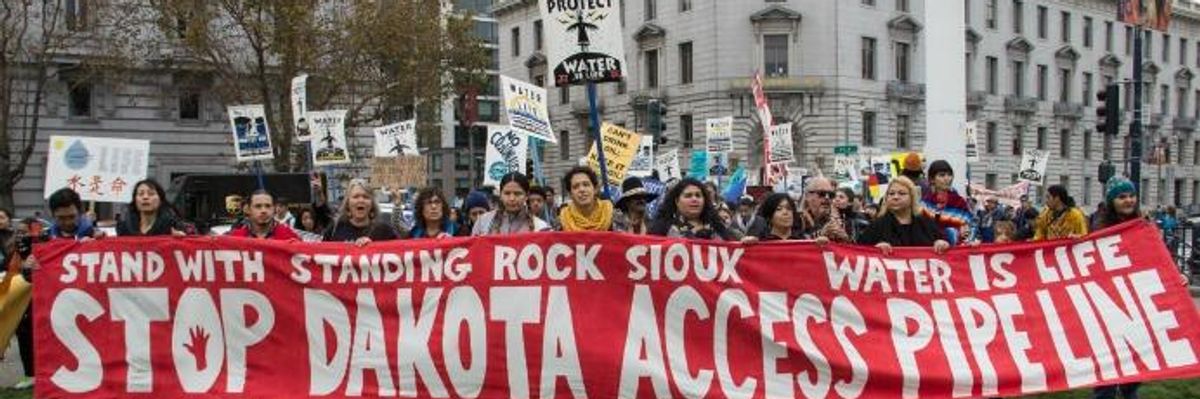
The pipeline sparked Indigenous-led protests that saw thousands of "water protectors" join. The demonstrations were met with forceful opposition, including "military-style counterterrorism measures" deployed by security firms.
"The pipeline became officially operational in June 2017," The New York Times reported Wednesday. "Today, 570,000 barrels of oil flow through it every day."
Indigenous, environmental, and landowner groups are hoping to stop that flow, and have urged 2020 Democratic presidential primary candidates to sign on to the "NoKXL pledge," which includes a promise to revoke the presidential permit for the Dakota Access pipeline. Sens. Elizabeth Warren, Bernie Sanders, Kamala Harris, and Cory Booker have signed, as have Tom Steyer, Julian Castro, and Pete Buttigieg.
To hear Montoya and Reznicek in their own words, watch the 2017 Democracy Now! interview below:
Dear Common Dreams reader, It’s been nearly 30 years since I co-founded Common Dreams with my late wife, Lina Newhouser. We had the radical notion that journalism should serve the public good, not corporate profits. It was clear to us from the outset what it would take to build such a project. No paid advertisements. No corporate sponsors. No millionaire publisher telling us what to think or do. Many people said we wouldn't last a year, but we proved those doubters wrong. Together with a tremendous team of journalists and dedicated staff, we built an independent media outlet free from the constraints of profits and corporate control. Our mission has always been simple: To inform. To inspire. To ignite change for the common good. Building Common Dreams was not easy. Our survival was never guaranteed. When you take on the most powerful forces—Wall Street greed, fossil fuel industry destruction, Big Tech lobbyists, and uber-rich oligarchs who have spent billions upon billions rigging the economy and democracy in their favor—the only bulwark you have is supporters who believe in your work. But here’s the urgent message from me today. It's never been this bad out there. And it's never been this hard to keep us going. At the very moment Common Dreams is most needed, the threats we face are intensifying. We need your support now more than ever. We don't accept corporate advertising and never will. We don't have a paywall because we don't think people should be blocked from critical news based on their ability to pay. Everything we do is funded by the donations of readers like you. When everyone does the little they can afford, we are strong. But if that support retreats or dries up, so do we. Will you donate now to make sure Common Dreams not only survives but thrives? —Craig Brown, Co-founder |
It was announced this week that two fossil fuel activists face nine charges each in federal court for their actions to stop the controversial Dakota Access pipeline--actions they said they undertook "to save human life, to save our planet, to save our resources."
According to a statement released Wednesday by the U.S. Attorney's Office for the Southern District of Iowa, a federal grand jury returned an indictment charging Ruby Montoya and Jessica Reznicek on September 19, 2019. The charges include one count of conspiracy to damage an energy facility, four counts of use of fire in the commission of a felony, and four counts of malicious use of fire.
The pair each face as many as 110 years in prison.
"I wish the government would use the same resources to go after the oil companies and pipeline companies, but clearly they're not interested in that," Bill Quigley, an attorney who previously represented Montoya and Reznicek, told The Intercept.
"They shouldn't be prosecuted; they should be praised," said Quigley. "They're trying to stop the destruction of the human race."
The indictment announcement comes more than two years after Montoya and Reznicek, who are both part of the Catholic Worker movement, spoke outside the Iowa Utilities Board office and explained their successful strategies for delaying the Energy Transfer Partners-owned pipeline.
As the Des Moines Register reported,
their sabotage included burning at least five pieces of heavy construction equipment in northwest Iowa's Buena Vista County.
They also used oxyacetylene cutting torches to damage exposed, empty pipeline valves up and down the pipeline route across Iowa and South Dakota.
They later used tires and gasoline-soaked rags to burn multiple valve sites and electric units, as well as heavy equipment on pipeline easements.
Speaking to Democracy Now! in 2017, Reznicek rejected the characterization of her and Montoya's actions as violent.
I think that the oil being taken out of the ground and the machinery that does it and the infrastructure which supports it, that this is violent. This is--these tools and these mechanisms that industry and corporate--corporate power and government power have all colluded together to create, this is destructive, this is violent, and it needs to be stopped.
And we never at all threatened human life. We never at all--and, actually, we're acting in an effort to save human life, to save our planet, to save our resources. And nothing at any point was ever done by Ruby nor I in anything outside of peaceful, deliberate, and steady loving hands.
A trial is set for December 2.
The pipeline sparked Indigenous-led protests that saw thousands of "water protectors" join. The demonstrations were met with forceful opposition, including "military-style counterterrorism measures" deployed by security firms.
"The pipeline became officially operational in June 2017," The New York Times reported Wednesday. "Today, 570,000 barrels of oil flow through it every day."
Indigenous, environmental, and landowner groups are hoping to stop that flow, and have urged 2020 Democratic presidential primary candidates to sign on to the "NoKXL pledge," which includes a promise to revoke the presidential permit for the Dakota Access pipeline. Sens. Elizabeth Warren, Bernie Sanders, Kamala Harris, and Cory Booker have signed, as have Tom Steyer, Julian Castro, and Pete Buttigieg.
To hear Montoya and Reznicek in their own words, watch the 2017 Democracy Now! interview below:
It was announced this week that two fossil fuel activists face nine charges each in federal court for their actions to stop the controversial Dakota Access pipeline--actions they said they undertook "to save human life, to save our planet, to save our resources."
According to a statement released Wednesday by the U.S. Attorney's Office for the Southern District of Iowa, a federal grand jury returned an indictment charging Ruby Montoya and Jessica Reznicek on September 19, 2019. The charges include one count of conspiracy to damage an energy facility, four counts of use of fire in the commission of a felony, and four counts of malicious use of fire.
The pair each face as many as 110 years in prison.
"I wish the government would use the same resources to go after the oil companies and pipeline companies, but clearly they're not interested in that," Bill Quigley, an attorney who previously represented Montoya and Reznicek, told The Intercept.
"They shouldn't be prosecuted; they should be praised," said Quigley. "They're trying to stop the destruction of the human race."
The indictment announcement comes more than two years after Montoya and Reznicek, who are both part of the Catholic Worker movement, spoke outside the Iowa Utilities Board office and explained their successful strategies for delaying the Energy Transfer Partners-owned pipeline.
As the Des Moines Register reported,
their sabotage included burning at least five pieces of heavy construction equipment in northwest Iowa's Buena Vista County.
They also used oxyacetylene cutting torches to damage exposed, empty pipeline valves up and down the pipeline route across Iowa and South Dakota.
They later used tires and gasoline-soaked rags to burn multiple valve sites and electric units, as well as heavy equipment on pipeline easements.
Speaking to Democracy Now! in 2017, Reznicek rejected the characterization of her and Montoya's actions as violent.
I think that the oil being taken out of the ground and the machinery that does it and the infrastructure which supports it, that this is violent. This is--these tools and these mechanisms that industry and corporate--corporate power and government power have all colluded together to create, this is destructive, this is violent, and it needs to be stopped.
And we never at all threatened human life. We never at all--and, actually, we're acting in an effort to save human life, to save our planet, to save our resources. And nothing at any point was ever done by Ruby nor I in anything outside of peaceful, deliberate, and steady loving hands.
A trial is set for December 2.
The pipeline sparked Indigenous-led protests that saw thousands of "water protectors" join. The demonstrations were met with forceful opposition, including "military-style counterterrorism measures" deployed by security firms.
"The pipeline became officially operational in June 2017," The New York Times reported Wednesday. "Today, 570,000 barrels of oil flow through it every day."
Indigenous, environmental, and landowner groups are hoping to stop that flow, and have urged 2020 Democratic presidential primary candidates to sign on to the "NoKXL pledge," which includes a promise to revoke the presidential permit for the Dakota Access pipeline. Sens. Elizabeth Warren, Bernie Sanders, Kamala Harris, and Cory Booker have signed, as have Tom Steyer, Julian Castro, and Pete Buttigieg.
To hear Montoya and Reznicek in their own words, watch the 2017 Democracy Now! interview below: