SUBSCRIBE TO OUR FREE NEWSLETTER
Daily news & progressive opinion—funded by the people, not the corporations—delivered straight to your inbox.
5
#000000
#FFFFFF
To donate by check, phone, or other method, see our More Ways to Give page.
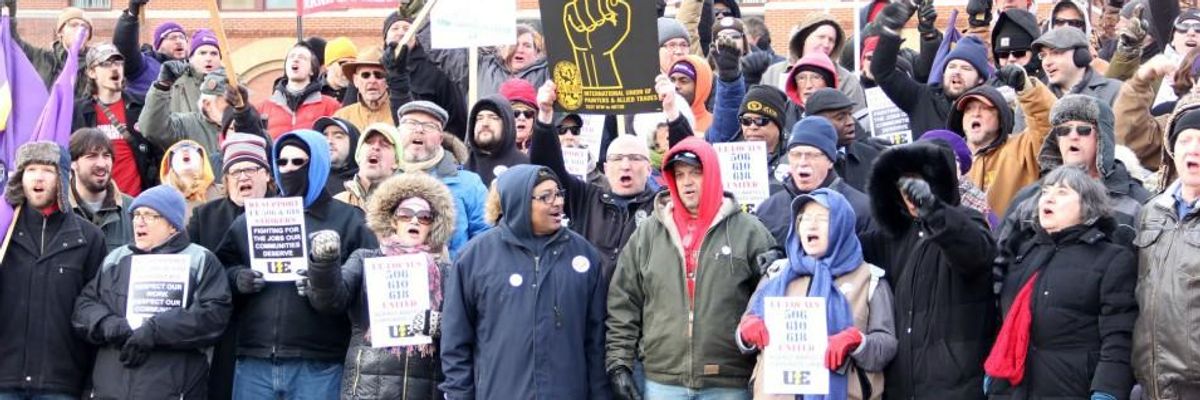
Just ahead of the 125th anniversary of the creation of Labor Day as a national holiday, a Gallup poll published Wednesday showed support for unions among the American public is at a near 50-year high despite the best efforts of corporations and right-wing politicians.
The Gallup survey found that 64 percent of Americans approve of unions, up 16 percent from 2009.
"The current 64 percent reading is one of the highest union approval ratings Gallup has recorded over the past 50 years," the polling organization noted, "topped only in March 1999 (66 percent), August 1999 (65 percent), and August 2003 (65 percent) surveys."
Lee Saunders, president of the American Federation of State, County, and Municipal Employees (AFSCME)--the largest union of public employees in the U.S.--said the poll shows that, in the realm of public sentiment, the labor movement has weathered "relentless anti-union attacks from wealthy corporations."
"More and more people recognize that unions are a force for progress and national strength, improving the lives of all working families, and their communities," said Saunders. "The labor movement has a powerful wind at its back. And we will carry this momentum into new organizing campaigns and our work in the 2020 elections."
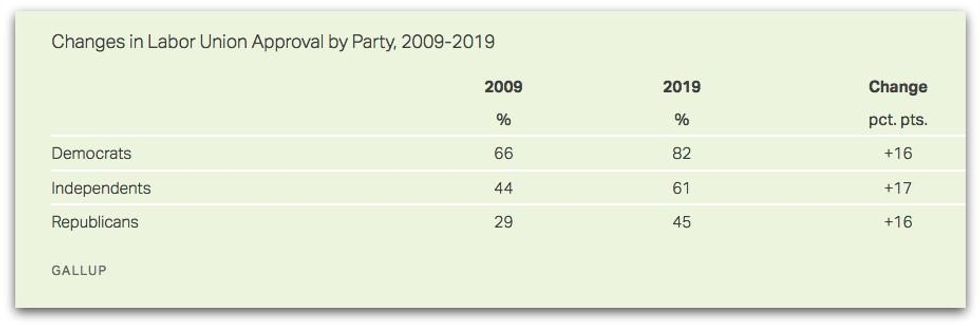
The survey comes after 2018 saw a record-breaking number of work stoppages as teachers, healthcare workers, and others walked off the job to protest poor benefits and low wages.
"The number of U.S. workers involved in a strike in 2018 was the highest since 1986," Time reported in February.
The wave of collective action continued in 2019 as teachers across the nation--from Denver to Sacramento to West Virginia--struck to resist school privatization efforts and paltry salaries.
Gallup's survey also comes as 2020 Democratic presidential candidates are battling for union support as the primary process continues to intensify.
As Common Dreams reported last week, Sen. Bernie Sanders (I-Vt.) unveiled a comprehensive plan to bolster workers' rights and double union membership. Days after Sanders released his proposal, the 35,000-member United Electrical, Radio, and Machine Workers of America (UE) became the first national union to endorse the Vermont senator.
AFSCME said in a statement Wednesday that, with support for organized labor rising, "it's more important than ever that our elected representatives give people more freedom to join unions."
Just ahead of the 125th anniversary of the creation of Labor Day as a national holiday, a Gallup poll published Wednesday showed support for unions among the American public is at a near 50-year high despite the best efforts of corporations and right-wing politicians.
The Gallup survey found that 64 percent of Americans approve of unions, up 16 percent from 2009.
"The current 64 percent reading is one of the highest union approval ratings Gallup has recorded over the past 50 years," the polling organization noted, "topped only in March 1999 (66 percent), August 1999 (65 percent), and August 2003 (65 percent) surveys."
Lee Saunders, president of the American Federation of State, County, and Municipal Employees (AFSCME)--the largest union of public employees in the U.S.--said the poll shows that, in the realm of public sentiment, the labor movement has weathered "relentless anti-union attacks from wealthy corporations."
"More and more people recognize that unions are a force for progress and national strength, improving the lives of all working families, and their communities," said Saunders. "The labor movement has a powerful wind at its back. And we will carry this momentum into new organizing campaigns and our work in the 2020 elections."
The survey comes after 2018 saw a record-breaking number of work stoppages as teachers, healthcare workers, and others walked off the job to protest poor benefits and low wages.
"The number of U.S. workers involved in a strike in 2018 was the highest since 1986," Time reported in February.
The wave of collective action continued in 2019 as teachers across the nation--from Denver to Sacramento to West Virginia--struck to resist school privatization efforts and paltry salaries.
Gallup's survey also comes as 2020 Democratic presidential candidates are battling for union support as the primary process continues to intensify.
As Common Dreams reported last week, Sen. Bernie Sanders (I-Vt.) unveiled a comprehensive plan to bolster workers' rights and double union membership. Days after Sanders released his proposal, the 35,000-member United Electrical, Radio, and Machine Workers of America (UE) became the first national union to endorse the Vermont senator.
AFSCME said in a statement Wednesday that, with support for organized labor rising, "it's more important than ever that our elected representatives give people more freedom to join unions."
Just ahead of the 125th anniversary of the creation of Labor Day as a national holiday, a Gallup poll published Wednesday showed support for unions among the American public is at a near 50-year high despite the best efforts of corporations and right-wing politicians.
The Gallup survey found that 64 percent of Americans approve of unions, up 16 percent from 2009.
"The current 64 percent reading is one of the highest union approval ratings Gallup has recorded over the past 50 years," the polling organization noted, "topped only in March 1999 (66 percent), August 1999 (65 percent), and August 2003 (65 percent) surveys."
Lee Saunders, president of the American Federation of State, County, and Municipal Employees (AFSCME)--the largest union of public employees in the U.S.--said the poll shows that, in the realm of public sentiment, the labor movement has weathered "relentless anti-union attacks from wealthy corporations."
"More and more people recognize that unions are a force for progress and national strength, improving the lives of all working families, and their communities," said Saunders. "The labor movement has a powerful wind at its back. And we will carry this momentum into new organizing campaigns and our work in the 2020 elections."
The survey comes after 2018 saw a record-breaking number of work stoppages as teachers, healthcare workers, and others walked off the job to protest poor benefits and low wages.
"The number of U.S. workers involved in a strike in 2018 was the highest since 1986," Time reported in February.
The wave of collective action continued in 2019 as teachers across the nation--from Denver to Sacramento to West Virginia--struck to resist school privatization efforts and paltry salaries.
Gallup's survey also comes as 2020 Democratic presidential candidates are battling for union support as the primary process continues to intensify.
As Common Dreams reported last week, Sen. Bernie Sanders (I-Vt.) unveiled a comprehensive plan to bolster workers' rights and double union membership. Days after Sanders released his proposal, the 35,000-member United Electrical, Radio, and Machine Workers of America (UE) became the first national union to endorse the Vermont senator.
AFSCME said in a statement Wednesday that, with support for organized labor rising, "it's more important than ever that our elected representatives give people more freedom to join unions."