

SUBSCRIBE TO OUR FREE NEWSLETTER
Daily news & progressive opinion—funded by the people, not the corporations—delivered straight to your inbox.
5
#000000
#FFFFFF
To donate by check, phone, or other method, see our More Ways to Give page.
Daily news & progressive opinion—funded by the people, not the corporations—delivered straight to your inbox.
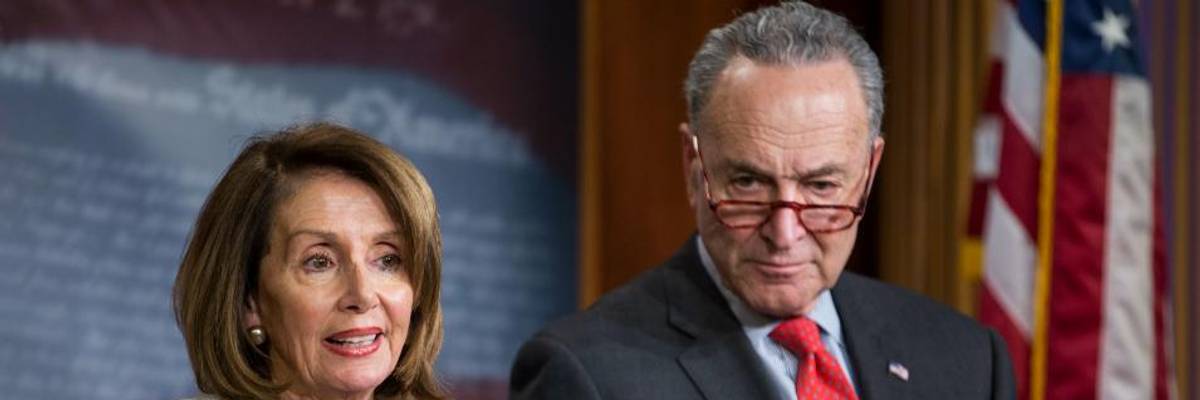
House Speaker Nancy Pelosi (D-Calif.) speaks during a news conference with Senate Minority Leader Chuck Schumer (D-N.Y.) at the U.S. Capitol January 25, 2019 in Washington, D.C.
House Speaker Nancy Pelosi may have helped temporarily avert a looming fiscal crisis on Monday by striking a budget deal with the Trump administration, but progressives warned the agreement hands Republicans power to kneecap the next president's agenda by suspending the debt ceiling until after the 2020 elections.
"You can almost hear Ted Cruz yelling on the floor of the Senate that Congress shouldn't raise the debt limit by one more dollar unless President Bernie Sanders promises to drop his demand for Medicare for All."
--Paul Blest, Splinter
The debt ceiling is the legislative limit on how much the federal government can borrow. If the ceiling is not raised, the U.S. would risk defaulting on its debts and potentially sparking a global financial crisis.
Former congressional staffers and other critics said that by agreeing to suspend the debt ceiling until 2021, Pelosi gave Senate Majority Leader Mitch McConnell (R-Ky.) the ability to extract massive spending cuts and other concessions from a Democratic president in exchange for raising the debt limit.
Paul Blest of Splinter wrote Tuesday that "if the eventual Democratic presidential nominee defeats Trump in 2020, this will be one of the things they have to deal with in their first year in office."
"If you really listen," Blest wrote, "you can almost hear [Texas Sen.] Ted Cruz yelling on the floor of the Senate that Congress shouldn't raise the debt limit by one more dollar unless President Bernie Sanders promises to drop his demand for Medicare for All."
In the lead-up to Pelosi's agreement with Treasury Secretary Steve Mnuchin, a number of commentators called for abolition of the debt ceiling, arguing it is an arbitrary and "absolutely insane" restriction that serves no legitimate purpose.
Citing a Democratic source close to the negotiations, Blest reported that "the possibility of ending the debt ceiling came up and 'interest was expressed,' [but] it was decided that it was 'too difficult' to do in this particular agreement."
"The biggest win of Pelosi's second stint as Speaker so far was holding the line on the government shutdown earlier this year," Blest wrote. "So, Pelosi knows how to use leverage; she just didn't push hard enough this time, for whatever reason."
Adam Jentleson, who served as deputy chief of staff to former Senate Democratic Leader Harry Reid, echoed Blest's fears about the budget deal in an interview with Bloomberg, which reported Tuesday that 2020 Democratic presidential candidates are "quietly expressing consternation" that the agreement could set them up for a disastrous first year in the White House.
"The timing of it really bugs me," said Jentleson. "It sets up a crisis of the first year of the next president's administration. We're letting them light the fuse on another bomb and place it squarely in the middle of the next president's first year in office."
The Democratic leadership, said Jentleson, handed Republicans--who are favored to hold the Senate in 2020--"a major weapon" to completely derail progressive agenda items that 2020 Democrats have placed at the center of their White House bids.
As Jentleson pointed out on Twitter, Republicans weaponized the debt ceiling against former President Barack Obama in 2011:
Pelosi's agreement with Mnuchin--which President Donald Trump applauded in a series of tweets Monday night--must be approved by the House and Senate. The deal would lift spending limits by $320 billion and hand the Pentagon a $738 billion budget, a $22 billion increase from the previous year.
In a joint statement, Pelosi and Senate Minority Leader Chuck Schumer (D-N.Y.) hailed the agreement as a bipartisan compromise "that will enhance our national security and invest in middle class priorities that advance the health, financial security, and well-being of the American people."
Brian Fallon, executive director of progressive advocacy group Demand Justice and former aide to Schumer, was not as enthusiastic about the deal.
"It was fun for a while to debate whether the Democrat who beats Trump should focus on election reform or climate change in 2021," Fallon tweeted. "Now Republicans will make it a fight over lifting the debt ceiling."
"The negotiations over the debt ceiling clearly illustrate the asymmetry between the two parties," Fallon added. "GOP is happy to preserve the debt limit because they know Dems will never hang it over a GOP president's head. On other hand, GOP is happy to play chicken with it when a Dem is in office."
Dear Common Dreams reader, It’s been nearly 30 years since I co-founded Common Dreams with my late wife, Lina Newhouser. We had the radical notion that journalism should serve the public good, not corporate profits. It was clear to us from the outset what it would take to build such a project. No paid advertisements. No corporate sponsors. No millionaire publisher telling us what to think or do. Many people said we wouldn't last a year, but we proved those doubters wrong. Together with a tremendous team of journalists and dedicated staff, we built an independent media outlet free from the constraints of profits and corporate control. Our mission has always been simple: To inform. To inspire. To ignite change for the common good. Building Common Dreams was not easy. Our survival was never guaranteed. When you take on the most powerful forces—Wall Street greed, fossil fuel industry destruction, Big Tech lobbyists, and uber-rich oligarchs who have spent billions upon billions rigging the economy and democracy in their favor—the only bulwark you have is supporters who believe in your work. But here’s the urgent message from me today. It's never been this bad out there. And it's never been this hard to keep us going. At the very moment Common Dreams is most needed, the threats we face are intensifying. We need your support now more than ever. We don't accept corporate advertising and never will. We don't have a paywall because we don't think people should be blocked from critical news based on their ability to pay. Everything we do is funded by the donations of readers like you. When everyone does the little they can afford, we are strong. But if that support retreats or dries up, so do we. Will you donate now to make sure Common Dreams not only survives but thrives? —Craig Brown, Co-founder |
House Speaker Nancy Pelosi may have helped temporarily avert a looming fiscal crisis on Monday by striking a budget deal with the Trump administration, but progressives warned the agreement hands Republicans power to kneecap the next president's agenda by suspending the debt ceiling until after the 2020 elections.
"You can almost hear Ted Cruz yelling on the floor of the Senate that Congress shouldn't raise the debt limit by one more dollar unless President Bernie Sanders promises to drop his demand for Medicare for All."
--Paul Blest, Splinter
The debt ceiling is the legislative limit on how much the federal government can borrow. If the ceiling is not raised, the U.S. would risk defaulting on its debts and potentially sparking a global financial crisis.
Former congressional staffers and other critics said that by agreeing to suspend the debt ceiling until 2021, Pelosi gave Senate Majority Leader Mitch McConnell (R-Ky.) the ability to extract massive spending cuts and other concessions from a Democratic president in exchange for raising the debt limit.
Paul Blest of Splinter wrote Tuesday that "if the eventual Democratic presidential nominee defeats Trump in 2020, this will be one of the things they have to deal with in their first year in office."
"If you really listen," Blest wrote, "you can almost hear [Texas Sen.] Ted Cruz yelling on the floor of the Senate that Congress shouldn't raise the debt limit by one more dollar unless President Bernie Sanders promises to drop his demand for Medicare for All."
In the lead-up to Pelosi's agreement with Treasury Secretary Steve Mnuchin, a number of commentators called for abolition of the debt ceiling, arguing it is an arbitrary and "absolutely insane" restriction that serves no legitimate purpose.
Citing a Democratic source close to the negotiations, Blest reported that "the possibility of ending the debt ceiling came up and 'interest was expressed,' [but] it was decided that it was 'too difficult' to do in this particular agreement."
"The biggest win of Pelosi's second stint as Speaker so far was holding the line on the government shutdown earlier this year," Blest wrote. "So, Pelosi knows how to use leverage; she just didn't push hard enough this time, for whatever reason."
Adam Jentleson, who served as deputy chief of staff to former Senate Democratic Leader Harry Reid, echoed Blest's fears about the budget deal in an interview with Bloomberg, which reported Tuesday that 2020 Democratic presidential candidates are "quietly expressing consternation" that the agreement could set them up for a disastrous first year in the White House.
"The timing of it really bugs me," said Jentleson. "It sets up a crisis of the first year of the next president's administration. We're letting them light the fuse on another bomb and place it squarely in the middle of the next president's first year in office."
The Democratic leadership, said Jentleson, handed Republicans--who are favored to hold the Senate in 2020--"a major weapon" to completely derail progressive agenda items that 2020 Democrats have placed at the center of their White House bids.
As Jentleson pointed out on Twitter, Republicans weaponized the debt ceiling against former President Barack Obama in 2011:
Pelosi's agreement with Mnuchin--which President Donald Trump applauded in a series of tweets Monday night--must be approved by the House and Senate. The deal would lift spending limits by $320 billion and hand the Pentagon a $738 billion budget, a $22 billion increase from the previous year.
In a joint statement, Pelosi and Senate Minority Leader Chuck Schumer (D-N.Y.) hailed the agreement as a bipartisan compromise "that will enhance our national security and invest in middle class priorities that advance the health, financial security, and well-being of the American people."
Brian Fallon, executive director of progressive advocacy group Demand Justice and former aide to Schumer, was not as enthusiastic about the deal.
"It was fun for a while to debate whether the Democrat who beats Trump should focus on election reform or climate change in 2021," Fallon tweeted. "Now Republicans will make it a fight over lifting the debt ceiling."
"The negotiations over the debt ceiling clearly illustrate the asymmetry between the two parties," Fallon added. "GOP is happy to preserve the debt limit because they know Dems will never hang it over a GOP president's head. On other hand, GOP is happy to play chicken with it when a Dem is in office."
House Speaker Nancy Pelosi may have helped temporarily avert a looming fiscal crisis on Monday by striking a budget deal with the Trump administration, but progressives warned the agreement hands Republicans power to kneecap the next president's agenda by suspending the debt ceiling until after the 2020 elections.
"You can almost hear Ted Cruz yelling on the floor of the Senate that Congress shouldn't raise the debt limit by one more dollar unless President Bernie Sanders promises to drop his demand for Medicare for All."
--Paul Blest, Splinter
The debt ceiling is the legislative limit on how much the federal government can borrow. If the ceiling is not raised, the U.S. would risk defaulting on its debts and potentially sparking a global financial crisis.
Former congressional staffers and other critics said that by agreeing to suspend the debt ceiling until 2021, Pelosi gave Senate Majority Leader Mitch McConnell (R-Ky.) the ability to extract massive spending cuts and other concessions from a Democratic president in exchange for raising the debt limit.
Paul Blest of Splinter wrote Tuesday that "if the eventual Democratic presidential nominee defeats Trump in 2020, this will be one of the things they have to deal with in their first year in office."
"If you really listen," Blest wrote, "you can almost hear [Texas Sen.] Ted Cruz yelling on the floor of the Senate that Congress shouldn't raise the debt limit by one more dollar unless President Bernie Sanders promises to drop his demand for Medicare for All."
In the lead-up to Pelosi's agreement with Treasury Secretary Steve Mnuchin, a number of commentators called for abolition of the debt ceiling, arguing it is an arbitrary and "absolutely insane" restriction that serves no legitimate purpose.
Citing a Democratic source close to the negotiations, Blest reported that "the possibility of ending the debt ceiling came up and 'interest was expressed,' [but] it was decided that it was 'too difficult' to do in this particular agreement."
"The biggest win of Pelosi's second stint as Speaker so far was holding the line on the government shutdown earlier this year," Blest wrote. "So, Pelosi knows how to use leverage; she just didn't push hard enough this time, for whatever reason."
Adam Jentleson, who served as deputy chief of staff to former Senate Democratic Leader Harry Reid, echoed Blest's fears about the budget deal in an interview with Bloomberg, which reported Tuesday that 2020 Democratic presidential candidates are "quietly expressing consternation" that the agreement could set them up for a disastrous first year in the White House.
"The timing of it really bugs me," said Jentleson. "It sets up a crisis of the first year of the next president's administration. We're letting them light the fuse on another bomb and place it squarely in the middle of the next president's first year in office."
The Democratic leadership, said Jentleson, handed Republicans--who are favored to hold the Senate in 2020--"a major weapon" to completely derail progressive agenda items that 2020 Democrats have placed at the center of their White House bids.
As Jentleson pointed out on Twitter, Republicans weaponized the debt ceiling against former President Barack Obama in 2011:
Pelosi's agreement with Mnuchin--which President Donald Trump applauded in a series of tweets Monday night--must be approved by the House and Senate. The deal would lift spending limits by $320 billion and hand the Pentagon a $738 billion budget, a $22 billion increase from the previous year.
In a joint statement, Pelosi and Senate Minority Leader Chuck Schumer (D-N.Y.) hailed the agreement as a bipartisan compromise "that will enhance our national security and invest in middle class priorities that advance the health, financial security, and well-being of the American people."
Brian Fallon, executive director of progressive advocacy group Demand Justice and former aide to Schumer, was not as enthusiastic about the deal.
"It was fun for a while to debate whether the Democrat who beats Trump should focus on election reform or climate change in 2021," Fallon tweeted. "Now Republicans will make it a fight over lifting the debt ceiling."
"The negotiations over the debt ceiling clearly illustrate the asymmetry between the two parties," Fallon added. "GOP is happy to preserve the debt limit because they know Dems will never hang it over a GOP president's head. On other hand, GOP is happy to play chicken with it when a Dem is in office."

