SUBSCRIBE TO OUR FREE NEWSLETTER
Daily news & progressive opinion—funded by the people, not the corporations—delivered straight to your inbox.
5
#000000
#FFFFFF
To donate by check, phone, or other method, see our More Ways to Give page.
Daily news & progressive opinion—funded by the people, not the corporations—delivered straight to your inbox.
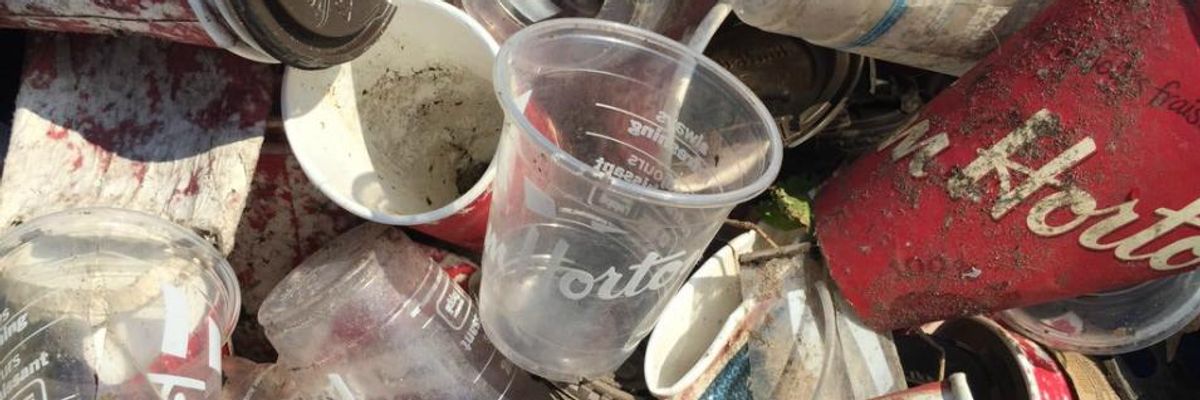
Greenpeace activists gathered waste for World Clean-up Day in 2018.
Environmental campaigners on Monday welcomed the Canadian government's new plan to ban certain single-use plastics as early as 2021 and work with provinces and territories to make corporations responsible for their plastic waste.
"Ultimately Canada needs to move towards phasing out all non-essential plastics if we are going to truly reduce the awful plastic legacy we are leaving for future generations of all life on this planet," Sarah King of Greenpeace Canada said in a statement. "The federal government's announcements marks the first step in an essential journey to break free from plastic."
Food & Water Watch executive director Wenonah Hauter, who also praised the plan in a statement, said that "bans on single-use plastics will help address the growing threat of microplastics in our food, water, and air--the health effects of which are unknown. They also send a powerful signal that the world does not welcome more climate-damaging fracked gas to create plastic."
Pointing to a Food & Water Watch report released last week that detailed how the petrochemical and other industries help drive fracking for natural gas, Hauter explained that "there is a symbiotic relationship between plastic manufacturing and the fracking industry. Any regulation that curbs one industry will help decrease pollution from the other."
A statement Monday from the office of Canadian Prime Minister Justin Trudeau described widespread plastic pollution as "a global challenge that requires immediate action" and outlined the broad goals of the government's plan. Across Canada, people throw away more than 3 million tons of plastic waste per year, and about a third of all plastics are single-use items like straws and shopping bags.
"Canadians know first-hand the impacts of plastic pollution, and are tired of seeing their beaches, parks, streets, and shorelines littered with plastic waste," Trudeau said. "We have a responsibility to work with our partners to reduce plastic pollution, protect the environment, and create jobs and grow our economy. "We owe it to our kids to keep the environment clean and safe for generations to come."
Trudeau's government intends to work with political and business partners throughout the North American country to:
The prime minister spoke about the plan in a speech Monday at the Gault Nature Reserve in Mont-Saint-Hilaire, outside Montreal. CBC reported:
Trudeau said the government will research the question of which items it should ban and follow the model chosen by the European Union, which voted in March to ban plastic items for which market alternatives exist--such as single-use plastic cutlery and plates--and items made of oxo-degradable plastics, such as bags. (Oxo-degradable plastics aren't really biodegradable; they contain additives that cause the plastic to fragment without breaking down chemically.)
Greenpeace Canada--noting that the government's statement mentioned a few specific single-use products that may be banned--called for phasing out all "problematic and unnecessary plastics," including PVC, bags, bottles, straws, utensils, expanded polystyrene, cups and lids, multilayered wrappers, and take-out containers.
"We know the science and real-world evidence is clear that single-use plastics and waste is toxic, infiltrating food chains and even the air we breathe," said King. "Acting now to ban the most problematic and unnecessary plastics while holding corporations accountable for the waste problem they have created can set us on a better course. But the government must act as quickly as possible so this announcement isn't a single-use election promise."
Dear Common Dreams reader, It’s been nearly 30 years since I co-founded Common Dreams with my late wife, Lina Newhouser. We had the radical notion that journalism should serve the public good, not corporate profits. It was clear to us from the outset what it would take to build such a project. No paid advertisements. No corporate sponsors. No millionaire publisher telling us what to think or do. Many people said we wouldn't last a year, but we proved those doubters wrong. Together with a tremendous team of journalists and dedicated staff, we built an independent media outlet free from the constraints of profits and corporate control. Our mission has always been simple: To inform. To inspire. To ignite change for the common good. Building Common Dreams was not easy. Our survival was never guaranteed. When you take on the most powerful forces—Wall Street greed, fossil fuel industry destruction, Big Tech lobbyists, and uber-rich oligarchs who have spent billions upon billions rigging the economy and democracy in their favor—the only bulwark you have is supporters who believe in your work. But here’s the urgent message from me today. It's never been this bad out there. And it's never been this hard to keep us going. At the very moment Common Dreams is most needed, the threats we face are intensifying. We need your support now more than ever. We don't accept corporate advertising and never will. We don't have a paywall because we don't think people should be blocked from critical news based on their ability to pay. Everything we do is funded by the donations of readers like you. When everyone does the little they can afford, we are strong. But if that support retreats or dries up, so do we. Will you donate now to make sure Common Dreams not only survives but thrives? —Craig Brown, Co-founder |
Environmental campaigners on Monday welcomed the Canadian government's new plan to ban certain single-use plastics as early as 2021 and work with provinces and territories to make corporations responsible for their plastic waste.
"Ultimately Canada needs to move towards phasing out all non-essential plastics if we are going to truly reduce the awful plastic legacy we are leaving for future generations of all life on this planet," Sarah King of Greenpeace Canada said in a statement. "The federal government's announcements marks the first step in an essential journey to break free from plastic."
Food & Water Watch executive director Wenonah Hauter, who also praised the plan in a statement, said that "bans on single-use plastics will help address the growing threat of microplastics in our food, water, and air--the health effects of which are unknown. They also send a powerful signal that the world does not welcome more climate-damaging fracked gas to create plastic."
Pointing to a Food & Water Watch report released last week that detailed how the petrochemical and other industries help drive fracking for natural gas, Hauter explained that "there is a symbiotic relationship between plastic manufacturing and the fracking industry. Any regulation that curbs one industry will help decrease pollution from the other."
A statement Monday from the office of Canadian Prime Minister Justin Trudeau described widespread plastic pollution as "a global challenge that requires immediate action" and outlined the broad goals of the government's plan. Across Canada, people throw away more than 3 million tons of plastic waste per year, and about a third of all plastics are single-use items like straws and shopping bags.
"Canadians know first-hand the impacts of plastic pollution, and are tired of seeing their beaches, parks, streets, and shorelines littered with plastic waste," Trudeau said. "We have a responsibility to work with our partners to reduce plastic pollution, protect the environment, and create jobs and grow our economy. "We owe it to our kids to keep the environment clean and safe for generations to come."
Trudeau's government intends to work with political and business partners throughout the North American country to:
The prime minister spoke about the plan in a speech Monday at the Gault Nature Reserve in Mont-Saint-Hilaire, outside Montreal. CBC reported:
Trudeau said the government will research the question of which items it should ban and follow the model chosen by the European Union, which voted in March to ban plastic items for which market alternatives exist--such as single-use plastic cutlery and plates--and items made of oxo-degradable plastics, such as bags. (Oxo-degradable plastics aren't really biodegradable; they contain additives that cause the plastic to fragment without breaking down chemically.)
Greenpeace Canada--noting that the government's statement mentioned a few specific single-use products that may be banned--called for phasing out all "problematic and unnecessary plastics," including PVC, bags, bottles, straws, utensils, expanded polystyrene, cups and lids, multilayered wrappers, and take-out containers.
"We know the science and real-world evidence is clear that single-use plastics and waste is toxic, infiltrating food chains and even the air we breathe," said King. "Acting now to ban the most problematic and unnecessary plastics while holding corporations accountable for the waste problem they have created can set us on a better course. But the government must act as quickly as possible so this announcement isn't a single-use election promise."
Environmental campaigners on Monday welcomed the Canadian government's new plan to ban certain single-use plastics as early as 2021 and work with provinces and territories to make corporations responsible for their plastic waste.
"Ultimately Canada needs to move towards phasing out all non-essential plastics if we are going to truly reduce the awful plastic legacy we are leaving for future generations of all life on this planet," Sarah King of Greenpeace Canada said in a statement. "The federal government's announcements marks the first step in an essential journey to break free from plastic."
Food & Water Watch executive director Wenonah Hauter, who also praised the plan in a statement, said that "bans on single-use plastics will help address the growing threat of microplastics in our food, water, and air--the health effects of which are unknown. They also send a powerful signal that the world does not welcome more climate-damaging fracked gas to create plastic."
Pointing to a Food & Water Watch report released last week that detailed how the petrochemical and other industries help drive fracking for natural gas, Hauter explained that "there is a symbiotic relationship between plastic manufacturing and the fracking industry. Any regulation that curbs one industry will help decrease pollution from the other."
A statement Monday from the office of Canadian Prime Minister Justin Trudeau described widespread plastic pollution as "a global challenge that requires immediate action" and outlined the broad goals of the government's plan. Across Canada, people throw away more than 3 million tons of plastic waste per year, and about a third of all plastics are single-use items like straws and shopping bags.
"Canadians know first-hand the impacts of plastic pollution, and are tired of seeing their beaches, parks, streets, and shorelines littered with plastic waste," Trudeau said. "We have a responsibility to work with our partners to reduce plastic pollution, protect the environment, and create jobs and grow our economy. "We owe it to our kids to keep the environment clean and safe for generations to come."
Trudeau's government intends to work with political and business partners throughout the North American country to:
The prime minister spoke about the plan in a speech Monday at the Gault Nature Reserve in Mont-Saint-Hilaire, outside Montreal. CBC reported:
Trudeau said the government will research the question of which items it should ban and follow the model chosen by the European Union, which voted in March to ban plastic items for which market alternatives exist--such as single-use plastic cutlery and plates--and items made of oxo-degradable plastics, such as bags. (Oxo-degradable plastics aren't really biodegradable; they contain additives that cause the plastic to fragment without breaking down chemically.)
Greenpeace Canada--noting that the government's statement mentioned a few specific single-use products that may be banned--called for phasing out all "problematic and unnecessary plastics," including PVC, bags, bottles, straws, utensils, expanded polystyrene, cups and lids, multilayered wrappers, and take-out containers.
"We know the science and real-world evidence is clear that single-use plastics and waste is toxic, infiltrating food chains and even the air we breathe," said King. "Acting now to ban the most problematic and unnecessary plastics while holding corporations accountable for the waste problem they have created can set us on a better course. But the government must act as quickly as possible so this announcement isn't a single-use election promise."