SUBSCRIBE TO OUR FREE NEWSLETTER
Daily news & progressive opinion—funded by the people, not the corporations—delivered straight to your inbox.
5
#000000
#FFFFFF
To donate by check, phone, or other method, see our More Ways to Give page.
Daily news & progressive opinion—funded by the people, not the corporations—delivered straight to your inbox.
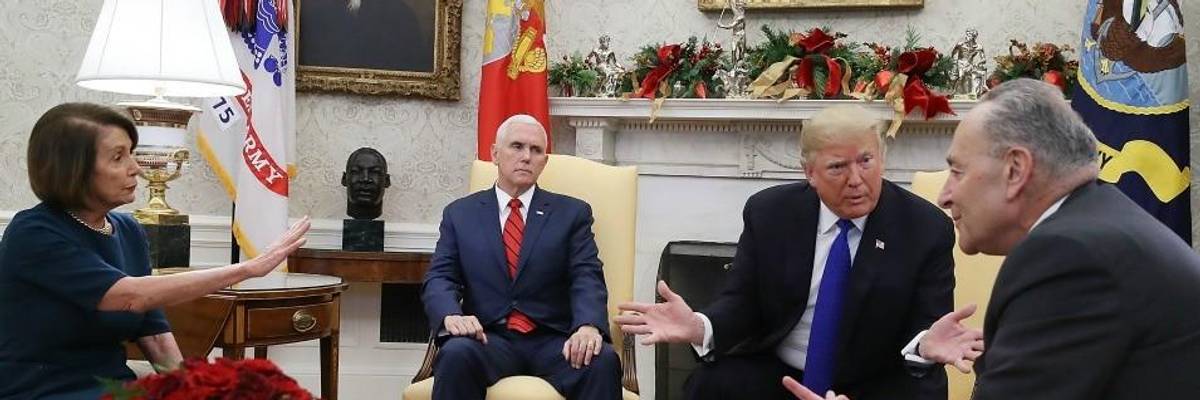
President Donald Trump talks about border security with Senate Minority Leader Chuck Schumer (D-N.Y.) and House Speaker Nancy Pelosi (D-Calif.) as Vice President Mike Pence sits nearby in the Oval Office on December 11, 2018 in Washington, D.C. (Photo: Mark Wilson/Getty Images)
With President Donald Trump and Democratic leaders set to meet Wednesday to discuss a possible $2 trillion infrastructure package, a progressive advocacy group on Monday warned that any proposal that doesn't include significant tax hikes on the rich and corporations "will be meaningless and doomed to failure."
"Without asking more from the wealthy and corporations, the plan will be just another empty promise while our roads, bridges, rail lines, and public buildings continue to deteriorate."
--Frank Clemente, Americans for Tax Fairness
"If major tax increases are off the table, there is no way to pay for a $2 trillion infrastructure plan, it's that simple," Frank Clemente, executive director of Americans for Tax Fairness (ATF), said in a statement. "Other options, such as raising the gas tax, might be part of the package, but by themselves won't come close to reaching the $2 trillion that's needed."
During his scheduled meeting with House Speaker Nancy Pelosi (D-Calif.) and Senate Minority Leader Chuck Schumer (D-N.Y.), Trump is expected to unveil a plan to fund an infrastructure package.
"It will be interesting to see what the president comes up with," said Clemente. "But without asking more from the wealthy and corporations, the plan will be just another empty promise while our roads, bridges, rail lines, and public buildings continue to deteriorate."
Clemente pointed out that while Senate Democrats have proposed rolling back some of the tax cuts for the rich and corporations in the Trump-GOP tax law as a way to pay for an ambitious infrastructure plan, congressional Republicans have signaled they would oppose such a move.
And, as The Hill reported last week, Republicans in Congress "have indicated they are unlikely to support an infrastructure package" with a $2 trillion price tag "unless they can reach a deal on how to pay for it without adding to the deficit."
"None of these objections were raised by Republicans when they passed their tax cuts for the wealthy and big corporations that weren't paid for and added nearly $2 trillion to the debt," Clemente said. "They continue to insist that the tax cuts will pay for themselves, but that won't happen."
ATF offered five possible funding mechanisms for a $2 trillion infrastructure plan:
Following negotiations with Trump last month, Schumer told reporters that Democrats called for 80 percent of the infrastructure plan to be funded by the federal government and 20 percent by localities. At the time, The Hill reported, Schumer also suggested including a "public-private partnership element" in the plan.
While Trump's infrastructure proposal last year called for public-private partnerships, the president last month denounced such arrangements as "stupid" because "you get sued."
ATF also expressed opposition to public-private partnerships, but for entirely different reasons.
"Only about 12 percent of infrastructure projects offer a return that would attract private investment," according to ATF, "and the tolls and fees necessary to make the projects viable would disproportionately tax working families while providing long-term guaranteed profits for big corporations and Wall Street."
Dear Common Dreams reader, It’s been nearly 30 years since I co-founded Common Dreams with my late wife, Lina Newhouser. We had the radical notion that journalism should serve the public good, not corporate profits. It was clear to us from the outset what it would take to build such a project. No paid advertisements. No corporate sponsors. No millionaire publisher telling us what to think or do. Many people said we wouldn't last a year, but we proved those doubters wrong. Together with a tremendous team of journalists and dedicated staff, we built an independent media outlet free from the constraints of profits and corporate control. Our mission has always been simple: To inform. To inspire. To ignite change for the common good. Building Common Dreams was not easy. Our survival was never guaranteed. When you take on the most powerful forces—Wall Street greed, fossil fuel industry destruction, Big Tech lobbyists, and uber-rich oligarchs who have spent billions upon billions rigging the economy and democracy in their favor—the only bulwark you have is supporters who believe in your work. But here’s the urgent message from me today. It's never been this bad out there. And it's never been this hard to keep us going. At the very moment Common Dreams is most needed, the threats we face are intensifying. We need your support now more than ever. We don't accept corporate advertising and never will. We don't have a paywall because we don't think people should be blocked from critical news based on their ability to pay. Everything we do is funded by the donations of readers like you. When everyone does the little they can afford, we are strong. But if that support retreats or dries up, so do we. Will you donate now to make sure Common Dreams not only survives but thrives? —Craig Brown, Co-founder |
With President Donald Trump and Democratic leaders set to meet Wednesday to discuss a possible $2 trillion infrastructure package, a progressive advocacy group on Monday warned that any proposal that doesn't include significant tax hikes on the rich and corporations "will be meaningless and doomed to failure."
"Without asking more from the wealthy and corporations, the plan will be just another empty promise while our roads, bridges, rail lines, and public buildings continue to deteriorate."
--Frank Clemente, Americans for Tax Fairness
"If major tax increases are off the table, there is no way to pay for a $2 trillion infrastructure plan, it's that simple," Frank Clemente, executive director of Americans for Tax Fairness (ATF), said in a statement. "Other options, such as raising the gas tax, might be part of the package, but by themselves won't come close to reaching the $2 trillion that's needed."
During his scheduled meeting with House Speaker Nancy Pelosi (D-Calif.) and Senate Minority Leader Chuck Schumer (D-N.Y.), Trump is expected to unveil a plan to fund an infrastructure package.
"It will be interesting to see what the president comes up with," said Clemente. "But without asking more from the wealthy and corporations, the plan will be just another empty promise while our roads, bridges, rail lines, and public buildings continue to deteriorate."
Clemente pointed out that while Senate Democrats have proposed rolling back some of the tax cuts for the rich and corporations in the Trump-GOP tax law as a way to pay for an ambitious infrastructure plan, congressional Republicans have signaled they would oppose such a move.
And, as The Hill reported last week, Republicans in Congress "have indicated they are unlikely to support an infrastructure package" with a $2 trillion price tag "unless they can reach a deal on how to pay for it without adding to the deficit."
"None of these objections were raised by Republicans when they passed their tax cuts for the wealthy and big corporations that weren't paid for and added nearly $2 trillion to the debt," Clemente said. "They continue to insist that the tax cuts will pay for themselves, but that won't happen."
ATF offered five possible funding mechanisms for a $2 trillion infrastructure plan:
Following negotiations with Trump last month, Schumer told reporters that Democrats called for 80 percent of the infrastructure plan to be funded by the federal government and 20 percent by localities. At the time, The Hill reported, Schumer also suggested including a "public-private partnership element" in the plan.
While Trump's infrastructure proposal last year called for public-private partnerships, the president last month denounced such arrangements as "stupid" because "you get sued."
ATF also expressed opposition to public-private partnerships, but for entirely different reasons.
"Only about 12 percent of infrastructure projects offer a return that would attract private investment," according to ATF, "and the tolls and fees necessary to make the projects viable would disproportionately tax working families while providing long-term guaranteed profits for big corporations and Wall Street."
With President Donald Trump and Democratic leaders set to meet Wednesday to discuss a possible $2 trillion infrastructure package, a progressive advocacy group on Monday warned that any proposal that doesn't include significant tax hikes on the rich and corporations "will be meaningless and doomed to failure."
"Without asking more from the wealthy and corporations, the plan will be just another empty promise while our roads, bridges, rail lines, and public buildings continue to deteriorate."
--Frank Clemente, Americans for Tax Fairness
"If major tax increases are off the table, there is no way to pay for a $2 trillion infrastructure plan, it's that simple," Frank Clemente, executive director of Americans for Tax Fairness (ATF), said in a statement. "Other options, such as raising the gas tax, might be part of the package, but by themselves won't come close to reaching the $2 trillion that's needed."
During his scheduled meeting with House Speaker Nancy Pelosi (D-Calif.) and Senate Minority Leader Chuck Schumer (D-N.Y.), Trump is expected to unveil a plan to fund an infrastructure package.
"It will be interesting to see what the president comes up with," said Clemente. "But without asking more from the wealthy and corporations, the plan will be just another empty promise while our roads, bridges, rail lines, and public buildings continue to deteriorate."
Clemente pointed out that while Senate Democrats have proposed rolling back some of the tax cuts for the rich and corporations in the Trump-GOP tax law as a way to pay for an ambitious infrastructure plan, congressional Republicans have signaled they would oppose such a move.
And, as The Hill reported last week, Republicans in Congress "have indicated they are unlikely to support an infrastructure package" with a $2 trillion price tag "unless they can reach a deal on how to pay for it without adding to the deficit."
"None of these objections were raised by Republicans when they passed their tax cuts for the wealthy and big corporations that weren't paid for and added nearly $2 trillion to the debt," Clemente said. "They continue to insist that the tax cuts will pay for themselves, but that won't happen."
ATF offered five possible funding mechanisms for a $2 trillion infrastructure plan:
Following negotiations with Trump last month, Schumer told reporters that Democrats called for 80 percent of the infrastructure plan to be funded by the federal government and 20 percent by localities. At the time, The Hill reported, Schumer also suggested including a "public-private partnership element" in the plan.
While Trump's infrastructure proposal last year called for public-private partnerships, the president last month denounced such arrangements as "stupid" because "you get sued."
ATF also expressed opposition to public-private partnerships, but for entirely different reasons.
"Only about 12 percent of infrastructure projects offer a return that would attract private investment," according to ATF, "and the tolls and fees necessary to make the projects viable would disproportionately tax working families while providing long-term guaranteed profits for big corporations and Wall Street."