SUBSCRIBE TO OUR FREE NEWSLETTER
Daily news & progressive opinion—funded by the people, not the corporations—delivered straight to your inbox.
5
#000000
#FFFFFF
To donate by check, phone, or other method, see our More Ways to Give page.
Daily news & progressive opinion—funded by the people, not the corporations—delivered straight to your inbox.
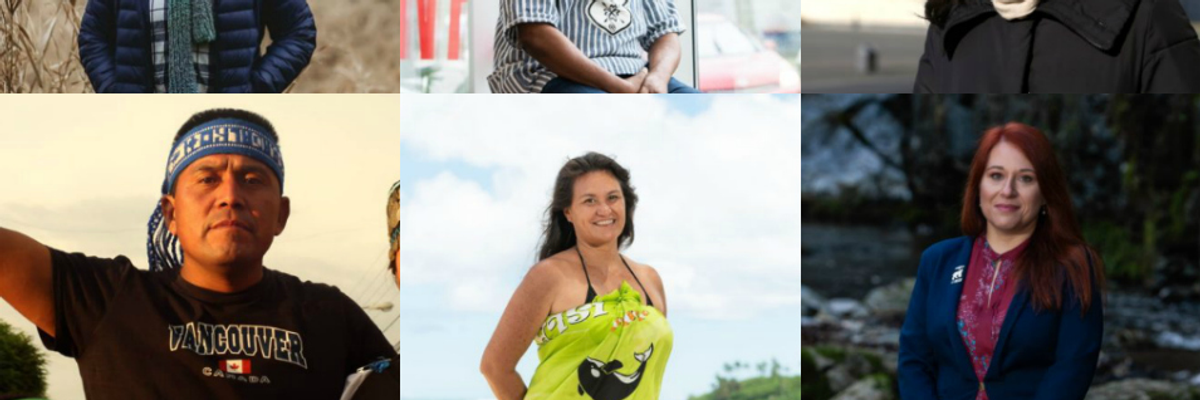
The six recipients of this year's Goldman Environmental Prize were revealed Monday. (Photos: Goldman Environmental Foundation.)
From preserving marine biodiversity to protecting tropical forests from palm oil developers, the six recipients of a prestigious environmental award are "extraordinary individuals who have moved mountains to protect our planet."
"Each of them has selflessly stood up to stop injustice, become a leader when leadership was critical, and vanquished powerful adversaries who would desecrate our planet."
--Susie Gelman, Goldman Environmental Foundation
That's according to the Goldman Environmental Foundation, which for the past 30 years has honored grassroots activists from across the globe. This year's winners, described on Twitter by fellow activist Bill McKibben as "a great collection of #KeepItInTheGround leaders," were announced Monday.
Each of the six recipients hails from one of the world's inhabited continents.
Environmental lawyer Alfred Brownell is being recognized for his successful efforts to stop palm oil plantation developers from destroying forests vital to biodiversity in his home country of Liberia. For safety reasons--and after his government threatened to arrest Brownell for his activism--he now lives in exile in the United States.
Brownell told The Guardian about an encounter with private security guards in 2016.
"They threatened to cut off my head, to eat my heart, and drink out of my skull," Brownell said. "They began a war dance around the car. They were drinking and said they would cannibalize me."
Brownell added that receiving the honor has made him optimist about returning to Liberia in the future: "I hope this award will help change the minds of people in Liberia so we find more allies to speak to the government and the company. We need to find a way to engage with them so I can go home."
Bayarjargal Agvaantseren, of Mongolia, was selected for her work to establish the Tost Tosonbumba Nature Reserve in the South Gobi Desert--which is home to the snow leopard, a vulnerable species threatened by mining in the area. Due in part to pressure from Agvaantseren, the Mongolian government has canceled all mining licenses in the reserve.
Alberto Curamil--a Mapuche, Chile's largest indigenous group--organized the people of Araucania to block the construction of two hydroelectric projects that could have diverted more than 500 million gallons of water daily from the Cautin River, with dire consequences for the regional ecosystem. Curamil was arrested for his activism last year and remains in jail.
The first-ever recipient from North Macedonia, Ana Colovic Lesoska, campaigned against a pair of hydropower plants. The campaign she led convinced key international backers to pull their funding for the projects in the Mavrovo National Park, one of the last habitats for the endangered Balkan linx. She, too, has faced consequences for her activism.
"I've received death threats and warnings that I will be imprisoned," she told the The Guardian. "Newspaper articles have suggested we are aiding foreign governments just because the rivers we are protecting run to Albania."
Jacqueline Evans, of the Cook Islands, is also the first person from her country to receive the Goldman prize. Evans fought for legislation to restrict large-scale commercial fishing and seabed mining around her nation's 15 islands to safeguard south Pacific marine biodiversity--including whales, sea turtles, manta rays, seabirds, and sharks.
The North American recipient, Linda Garcia, was among the activists who blocked the construction of the continent's largest oil terminal, which was set to be built in Vancouver, Washington. Garcia organized residents of Fruit Valley, a racially diverse, low-income neighborhood whose air would have been impacted by the project.
"Each of them has selflessly stood up to stop injustice, become a leader when leadership was critical, and vanquished powerful adversaries who would desecrate our planet," Susie Gelman, president of the Goldman Environmental Foundation, said in a statement. "These are six ordinary, yet extraordinary, human beings who remind us that we all have a role in protecting the Earth."
The foundation planned an award ceremony in San Francisco for Monday evening featuring a speech from former Vice President Al Gore, a vocal environmental activist. The event will be broadcast on Facebook, Twitter, and YouTube, with updates posted on social media using the hashtag #GoldmanPrize30. A second ceremony is scheduled for May 1 at the National Academy of Sciences in Washington, D.C.
"Thirty years ago, when Richard and Rhoda Goldman started the Goldman Environmental Prize, the idea of celebrating grassroots environmentalists was a novel one," said Gore, a friend of the founders. "Today, thanks in large part to the Goldmans, the world recognizes just how important it is to honor and illuminate those who have shown courage in the face of environmental destruction."
Dear Common Dreams reader, It’s been nearly 30 years since I co-founded Common Dreams with my late wife, Lina Newhouser. We had the radical notion that journalism should serve the public good, not corporate profits. It was clear to us from the outset what it would take to build such a project. No paid advertisements. No corporate sponsors. No millionaire publisher telling us what to think or do. Many people said we wouldn't last a year, but we proved those doubters wrong. Together with a tremendous team of journalists and dedicated staff, we built an independent media outlet free from the constraints of profits and corporate control. Our mission has always been simple: To inform. To inspire. To ignite change for the common good. Building Common Dreams was not easy. Our survival was never guaranteed. When you take on the most powerful forces—Wall Street greed, fossil fuel industry destruction, Big Tech lobbyists, and uber-rich oligarchs who have spent billions upon billions rigging the economy and democracy in their favor—the only bulwark you have is supporters who believe in your work. But here’s the urgent message from me today. It's never been this bad out there. And it's never been this hard to keep us going. At the very moment Common Dreams is most needed, the threats we face are intensifying. We need your support now more than ever. We don't accept corporate advertising and never will. We don't have a paywall because we don't think people should be blocked from critical news based on their ability to pay. Everything we do is funded by the donations of readers like you. When everyone does the little they can afford, we are strong. But if that support retreats or dries up, so do we. Will you donate now to make sure Common Dreams not only survives but thrives? —Craig Brown, Co-founder |
From preserving marine biodiversity to protecting tropical forests from palm oil developers, the six recipients of a prestigious environmental award are "extraordinary individuals who have moved mountains to protect our planet."
"Each of them has selflessly stood up to stop injustice, become a leader when leadership was critical, and vanquished powerful adversaries who would desecrate our planet."
--Susie Gelman, Goldman Environmental Foundation
That's according to the Goldman Environmental Foundation, which for the past 30 years has honored grassroots activists from across the globe. This year's winners, described on Twitter by fellow activist Bill McKibben as "a great collection of #KeepItInTheGround leaders," were announced Monday.
Each of the six recipients hails from one of the world's inhabited continents.
Environmental lawyer Alfred Brownell is being recognized for his successful efforts to stop palm oil plantation developers from destroying forests vital to biodiversity in his home country of Liberia. For safety reasons--and after his government threatened to arrest Brownell for his activism--he now lives in exile in the United States.
Brownell told The Guardian about an encounter with private security guards in 2016.
"They threatened to cut off my head, to eat my heart, and drink out of my skull," Brownell said. "They began a war dance around the car. They were drinking and said they would cannibalize me."
Brownell added that receiving the honor has made him optimist about returning to Liberia in the future: "I hope this award will help change the minds of people in Liberia so we find more allies to speak to the government and the company. We need to find a way to engage with them so I can go home."
Bayarjargal Agvaantseren, of Mongolia, was selected for her work to establish the Tost Tosonbumba Nature Reserve in the South Gobi Desert--which is home to the snow leopard, a vulnerable species threatened by mining in the area. Due in part to pressure from Agvaantseren, the Mongolian government has canceled all mining licenses in the reserve.
Alberto Curamil--a Mapuche, Chile's largest indigenous group--organized the people of Araucania to block the construction of two hydroelectric projects that could have diverted more than 500 million gallons of water daily from the Cautin River, with dire consequences for the regional ecosystem. Curamil was arrested for his activism last year and remains in jail.
The first-ever recipient from North Macedonia, Ana Colovic Lesoska, campaigned against a pair of hydropower plants. The campaign she led convinced key international backers to pull their funding for the projects in the Mavrovo National Park, one of the last habitats for the endangered Balkan linx. She, too, has faced consequences for her activism.
"I've received death threats and warnings that I will be imprisoned," she told the The Guardian. "Newspaper articles have suggested we are aiding foreign governments just because the rivers we are protecting run to Albania."
Jacqueline Evans, of the Cook Islands, is also the first person from her country to receive the Goldman prize. Evans fought for legislation to restrict large-scale commercial fishing and seabed mining around her nation's 15 islands to safeguard south Pacific marine biodiversity--including whales, sea turtles, manta rays, seabirds, and sharks.
The North American recipient, Linda Garcia, was among the activists who blocked the construction of the continent's largest oil terminal, which was set to be built in Vancouver, Washington. Garcia organized residents of Fruit Valley, a racially diverse, low-income neighborhood whose air would have been impacted by the project.
"Each of them has selflessly stood up to stop injustice, become a leader when leadership was critical, and vanquished powerful adversaries who would desecrate our planet," Susie Gelman, president of the Goldman Environmental Foundation, said in a statement. "These are six ordinary, yet extraordinary, human beings who remind us that we all have a role in protecting the Earth."
The foundation planned an award ceremony in San Francisco for Monday evening featuring a speech from former Vice President Al Gore, a vocal environmental activist. The event will be broadcast on Facebook, Twitter, and YouTube, with updates posted on social media using the hashtag #GoldmanPrize30. A second ceremony is scheduled for May 1 at the National Academy of Sciences in Washington, D.C.
"Thirty years ago, when Richard and Rhoda Goldman started the Goldman Environmental Prize, the idea of celebrating grassroots environmentalists was a novel one," said Gore, a friend of the founders. "Today, thanks in large part to the Goldmans, the world recognizes just how important it is to honor and illuminate those who have shown courage in the face of environmental destruction."
From preserving marine biodiversity to protecting tropical forests from palm oil developers, the six recipients of a prestigious environmental award are "extraordinary individuals who have moved mountains to protect our planet."
"Each of them has selflessly stood up to stop injustice, become a leader when leadership was critical, and vanquished powerful adversaries who would desecrate our planet."
--Susie Gelman, Goldman Environmental Foundation
That's according to the Goldman Environmental Foundation, which for the past 30 years has honored grassroots activists from across the globe. This year's winners, described on Twitter by fellow activist Bill McKibben as "a great collection of #KeepItInTheGround leaders," were announced Monday.
Each of the six recipients hails from one of the world's inhabited continents.
Environmental lawyer Alfred Brownell is being recognized for his successful efforts to stop palm oil plantation developers from destroying forests vital to biodiversity in his home country of Liberia. For safety reasons--and after his government threatened to arrest Brownell for his activism--he now lives in exile in the United States.
Brownell told The Guardian about an encounter with private security guards in 2016.
"They threatened to cut off my head, to eat my heart, and drink out of my skull," Brownell said. "They began a war dance around the car. They were drinking and said they would cannibalize me."
Brownell added that receiving the honor has made him optimist about returning to Liberia in the future: "I hope this award will help change the minds of people in Liberia so we find more allies to speak to the government and the company. We need to find a way to engage with them so I can go home."
Bayarjargal Agvaantseren, of Mongolia, was selected for her work to establish the Tost Tosonbumba Nature Reserve in the South Gobi Desert--which is home to the snow leopard, a vulnerable species threatened by mining in the area. Due in part to pressure from Agvaantseren, the Mongolian government has canceled all mining licenses in the reserve.
Alberto Curamil--a Mapuche, Chile's largest indigenous group--organized the people of Araucania to block the construction of two hydroelectric projects that could have diverted more than 500 million gallons of water daily from the Cautin River, with dire consequences for the regional ecosystem. Curamil was arrested for his activism last year and remains in jail.
The first-ever recipient from North Macedonia, Ana Colovic Lesoska, campaigned against a pair of hydropower plants. The campaign she led convinced key international backers to pull their funding for the projects in the Mavrovo National Park, one of the last habitats for the endangered Balkan linx. She, too, has faced consequences for her activism.
"I've received death threats and warnings that I will be imprisoned," she told the The Guardian. "Newspaper articles have suggested we are aiding foreign governments just because the rivers we are protecting run to Albania."
Jacqueline Evans, of the Cook Islands, is also the first person from her country to receive the Goldman prize. Evans fought for legislation to restrict large-scale commercial fishing and seabed mining around her nation's 15 islands to safeguard south Pacific marine biodiversity--including whales, sea turtles, manta rays, seabirds, and sharks.
The North American recipient, Linda Garcia, was among the activists who blocked the construction of the continent's largest oil terminal, which was set to be built in Vancouver, Washington. Garcia organized residents of Fruit Valley, a racially diverse, low-income neighborhood whose air would have been impacted by the project.
"Each of them has selflessly stood up to stop injustice, become a leader when leadership was critical, and vanquished powerful adversaries who would desecrate our planet," Susie Gelman, president of the Goldman Environmental Foundation, said in a statement. "These are six ordinary, yet extraordinary, human beings who remind us that we all have a role in protecting the Earth."
The foundation planned an award ceremony in San Francisco for Monday evening featuring a speech from former Vice President Al Gore, a vocal environmental activist. The event will be broadcast on Facebook, Twitter, and YouTube, with updates posted on social media using the hashtag #GoldmanPrize30. A second ceremony is scheduled for May 1 at the National Academy of Sciences in Washington, D.C.
"Thirty years ago, when Richard and Rhoda Goldman started the Goldman Environmental Prize, the idea of celebrating grassroots environmentalists was a novel one," said Gore, a friend of the founders. "Today, thanks in large part to the Goldmans, the world recognizes just how important it is to honor and illuminate those who have shown courage in the face of environmental destruction."