
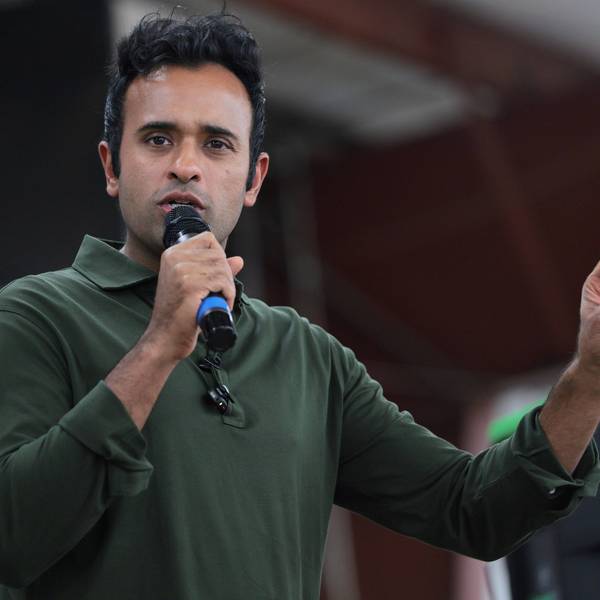

"A great nation is not judged, historically, by the number of billionaires it has, or by the number of nuclear weapons it has. It is judged by how it treats the weakest and most vulnerable people amongst us," Sen. Bernie Sanders (I-Vt.) said during a press conference on Wednesday. (Photo: Social Security Works/Screengrab)
To Ensure Dignity for 'Most Vulnerable' Among Us, Bernie Sanders Introduces Bill to Expand Social Security
"Expanding Social Security as this legislation does is a solution to our looming retirement income crisis and to growing inequality between the wealthy and everyone else."
In an effort to strengthen one of the nation's most popular programs as the GOP pushes for cuts, Sen. Bernie Sanders (I-Vt.) and several congressional Democrats on Wednesday introduced the Social Security Expansion Act to ensure that seniors can retire in dignity and "everyone with a disability can live with the security they need."
"A great nation is not judged, historically, by the number of billionaires it has, or by the number of nuclear weapons it has. It is judged by how it treats the weakest and most vulnerable people amongst us."
--Sen. Bernie Sanders
Confronting an economic landscape in which half of older Americans have no retirement savings and 20 percent of seniors are forced to live on income that barely exceeds the federal poverty line, Sanders' legislation would significantly expand Social Security benefits and ensure the program remains solvent for at least the next five decades by subjecting all income over $250,000 to the Social Security payroll tax.
Sanders officially introduced his legislation at a press conference alongside Rep. Peter DeFazio (D-Ore.) and Democratic Sens. Kirsten Gillibrand (N.Y.), Jeff Merkley (Ore.), and Cory Booker (N.J.).
"You got a government that represents the wealthy and the powerful, our job is to get a government that represents all of us," the Vermont senator said. "And the only way we do that is when we mobilize millions of people to say that we're gonna protect our seniors."
Watch:
"In my humble opinion, a great nation is not judged, historically, by the number of billionaires it has, or by the number of nuclear weapons it has," Sanders' said. "It is judged by how it treats the weakest and most vulnerable people amongst us."
"And when we talk about vulnerable people," Sanders continued, "these are folks who are in their 80s and their 90s, people who have worked their entire lives, people who have raised us as children... What we are saying today, to those senior citizens who are struggling economically to live out their last years with dignity: We will no longer turn our backs on you."
Arguing that Republican leaders who want to slash Social Security after giving tax breaks to the rich have "their priorities backwards," Sanders declared, "We're gonna tax the billionaires and expand Social Security."
According to a fact sheet put out by Sanders' office, the legislation would:
- Extend the solvency of Social Security for 52 years to the year 2071 by requiring the wealthiest American households to pay their fair share of taxes. Today, because of the earnings cap on Social Security taxes, a CEO making $20 million a year pays the same amount of money into Social Security as someone who makes $132,900 a year. This legislation would lift this cap and subject all income above $250,000 to the Social Security Payroll tax. Under this bill, 98.2 percent of wage earners would not see their taxes go up by one penny;
- Expand Social Security benefits across-the-board. Under this bill, Social Security retirement benefits for low-income Americans would go up by about $1,300 a year;
- Increase Cost-Of-Living-Adjustments (COLAs). This bill would more accurately measure the spending patterns for seniors by adopting the Consumer Price Index for the Elderly (CPI-E). Older Americans, by and large, are not going out on spending sprees buying big screen TVs, laptops, or the latest high-tech gadgets. Rather, they spend a disproportionate amount of their income on health care and prescription drugs and that would be reflected in the formula for calculating COLAs under this legislation;
- Improve the Special Minimum Benefit for Social Security recipients. This bill will help low income workers stay out of poverty by updating the Special Minimum Benefit to make it easier for them to qualify and by increasing and indexing the benefit level so that it is equal to 125 percent of the poverty line;
- Restore student benefits up to age 22 for children of disabled or deceased workers, if the child is a full-time student in a college or vocational school. This legislation restores student benefits that were eliminated in 1983 to help educate children of deceased or disabled parents;
- Combine the Disability Insurance Trust Fund with the Old Age and Survivors Trust fund to help senior citizens and persons with disabilities.
The Social Security Expansion Act is backed by unions and progressive advocacy groups like Social Security Works, which applauded the legislation as a "profoundly wise" and necessary step toward ensuring a dignified retirement for all.
"Expanding Social Security as this legislation does is a solution to our looming retirement income crisis and to growing inequality between the wealthy and everyone else, as well as to the financial squeeze confronting working families," Nancy Altman, president of Social Security Works, said in a statement. "Not only is expanding Social Security, financed by requiring the wealthy to pay their fair share, extremely wise policy, it is overwhelmingly supported by voters across the political spectrum. That makes it powerfully winning politics, as well."
We are at a crossroads
This country and this world are at a monumental crossroads. In a few short weeks, US voters will have an opportunity to beat back the forces of fascism and confront the billionaires who are rigging the economy, our media system, and our democracy, making it increasingly impossible for ordinary people to get by. We’re not just talking about the election. We’re talking about what must be done once these fascist elements are vanquished from power. We need a bolder set of solutions than what either major party has so far been willing to offer and a working-class movement ready to fight like hell for it. Trump didn't emerge from nowhere. The conditions that fueled MAGA authoritarianism were created by decades of radical neoliberal economic policies and a corrupt political system dominated by corporate interests. They slashed taxes on the super-rich, promising that the benefits would trickle down. They said giveaways to the corporate titans would make life more affordable for the rest of us. It was all bullshit. And when a bitter, betrayed populace searches for someone to blame, right-wing demagogues have little trouble finding scapegoats. People know when they're being lied to, but you won't hear any of this from the corporate media. Only independent journalism—powered and funded by people who believe in building a better world—can deliver truly trustworthy daily news. Our Fall Campaign is underway, and we need your help. To power our newsroom through the rest of the year, we need to raise $125,000 by midnight on October 31. So if you share our vision, please contribute whatever you can to sustain our work. |
In an effort to strengthen one of the nation's most popular programs as the GOP pushes for cuts, Sen. Bernie Sanders (I-Vt.) and several congressional Democrats on Wednesday introduced the Social Security Expansion Act to ensure that seniors can retire in dignity and "everyone with a disability can live with the security they need."
"A great nation is not judged, historically, by the number of billionaires it has, or by the number of nuclear weapons it has. It is judged by how it treats the weakest and most vulnerable people amongst us."
--Sen. Bernie Sanders
Confronting an economic landscape in which half of older Americans have no retirement savings and 20 percent of seniors are forced to live on income that barely exceeds the federal poverty line, Sanders' legislation would significantly expand Social Security benefits and ensure the program remains solvent for at least the next five decades by subjecting all income over $250,000 to the Social Security payroll tax.
Sanders officially introduced his legislation at a press conference alongside Rep. Peter DeFazio (D-Ore.) and Democratic Sens. Kirsten Gillibrand (N.Y.), Jeff Merkley (Ore.), and Cory Booker (N.J.).
"You got a government that represents the wealthy and the powerful, our job is to get a government that represents all of us," the Vermont senator said. "And the only way we do that is when we mobilize millions of people to say that we're gonna protect our seniors."
Watch:
"In my humble opinion, a great nation is not judged, historically, by the number of billionaires it has, or by the number of nuclear weapons it has," Sanders' said. "It is judged by how it treats the weakest and most vulnerable people amongst us."
"And when we talk about vulnerable people," Sanders continued, "these are folks who are in their 80s and their 90s, people who have worked their entire lives, people who have raised us as children... What we are saying today, to those senior citizens who are struggling economically to live out their last years with dignity: We will no longer turn our backs on you."
Arguing that Republican leaders who want to slash Social Security after giving tax breaks to the rich have "their priorities backwards," Sanders declared, "We're gonna tax the billionaires and expand Social Security."
According to a fact sheet put out by Sanders' office, the legislation would:
- Extend the solvency of Social Security for 52 years to the year 2071 by requiring the wealthiest American households to pay their fair share of taxes. Today, because of the earnings cap on Social Security taxes, a CEO making $20 million a year pays the same amount of money into Social Security as someone who makes $132,900 a year. This legislation would lift this cap and subject all income above $250,000 to the Social Security Payroll tax. Under this bill, 98.2 percent of wage earners would not see their taxes go up by one penny;
- Expand Social Security benefits across-the-board. Under this bill, Social Security retirement benefits for low-income Americans would go up by about $1,300 a year;
- Increase Cost-Of-Living-Adjustments (COLAs). This bill would more accurately measure the spending patterns for seniors by adopting the Consumer Price Index for the Elderly (CPI-E). Older Americans, by and large, are not going out on spending sprees buying big screen TVs, laptops, or the latest high-tech gadgets. Rather, they spend a disproportionate amount of their income on health care and prescription drugs and that would be reflected in the formula for calculating COLAs under this legislation;
- Improve the Special Minimum Benefit for Social Security recipients. This bill will help low income workers stay out of poverty by updating the Special Minimum Benefit to make it easier for them to qualify and by increasing and indexing the benefit level so that it is equal to 125 percent of the poverty line;
- Restore student benefits up to age 22 for children of disabled or deceased workers, if the child is a full-time student in a college or vocational school. This legislation restores student benefits that were eliminated in 1983 to help educate children of deceased or disabled parents;
- Combine the Disability Insurance Trust Fund with the Old Age and Survivors Trust fund to help senior citizens and persons with disabilities.
The Social Security Expansion Act is backed by unions and progressive advocacy groups like Social Security Works, which applauded the legislation as a "profoundly wise" and necessary step toward ensuring a dignified retirement for all.
"Expanding Social Security as this legislation does is a solution to our looming retirement income crisis and to growing inequality between the wealthy and everyone else, as well as to the financial squeeze confronting working families," Nancy Altman, president of Social Security Works, said in a statement. "Not only is expanding Social Security, financed by requiring the wealthy to pay their fair share, extremely wise policy, it is overwhelmingly supported by voters across the political spectrum. That makes it powerfully winning politics, as well."
In an effort to strengthen one of the nation's most popular programs as the GOP pushes for cuts, Sen. Bernie Sanders (I-Vt.) and several congressional Democrats on Wednesday introduced the Social Security Expansion Act to ensure that seniors can retire in dignity and "everyone with a disability can live with the security they need."
"A great nation is not judged, historically, by the number of billionaires it has, or by the number of nuclear weapons it has. It is judged by how it treats the weakest and most vulnerable people amongst us."
--Sen. Bernie Sanders
Confronting an economic landscape in which half of older Americans have no retirement savings and 20 percent of seniors are forced to live on income that barely exceeds the federal poverty line, Sanders' legislation would significantly expand Social Security benefits and ensure the program remains solvent for at least the next five decades by subjecting all income over $250,000 to the Social Security payroll tax.
Sanders officially introduced his legislation at a press conference alongside Rep. Peter DeFazio (D-Ore.) and Democratic Sens. Kirsten Gillibrand (N.Y.), Jeff Merkley (Ore.), and Cory Booker (N.J.).
"You got a government that represents the wealthy and the powerful, our job is to get a government that represents all of us," the Vermont senator said. "And the only way we do that is when we mobilize millions of people to say that we're gonna protect our seniors."
Watch:
"In my humble opinion, a great nation is not judged, historically, by the number of billionaires it has, or by the number of nuclear weapons it has," Sanders' said. "It is judged by how it treats the weakest and most vulnerable people amongst us."
"And when we talk about vulnerable people," Sanders continued, "these are folks who are in their 80s and their 90s, people who have worked their entire lives, people who have raised us as children... What we are saying today, to those senior citizens who are struggling economically to live out their last years with dignity: We will no longer turn our backs on you."
Arguing that Republican leaders who want to slash Social Security after giving tax breaks to the rich have "their priorities backwards," Sanders declared, "We're gonna tax the billionaires and expand Social Security."
According to a fact sheet put out by Sanders' office, the legislation would:
- Extend the solvency of Social Security for 52 years to the year 2071 by requiring the wealthiest American households to pay their fair share of taxes. Today, because of the earnings cap on Social Security taxes, a CEO making $20 million a year pays the same amount of money into Social Security as someone who makes $132,900 a year. This legislation would lift this cap and subject all income above $250,000 to the Social Security Payroll tax. Under this bill, 98.2 percent of wage earners would not see their taxes go up by one penny;
- Expand Social Security benefits across-the-board. Under this bill, Social Security retirement benefits for low-income Americans would go up by about $1,300 a year;
- Increase Cost-Of-Living-Adjustments (COLAs). This bill would more accurately measure the spending patterns for seniors by adopting the Consumer Price Index for the Elderly (CPI-E). Older Americans, by and large, are not going out on spending sprees buying big screen TVs, laptops, or the latest high-tech gadgets. Rather, they spend a disproportionate amount of their income on health care and prescription drugs and that would be reflected in the formula for calculating COLAs under this legislation;
- Improve the Special Minimum Benefit for Social Security recipients. This bill will help low income workers stay out of poverty by updating the Special Minimum Benefit to make it easier for them to qualify and by increasing and indexing the benefit level so that it is equal to 125 percent of the poverty line;
- Restore student benefits up to age 22 for children of disabled or deceased workers, if the child is a full-time student in a college or vocational school. This legislation restores student benefits that were eliminated in 1983 to help educate children of deceased or disabled parents;
- Combine the Disability Insurance Trust Fund with the Old Age and Survivors Trust fund to help senior citizens and persons with disabilities.
The Social Security Expansion Act is backed by unions and progressive advocacy groups like Social Security Works, which applauded the legislation as a "profoundly wise" and necessary step toward ensuring a dignified retirement for all.
"Expanding Social Security as this legislation does is a solution to our looming retirement income crisis and to growing inequality between the wealthy and everyone else, as well as to the financial squeeze confronting working families," Nancy Altman, president of Social Security Works, said in a statement. "Not only is expanding Social Security, financed by requiring the wealthy to pay their fair share, extremely wise policy, it is overwhelmingly supported by voters across the political spectrum. That makes it powerfully winning politics, as well."