

SUBSCRIBE TO OUR FREE NEWSLETTER
Daily news & progressive opinion—funded by the people, not the corporations—delivered straight to your inbox.
5
#000000
#FFFFFF
To donate by check, phone, or other method, see our More Ways to Give page.
Daily news & progressive opinion—funded by the people, not the corporations—delivered straight to your inbox.
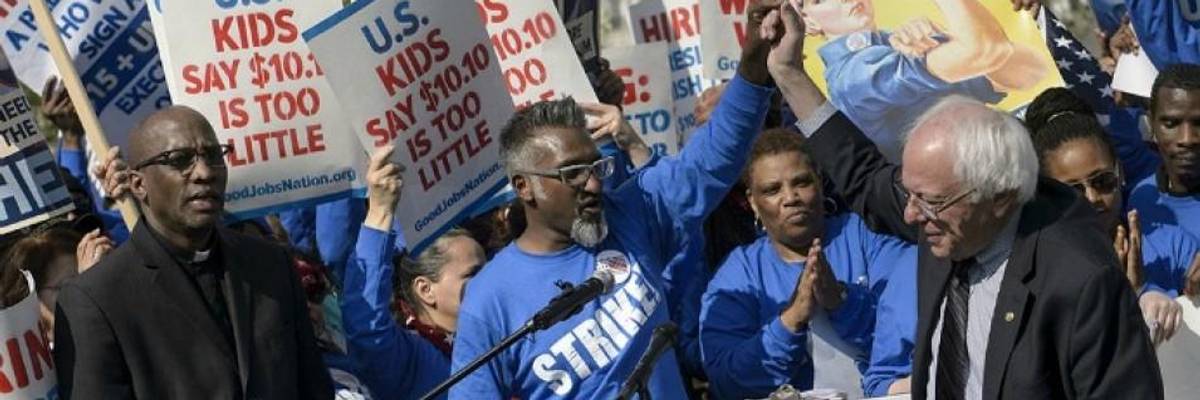
Sen. Bernie Sanders (I-Vt.) joined protesters at a Fight for $15 rally on Capitol Hill. (Photo: Getty)
Denouncing the current federal minimum wage as a "starvation wage" which never should have been permitted to be stagnant for the past decade, Sen. Bernie Sanders (I-Vt.) was joined Wednesday by several congressional Democrats in introducing legislation to raise the wage over the next five years.
"It is not a radical idea to say a job should lift you out of poverty, not keep you in it. The current $7.25 an hour federal minimum wage is a starvation wage. It must be increased to a living wage of $15 an hour." --Sen. Bernie Sanders (I-Vt.)The bicameral Raise the Wage Act would increase the federal minimum wage from $7.25 per hour, where it's stood since 2009, to $15 by 2024. The proposal would also bar employers from paying tipped workers below the minimum wage and stipulate future pay increases for low-wage workers to keep up with median wage growth and cost of living.
The House bill has 181 co-sponsors, while 31 Democrats joined Sanders in co-sponsoring the Senate version.
"Just a few short years ago, we were told that raising the minimum wage to $15 an hour was 'radical.'" said Sanders in a statement. "But a grassroots movement of millions of workers throughout this country refused to take 'no' for an answer. It is not a radical idea to say a job should lift you out of poverty, not keep you in it. The current $7.25 an hour federal minimum wage is a starvation wage. It must be increased to a living wage of $15 an hour."
The grassroots movement the senator referred to was the group Fight for $15, which began its fight for a minimum wage increase in 2012 and has since grown into a global movement in hundreds of cities. Fight for $15 celebrated the bill's introduction, with members gathering in Washington, D.C. as the legislation was proposed.
The movement has gained traction in recent years, amid growing anger over a federal minimum wage that won't allow a worker to afford the rent on a two-bedroom apartment in any state in the country. In just 22 out of more than 3,000 counties in the U.S., according to a report last year by the National Low Income Housing Coalition (NLIHC), would a minimum wage worker be able to afford a one-bedroom rental apartment.
Sanders was joined by progressive Rep. Mark Pocan (D-Ill.) in sponsoring the legislation, as well as far more centrist Democrats including Rep. Stephanie Murphy (D-Fla.)--leading Mother Jones reporter Kara Voght to note that the fight to raise the minimum wage has officially gone mainstream.
Pocan pointed out that cities and states have already raised local minimum wages to ensure workers can live on their salaries--and implored his colleagues in Congress to catch up.
"While some cities and states have led on this issue, we must raise the wage everywhere--from Madison, Wisconsin, to Mobile, Alabama--to ensure that every American worker can succeed," he said. "Every member of Congress should recognize the urgent need to raise the wage, and if they support a salary of only $15,080 per year, they should be forced to live on it."
Sanders and some of the bill's co-sponsors held a press conference on the new legislation Wednesday:
Dear Common Dreams reader, It’s been nearly 30 years since I co-founded Common Dreams with my late wife, Lina Newhouser. We had the radical notion that journalism should serve the public good, not corporate profits. It was clear to us from the outset what it would take to build such a project. No paid advertisements. No corporate sponsors. No millionaire publisher telling us what to think or do. Many people said we wouldn't last a year, but we proved those doubters wrong. Together with a tremendous team of journalists and dedicated staff, we built an independent media outlet free from the constraints of profits and corporate control. Our mission has always been simple: To inform. To inspire. To ignite change for the common good. Building Common Dreams was not easy. Our survival was never guaranteed. When you take on the most powerful forces—Wall Street greed, fossil fuel industry destruction, Big Tech lobbyists, and uber-rich oligarchs who have spent billions upon billions rigging the economy and democracy in their favor—the only bulwark you have is supporters who believe in your work. But here’s the urgent message from me today. It's never been this bad out there. And it's never been this hard to keep us going. At the very moment Common Dreams is most needed, the threats we face are intensifying. We need your support now more than ever. We don't accept corporate advertising and never will. We don't have a paywall because we don't think people should be blocked from critical news based on their ability to pay. Everything we do is funded by the donations of readers like you. When everyone does the little they can afford, we are strong. But if that support retreats or dries up, so do we. Will you donate now to make sure Common Dreams not only survives but thrives? —Craig Brown, Co-founder |
Denouncing the current federal minimum wage as a "starvation wage" which never should have been permitted to be stagnant for the past decade, Sen. Bernie Sanders (I-Vt.) was joined Wednesday by several congressional Democrats in introducing legislation to raise the wage over the next five years.
"It is not a radical idea to say a job should lift you out of poverty, not keep you in it. The current $7.25 an hour federal minimum wage is a starvation wage. It must be increased to a living wage of $15 an hour." --Sen. Bernie Sanders (I-Vt.)The bicameral Raise the Wage Act would increase the federal minimum wage from $7.25 per hour, where it's stood since 2009, to $15 by 2024. The proposal would also bar employers from paying tipped workers below the minimum wage and stipulate future pay increases for low-wage workers to keep up with median wage growth and cost of living.
The House bill has 181 co-sponsors, while 31 Democrats joined Sanders in co-sponsoring the Senate version.
"Just a few short years ago, we were told that raising the minimum wage to $15 an hour was 'radical.'" said Sanders in a statement. "But a grassroots movement of millions of workers throughout this country refused to take 'no' for an answer. It is not a radical idea to say a job should lift you out of poverty, not keep you in it. The current $7.25 an hour federal minimum wage is a starvation wage. It must be increased to a living wage of $15 an hour."
The grassroots movement the senator referred to was the group Fight for $15, which began its fight for a minimum wage increase in 2012 and has since grown into a global movement in hundreds of cities. Fight for $15 celebrated the bill's introduction, with members gathering in Washington, D.C. as the legislation was proposed.
The movement has gained traction in recent years, amid growing anger over a federal minimum wage that won't allow a worker to afford the rent on a two-bedroom apartment in any state in the country. In just 22 out of more than 3,000 counties in the U.S., according to a report last year by the National Low Income Housing Coalition (NLIHC), would a minimum wage worker be able to afford a one-bedroom rental apartment.
Sanders was joined by progressive Rep. Mark Pocan (D-Ill.) in sponsoring the legislation, as well as far more centrist Democrats including Rep. Stephanie Murphy (D-Fla.)--leading Mother Jones reporter Kara Voght to note that the fight to raise the minimum wage has officially gone mainstream.
Pocan pointed out that cities and states have already raised local minimum wages to ensure workers can live on their salaries--and implored his colleagues in Congress to catch up.
"While some cities and states have led on this issue, we must raise the wage everywhere--from Madison, Wisconsin, to Mobile, Alabama--to ensure that every American worker can succeed," he said. "Every member of Congress should recognize the urgent need to raise the wage, and if they support a salary of only $15,080 per year, they should be forced to live on it."
Sanders and some of the bill's co-sponsors held a press conference on the new legislation Wednesday:
Denouncing the current federal minimum wage as a "starvation wage" which never should have been permitted to be stagnant for the past decade, Sen. Bernie Sanders (I-Vt.) was joined Wednesday by several congressional Democrats in introducing legislation to raise the wage over the next five years.
"It is not a radical idea to say a job should lift you out of poverty, not keep you in it. The current $7.25 an hour federal minimum wage is a starvation wage. It must be increased to a living wage of $15 an hour." --Sen. Bernie Sanders (I-Vt.)The bicameral Raise the Wage Act would increase the federal minimum wage from $7.25 per hour, where it's stood since 2009, to $15 by 2024. The proposal would also bar employers from paying tipped workers below the minimum wage and stipulate future pay increases for low-wage workers to keep up with median wage growth and cost of living.
The House bill has 181 co-sponsors, while 31 Democrats joined Sanders in co-sponsoring the Senate version.
"Just a few short years ago, we were told that raising the minimum wage to $15 an hour was 'radical.'" said Sanders in a statement. "But a grassroots movement of millions of workers throughout this country refused to take 'no' for an answer. It is not a radical idea to say a job should lift you out of poverty, not keep you in it. The current $7.25 an hour federal minimum wage is a starvation wage. It must be increased to a living wage of $15 an hour."
The grassroots movement the senator referred to was the group Fight for $15, which began its fight for a minimum wage increase in 2012 and has since grown into a global movement in hundreds of cities. Fight for $15 celebrated the bill's introduction, with members gathering in Washington, D.C. as the legislation was proposed.
The movement has gained traction in recent years, amid growing anger over a federal minimum wage that won't allow a worker to afford the rent on a two-bedroom apartment in any state in the country. In just 22 out of more than 3,000 counties in the U.S., according to a report last year by the National Low Income Housing Coalition (NLIHC), would a minimum wage worker be able to afford a one-bedroom rental apartment.
Sanders was joined by progressive Rep. Mark Pocan (D-Ill.) in sponsoring the legislation, as well as far more centrist Democrats including Rep. Stephanie Murphy (D-Fla.)--leading Mother Jones reporter Kara Voght to note that the fight to raise the minimum wage has officially gone mainstream.
Pocan pointed out that cities and states have already raised local minimum wages to ensure workers can live on their salaries--and implored his colleagues in Congress to catch up.
"While some cities and states have led on this issue, we must raise the wage everywhere--from Madison, Wisconsin, to Mobile, Alabama--to ensure that every American worker can succeed," he said. "Every member of Congress should recognize the urgent need to raise the wage, and if they support a salary of only $15,080 per year, they should be forced to live on it."
Sanders and some of the bill's co-sponsors held a press conference on the new legislation Wednesday:

