SUBSCRIBE TO OUR FREE NEWSLETTER
Daily news & progressive opinion—funded by the people, not the corporations—delivered straight to your inbox.
5
#000000
#FFFFFF
To donate by check, phone, or other method, see our More Ways to Give page.
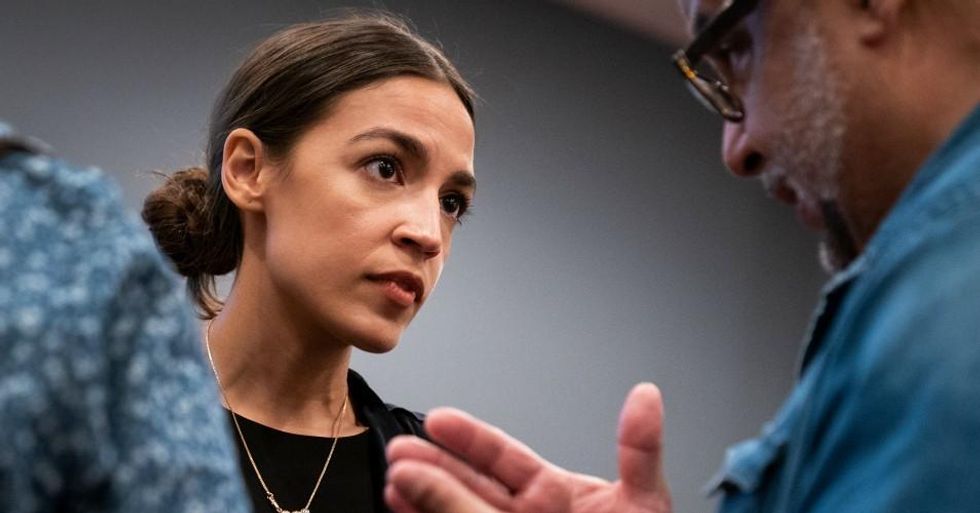
Rep. Alexandria Ocasio-Cortez (D-N.Y.) sparked a flood of hysterical and error-filled responses from the right when she suggested in a recent "60 Minutes" interview that America's top marginal tax rate should be hiked to 70 percent to help pay for bold progressive programs, but a survey published on Tuesday found that the majority of Americans are on the freshman congresswoman's side.
"This is a policy that is already popular and it's time that we embrace working Americans and it's time that the Democratic Party fights in a full-throated manner for the working class in the United States."
--Rep. Alexandria Ocasio-Cortez
Conducted by The Hill in partnership with the market research firm HarrisX, the poll found that 59 percent of the U.S. public supports raising the marginal tax rate on the richest Americans to 70 percent. The poll also found a "surprising amount of support" for the proposal among Republicans, with 45 percent backing the idea along with 71 percent of Democrats.
"Oh? What's that? The majority of Americans respect when you break down reasonable policy proposals that are designed to combat runaway income inequality and help fund priorities they value most?" Ocasio-Cortez wrote on Twitter in response to the new survey. "We can win public sentiment, stand our ground, and not be scared by GOP [mis]information."
"I don't think it's surprising," Ocasio-Cortez said of the poll results in an interview with The Hill. "What we see, overall, is that the vast majority of Americans know that income inequality is one of the biggest issues of our time."
"This is a policy that is already popular and it's time that we embrace working Americans and it's time that the Democratic Party fights in a full-throated manner for the working class in the United States and to not support a marginal tax rate is to really just allow runaway wealth and inequality to persist," she added.
As economists and historians hastened to point out after Ocasio-Cortez first floated the idea of raising the top marginal tax rate on the ultra-wealthy to 70 percent, similar and even higher rates were the norm for much of the 20th century.
After Anderson Cooper called Ocasio-Cortez's 70 percent top marginal tax rate suggestion and other bold progressive proposals a "radical agenda" during the "60 Minutes" interview, the New York congresswoman responded, "If that's what radical means, call me a radical."
According to an analysis by the Washington Post's Jeff Stein, the revenue raised over a decade from a 70 percent top marginal tax rate on those earning $10 million or more could fund almost all of Sen. Bernie Sanders' (I-Vt.) tuition-free public college plan, forgive over half of the student debt in the U.S., or nearly fund a $1 trillion infrastructure plan.
Rep. Alexandria Ocasio-Cortez (D-N.Y.) sparked a flood of hysterical and error-filled responses from the right when she suggested in a recent "60 Minutes" interview that America's top marginal tax rate should be hiked to 70 percent to help pay for bold progressive programs, but a survey published on Tuesday found that the majority of Americans are on the freshman congresswoman's side.
"This is a policy that is already popular and it's time that we embrace working Americans and it's time that the Democratic Party fights in a full-throated manner for the working class in the United States."
--Rep. Alexandria Ocasio-Cortez
Conducted by The Hill in partnership with the market research firm HarrisX, the poll found that 59 percent of the U.S. public supports raising the marginal tax rate on the richest Americans to 70 percent. The poll also found a "surprising amount of support" for the proposal among Republicans, with 45 percent backing the idea along with 71 percent of Democrats.
"Oh? What's that? The majority of Americans respect when you break down reasonable policy proposals that are designed to combat runaway income inequality and help fund priorities they value most?" Ocasio-Cortez wrote on Twitter in response to the new survey. "We can win public sentiment, stand our ground, and not be scared by GOP [mis]information."
"I don't think it's surprising," Ocasio-Cortez said of the poll results in an interview with The Hill. "What we see, overall, is that the vast majority of Americans know that income inequality is one of the biggest issues of our time."
"This is a policy that is already popular and it's time that we embrace working Americans and it's time that the Democratic Party fights in a full-throated manner for the working class in the United States and to not support a marginal tax rate is to really just allow runaway wealth and inequality to persist," she added.
As economists and historians hastened to point out after Ocasio-Cortez first floated the idea of raising the top marginal tax rate on the ultra-wealthy to 70 percent, similar and even higher rates were the norm for much of the 20th century.
After Anderson Cooper called Ocasio-Cortez's 70 percent top marginal tax rate suggestion and other bold progressive proposals a "radical agenda" during the "60 Minutes" interview, the New York congresswoman responded, "If that's what radical means, call me a radical."
According to an analysis by the Washington Post's Jeff Stein, the revenue raised over a decade from a 70 percent top marginal tax rate on those earning $10 million or more could fund almost all of Sen. Bernie Sanders' (I-Vt.) tuition-free public college plan, forgive over half of the student debt in the U.S., or nearly fund a $1 trillion infrastructure plan.
Rep. Alexandria Ocasio-Cortez (D-N.Y.) sparked a flood of hysterical and error-filled responses from the right when she suggested in a recent "60 Minutes" interview that America's top marginal tax rate should be hiked to 70 percent to help pay for bold progressive programs, but a survey published on Tuesday found that the majority of Americans are on the freshman congresswoman's side.
"This is a policy that is already popular and it's time that we embrace working Americans and it's time that the Democratic Party fights in a full-throated manner for the working class in the United States."
--Rep. Alexandria Ocasio-Cortez
Conducted by The Hill in partnership with the market research firm HarrisX, the poll found that 59 percent of the U.S. public supports raising the marginal tax rate on the richest Americans to 70 percent. The poll also found a "surprising amount of support" for the proposal among Republicans, with 45 percent backing the idea along with 71 percent of Democrats.
"Oh? What's that? The majority of Americans respect when you break down reasonable policy proposals that are designed to combat runaway income inequality and help fund priorities they value most?" Ocasio-Cortez wrote on Twitter in response to the new survey. "We can win public sentiment, stand our ground, and not be scared by GOP [mis]information."
"I don't think it's surprising," Ocasio-Cortez said of the poll results in an interview with The Hill. "What we see, overall, is that the vast majority of Americans know that income inequality is one of the biggest issues of our time."
"This is a policy that is already popular and it's time that we embrace working Americans and it's time that the Democratic Party fights in a full-throated manner for the working class in the United States and to not support a marginal tax rate is to really just allow runaway wealth and inequality to persist," she added.
As economists and historians hastened to point out after Ocasio-Cortez first floated the idea of raising the top marginal tax rate on the ultra-wealthy to 70 percent, similar and even higher rates were the norm for much of the 20th century.
After Anderson Cooper called Ocasio-Cortez's 70 percent top marginal tax rate suggestion and other bold progressive proposals a "radical agenda" during the "60 Minutes" interview, the New York congresswoman responded, "If that's what radical means, call me a radical."
According to an analysis by the Washington Post's Jeff Stein, the revenue raised over a decade from a 70 percent top marginal tax rate on those earning $10 million or more could fund almost all of Sen. Bernie Sanders' (I-Vt.) tuition-free public college plan, forgive over half of the student debt in the U.S., or nearly fund a $1 trillion infrastructure plan.