SUBSCRIBE TO OUR FREE NEWSLETTER
Daily news & progressive opinion—funded by the people, not the corporations—delivered straight to your inbox.
5
#000000
#FFFFFF
To donate by check, phone, or other method, see our More Ways to Give page.
Daily news & progressive opinion—funded by the people, not the corporations—delivered straight to your inbox.
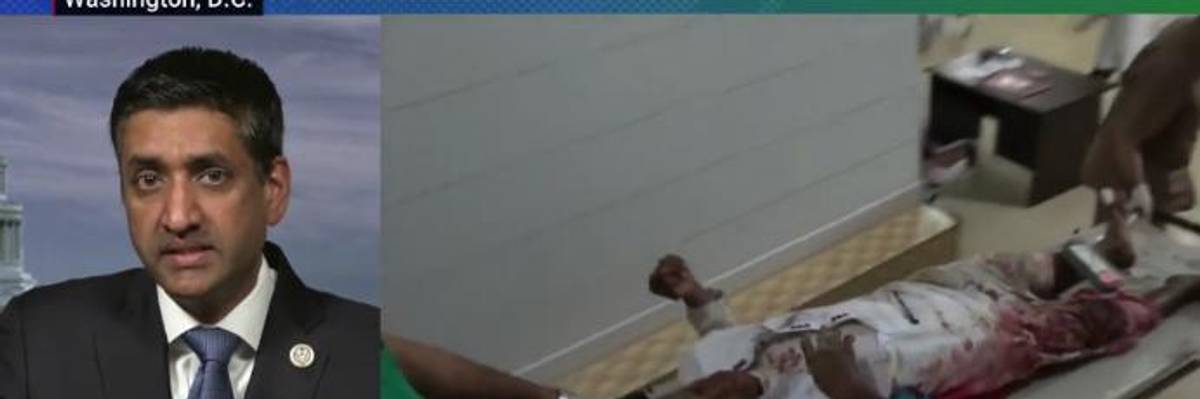
During an interview with Democracy Now! on Thursday, Rep. Ro Khanna (D-Calif.) vowed to keep fighting U.S. support for the Saudi- and UAE-led coalition bombing Yemen. (Photo: Democracy Now!)
"It was really an outrage."
That's how Rep. Ro Khanna (D-Calif.) responded Thursday to House Republicans' successful efforts to block a vote on his war powers resolution that aimed to end U.S. support for the Saudi- and UAE-led coalition's bombing of Yemen, which has produced the world's worst humanitarian crisis and put some 14 million civilians at risk of starving to death.
On Tuesday, the House Rules Committee advanced legislation to remove gray wolves from the endangered species list, but inserted language that also would effectively prevent a floor vote on Khanna's resolution. Wednesday evening, the House approved the rule 201-187.
"We've never seen those kinds of shenanigans with a war powers resolution," Khanna said of the Republicans' maneuvering on Democracy Now! Thursday morning. "They're not just hurting children in Yemen and the humanitarian crisis--they're undermining their own role as members of Congress."
"Let's be very clear: This is unprecedented... This is basically rendering ineffectual the War Powers Act," Khanna said on the House floor Wednesday evening. With this move, he argued, the GOP-controlled chamber is essentially saying that "if the president of the United States and the speaker believe we should be at war, we should be at war. It doesn't matter what members of Congress think."
In terms of next steps, Khanna said that the Senate may take up a version of the resolution by Sen. Bernie Sanders (I-Vt.), and if the upper chamber passes it, "we will bring it up again in the House before the lame-duck session ends because we don't have time to waste." If the Senate doesn't vote, or rejects Sanders' resolution, Khanna said he will push for a vote when Democrats take control of the House in January.
Although Secretary of State Mike Pompeo and Defense Secretary James Mattis announced last week that the U.S. would halt the refueling of the coalition's aircraft, as Khanna emphasized Thursday, "that's not a binding decision." In fact, "one of the reasons that Pompeo and Mattis called for a ceasefire of violence is they knew they were losing support in Congress. They knew that this war powers resolution was pending, that it was going to come for a vote, that they have 15 to 20 Republicans defecting--many from the Freedom Caucus--and they wanted to try to preempt that," Khanna claimed.
"When the new Congress convenes next year, ending all U.S. support for Saudi Arabia's devastating war in Yemen should be the first order of business."
--Paul Kawika Martin, Peace Action
As Paul Kawika Martin of Peace Action pointed out, "House Speaker Paul Ryan's office cited the administration's recent decision to end U.S. refueling of Saudi coalition aircraft in the war in Yemen as a reason for de-privileging the Yemen war powers resolution, but other forms of U.S. support for the coalition--arms sales, intelligence sharing, targeting assistance, and political support--are still fueling the world's worst humanitarian crisis in Yemen."
"When the new Congress convenes next year, ending all U.S. support for Saudi Arabia's devastating war in Yemen should be the first order of business," Martin added. While anti-war activists have fought for years to end U.S. complicity in the war and the subsequent humanitarian crisis, Saudi Arabia has garnered heightened media attention and criticism from the American public since Washington Post columnist Jamal Khashoggi was murdered at the Saudi consulate in Istanbul last month.
"His last column in the Washington Post was calling for the end of the barbaric campaign in Yemen," Khanna noted. "He was murdered precisely because he was speaking for hundreds of thousands of Yemeni civilians who didn't have a voice, and I'm glad that Khashoggi's murder has awakened the conscience of the United States and the world community about what was going on in Yemen."
"But the way we honor Khashoggi is not simply to seek retribution for the killers who took his life," the congressman concluded. "It's to make sure that the killers who are taking the lives of children in Yemen and hundreds of thousands of Yemeni civilians are brought to justice and that that stops."
Dear Common Dreams reader, It’s been nearly 30 years since I co-founded Common Dreams with my late wife, Lina Newhouser. We had the radical notion that journalism should serve the public good, not corporate profits. It was clear to us from the outset what it would take to build such a project. No paid advertisements. No corporate sponsors. No millionaire publisher telling us what to think or do. Many people said we wouldn't last a year, but we proved those doubters wrong. Together with a tremendous team of journalists and dedicated staff, we built an independent media outlet free from the constraints of profits and corporate control. Our mission has always been simple: To inform. To inspire. To ignite change for the common good. Building Common Dreams was not easy. Our survival was never guaranteed. When you take on the most powerful forces—Wall Street greed, fossil fuel industry destruction, Big Tech lobbyists, and uber-rich oligarchs who have spent billions upon billions rigging the economy and democracy in their favor—the only bulwark you have is supporters who believe in your work. But here’s the urgent message from me today. It's never been this bad out there. And it's never been this hard to keep us going. At the very moment Common Dreams is most needed, the threats we face are intensifying. We need your support now more than ever. We don't accept corporate advertising and never will. We don't have a paywall because we don't think people should be blocked from critical news based on their ability to pay. Everything we do is funded by the donations of readers like you. When everyone does the little they can afford, we are strong. But if that support retreats or dries up, so do we. Will you donate now to make sure Common Dreams not only survives but thrives? —Craig Brown, Co-founder |
"It was really an outrage."
That's how Rep. Ro Khanna (D-Calif.) responded Thursday to House Republicans' successful efforts to block a vote on his war powers resolution that aimed to end U.S. support for the Saudi- and UAE-led coalition's bombing of Yemen, which has produced the world's worst humanitarian crisis and put some 14 million civilians at risk of starving to death.
On Tuesday, the House Rules Committee advanced legislation to remove gray wolves from the endangered species list, but inserted language that also would effectively prevent a floor vote on Khanna's resolution. Wednesday evening, the House approved the rule 201-187.
"We've never seen those kinds of shenanigans with a war powers resolution," Khanna said of the Republicans' maneuvering on Democracy Now! Thursday morning. "They're not just hurting children in Yemen and the humanitarian crisis--they're undermining their own role as members of Congress."
"Let's be very clear: This is unprecedented... This is basically rendering ineffectual the War Powers Act," Khanna said on the House floor Wednesday evening. With this move, he argued, the GOP-controlled chamber is essentially saying that "if the president of the United States and the speaker believe we should be at war, we should be at war. It doesn't matter what members of Congress think."
In terms of next steps, Khanna said that the Senate may take up a version of the resolution by Sen. Bernie Sanders (I-Vt.), and if the upper chamber passes it, "we will bring it up again in the House before the lame-duck session ends because we don't have time to waste." If the Senate doesn't vote, or rejects Sanders' resolution, Khanna said he will push for a vote when Democrats take control of the House in January.
Although Secretary of State Mike Pompeo and Defense Secretary James Mattis announced last week that the U.S. would halt the refueling of the coalition's aircraft, as Khanna emphasized Thursday, "that's not a binding decision." In fact, "one of the reasons that Pompeo and Mattis called for a ceasefire of violence is they knew they were losing support in Congress. They knew that this war powers resolution was pending, that it was going to come for a vote, that they have 15 to 20 Republicans defecting--many from the Freedom Caucus--and they wanted to try to preempt that," Khanna claimed.
"When the new Congress convenes next year, ending all U.S. support for Saudi Arabia's devastating war in Yemen should be the first order of business."
--Paul Kawika Martin, Peace Action
As Paul Kawika Martin of Peace Action pointed out, "House Speaker Paul Ryan's office cited the administration's recent decision to end U.S. refueling of Saudi coalition aircraft in the war in Yemen as a reason for de-privileging the Yemen war powers resolution, but other forms of U.S. support for the coalition--arms sales, intelligence sharing, targeting assistance, and political support--are still fueling the world's worst humanitarian crisis in Yemen."
"When the new Congress convenes next year, ending all U.S. support for Saudi Arabia's devastating war in Yemen should be the first order of business," Martin added. While anti-war activists have fought for years to end U.S. complicity in the war and the subsequent humanitarian crisis, Saudi Arabia has garnered heightened media attention and criticism from the American public since Washington Post columnist Jamal Khashoggi was murdered at the Saudi consulate in Istanbul last month.
"His last column in the Washington Post was calling for the end of the barbaric campaign in Yemen," Khanna noted. "He was murdered precisely because he was speaking for hundreds of thousands of Yemeni civilians who didn't have a voice, and I'm glad that Khashoggi's murder has awakened the conscience of the United States and the world community about what was going on in Yemen."
"But the way we honor Khashoggi is not simply to seek retribution for the killers who took his life," the congressman concluded. "It's to make sure that the killers who are taking the lives of children in Yemen and hundreds of thousands of Yemeni civilians are brought to justice and that that stops."
"It was really an outrage."
That's how Rep. Ro Khanna (D-Calif.) responded Thursday to House Republicans' successful efforts to block a vote on his war powers resolution that aimed to end U.S. support for the Saudi- and UAE-led coalition's bombing of Yemen, which has produced the world's worst humanitarian crisis and put some 14 million civilians at risk of starving to death.
On Tuesday, the House Rules Committee advanced legislation to remove gray wolves from the endangered species list, but inserted language that also would effectively prevent a floor vote on Khanna's resolution. Wednesday evening, the House approved the rule 201-187.
"We've never seen those kinds of shenanigans with a war powers resolution," Khanna said of the Republicans' maneuvering on Democracy Now! Thursday morning. "They're not just hurting children in Yemen and the humanitarian crisis--they're undermining their own role as members of Congress."
"Let's be very clear: This is unprecedented... This is basically rendering ineffectual the War Powers Act," Khanna said on the House floor Wednesday evening. With this move, he argued, the GOP-controlled chamber is essentially saying that "if the president of the United States and the speaker believe we should be at war, we should be at war. It doesn't matter what members of Congress think."
In terms of next steps, Khanna said that the Senate may take up a version of the resolution by Sen. Bernie Sanders (I-Vt.), and if the upper chamber passes it, "we will bring it up again in the House before the lame-duck session ends because we don't have time to waste." If the Senate doesn't vote, or rejects Sanders' resolution, Khanna said he will push for a vote when Democrats take control of the House in January.
Although Secretary of State Mike Pompeo and Defense Secretary James Mattis announced last week that the U.S. would halt the refueling of the coalition's aircraft, as Khanna emphasized Thursday, "that's not a binding decision." In fact, "one of the reasons that Pompeo and Mattis called for a ceasefire of violence is they knew they were losing support in Congress. They knew that this war powers resolution was pending, that it was going to come for a vote, that they have 15 to 20 Republicans defecting--many from the Freedom Caucus--and they wanted to try to preempt that," Khanna claimed.
"When the new Congress convenes next year, ending all U.S. support for Saudi Arabia's devastating war in Yemen should be the first order of business."
--Paul Kawika Martin, Peace Action
As Paul Kawika Martin of Peace Action pointed out, "House Speaker Paul Ryan's office cited the administration's recent decision to end U.S. refueling of Saudi coalition aircraft in the war in Yemen as a reason for de-privileging the Yemen war powers resolution, but other forms of U.S. support for the coalition--arms sales, intelligence sharing, targeting assistance, and political support--are still fueling the world's worst humanitarian crisis in Yemen."
"When the new Congress convenes next year, ending all U.S. support for Saudi Arabia's devastating war in Yemen should be the first order of business," Martin added. While anti-war activists have fought for years to end U.S. complicity in the war and the subsequent humanitarian crisis, Saudi Arabia has garnered heightened media attention and criticism from the American public since Washington Post columnist Jamal Khashoggi was murdered at the Saudi consulate in Istanbul last month.
"His last column in the Washington Post was calling for the end of the barbaric campaign in Yemen," Khanna noted. "He was murdered precisely because he was speaking for hundreds of thousands of Yemeni civilians who didn't have a voice, and I'm glad that Khashoggi's murder has awakened the conscience of the United States and the world community about what was going on in Yemen."
"But the way we honor Khashoggi is not simply to seek retribution for the killers who took his life," the congressman concluded. "It's to make sure that the killers who are taking the lives of children in Yemen and hundreds of thousands of Yemeni civilians are brought to justice and that that stops."