

SUBSCRIBE TO OUR FREE NEWSLETTER
Daily news & progressive opinion—funded by the people, not the corporations—delivered straight to your inbox.
5
#000000
#FFFFFF
To donate by check, phone, or other method, see our More Ways to Give page.
Daily news & progressive opinion—funded by the people, not the corporations—delivered straight to your inbox.

"We cannot allow American national security simply to be sold to the highest bidder."
The unprecedented money that President Donald Trump is raking in from foreign investors during his second term has prompted Sen. Elizabeth Warren to take the lead in pushing back.
Speaking on the US Senate floor on Thursday, Warren (D-Mass.) called on her fellow senators to support a resolution in favor of condemning and reversing an agreement struck by the Trump administration to sell advanced artificial intelligence technology to the United Arab Emirates.
The resolution was also backed by Sens. Chris Van Hollen (D-Md.), Andy Kim (D-NJ), and Elissa Slotkin (D-Mich.).
Warren's call came days after the Wall Street Journal revealed that a member of the Abu Dhabi royal family secretly backed a massive $500 million investment into the Trump family’s cryptocurrency venture just months before the deal for the advanced AI chips was announced.
During her speech, Warren scoffed at the notion that Trump was unaware that lieutenants of Abu Dhabi royal Sheikh Tahnoon bin Zayed Al Nahyan signed a deal in early 2025 to buy a 49% stake in World Liberty Financial, the startup founded by members of the Trump family and the family of Trump Middle East envoy Steve Witkoff.
"President Trump’s own son signed the deal for half a billion dollars," remarked Warren. "An initial payment of $187 million dollars was reportedly directed to flow to Trump family companies. Another initial payment of $31 million dollars was reportedly directed to flow into entities connected to the family of Steve Witkoff, Trump’s golf buddy who had been named the US Special Envoy to the Middle East."
In addition to citing national security concerns about selling sensitive AI technology to the UAE, Warren said that Congress should step in to reverse the deal simply to stop Trump from using the presidency to enrich his personal finances.
"Here we are, one year into Donald Trump’s second term, and Trump has amassed more than $1.5 billion from his crypto ventures like World Liberty Financial," she noted. "Trump is profiting off the Presidency while American families are worrying about their jobs, the rising cost of groceries, and how they're going to pay their bills."
Warren ended her speech by demanding that her fellow lawmakers in Congress act.
"Trump is profiting from decisions that make it easier for countries like China to get their hands on some of our most sensitive and advanced technologies," she said. "Congress needs to grow a spine. We cannot allow American national security simply to be sold to the highest bidder. The Senate must pass this resolution to condemn this corruption and call on Donald Trump to reverse his decision to allow the export of advanced AI chips to the UAE."

The world is watching. So are the people of Sudan. The question is whether the United States will choose complicity—or conscience. We must act now.
In a world deluged with crises—each vying for our limited attention—the catastrophe unfolding in Sudan has remained largely invisible to the American public. Yet, by almost any measure, it is among the most severe humanitarian emergencies of our time. Over 30 million people—two-thirds of Sudan’s population—now require humanitarian support. More than 12 million have been displaced, and famine threatens to claim countless lives. This is not a distant tragedy; it is a crisis in which American policy and the interests of American capitalists are deeply entangled.
Now, Congress is poised to vote on a set of resolutions that could finally interrupt the United States’ role in fueling this disaster. You can call your Senator and ask them to support S.J.Res.51, S.J.Res.52, S.J.Res.53, and S.J.Res.54—the Joint Resolutions of Disapproval by Senator Chris Murphy et. al. that would block more than $3.5 billion in proposed arms sales to the United Arab Emirates (UAE) and Qatar. The Congressional Switchboard is at 202-224-3121.
This legislation is likely to come up this week and that makes this a rare moment of real leverage for American activists and concerned citizens. The urgency is clear: unless Congress acts, the U.S. risks deepening its complicity in Sudan’s suffering.
At the epicenter of Sudan’s unraveling is the Rapid Support Forces (RSF), a paramilitary group whose origins trace back to the notorious Janjaweed militias involved in the Darfur genocide in the early 2000s. The RSF has been implicated in a series of systematic atrocities: targeted ethnic violence, mass killings, forced displacement, and widespread sexual violence. Investigations by the United Nations, Human Rights Watch, and Amnesty International have all pointed to the same grim conclusion: the RSF’s actions constitute war crimes, ethnic cleansing, and, in the assessment of the U.S. State Department, genocide.
The mechanics of how these atrocities are sustained have already come into focus. According to Amnesty International, recently manufactured Emirati armored personnel carriers are now in the hands of the RSF. Flight data and satellite imagery have revealed a pattern: cargo planes departing from the UAE, landing at remote airstrips in Chad, and then offloading weapons and equipment that would soon appear on the front lines in Sudan. A New York Times investigation concluded that the UAE was “expanding its covert campaign to back a winner in Sudan, funneling money, weapons and, now, powerful drones” to the RSF.
What makes this all the more alarming is that the UAE is one of America’s closest military partners—and a major recipient of U.S. arms. Despite repeated assurances to Washington that it would not arm Sudan’s belligerents, the UAE has continued these transfers, as confirmed by the Biden Administration in one of its last acts as well as by members of Congress.
There is, however, another angle to this story—an angle that speaks to the corrosion of U.S. foreign policy by incredibly narrow financial interests. President Donald Trump and his family have cultivated deep financial ties with both the UAE and Qatar. The UAE has invested $2 billion in a Trump family crypto venture; Qatar has bestowed a $400 million on that luxury aircraft everyone’s heard about, intended for the U.S. presidential fleet, in a gesture that blurs the line between diplomacy and personal favor. These transactions are not just unseemly; they are emblematic of this new era in which U.S. foreign policy is increasingly shaped by the private interests of a handful of oligarchs.
To call this “kleptocracy” is not hyperbole. The intertwining of arms sales, foreign influence, and personal enrichment undermines both U.S. standing and the interests of the average American. Each weapon sold, each deal brokered, risks making the United States more complicit in the suffering of Sudan’s civilians.
To call this “kleptocracy” is not hyperbole. The intertwining of arms sales, foreign influence, and personal enrichment undermines both U.S. standing and the interests of the average American.
The Sudan crisis is a reminder that America’s actions abroad are neither abstract nor inconsequential—and all the uniqueness of the Trump 2.0 administration hasn’t changed that. U.S. policies still reverberate in the lives of millions. As citizens, we have a responsibility to demand that our leaders act not out of expedience or self-interest, but out of a sense of justice and human dignity. With a congressional vote imminent, the window for meaningful action is open—but it is closing fast.
The world is watching. So are the people of Sudan. The question is whether the United States will choose complicity—or conscience. Please call your Senators today at 202-224-3121.
The oil, coal, and gas industries have a lot to lose in the negotiations at COP28, and a lot to gain from continued diversion, distraction, and delay.
The 28th meeting of the Conference of the Parties (COP28) to the UN Framework Convention on Climate Change (UN FCCC) is set to begin in Dubai, United Arab Emirates, next week. One of the most crucial indicators of success will be whether the nations of the world reach agreement on a fast and fair phaseout of fossil fuels.
Progress on this front depends on protecting the negotiations—and national and subnational policies based on them—from fossil fuel industry interference. This will not be easy. Fossil fuel interests have had a heavy hand in international climate negotiations since they began more than three decades ago. A growing body of evidence amassed by academic research, investigative journalism, congressional investigations, and climate accountability litigation shows that ExxonMobil, Shell and other corporations have conducted campaigns to delay and block climate action. Those campaigns continue today.
As fossil fuel corporations rake in record profits and roll back their pledges to invest in renewable energy, it’s past time for a paradigm shift.
As we near the end of a year of devastating climate change-fueled disasters and record-breaking global average temperatures, the options to limit the worst potential impacts of climate change are narrowing. The fossil fuel industry has a lot to lose in the negotiations at COP28, and a lot to gain from continued diversion, distraction, and delay. Below are my dos and don’ts for COP28 negotiators to give the world the best chance to meet the climate Paris Agreement’s climate goals.
Fossil fuels—coal, gas, and oil—are by far the largest contributor to human-caused climate change. Peer-reviewed research by Richard Heede traced two-thirds of all industrial carbon dioxide and methane emissions since the start of the Industrial Revolution to just 90 entities—coal, gas, and oil producers and cement manufacturers.
It stands to reason that international climate change negotiations would tackle fossil fuels head on. Yet until two years ago in Glasgow, Scotland, no COP agreements or decisions mentioned fossil fuels, much less did anything to rein them in. The vested interests of investor- and state-owned fossil fuel companies ensured that glaring omission.
Christiana Figueres, who helped negotiate the Paris Agreement as head of the UNFCCC, once believed that the fossil fuel industry should help set climate policy. Earlier this year, she disavowed her previous position. “I thought fossil fuel firms could change,” she wrote. “I was wrong.”
As fossil fuel corporations rake in record profits and roll back their pledges to invest in renewable energy, it’s past time for a paradigm shift. The United States and other nations negotiating in Dubai must recognize that corporations hell-bent on squeezing every nickel of profit out of the planet’s coal, gas, and oil resources have a conflict of interest with climate action. The World Health Organization’s Framework Convention on Tobacco Control, which obligates parties to protect their public health policies from commercial and other vested interests of the tobacco industry, provides a valuable model for insulating national and international policymaking from corporate conflicts of interest.
Without protections against conflicts of interest at COP28, the fossil fuel industry will be out in force.
Two years ago at COP26, there were more than 500 people with links to fossil fuel interests accredited as participants, according to an analysis by Corporate Accountability, Corporate Europe Observatory (CEO), Glasgow Calls Out Polluters, and Global Witness. If the fossil fuel industry had been a delegation, it would have been larger than the delegation of any country.
At COP27, civil society watchdogs combed through registration lists to identify more than 600 oil and gas industry lobbyists. A more recent analysis by the Associated Press found nearly 400 people with fossil fuel industry ties attended last year’s talks.
In response to demands from elected officials and civil society, new transparency rules are in place for the first time at COP28. Participants must disclose their affiliation, which will be listed publicly. These disclosures are a step forward, necessary but not sufficient for true accountability.
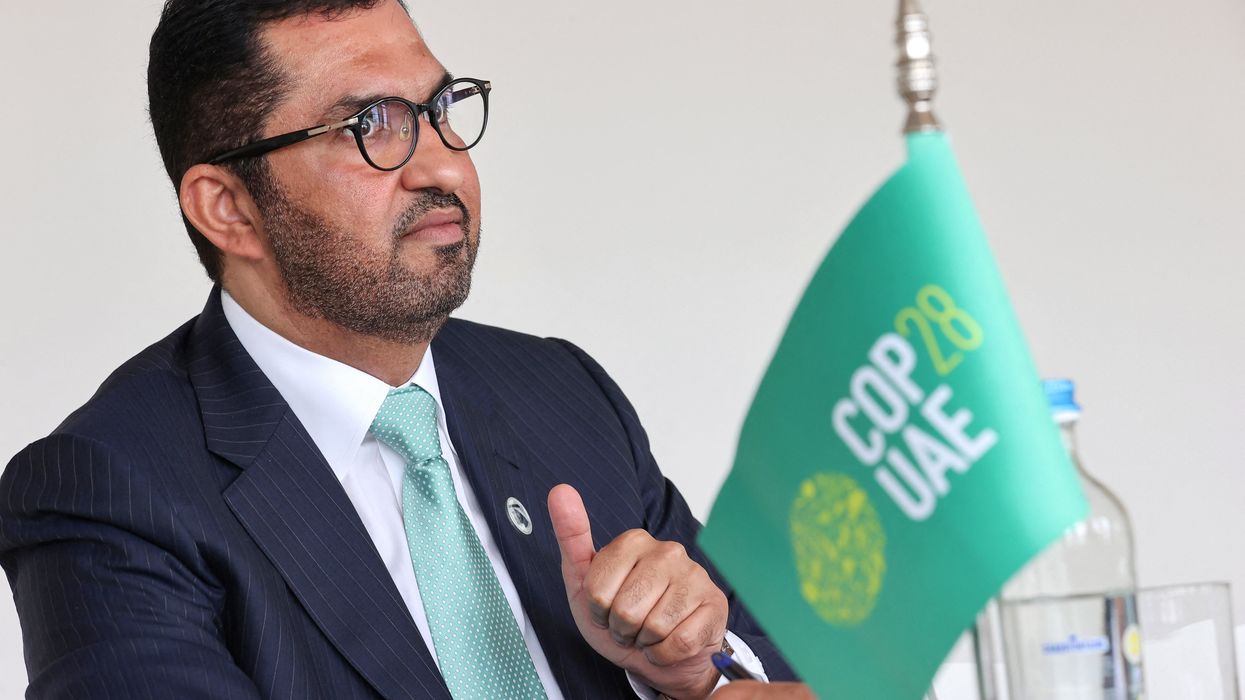
Concern about fossil fuel industry influence at COP28 is heightened because the head of this year’s negotiations is Sultan Al-Jaber, the CEO of the Abu Dhabi National Oil Company. The company plans to invest $150 billion to expand its oil and gas production over the next five years.
Under Chair and CEO Rex Tillerson (who served as secretary of state in the Trump administration), ExxonMobil supposedly acknowledged the risks of climate change and claimed to stop funding groups that promote climate denial. But a recent Wall Street Journal investigation of internal ExxonMobil documents revealed that the corporation has continued its efforts to cast doubt on climate science by, among other things, trying to influence the UN Intergovernmental Panel on Climate Change, the independent scientific body that provides the latest science to help inform nations participating in COP negotiations.
According to the internal documents, Tillerson dismissed the Paris Agreement goal of keeping global temperature increase to well below 2 degrees Celsius above preindustrial levels—and striving to limit it to 1.5 degrees C—as “something magical.” And just months before the agreement was signed, Tillerson asked, “Who is to say 2.5 [degrees C] is not good enough?”
Today, most major investor-owned oil and gas corporations claim to be aligned with Paris Agreement goals, and most have pledged to reach net-zero global warming emissions by 2050, but their actions belie these claims. BP, Chevron, ExxonMobil, Shell, and other major fossil fuel corporations continue to expand fossil fuel exploration, extraction, processing, marketing and sales while spreading climate disinformation and seeking to block climate action.
A 2022 peer-reviewed study led by Mei Li that drew on the Union of Concerned Scientists (UCS) Climate Accountability Scorecard found that BP, Chevron, ExxonMobil, and Shell continue to depend on fossil fuels, with insignificant and opaque spending on clean energy. The researchers concluded that the transition to clean energy business models is not occurring, and that accusations of greenwashing appear well-founded.
These companies have responded to investor demands by setting emissions reduction targets and publishing glossy climate reports. According to Net Zero Tracker, two-thirds of fossil fuel firms have net-zero commitments, but most are largely meaningless because they do not fully cover Scope 3 emissions from the use of their products, which account for 80 to 95 percent of heat-trapping emissions from the oil and gas sector. ExxonMobil, for example, still refuses to take responsibility for reducing emissions from burning its oil and gas products. Moreover, fossil fuel companies’ climate targets that do not include plans to phase out oil and gas are misaligned with the scientific and policy consensus. A report by a UN expert group clearly recommends that credible net-zero targets must include “specific targets aimed at ending the use of and/or support for fossil fuels.”
Disinformation and greenwashing pose a growing legal liability for the fossil fuel industry. Dozens of cities, counties, and states across the United States and its territories are suing the fossil fuel industry over climate damages and fraud. The latest climate accountability lawsuit, filed by California in September, documents and seeks to end ongoing climate disinformation campaigns by five investor-owned oil and gas corporations and their main trade association, the American Petroleum Institute. (Read more about the synergy between climate litigation and UN climate talks in this blog by my colleague Delta Merner.)
Fossil fuel defendants are pulling out all the stops to evade accountability and delay justice for people and communities harmed by their products and business practices. Last week, a self-described “hacker for hire” was sentenced to nearly seven years in prison for his role in a large-scale spear-phishing operation that targeted UCS and other public interest organizations exposing disinformation campaigns by ExxonMobil and other fossil fuel interests. While the investigation has not yet revealed who hired the hacker, ExxonMobil has used some of the hacked information in its efforts to thwart legal and public accountability.
At the same time, ExxonMobil and other fossil fuel corporations are trying desperately to frame themselves as part of the solution for climate change and regain their “social license”—their perceived legitimacy among consumers, workers, communities where they operate, investors, policymakers, and other key audiences. At last week’s Asia-Pacific Environmental Cooperation CEO summit in San Francisco, ExxonMobil Chair and CEO Darren Woods dismissed evidence of the company’s climate deception as “what was said 30 years ago or what they think Exxon knew back then.” Then he doubled down on his company’s deception by insisting that the problem is emissions, not oil and gas.
Woods wants us to believe that ExxonMobil can solve the climate change problem with such technologies as hydrogen and carbon capture and storage (CCS). He claims that ExxonMobil has the intellectual and financial resources to “bend the curve on emissions.” But the world’s most profitable oil and gas corporation had that technical and financial capacity decades ago, when its own scientists warned top management of the threat of climate change. Not only did Exxon decide to not apply its resources to leading the energy transition, it instead chose to fund a deliberate campaign of deception. Decades of delay have made the challenge the world faces between now and 2030 much bigger.
Ahead of the UN Climate Ambition Summit in September, tens of thousands of people marched to end fossil fuels. Meanwhile, UN Secretary-General António Guterres has clearly stated that countries must progressively phase out fossil fuels, “leave oil, coal and gas in the ground where they belong,” and massively boost investment in renewable energy. Guterres also has called for fossil fuel companies to “cease and desist influence peddling and legal threats designed to kneecap progress.”
While ExxonMobil’s Woods has falsely claimed that phasing out fossil fuels would prevent people in the Global South—who have contributed least to climate change—from accessing energy, Global South activists and advocates are among the most committed and powerful voices for a fossil-fuel phaseout. Extracting, processing, and burning fossil fuels is exacerbating health, environmental and social injustices in Black, Brown, Indigenous and low-income communities in the United States and around the world.
As my colleague Rachel Cleetus writes, the phaseout must be fast and fair and must cover all fossil fuels—gas and oil as well as coal. It also must include rapid, deep, direct cuts in fossil fuel use, and the default position of governments at every level should be to reject the expansion of fossil fuel production and the buildout of infrastructure that could remain in place for decades to come. Such approaches as CCS, carbon dioxide removal, and alternative combustion fuels may play a limited role to meet long-term climate goals, but they are not likely to play a material role in meeting 2030 targets, they would not fully reduce environmental injustices and public health harms of fossil fuels, and they are no substitute for immediate, sharp reductions in fossil fuel production and utilization that are necessary now.
Ahead of COP28, more than 650 scientists signed a letter to President Biden urging him to commit to a fast and fair phaseout of all fossil fuels with clear timelines and science-informed targets for the near- and long-term, and supported by finance for low- and middle-income countries for a clean energy transition. The scientists also called on the United States to publicly resist interference by fossil fuel interests, as well as their greenwashing that delays and impedes a fossil fuel phaseout, in the final agreement at COP28.
You can add your voice to this call for bold climate action at COP28 here.
"It is no secret that targeted digital surveillance has long been weaponized in the United Arab Emirates to crush dissent and stifle freedom of expression," said one campaigner.
With just two weeks until the next United Nations climate summit, Amnesty International on Wednesday expressed concerns about authorities in the United Arab Emirates using digital surveillance to target COP28 attendees and UAE residents alike.
"It is no secret that targeted digital surveillance has long been weaponized in the United Arab Emirates to crush dissent and stifle freedom of expression," said Rebecca White, a campaigner with Amnesty's Disrupting Surveillance Team, in a statement.
"Prior to his arrest in 2017, human rights defender Ahmed Mansoor faced a string of cyberattacks facilitated by mercenary surveillance companies," she noted. "Known as 'the last human rights defender' in the UAE, Mansoor, who openly criticized the authorities, has been languishing in an Emirati prison for over six years."
In recent months, Amnesty and other groups have called on U.S. Secretary of State Antony Blinken to pressure the UAE to "immediately and unconditionally release" Mansoor and other imprisoned human rights advocates before COP28. Amnesty has also joined other organizations in urging leaders of countries participating in the summit to address the host nation's human rights record and "destructive" climate policies amid a worsening global emergency.
"Amnesty International fears that human rights defenders and other members of civil society in the UAE may continue to be targeted with spyware, including those attending COP28," White said Wednesday. "As hosts of the conference, the UAE has pledged to offer a platform for activists' voices, yet this will not be possible unless human rights, including the rights to privacy and peaceful assembly, are respected."
The pledge she referenced was signed in August by the United Nations Framework Convention on Climate Change (UNFCCC) Executive Secretary Simon Stiell and the COP28 president-designate, Sultan bin Ahmed Al Jaber, who is also an oil executive.
Heba Morayef, Amnesty's regional director for the Middle East and North Africa, said at the time, "The fact that the hosts of this crucial climate meeting felt the need to highlight that some form of free assembly and expression will be allowed during COP28 serves only to highlight the normally restrictive human rights environment in the United Arab Emirates and the severe limits it places on the rights to freedom of expression and peaceful assembly."
White stressed Wednesday that "the UAE authorities must not engage in unlawful electronic surveillance of conference participants as well as all Emirati nationals and residents. They must also allow COP28 attendees to download privacy-respecting international communications applications like Signal in the UAE to ensure they can use safe, encrypted means of communication."
"We cannot address climate catastrophe without tackling its root cause: fossil fuel dependence," U.N. Secretary-General António Guterres said.
Twenty petrostates responsible for 84% of carbon dioxide emissions in 2021 plan to produce about 110% more oil, gas, and coal through 2030 than is compatible with limiting global heating to 1.5°C above preindustrial levels, a United Nations-led report has found.
The 2023 "Production Gap" Report was published Wednesday by the Stockholm Environment Institute (SEI), Climate Analytics, E3G, International Institute for Sustainable Development, and the U.N. Environment Programme (UNEP). It found that, if the plans of governments including the U.S., China, and the United Arab Emirates move ahead, coal production would increase until 2030 and oil and gas until at least 2050.
"Governments' plans to expand fossil fuel production are undermining the energy transition needed to achieve net-zero emissions, throwing humanity's future into question," UNEP executive director Inger Andersen said in a statement. "Powering economies with clean and efficient energy is the only way to end energy poverty and bring down emissions at the same time."
The report noted that 17 of the 20 countries it profiled have promised to reach net-zero emissions, but none of them have promised to phase out fossil fuels in keeping with the 1.5°C goal. The production plans outlined in the report contradict the nations' climate mitigation plans and pledges made as of September 2022 and would see coal production increase by 460% more than is consistent with limiting warming to 1.5°C, gas by 82% more, and oil by 29% more.
U.N. Secretary-General António Guterres called the report a "startling indictment of runaway climate carelessness."
"Governments are literally doubling down on fossil fuel production; that spells double trouble for people and planet," Guterres said. "We cannot address climate catastrophe without tackling its root cause: fossil fuel dependence."
"The report confirms that the failure by oil and gas producing countries to rein in their production is making climate and economic catastrophe more likely everyday."
The findings come amid what is likely to be the hottest year on record and follow a summer of climate-charged extreme weather events, from historic heatwaves to massive wildfires to deadly floods.
"Fossil fuel emissions are already causing climate chaos which is devastating lives and livelihoods, and we're on course for far worse," Guterres continued. "Leaders must act now to save humanity from the worst impacts of climate chaos, and profit from the extraordinary benefits of renewable energy. That means ending our fossil fuel addiction by shrinking supply, driving down demand, and accelerating the renewables revolution, as part of a just transition."
On a country-by-country level, the nations with the most emissions-intensive plans were India from coal, Saudi Arabia from oil, and Russia from oil, gas, and coal, The Guardian reported. The U.S. had plans to expand its oil production the second most after Saudi Arabia and its gas production the fifth most. The UAE, which is hosting the upcoming U.N. Climate Change Conference, or COP28, had the seventh largest plan to expand its oil production. The upcoming talks are already controversial because their president, Sultan Ahmed al-Jaber, is also the head of the UAE's state oil company.
"Despite their climate promises, governments plan on ploughing yet more money into a dirty, dying industry, while opportunities abound in a flourishing clean energy sector," Neil Grant, a climate and energy analyst with Climate Analytics, said in response to the report. "On top of economic insanity, it is a climate disaster of our own making."
The report builds on findings from Oil Change International in September that five Global North countries including the U.S. would drive more than 50% of new oil and gas field development through 2050, with the U.S. behind more than a third of the plans.
"The report confirms that the failure by oil and gas producing countries to rein in their production is making climate and economic catastrophe more likely everyday," Oil Change International's global policy manager Romain Ioualalen said in a statement. "It is a stark reminder that we need an immediate halt to all new oil and gas projects, and for governments around the world to agree to a rapid and equitable phase out of all fossil fuels at this year's U.N. climate talks in Dubai."
Cassidy DiPaola, the campaign manager for Fossil Free Media, noted that the report came on the heels of several contentious decisions by the administration of U.S. President Joe Biden to approve major fossil fuel projects, as well as the news that he would not be attending the U.N. talks.
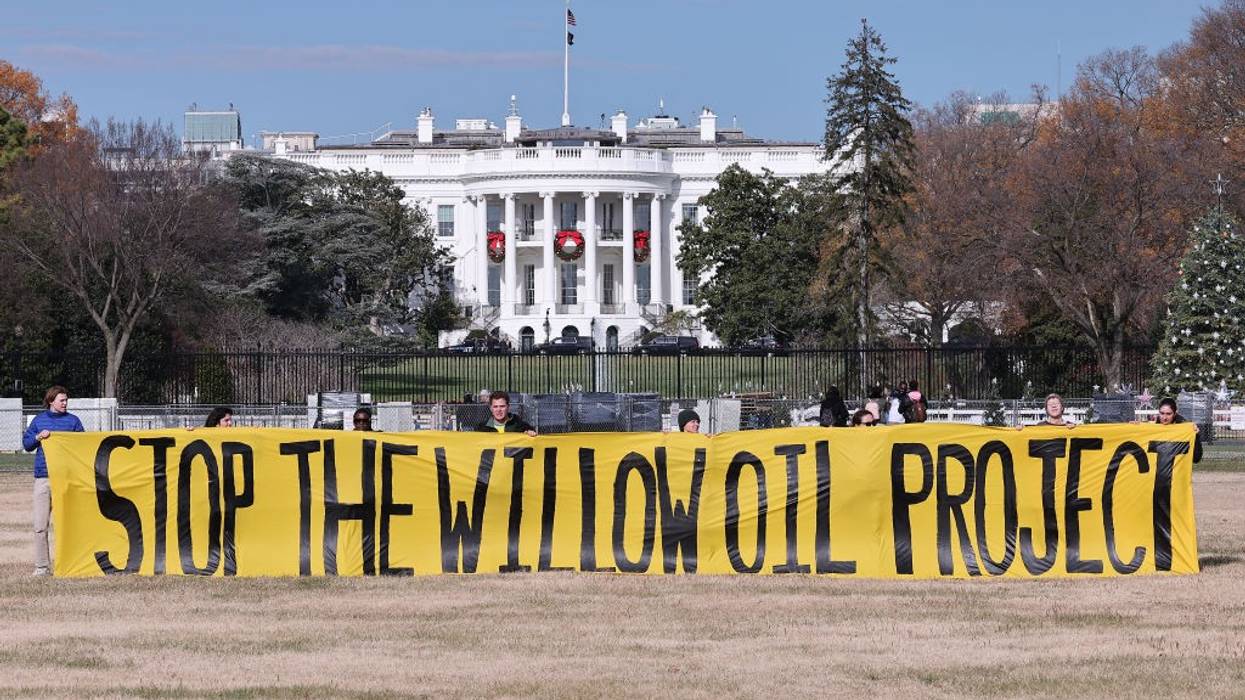
"President Biden's administration has spent 2023 approving massive fossil fuel projects like Willow and the Mountain Valley Pipeline, even as he trumpets climate leadership," DiPaola said in a statement. "His absence from COP28 further calls this leadership into question. How can we take these climate commitments seriously when major emitters like the U.S continue expanding fossil fuel production and infrastructure?"
The U.N. report authors criticized in particular the idea that gas can act as a so-called bridge fuel away from oil and coal.
"We find that many governments are promoting fossil gas as an essential 'transition' fuel but with no apparent plans to transition away from it later," lead report author and SEI scientist Ploy Achakulwisut said in a statement. "But science says we must start reducing global coal, oil, and gas production and use now."
The authors called on the top fossil fuel producing nations to shift course and plan to stop using and producing coal by 2040 and cut oil and gas use and production by at least 75% of 2020 levels by 2050.
"COP28 could be the pivotal moment where governments finally commit to the phaseout of all fossil fuels and acknowledge the role producers have to play in facilitating a managed and equitable transition," Michael Lazarus, a lead author and the director of the SEI U.S. center, said in a statement. "Governments with the greatest capacities to transition away from fossil fuel production bear the greatest responsibility to do so while providing finance and support to help other countries do the same."
Guterres also called for decisive action at the climate talks, which begin at the end of the month.
"COP28 must send a clear signal that the fossil fuel age is out of gas—that its end is inevitable," he said. "We need credible commitments to ramp up renewables, phase out fossil fuels, and boost energy efficiency, while ensuring a just, equitable transition. Fossil fuels are sending essential climate goals up in smoke. It's time for change."
The Palestinian issue could not simply be wished away, and the signing of the pacts created a set of contradictions that fueled the tensions that erupted October 7.
It’s easy to forget now, but the shocking and horrific violence that set off the current hostilities in the Middle East, where Hamas militants slaughtered and kidnapped innocent Israeli civilians, was predicted. Specifically, the U.S. Department of Homeland Security under Donald Trump warned in October 2020 that terrorist violence was set to be imminently inflamed.
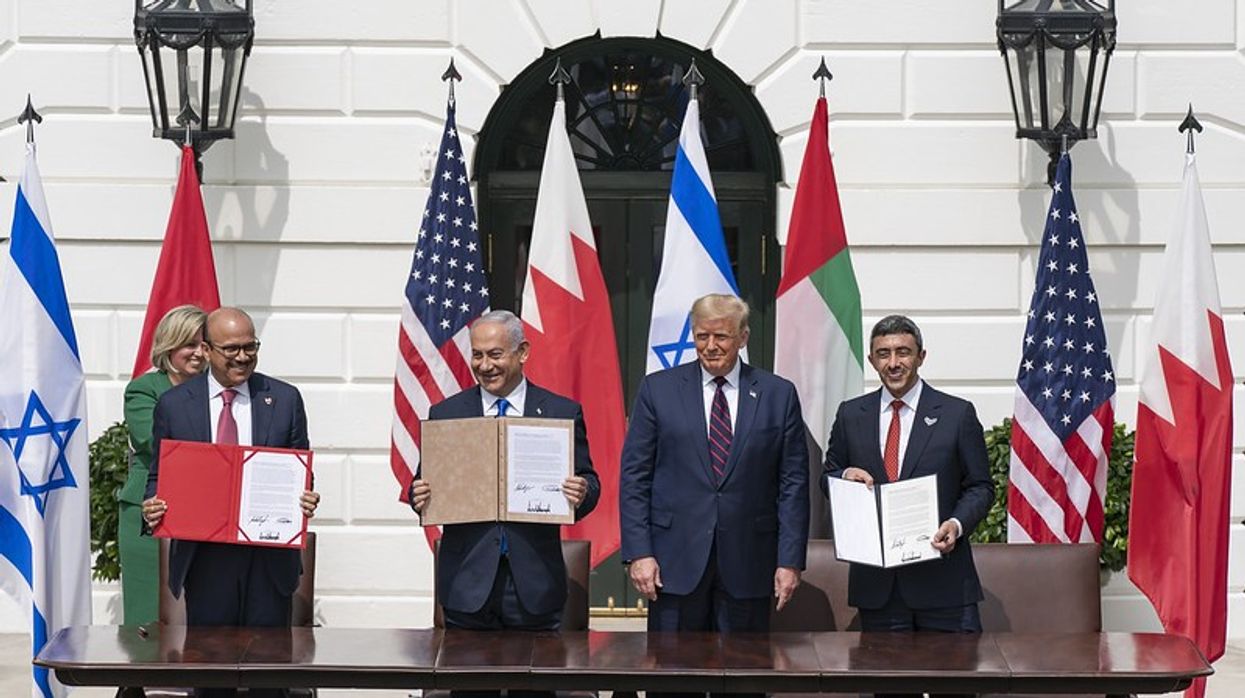
Trump’s DHS didn’t claim it was because, in President Joe Biden words, of “sheer evil” from those who exist only “to kill Jews.” Rather, it pointed to the Abraham Accords: the U.S.-led effort to normalize relations between Israel and its Arab neighbors, which Trump claimed would shift the course of Middle Eastern history from “decades of division and conflict” and which the Biden administration claimed would make the region “safer and more prosperous.”
So how did we end up with the exact opposite?
Hamas’attack also can’t be understood without the bipartisan push for Israeli-Arab normalization at the Palestinians’ expense, and the outrage, anger, and despair it has inspired.
For decades, the peaceful resolution of the Israeli-Palestinian conflict, meaning the provision of an independent state for the Palestinian people and the end of Israeli occupation of Palestinian territory, was central to the task of engineering peace between Israel and its Arab neighbors. This was a problem, since between successive Israeli governments steadily chipping away at the possibility of a two-state solution to the conflict and dwindling U.S. interest in pressuring the Israeli state to follow through on the commitment, that resolution started to look increasingly impossible.
But over time, the priorities of the Arab states shifted away from the Palestinians, too. Their largely authoritarian leadership became more preoccupied with matters like maintaining political control in the wake of the Arab Spring protests—for which support from an advanced military power like Israel might prove useful—and an increasingly assertive Iran, which then-newly appointed Saudi Crown Prince Mohammed Bin Salman called a “much more urgent and more important” issue.
This shift dovetailed with the Trump administration’s ultra-Israel-friendly stance and its own goal of further isolating Iran in the region. The resulting Abraham Accords were, at least in the neoconservative world, considered a stroke of “genius.” Rather than finding a solution to the seemingly intractable question of Palestinian statehood, it simply sidelined it.
The signers dropped this long-standing precondition as they re-established diplomatic relations and deepened security and economic cooperation with Israel, while Trump lavished them with rewards, like an arms deal for the United Arab Emirates (UAE), and U.S. recognition of the annexation of West Sahara for Morocco. It effectively supplanted the Saudi government’s Arab Peace Initiative, which since its 2002 introduction had been the foundation of the Arab world’s program for resolving the conflict, placing the Palestinians front and center.
The new normalization agreements’ foundational and cynical assumption was that the plight of the Palestinians could and would be safely ignored and forgotten about by both the region’s governments and the broader international community. Both the Trump administration and, reportedly, bin Salman, pressured Palestinian Authority President Mahmoud Abbas to assent, while the states that signed continued paying lip service to the Palestinian cause, claiming this normalization push would halt Israel’s annexation plans for its illegal West Bank settlements.
In reality, the text of the agreements barely mentioned Palestinians, outside of a few vague assurances to keep working toward a negotiated solution to the Israeli-Palestinian conflict and that Morocco maintained a “coherent, constant, and unchanged position” on the matter. This was, to put it mildly, far short of what both Palestinians and their supporters in the U.S. Congress demanded.
As Arab states began gradually deepening ties with Israel, they increasingly backed away from their historic positions. Bin Salman declared (and subsequently walked back) that Israelis “have the right to have their own land,” effectively sanctioning the loss of what the Muslim world viewed as Palestinians’ historic land.
When violence broke out in April 2021 at the Al-Aqsa mosque, with Israeli forces raiding one of Islam’s holiest sites, the UAE response was notably muted. That the normalization process continued despite what would earlier have been viewed as an unacceptable provocation against both Palestinians and Islam itself was celebrated by the accords’ supporters, as proof that ongoing repression of Palestinians could indeed be safely ignored.
But the Palestinian issue could not simply be wished away, and the signing of the pacts created a set of contradictions that fueled the tensions that erupted October 7. The vast majority of the populations of Israel’s Arab neighbors opposed the accords, as did some leaders, like Turkish Foreign Minister Mevlüt Çavuşoğlu, who charged that the signers had “lost their moral compass,” and Jordan’s King Abdullah, who declared that “no architecture for regional security and development can stand over the burning ashes of this conflict.”
So did Palestinians themselves, across opinion surveys, with both the Palestinian Authority and Hamas calling it a “betrayal,” a “treacherous stab,” and “grave harm.” Hamas also called for “an integrated plan to bring down normalization.” Protests against the accords erupted in Morocco, one of the signers.
The signing of the accords was particularly fraught in Saudi Arabia. The country’s powerful clerics continued to oppose Israeli policy toward the Palestinians. But beyond that, the Saudi leadership’s internal legitimacy and its standing as the region’s leader of the Islamic continued to rest in part on its commitment to the Palestinians. Regional rival Iran quickly stepped in to fill this vacuum left by Saudi support for the deals, sharply criticizing the normalization effort as a “betrayal of Palestinian aspirations for freedom.”
Meanwhile, Israeli policy didn’t change as promised, and in fact, only hardened. Since 2020, when the accords were signed, illegal settlements have expanded and even ramped up alongside settler violence. The Netanyahu government has now advanced a record number of settler housing units, and transferred administration of the occupied territories from military to civilian hands, widely interpreted as signaling plans for annexation, even as figures like former Abbas adviser Ghaith al-Omari claimed the accords had “already delivered to the Palestinians” by stopping this policy.
This past September, the UAE’s ambassador to the United States admitted annexation hadn’t actually stopped.
The Biden administration could have reversed Trump’s efforts, and placed pressure on Israel to halt these plans, as well as end its settlement expansion while making good on its promises and obligations under the peace process. Instead, the president continued Trump’s normalization efforts while breaking from presidential precedent and not even attempting to advance the peace process, all while issuing little to no criticism of the Israeli government’s violations.
He has in fact escalated the issue, pushing for an Israeli-Saudi normalization agreement, with the only concession to Palestinians the mere preservation of the possibility of Israeli-Palestinian peace—an agreement that would also entail further nuclear proliferation in the region and giving Saudi Arabia security assurances. Even so, Biden’s secretary of state continues to claim that this could “be used to advance” such a peace.
So while Hamas had reportedly planned this operation for two years, and claimed it was motivated by years of violence at Al-Aqsa, its attack also can’t be understood without the bipartisan push for Israeli-Arab normalization at the Palestinians’ expense, and the outrage, anger, and despair it has inspired.
What is clear—from Hamas’s extraordinary violence, the wider regional war it threatens to spark, as well as the major pro-Palestinian protests across Arab countries in response to Israel’s bombing campaign—is that almost every assumption that undergirded the Abraham Accords was disastrously wrong, not least the idea that dismissing the Palestinians would make for a more peaceful Middle East.

"The necessary transition towards clean energy sources such as wind and solar energy, and the abandonment of fossil fuels, is not progressing at the necessary speed," he said.
In his second major address on the climate crisis, Pope Francis called for urgent global action ahead of the COP28 United Nations climate conference.
The pontiff's remarks came in a papal exhortation published Wednesday morning titled "Laudate Deum" or "praise God."
"We must move beyond the mentality of appearing to be concerned but not having the courage needed to produce substantial changes," Francis said.
The pope made waves in 2015 when he published an encyclical on climate and the environment titled Laudato Si, shortly before world leaders negotiated the Paris agreement. An exhortation is a shorter, less prestigious document, according to The Washington Post. In Wednesday's document, the first he has published on the climate crisis in eight years, Francis reflected on how far the world hadn't come.
"With the passage of time, I have realized that our responses have not been adequate, while the world in which we live is collapsing and may be nearing the breaking point," he said.
As the world prepares for COP28, he said that international agreements had not so far led to effective action.
"The necessary transition towards clean energy sources such as wind and solar energy, and the abandonment of fossil fuels, is not progressing at the necessary speed," he said. "Consequently, whatever is being done risks being seen only as a ploy to distract attention."
"In conferences on the climate, the actions of groups negatively portrayed as 'radicalized' tend to attract attention. But in reality they are filling a space left empty by society as a whole."
He also addressed concerns about the conference being hosted in a major oil-producing country, though he acknowledged that the United Arab Emirates had made significant investments in renewable energy.
"Meanwhile, gas and oil companies are planning new projects there, with the aim of further increasing their production," he said.
The pope warned about the consequences of inaction:
We know that at this pace in just a few years we will surpass the maximum recommended limit of 1.5° C and shortly thereafter even reach 3° C, with a high risk of arriving at a critical point. Even if we do not reach this point of no return, it is certain that the consequences would be disastrous and precipitous measures would have to be taken, at enormous cost and with grave and intolerable economic and social effects. Although the measures that we can take now are costly, the cost will be all the more burdensome the longer we wait.
Yet he also counseled against abandoning hope, saying it "would be suicidal, for it would mean exposing all humanity, especially the poorest, to the worst impacts of climate change."
Instead, he argued that hope should be found in structural changes rather than relying entirely on technological fixes like carbon capture.
"We risk remaining trapped in the mindset of pasting and papering over cracks, while beneath the surface there is a continuing deterioration to which we continue to contribute," he wrote. "To suppose that all problems in the future will be able to be solved by new technical interventions is a form of homicidal pragmatism, like pushing a snowball down a hill."
Throughout the text, he emphasized climate justice, pointing out that the wealthy world had contributed more to the crisis, while the Global South suffered disproportionately from its impacts. In particular, he called on the United States to alter its energy-intensive lifestyle.
"If we consider that emissions per individual in the United States are about two times greater than those of individuals living in China, and about seven times greater than the average of the poorest countries, we can state that a broad change in the irresponsible lifestyle connected with the Western model would have a significant long-term impact," he said.
"Global leaders meeting in Dubai for COP28 must heed the pope's call to agree to a just and equitable phaseout of all fossil fuels and a transition to renewable energy, with adequate financial support for impacted countries."
He also defended climate activists who have been criticized for disruptive tactics.
"In conferences on the climate, the actions of groups negatively portrayed as 'radicalized' tend to attract attention," he said. "But in reality they are filling a space left empty by society as a whole, which ought to exercise a healthy 'pressure,' since every family ought to realize that the future of their children is at stake."
Several long-time climate advocates welcomed Pope Francis' remarks.
"The pope's intervention ahead of the Dubai climate talks is welcome and adds to an increasingly loud chorus of voices demanding that countries tackle the root cause of the climate crisis: fossil fuels," Mariam Kemple Hardy, global campaigns manager at Oil Change International, said in a statement. "The pope is right to point out the growing gap between the urgent need to phase out all fossil fuels and the fact that countries and the oil and gas industry are doubling down on new production that is incompatible with a livable climate."
Hardy also echoed the pope's emphasis climate justice, calling out wealthy nations for continuing to exploit fossil fuels.
"Global leaders meeting in Dubai for COP28 must heed the pope's call to agree to a just and equitable phaseout of all fossil fuels and a transition to renewable energy, with adequate financial support for impacted countries. Unless it does so, COP28 will be a failure," Hardy said.
350.org and Third Act co-founder Bill McKibben hoped that the pope's message might succeed where others had failed.
"The work of spiritual leaders around the world may be our best chance of getting hold of things," McKibben told The Guardian. "Yes, the engineers have done their job. Yes, the scientists have done their job. But it's high time for the human heart to do its job. That's what we need this leadership for."
"This is a classic case of hypocritical fossil fuel firms saying one thing and doing another," said a senior Global Witness investigator.
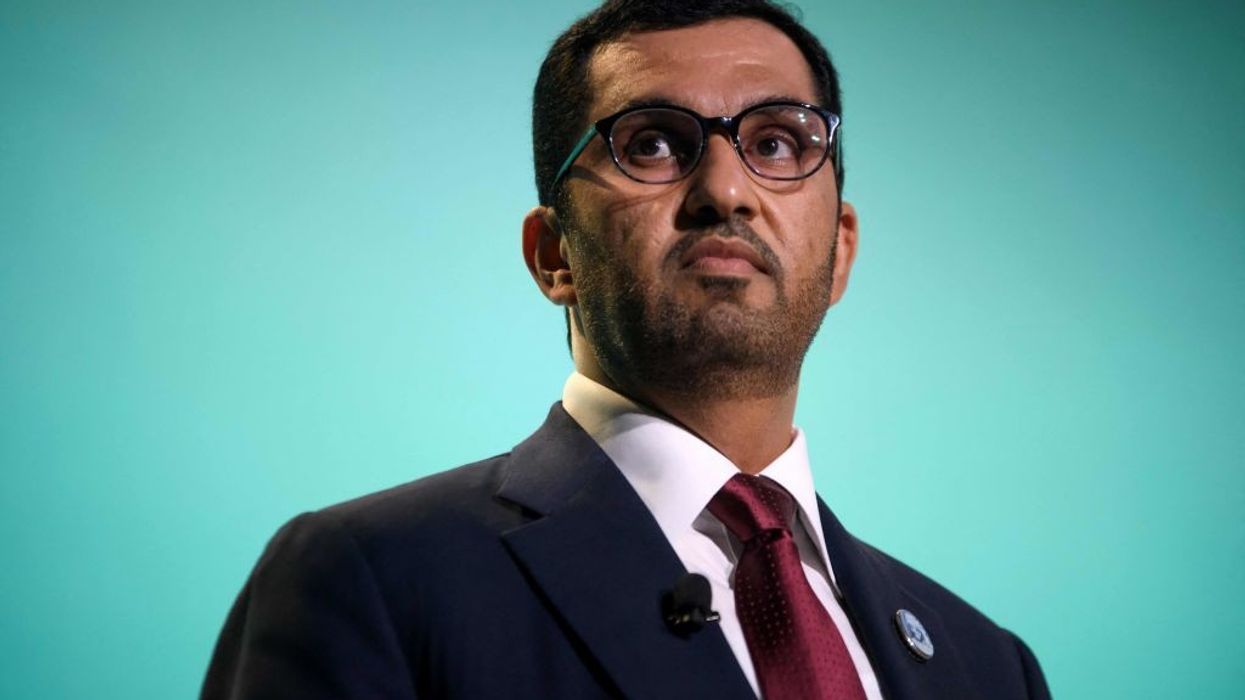
An investigation published Friday by the international NGO Global Witness revealed that the oil giant run by Emirati Minister of Industry Sultan Ahmed Al Jaber—who is also president of this year's United Nations Climate Change Conference—was responsible for 14 times more planet-heating carbon emissions last year than it reported.
Last month, Al Jaber, who is CEO of state-owned Abu Dhabi National Oil Company (ADNOC), said that nations attending this autumn's U.N. summit, or COP28, in Dubai "must be brutally honest" about "all emissions, everywhere. [Scope] 1, 2, and 3."
As Global Witness explained:
Scope 1 and 2 emissions do not include pollution released when fossil fuels like oil and gas are burned for energy. These—known as scope 3—typically make up the vast majority of an oil company's carbon footprint. Although most oil and gas majors do not traditionally track Scope 3, some such as BP and Chevron do include scope 3 reductions in their climate targets.
Analysis of production data from Rystad Energy shows that ADNOC in 2022 produced over 650 million barrels of oil—enough to power China's oil demand for six weeks—and over 40 billion cubic meters of gas.
Emissions from those products alone are calculated to just over 340 million tonnes of CO2—more than the U.K. produces each year, and 14.1 times higher than the emissions the ADNOC disclosed this week.
"This is a classic case of hypocritical fossil fuel firms saying one thing and doing another," Global Witness senior investigator Patrick Galey said in a statement. "Sultan Al Jaber is on one hand asking companies to include all emissions in their climate strategies, while his firm is patting itself on the back for disclosing only a tiny fraction of its true climate impact."
"Fossil fuels account for 90% of the carbon emissions that are heating the planet and inflicting misery and loss on millions of people. The climate doesn't respond to clever accounting," Galey added. "While conceding publicly that a liveble future means cutting all emissions, Al Jaber's firm is refusing to acknowledge the vast majority of its products' emissions as its own."
At the same time, Al Jaber is presiding over a massive expansion of ADNOC—the world's 11th-largest fossil fuel company—that is planned to boost production by the equivalent of over 7.5 billion barrels of oil in the coming years. According to The Guardian, that's the world's fifth-largest increase.
Climate defenders have warned all year that COP28 is likely to end in failure after the UAE appointed Al Jaber to preside over the summit, which seeks to "unite the world towards agreement" on "the most pressing global challenge of our time."
CCS should not be used as a smokescreen for real climate action or as an excuse to carry on drilling. We must transition away from oil and gas.
At the beginning of 2000s, as concerns about climate change grew, some of the biggest oil companies began to modify their climate change public relations strategies.
Instead of denying the evidence to sow doubt, they decided to try and spin their actions in more of a positive light. To try and co-opt the debate. They learnt their strategy from the masters of deception, the tobacco industry.
BP was the first to break ranks by changing its old tired logo to a Helios, a Greek sunburst, with its new strapline “beyond petroleum.”
The concept of a fossil fuel company registering a website that mirrors the temperature rise the world is trying to limit itself to because of burning fossil fuels would be seen as deeply ironic by many. But not the deeply misguided leaders at Occidental.
BP never did go beyond petroleum, but the company had thrown a gauntlet down to the others to give the smokescreen of at least beginning to take climate change seriously.
By now, there was emerging scientific consensus that the world had to limit warming to 1.5°C if we wanted a liveable future. So four years later, in 2004, Occidental Petroleum quietly registered the website: www.1pointfive.com.
The concept of a fossil fuel company registering a website that mirrors the temperature rise the world is trying to limit itself to because of burning fossil fuels would be seen as deeply ironic by many. But not the deeply misguided leaders at Occidental.
As the oil industry expanded its production and still tried to obfuscate action on climate change, the 1pointfive.com website lay dormant for 16 long years. And every year, our climate emergency has worsened.
Finally, in 2020, the website sprung into life. In October of that year, the website was launched, outlining in bold: “A Turning Point for Climate Change.” The website said the mission of the company was “Negative emissions.”.
It stated: “Oxy Low Carbon Ventures and Rusheen Capital have come together to drive change and jumpstart the Direct Air Capture industry around the world.”
Fast forward another three years, and this week, Occidental announced that it had signed an agreement with ADNOC, the Abu Dhabi National Oil company, to evaluate investment opportunities in the controversial technologies of Carbon, Capture, and Storage (CCS), in both the UAE and the U.S..
ADNOC is in the spotlight this year because its head, Sultan Ahmed Al Jaber, is the host of COP28 climate talks, a choice which has drawn criticism from climate activists and scientists alike. Christiana Figueres, ex-Secretary General of the UNFCC, calls the idea of putting Al Jaber in charge of COP as “dangerous.”
She is not the only one outraged that the head of an oil company should host the world’s leading climate conference. It is akin to a tobacco executive hosting a conference on lung cancer and health.
You cannot be an oil company boss and host a climate conference without escaping controversy and scrutiny. So ADNOC is desperate to boost its green credentials, or at least give its operations a good green veneer, just as BP tried to do earlier this century.
To this end, the announcement between Occidental and ADNOC noted that two oil companies had come together “to develop a carbon management platform to accelerate the net-zero goals of both companies.” The key to this plan is Direct Air Capture—sucking carbon dioxide out of the air and burying it underground.
Recent OCI research has shown that the UAE is poised to become the third-largest expander of oil and gas production between 2023 and 2025, and ADNOC the second-largest expander company.
Despite the spin, even the company’s website shows how futile this procedure is. According to the 1pointfive website, globally it takes 13 hours to emit 67 million tonnes of CO2, enough to fill the Hoover Dam.
In contrast, it states that 1PointFive is developing the world’s largest Direct Air Capture facility, which will suck out 500,000 tonnes per year. That is 0.75% of what the world emits in 13 hours captured in one year.
And even if the Direct Air Capture technology is a success, there are other problems too.
Again trying to ward off its critics, ADNOC has just produced its first-ever report documenting the scale of its carbon emissions. The company says it emitted about 24 million tonnes of carbon dioxide equivalent in 2022. So direct air capture would again only capture 2% of this.
But more importantly, the 24 million tonne figure is still not including its Scope 3 emissions. These are the emissions from burning oil and gas, which usually equate for 80-90% of an oil or gas company’s emissions.
The Occidental and ADNOC announcement on carbon capture came a day after ADNOC revised its plans to reach net-zero emissions by 2045 from an original target of 2050. ADNOC also stated that it aimed to achieve zero methane emissions by the end of the decade.
On the surface, this seems welcome, but in reality, it is just more smoke and mirrors.
The announcements form part of a wider climate spin machine that includes fake bots spreading misinformation on Twitter and a potential rebrand.
Last month, leaked documents obtained by the Centre for Climate Reporting and Drilled revealed that ADNOC worried about “whats in a name” and had become “increasingly aware of the reputational challenges posed by our brand name.” ADNOC was thinking of future-proofing “the company, without compromising or undermining the equity of the ADNOC brand.”
Due to this, the UAE had contemplated dropping the word oil from ADNOC’s name in a major rebranding—or greenwashing—exercise. Just as BP had changed its name, so ADNOC was thinking of doing the same.
An advertising pitch warned that the ‘National Oil Company’ portion of its name was a “target for potential criticism.” Therefore the rebranded, green-veneered ADNOC would position itself as “a disruptive, ambitious, and confident energy company of the future” that “will invest and operate across the energy spectrum—from hydrocarbons and hydrogen to new and emerging energies.”
The rebrand may not have happened, but there are other flaws too. Firstly, despite this new commitment to reach net zero quicker and to develop its carbon capture technology, ADNOC still plans to increase production.
The reality is, as The Wall Street Journal so neatly put it in a recent headline: “Occidental Plans to Suck Carbon From the Air—So It Can Keep Pumping Oil.”
CCS should not be used as a smokescreen for real climate action or as an excuse to carry on drilling. We must transition away from oil and gas.
Recent OCI research has shown that the UAE is poised to become the third-largest expander of oil and gas production between 2023 and 2025, and ADNOC the second-largest expander company.
The analysis shows that ADNOC’s new oil and gas production over the next three years would lock in over 2.7 gigatonnes of CO2 emissions, equivalent to one year of the European Union’s CO2 emissions from fossil fuels.
Anything short of phasing out fossil fuel expansion and production will lead to climate chaos.
Secondly, as the WSJ points out, we have no idea if direct air capture will work at scale. “Removing CO2 from the atmosphere at this scale has never been done before, and the enterprise comes with abundant commercial and scientific uncertainties... Many industry experts doubt that direct-air capture can be done economically because the amounts of air that need to be scrubbed are so large.”
Also, the company is not doing this to save the climate but to make money off the flawed carbon markets. 1pointfive.com is working with Verra, the industry leader in carbon offsetting. An investigation by The Guardian and Source Material earlier this year found that more than 90% of rainforest carbon offsets issued by Verra were worthless. It’s no wonder commentators are skeptical:
Both announcements are part of a public relations drive by ADNOC in the run-up to COP. Again spin over substance.
David Tong, the Global Industry Campaign Manager for OCI who spoke to Living on Earth this week, said that ADNOC was “on track to be the second largest expander in terms of companies with the most expansion in new oil and gas from this year until 2025. So it’s really concerning to have him presiding over the U.N.’s crucial climate change negotiations.”
Moving the net zero target by five years, says Tong, looks “like a presidency, a country under intense pressure given their extraordinary conflict of interest, that is trying to salvage their credibility by framing themselves as a climate leader, without actually taking meaningful action to achieve this.”
“The UAE has made it very clear that they see it necessary to phase out fossil fuel emissions and argue that that is somehow possible to do without phasing out fossil fuels. That is simply false.”
The domestic policies that the UAE is putting in place have not changed significantly with this new target, and they are grossly insignificant, said Tong. “They’re all in on expanding the use of fossil gas, which is completely at odds with both their climate targets and with what the world needs for 1.5°C.”
“The UAE has made it very clear that they see it necessary to phase out fossil fuel emissions and argue that that is somehow possible to do without phasing out fossil fuels. That is simply false,” says Tong. “And the UAE is planning to do this through claiming that they can use dangerous distractions like carbon capture, which is a smokescreen to allow for continued oil and gas production.”
Finally, Tong said, “Both the Intergovernmental Panel on Climate Change and the International Energy Agency have made it clear that there’s no room for new oil and gas if we are to achieve the objectives of the Paris Agreement and limit warming to 1.5.”
If we are to keep 1.5 alive, we cannot carry on drilling for oil and gas, like ADNOC is. We cannot allow oil companies to set up climate-friendly-sounding websites pushing false and flawed solutions like Occidental has. We have to start phasing out production, which ADNOC is not.
It should also be pointed out that wealthy countries such as Norway, the U.K., Canada, Australia, and the USA have not signalled that they will cut production either. They must act too. But that does not let ADNOC off the hook. No matter how much spin you read or see in the run-up to COP28, ADNOC is not a climate leader until it signals it really is going beyond petroleum and keeping oil in the ground.
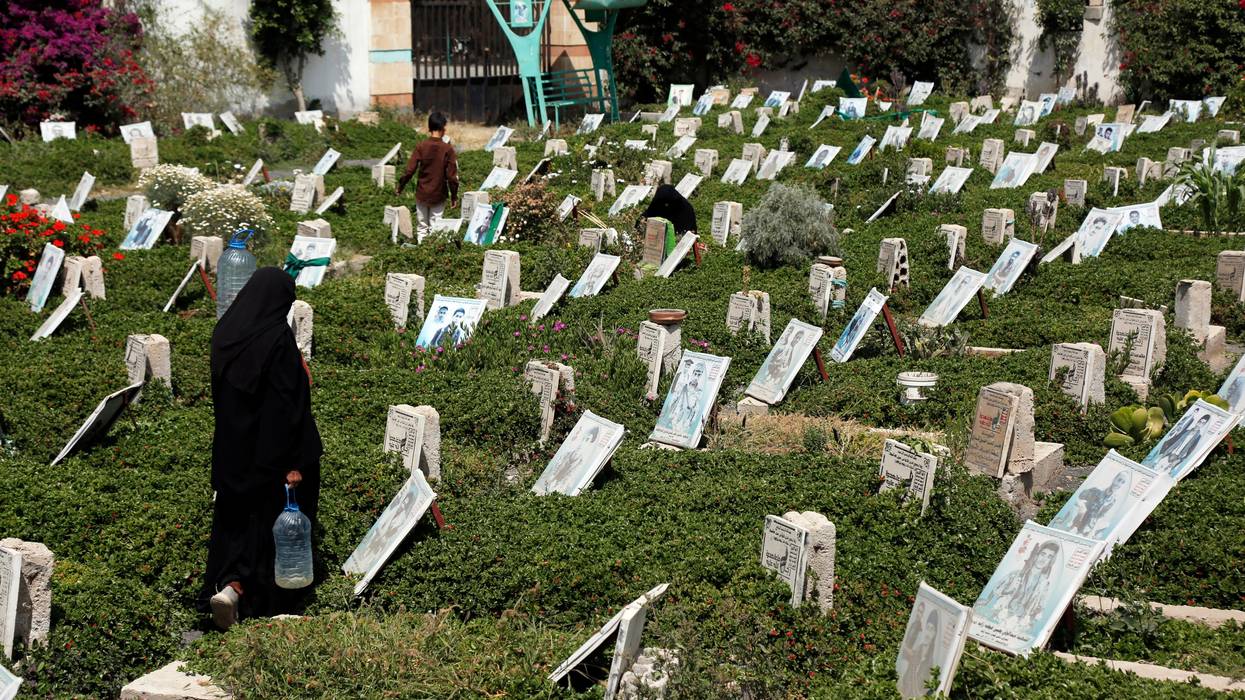
A coalition of more than 100 advocacy, faith-based, and news organizations on Wednesday urged members of Congress to adopt Sen. Bernie Sanders' War Powers Resolution to block U.S. support for the Saudi-led war in Yemen, where the recent expiry of a temporary cease-fire has renewed suffering in one of the world's worst humanitarian crises.
"We, the undersigned 105 organizations, welcomed news earlier this year that Yemen's warring parties agreed to a nationwide truce to halt military operations, lift fuel restrictions, and open Sanaa airport to commercial traffic," the signatories wrote in a letter to congressional lawmakers. "Unfortunately, it's been almost two months since the U.N.-brokered truce in Yemen expired, violence on the ground is escalating, and there is still no formal mechanism preventing a return to all-out war."
"In an effort to renew this truce and further incentivize Saudi Arabia to stay at the negotiating table, we urge you to bring the War Powers Resolutions to end U.S. military participation in the Saudi-led coalition's war on Yemen," the signers added.
In June, 48 bipartisan House lawmakers led by Reps. Peter DeFazio (D-Ore.), Pramila Jayapal (D-Wash.), Nancy Mace (R-S.C.), and Adam Schiff (D-Calif.) introduced a War Powers Resolution to end unauthorized U.S. support for a war in which nearly 400,000 people have been killed.
A Saudi-led blockade has also exacerbated starvation and disease in Yemen, where more than 23 million of the country's 30 million people required some form of assistance in 2022, according to United Nations humanitarian officials.
Sanders (I-Vt.), along with Sens. Patrick Leahy (D-Vt.) and Elizabeth Warren (D-Mass.), introduced a Senate version of the resolution in July, with the two-time Democratic presidential candidate declaring that "we must put an end to the unauthorized and unconstitutional involvement of U.S. armed forces in the catastrophic Saudi-led war in Yemen."
On Tuesday, Sanders said he believes he has enough support to pass a Senate resolution, and that he plans to bring the measure to a floor vote "hopefully next week."
The War Powers Resolution would require only a simple majority to pass in both the House and Senate.
Meanwhile, progressives are pushing President Joe Biden to hold Saudi leaders, especially Crown Prince and Prime Minister Mohammed bin Salman, accountable for atrocities including war crimes in Yemen and the murder of journalist Jamal Khashoggi.
As the groups' letter details:
With continued U.S. military support, Saudi Arabia escalated its campaign of collective punishment on the people of Yemen in recent months... Earlier this year, Saudi airstrikes targeting a migrant detention facility and vital communications infrastructure killed at least 90 civilians, wounded over 200, and triggered a nationwide internet blackout.
After seven years of direct and indirect involvement in the Yemen war, the United States must cease supplying weapons, spare parts, maintenance services, and logistical support to Saudi Arabia to ensure that there is no return of hostilities in Yemen and the conditions remain for the parties to achieve a lasting peace agreement.
In October, Rep. Ro Khanna (D-Calif.) and Sen. Richard Blumenthal (D-Conn.) introduced a bill to block all U.S. weapons sales to Saudi Arabia. After initially freezing arms sales to the kingdom and its coalition partner United Arab Emirates and promising to end all offensive support for the war shortly after taking office, Biden resumed hundreds of millions of dollars in arms and support sales to the countries.
The new letter's signatories include: American Friends Service Committee, Antiwar.com, Center for Constitutional Rights, CodePink, Defending Rights & Dissent, Demand Progress, Democracy for the Arab World Now, Evangelical Lutheran Church in America, Indivisible, Jewish Voice for Peace Action, MADRE, MoveOn, MPower Change, Muslim Justice League, National Council of Churches, Our Revolution, Pax Christi USA, Peace Action, Physicians for Social Responsibility, Presbyterian Church USA, Public Citizen, RootsAction, Sunrise Movement, Veterans for Peace, Win Without War, and World Beyond War.