SUBSCRIBE TO OUR FREE NEWSLETTER
Daily news & progressive opinion—funded by the people, not the corporations—delivered straight to your inbox.
5
#000000
#FFFFFF
To donate by check, phone, or other method, see our More Ways to Give page.
Daily news & progressive opinion—funded by the people, not the corporations—delivered straight to your inbox.
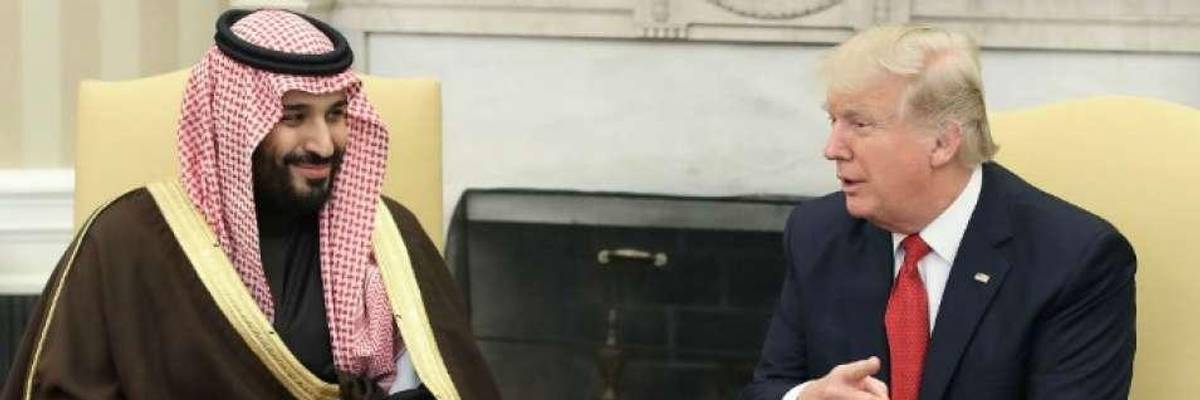
U.S. President Donald Trump meets with Mohammed bin Salman, Deputy Crown Prince and Minister of Defense of the Kingdom of Saudi Arabia, in the Oval Office at the White House, March 14, 2017 in Washington, D.C. (Photo: Mark Wilson/Getty Images)
Nine days after journalist Jamal Khashoggi's disappearance in the Saudi consulate in Istanbul, President Trump has expressed only vague concern over reports that he had been murdered by a Saudi "hit team"--and late on Wednesday he all but took off the table the possibility of cutting off arms sales to the Saudis if they are found responsible for Khashoggi's likely death.
"We have jobs. We have a lot of things happening in this country. We have a country that's doing probably better economically than it's ever done before," Trump said in a Fox News interview. "A part of that is what we are doing with our defense systems and everybody is wanting them and, frankly, I think [ending arms sales] would be a very, very tough pill to swallow for our country."
The U.S. has sold more than $200 billion in weapons and military equipment to the Saudis in recent years, with Trump signing off on a $110 billion agreement weeks after taking office and the Obama administration offering the country $115 billion in arms sales. Since 2015, those sales have helped to fund Saudi Arabia's air war in Yemen, which has killed more than 16,000 civilians and left millions displaced and on the verge of famine.
Khashoggi's disappearance on October 2 has led nearly two dozen senators to call for the Trump administration to take action against the Saudis, who Turkish officials believe had the Washington Post columnist killed.
"We request that you make a determination on the imposition of sanctions pursuant to the Global Magnitsky Human Rights Accountability Act with respect to any foreign person responsible for such a violation related to Mr. Khashoggi," wrote the bipartisan group of lawmakers in a letter to Trump on Wednesday. "Our expectation is that in making your determination you will consider any relevant information, including with respect to the highest-ranking officials in the government of Saudi Arabia."
In thread posted to Twitter, Rep. Ro Khanna (D-Calif.) also called for a full probe and said, "This is what happens when you embolden authoritarian dictators around the world."
Khanna added, "I hope Congress will stand up to this administration, end our involvement in the war in Yemen and cut of all arms sales to Saudi Arabia."
Khashoggi went into the building to obtain routine paperwork while his fiancee, Hatice Cengiz, waited outside. He has not been seen since. At the Post, the Saudi-born writer frequently criticized his home country's government and Crown Prince Mohammed bin Salman's restrictions on free speech.
Trump's remarks on Wednesday night outraged many who fear the administration will do little to uncover the truth about what happened to Khashoggi.
While shocking, the president's comments mirrored attitudes held for years by many in Washington, journalist Glenn Greenwald pointed out.
"Trump here is expressing the views and conduct of U.S. officials and D.C. foreign policy elites for decades. He's just doing it with a bluntness that illuminates rather than obfuscates. So often, D.C. mavens hate Trump mostly because of his inability and/or refusal to mask what the U.S. is," Greenwald wrote on Twitter, posting a 2016 video of CNN's Wolf Blitzer pondering whether ending the United States' support of a war which had by then attacked hundreds of non-military targets, was worth the weapons manufacturing jobs that may be lost as a result.
Dear Common Dreams reader, It’s been nearly 30 years since I co-founded Common Dreams with my late wife, Lina Newhouser. We had the radical notion that journalism should serve the public good, not corporate profits. It was clear to us from the outset what it would take to build such a project. No paid advertisements. No corporate sponsors. No millionaire publisher telling us what to think or do. Many people said we wouldn't last a year, but we proved those doubters wrong. Together with a tremendous team of journalists and dedicated staff, we built an independent media outlet free from the constraints of profits and corporate control. Our mission has always been simple: To inform. To inspire. To ignite change for the common good. Building Common Dreams was not easy. Our survival was never guaranteed. When you take on the most powerful forces—Wall Street greed, fossil fuel industry destruction, Big Tech lobbyists, and uber-rich oligarchs who have spent billions upon billions rigging the economy and democracy in their favor—the only bulwark you have is supporters who believe in your work. But here’s the urgent message from me today. It's never been this bad out there. And it's never been this hard to keep us going. At the very moment Common Dreams is most needed, the threats we face are intensifying. We need your support now more than ever. We don't accept corporate advertising and never will. We don't have a paywall because we don't think people should be blocked from critical news based on their ability to pay. Everything we do is funded by the donations of readers like you. When everyone does the little they can afford, we are strong. But if that support retreats or dries up, so do we. Will you donate now to make sure Common Dreams not only survives but thrives? —Craig Brown, Co-founder |
Nine days after journalist Jamal Khashoggi's disappearance in the Saudi consulate in Istanbul, President Trump has expressed only vague concern over reports that he had been murdered by a Saudi "hit team"--and late on Wednesday he all but took off the table the possibility of cutting off arms sales to the Saudis if they are found responsible for Khashoggi's likely death.
"We have jobs. We have a lot of things happening in this country. We have a country that's doing probably better economically than it's ever done before," Trump said in a Fox News interview. "A part of that is what we are doing with our defense systems and everybody is wanting them and, frankly, I think [ending arms sales] would be a very, very tough pill to swallow for our country."
The U.S. has sold more than $200 billion in weapons and military equipment to the Saudis in recent years, with Trump signing off on a $110 billion agreement weeks after taking office and the Obama administration offering the country $115 billion in arms sales. Since 2015, those sales have helped to fund Saudi Arabia's air war in Yemen, which has killed more than 16,000 civilians and left millions displaced and on the verge of famine.
Khashoggi's disappearance on October 2 has led nearly two dozen senators to call for the Trump administration to take action against the Saudis, who Turkish officials believe had the Washington Post columnist killed.
"We request that you make a determination on the imposition of sanctions pursuant to the Global Magnitsky Human Rights Accountability Act with respect to any foreign person responsible for such a violation related to Mr. Khashoggi," wrote the bipartisan group of lawmakers in a letter to Trump on Wednesday. "Our expectation is that in making your determination you will consider any relevant information, including with respect to the highest-ranking officials in the government of Saudi Arabia."
In thread posted to Twitter, Rep. Ro Khanna (D-Calif.) also called for a full probe and said, "This is what happens when you embolden authoritarian dictators around the world."
Khanna added, "I hope Congress will stand up to this administration, end our involvement in the war in Yemen and cut of all arms sales to Saudi Arabia."
Khashoggi went into the building to obtain routine paperwork while his fiancee, Hatice Cengiz, waited outside. He has not been seen since. At the Post, the Saudi-born writer frequently criticized his home country's government and Crown Prince Mohammed bin Salman's restrictions on free speech.
Trump's remarks on Wednesday night outraged many who fear the administration will do little to uncover the truth about what happened to Khashoggi.
While shocking, the president's comments mirrored attitudes held for years by many in Washington, journalist Glenn Greenwald pointed out.
"Trump here is expressing the views and conduct of U.S. officials and D.C. foreign policy elites for decades. He's just doing it with a bluntness that illuminates rather than obfuscates. So often, D.C. mavens hate Trump mostly because of his inability and/or refusal to mask what the U.S. is," Greenwald wrote on Twitter, posting a 2016 video of CNN's Wolf Blitzer pondering whether ending the United States' support of a war which had by then attacked hundreds of non-military targets, was worth the weapons manufacturing jobs that may be lost as a result.
Nine days after journalist Jamal Khashoggi's disappearance in the Saudi consulate in Istanbul, President Trump has expressed only vague concern over reports that he had been murdered by a Saudi "hit team"--and late on Wednesday he all but took off the table the possibility of cutting off arms sales to the Saudis if they are found responsible for Khashoggi's likely death.
"We have jobs. We have a lot of things happening in this country. We have a country that's doing probably better economically than it's ever done before," Trump said in a Fox News interview. "A part of that is what we are doing with our defense systems and everybody is wanting them and, frankly, I think [ending arms sales] would be a very, very tough pill to swallow for our country."
The U.S. has sold more than $200 billion in weapons and military equipment to the Saudis in recent years, with Trump signing off on a $110 billion agreement weeks after taking office and the Obama administration offering the country $115 billion in arms sales. Since 2015, those sales have helped to fund Saudi Arabia's air war in Yemen, which has killed more than 16,000 civilians and left millions displaced and on the verge of famine.
Khashoggi's disappearance on October 2 has led nearly two dozen senators to call for the Trump administration to take action against the Saudis, who Turkish officials believe had the Washington Post columnist killed.
"We request that you make a determination on the imposition of sanctions pursuant to the Global Magnitsky Human Rights Accountability Act with respect to any foreign person responsible for such a violation related to Mr. Khashoggi," wrote the bipartisan group of lawmakers in a letter to Trump on Wednesday. "Our expectation is that in making your determination you will consider any relevant information, including with respect to the highest-ranking officials in the government of Saudi Arabia."
In thread posted to Twitter, Rep. Ro Khanna (D-Calif.) also called for a full probe and said, "This is what happens when you embolden authoritarian dictators around the world."
Khanna added, "I hope Congress will stand up to this administration, end our involvement in the war in Yemen and cut of all arms sales to Saudi Arabia."
Khashoggi went into the building to obtain routine paperwork while his fiancee, Hatice Cengiz, waited outside. He has not been seen since. At the Post, the Saudi-born writer frequently criticized his home country's government and Crown Prince Mohammed bin Salman's restrictions on free speech.
Trump's remarks on Wednesday night outraged many who fear the administration will do little to uncover the truth about what happened to Khashoggi.
While shocking, the president's comments mirrored attitudes held for years by many in Washington, journalist Glenn Greenwald pointed out.
"Trump here is expressing the views and conduct of U.S. officials and D.C. foreign policy elites for decades. He's just doing it with a bluntness that illuminates rather than obfuscates. So often, D.C. mavens hate Trump mostly because of his inability and/or refusal to mask what the U.S. is," Greenwald wrote on Twitter, posting a 2016 video of CNN's Wolf Blitzer pondering whether ending the United States' support of a war which had by then attacked hundreds of non-military targets, was worth the weapons manufacturing jobs that may be lost as a result.