
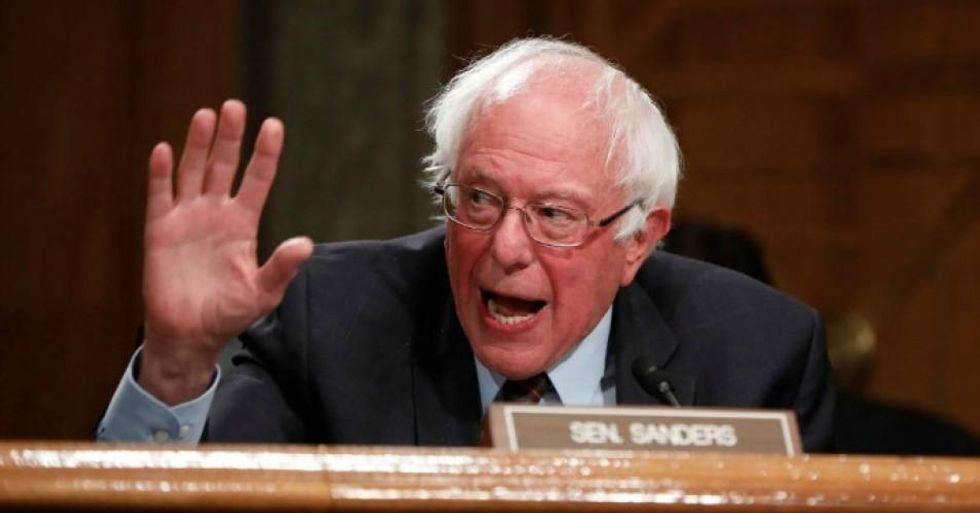
In a letter to Senate Judiciary Committee chairman Chuck Grassley (R-Iowa) on Saturday, Sen. Bernie Sanders (I-Vt.) demanded that the newly reopened FBI investigation into Supreme Court nominee Brett Kavanaugh examine both the serious accusations of sexual assault against him and whether he lied to Congress in his testimony.
"If a thorough investigation takes longer than a week, so be it. First and foremost, we need the truth."
--Sen. Bernie Sanders
"In order for this FBI investigation regarding Judge Brett Kavanaugh's nomination to be complete," Sanders wrote, "it is imperative the bureau must not only look into the accusations made by Dr. Ford, Deborah Ramirez, and Julie Swetnick, it should also examine the veracity of his testimony before the Judiciary Committee."
The Vermont senator went on to call on the Senate to not "constrain" the FBI probe to one week, arguing that a truly thorough probe could take longer.
"If you are concerned with a delay in this confirmation process, remember that Senate Republicans refused to allow the Senate to consider Merrick Garland's nomination to the Supreme Court for nearly a year," Sanders wrote. "In addition to investigating the accusations made by multiple women, a thorough investigation should include a review of Judge Kavanaugh's numerous untruthful statements in his previous testimony before Congress."
Even prior to the emergence of credible sexual assault allegations against him, Kavanaugh--who on Thursday repeatedly refused to endorse an FBI probe into the allegations against him--was accused by several Democratic senators of lying to the Senate during hearings for his nomination to the U.S. Court of Appeals in 2004 and 2006.
In his letter to Grassley on Saturday, Sanders listed some of these examples, as well as statements Kavanaugh made "under oath regarding his treatment of women and his use of alcohol," which "appear not to be true."
Read Sanders' full letter:
Dear Chairman Grassley,
In order for this FBI investigation regarding Judge Brett Kavanaugh's nomination to be complete, it is imperative the bureau must not only look into the accusations made by Dr. Ford, Deborah Ramirez and Julie Swetnick, it should also examine the veracity of his testimony before the Judiciary Committee.
The Senate should not constrain the FBI to one week and must allow time for a full investigation. I would request that you inform the FBI that you will not consider their work complete until they examine the truthfulness of Judge Kavanaugh's statements under oath while testifying before the Senate throughout his career, given the very serious fact that lying to Congress is a federal crime.
If you are concerned with a delay in this confirmation process, remember that Senate Republicans refused to allow the Senate to consider Merrick Garland's nomination to the Supreme Court for nearly a year.
In addition to investigating the accusations made by multiple women, a thorough investigation should include a review of Judge Kavanaugh's numerous untruthful statements in his previous testimony before Congress. Specifically:
- In his previous testimony before Congress, Judge Kavanaugh was asked more than 100 times if he knew about files stolen by Republican staffers from Judiciary Committee Democrats. He said he knew nothing. Emails released as part of these hearings show that these files were regularly shared with Kavanaugh while he was on the White House staff. One of the emails had the subject line "spying." Was Judge Kavanaugh being truthful with the committee?
- In 2006 Judge Kavanaugh told Congress he did not know anything about the NSA warrantless wiretapping program prior to it being reported by the New York Times. This year an email revealed that while at the White House he might have been involved in some conversations about this program. Was Judge Kavanaugh being truthful with the committee?
- In 2004 Judge Kavanaugh testified the nomination of William Pryor to the 11th Circuit "was not one that I worked on personally." Documents now contradict that statement. Newly released documents also call into question whether Judge Kavanaugh was truthful that the nomination of Charles Pickering "was not one of the judicial nominees that I was primarily handling." Was Judge Kavanaugh being truthful with the committee?
- In 2006 Judge Kavanaugh testified, "I was not involved and am not involved in the questions about the rules governing detention of combatants." New evidence released as part of these confirmation hearing contradicts that assertion. Was Judge Kavanaugh being truthful with the committee?
- Kavanaugh testified before the committee that he did not believe polygraphs were reliable. In 2016 he wrote, "As the Government notes, law enforcement agencies use polygraphs to test the credibility of witnesses and criminal defendants. Those agencies also use polygraphs to 'screen applicants for security clearances so that they may be deemed suitable for work in critical law enforcement, defense, and intelligence collection roles.' . . . The Government has satisfactorily explained how polygraph examinations serve law enforcement purposes." (Sack v. United States Department of Defense, 823 F.3d 687 (2016)) What changed his opinion or was he misleading the committee as to his beliefs about the reliability of polygraph tests?
Additionally, several statements made by Judge Kavanaugh under oath regarding his treatment of women and his use of alcohol appear not to be true. The scope of the FBI's investigation must include investigating the following statements:
- Judge Kavanaugh repeatedly told the committee he never drank to the point where he didn't remember something. He also denied ever becoming aggressive when he drinks. However there have been many reports from those Judge Kavanaugh attended high school, college and law school with that contradict this assertion. Was he being truthful with the committee?
- Judge Kavanaugh testified he treated women "as friends and equals" and "with dignity and respect." Numerous entries in his school yearbook would seem to contradict this. Was Judge Kavanaugh's statement to the committee truthful?
- Judge Kavanaugh claimed that he and Dr. Ford "did not travel in the same social circles." Dr. Ford said she dated Chris Garrett, referenced as a friend in his yearbook. In fact she testified Garrett introduced her to Kavanaugh. Was Judge Kavanaugh's statement to the committee truthful?
- Kavanaugh claimed he did not drink on weeknights but an entry on his calendar for Thursday July 1 states, "Go to Timmy's for Skis w/ Judge, Tom, Pj, Bernie, Squi." Kavanaugh clarified to Sen. Booker that "Skis" referred to beer. Was his original statement to the committee truthful?
A fundamental question the FBI can help answer is whether Judge Kavanaugh has been truthful with the committee. This goes to the very heart of whether he should be confirmed to the court. If a thorough investigation takes longer than a week, so be it. First and foremost, we need the truth.
Sincerely,
Bernard Sanders
In a letter to Senate Judiciary Committee chairman Chuck Grassley (R-Iowa) on Saturday, Sen. Bernie Sanders (I-Vt.) demanded that the newly reopened FBI investigation into Supreme Court nominee Brett Kavanaugh examine both the serious accusations of sexual assault against him and whether he lied to Congress in his testimony.
"If a thorough investigation takes longer than a week, so be it. First and foremost, we need the truth."
--Sen. Bernie Sanders
"In order for this FBI investigation regarding Judge Brett Kavanaugh's nomination to be complete," Sanders wrote, "it is imperative the bureau must not only look into the accusations made by Dr. Ford, Deborah Ramirez, and Julie Swetnick, it should also examine the veracity of his testimony before the Judiciary Committee."
The Vermont senator went on to call on the Senate to not "constrain" the FBI probe to one week, arguing that a truly thorough probe could take longer.
"If you are concerned with a delay in this confirmation process, remember that Senate Republicans refused to allow the Senate to consider Merrick Garland's nomination to the Supreme Court for nearly a year," Sanders wrote. "In addition to investigating the accusations made by multiple women, a thorough investigation should include a review of Judge Kavanaugh's numerous untruthful statements in his previous testimony before Congress."
Even prior to the emergence of credible sexual assault allegations against him, Kavanaugh--who on Thursday repeatedly refused to endorse an FBI probe into the allegations against him--was accused by several Democratic senators of lying to the Senate during hearings for his nomination to the U.S. Court of Appeals in 2004 and 2006.
In his letter to Grassley on Saturday, Sanders listed some of these examples, as well as statements Kavanaugh made "under oath regarding his treatment of women and his use of alcohol," which "appear not to be true."
Read Sanders' full letter:
Dear Chairman Grassley,
In order for this FBI investigation regarding Judge Brett Kavanaugh's nomination to be complete, it is imperative the bureau must not only look into the accusations made by Dr. Ford, Deborah Ramirez and Julie Swetnick, it should also examine the veracity of his testimony before the Judiciary Committee.
The Senate should not constrain the FBI to one week and must allow time for a full investigation. I would request that you inform the FBI that you will not consider their work complete until they examine the truthfulness of Judge Kavanaugh's statements under oath while testifying before the Senate throughout his career, given the very serious fact that lying to Congress is a federal crime.
If you are concerned with a delay in this confirmation process, remember that Senate Republicans refused to allow the Senate to consider Merrick Garland's nomination to the Supreme Court for nearly a year.
In addition to investigating the accusations made by multiple women, a thorough investigation should include a review of Judge Kavanaugh's numerous untruthful statements in his previous testimony before Congress. Specifically:
- In his previous testimony before Congress, Judge Kavanaugh was asked more than 100 times if he knew about files stolen by Republican staffers from Judiciary Committee Democrats. He said he knew nothing. Emails released as part of these hearings show that these files were regularly shared with Kavanaugh while he was on the White House staff. One of the emails had the subject line "spying." Was Judge Kavanaugh being truthful with the committee?
- In 2006 Judge Kavanaugh told Congress he did not know anything about the NSA warrantless wiretapping program prior to it being reported by the New York Times. This year an email revealed that while at the White House he might have been involved in some conversations about this program. Was Judge Kavanaugh being truthful with the committee?
- In 2004 Judge Kavanaugh testified the nomination of William Pryor to the 11th Circuit "was not one that I worked on personally." Documents now contradict that statement. Newly released documents also call into question whether Judge Kavanaugh was truthful that the nomination of Charles Pickering "was not one of the judicial nominees that I was primarily handling." Was Judge Kavanaugh being truthful with the committee?
- In 2006 Judge Kavanaugh testified, "I was not involved and am not involved in the questions about the rules governing detention of combatants." New evidence released as part of these confirmation hearing contradicts that assertion. Was Judge Kavanaugh being truthful with the committee?
- Kavanaugh testified before the committee that he did not believe polygraphs were reliable. In 2016 he wrote, "As the Government notes, law enforcement agencies use polygraphs to test the credibility of witnesses and criminal defendants. Those agencies also use polygraphs to 'screen applicants for security clearances so that they may be deemed suitable for work in critical law enforcement, defense, and intelligence collection roles.' . . . The Government has satisfactorily explained how polygraph examinations serve law enforcement purposes." (Sack v. United States Department of Defense, 823 F.3d 687 (2016)) What changed his opinion or was he misleading the committee as to his beliefs about the reliability of polygraph tests?
Additionally, several statements made by Judge Kavanaugh under oath regarding his treatment of women and his use of alcohol appear not to be true. The scope of the FBI's investigation must include investigating the following statements:
- Judge Kavanaugh repeatedly told the committee he never drank to the point where he didn't remember something. He also denied ever becoming aggressive when he drinks. However there have been many reports from those Judge Kavanaugh attended high school, college and law school with that contradict this assertion. Was he being truthful with the committee?
- Judge Kavanaugh testified he treated women "as friends and equals" and "with dignity and respect." Numerous entries in his school yearbook would seem to contradict this. Was Judge Kavanaugh's statement to the committee truthful?
- Judge Kavanaugh claimed that he and Dr. Ford "did not travel in the same social circles." Dr. Ford said she dated Chris Garrett, referenced as a friend in his yearbook. In fact she testified Garrett introduced her to Kavanaugh. Was Judge Kavanaugh's statement to the committee truthful?
- Kavanaugh claimed he did not drink on weeknights but an entry on his calendar for Thursday July 1 states, "Go to Timmy's for Skis w/ Judge, Tom, Pj, Bernie, Squi." Kavanaugh clarified to Sen. Booker that "Skis" referred to beer. Was his original statement to the committee truthful?
A fundamental question the FBI can help answer is whether Judge Kavanaugh has been truthful with the committee. This goes to the very heart of whether he should be confirmed to the court. If a thorough investigation takes longer than a week, so be it. First and foremost, we need the truth.
Sincerely,
Bernard Sanders
In a letter to Senate Judiciary Committee chairman Chuck Grassley (R-Iowa) on Saturday, Sen. Bernie Sanders (I-Vt.) demanded that the newly reopened FBI investigation into Supreme Court nominee Brett Kavanaugh examine both the serious accusations of sexual assault against him and whether he lied to Congress in his testimony.
"If a thorough investigation takes longer than a week, so be it. First and foremost, we need the truth."
--Sen. Bernie Sanders
"In order for this FBI investigation regarding Judge Brett Kavanaugh's nomination to be complete," Sanders wrote, "it is imperative the bureau must not only look into the accusations made by Dr. Ford, Deborah Ramirez, and Julie Swetnick, it should also examine the veracity of his testimony before the Judiciary Committee."
The Vermont senator went on to call on the Senate to not "constrain" the FBI probe to one week, arguing that a truly thorough probe could take longer.
"If you are concerned with a delay in this confirmation process, remember that Senate Republicans refused to allow the Senate to consider Merrick Garland's nomination to the Supreme Court for nearly a year," Sanders wrote. "In addition to investigating the accusations made by multiple women, a thorough investigation should include a review of Judge Kavanaugh's numerous untruthful statements in his previous testimony before Congress."
Even prior to the emergence of credible sexual assault allegations against him, Kavanaugh--who on Thursday repeatedly refused to endorse an FBI probe into the allegations against him--was accused by several Democratic senators of lying to the Senate during hearings for his nomination to the U.S. Court of Appeals in 2004 and 2006.
In his letter to Grassley on Saturday, Sanders listed some of these examples, as well as statements Kavanaugh made "under oath regarding his treatment of women and his use of alcohol," which "appear not to be true."
Read Sanders' full letter:
Dear Chairman Grassley,
In order for this FBI investigation regarding Judge Brett Kavanaugh's nomination to be complete, it is imperative the bureau must not only look into the accusations made by Dr. Ford, Deborah Ramirez and Julie Swetnick, it should also examine the veracity of his testimony before the Judiciary Committee.
The Senate should not constrain the FBI to one week and must allow time for a full investigation. I would request that you inform the FBI that you will not consider their work complete until they examine the truthfulness of Judge Kavanaugh's statements under oath while testifying before the Senate throughout his career, given the very serious fact that lying to Congress is a federal crime.
If you are concerned with a delay in this confirmation process, remember that Senate Republicans refused to allow the Senate to consider Merrick Garland's nomination to the Supreme Court for nearly a year.
In addition to investigating the accusations made by multiple women, a thorough investigation should include a review of Judge Kavanaugh's numerous untruthful statements in his previous testimony before Congress. Specifically:
- In his previous testimony before Congress, Judge Kavanaugh was asked more than 100 times if he knew about files stolen by Republican staffers from Judiciary Committee Democrats. He said he knew nothing. Emails released as part of these hearings show that these files were regularly shared with Kavanaugh while he was on the White House staff. One of the emails had the subject line "spying." Was Judge Kavanaugh being truthful with the committee?
- In 2006 Judge Kavanaugh told Congress he did not know anything about the NSA warrantless wiretapping program prior to it being reported by the New York Times. This year an email revealed that while at the White House he might have been involved in some conversations about this program. Was Judge Kavanaugh being truthful with the committee?
- In 2004 Judge Kavanaugh testified the nomination of William Pryor to the 11th Circuit "was not one that I worked on personally." Documents now contradict that statement. Newly released documents also call into question whether Judge Kavanaugh was truthful that the nomination of Charles Pickering "was not one of the judicial nominees that I was primarily handling." Was Judge Kavanaugh being truthful with the committee?
- In 2006 Judge Kavanaugh testified, "I was not involved and am not involved in the questions about the rules governing detention of combatants." New evidence released as part of these confirmation hearing contradicts that assertion. Was Judge Kavanaugh being truthful with the committee?
- Kavanaugh testified before the committee that he did not believe polygraphs were reliable. In 2016 he wrote, "As the Government notes, law enforcement agencies use polygraphs to test the credibility of witnesses and criminal defendants. Those agencies also use polygraphs to 'screen applicants for security clearances so that they may be deemed suitable for work in critical law enforcement, defense, and intelligence collection roles.' . . . The Government has satisfactorily explained how polygraph examinations serve law enforcement purposes." (Sack v. United States Department of Defense, 823 F.3d 687 (2016)) What changed his opinion or was he misleading the committee as to his beliefs about the reliability of polygraph tests?
Additionally, several statements made by Judge Kavanaugh under oath regarding his treatment of women and his use of alcohol appear not to be true. The scope of the FBI's investigation must include investigating the following statements:
- Judge Kavanaugh repeatedly told the committee he never drank to the point where he didn't remember something. He also denied ever becoming aggressive when he drinks. However there have been many reports from those Judge Kavanaugh attended high school, college and law school with that contradict this assertion. Was he being truthful with the committee?
- Judge Kavanaugh testified he treated women "as friends and equals" and "with dignity and respect." Numerous entries in his school yearbook would seem to contradict this. Was Judge Kavanaugh's statement to the committee truthful?
- Judge Kavanaugh claimed that he and Dr. Ford "did not travel in the same social circles." Dr. Ford said she dated Chris Garrett, referenced as a friend in his yearbook. In fact she testified Garrett introduced her to Kavanaugh. Was Judge Kavanaugh's statement to the committee truthful?
- Kavanaugh claimed he did not drink on weeknights but an entry on his calendar for Thursday July 1 states, "Go to Timmy's for Skis w/ Judge, Tom, Pj, Bernie, Squi." Kavanaugh clarified to Sen. Booker that "Skis" referred to beer. Was his original statement to the committee truthful?
A fundamental question the FBI can help answer is whether Judge Kavanaugh has been truthful with the committee. This goes to the very heart of whether he should be confirmed to the court. If a thorough investigation takes longer than a week, so be it. First and foremost, we need the truth.
Sincerely,
Bernard Sanders