SUBSCRIBE TO OUR FREE NEWSLETTER
Daily news & progressive opinion—funded by the people, not the corporations—delivered straight to your inbox.
5
#000000
#FFFFFF
To donate by check, phone, or other method, see our More Ways to Give page.
Daily news & progressive opinion—funded by the people, not the corporations—delivered straight to your inbox.
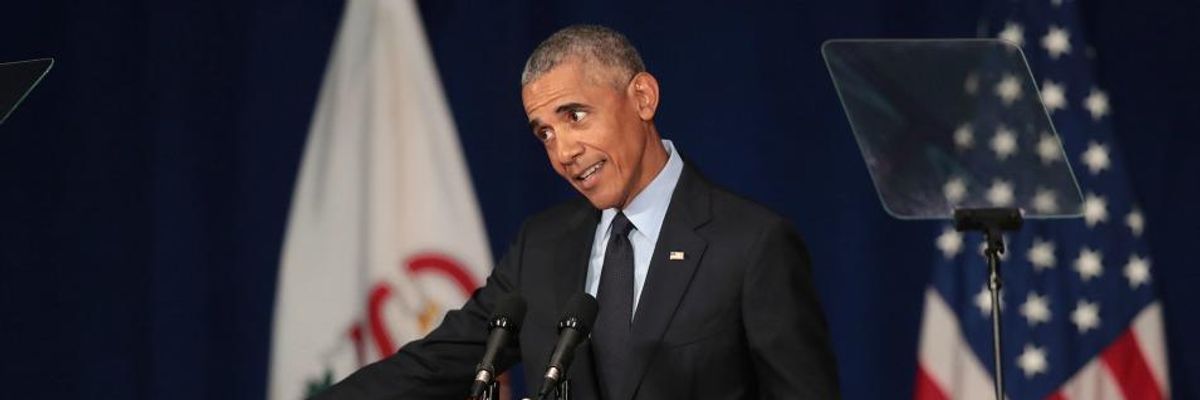
Former President Barack Obama endorsed Medicare for All in a speech in Illinois on Friday, calling it "a good new idea." (Photo: @THR/Twitter)
While progressives pointed out that it would have been worthy of more applause if the offer of support had come back when he had the actual power to do something about it, Medicare for All proponents applauded the huge paradigm shift denoted by the newest high-profile endorsement of the popular proposal: former President Barack Obama.
Speaking at the University of Illinois in his first explicit rebuke of President Donald Trump and what was seen as his first major campaign speech for Democrats in 2018, Obama said that progressives "aren't just running on good old ideas like a higher minimum wage, they're running on good new ideas like Medicare for all, giving workers seats on corporate boards, reversing the most egregious corporate tax cuts to make sure college students graduate debt-free."
The speech, noted journalist David Sirota, was a clear sign that in the two and a half years since Hillary Clinton predicted that single payer healthcare would "never, ever" happen, Sen. Bernie Sanders' (I-Vt.) and other universal healthcare advocates' efforts to push the Democrats to embrace the proposal have been a success.
Sanders himself expressed appreciation for Obama's support:
New York congressional candidate Alexandria Ocasio-Cortez also praised Obama's statement, and focused on what the endorsement means for the future of Medicare for All and the success of the grassroots groups that have led the charge demanding universal healthcare for decades--like Physicians for a National Health Program (PNHP) and Healthcare Now.
But a number of progressives expressed deep frustration at the former president--who said in 2003, "I happen to be a proponent of a single payer universal health care program"--for casting Medicare for All as a "new" idea.
"Respectfully, Medicare for All isn't a new idea," tweeted Bonnie Castillo, executive director of National Nurses United (NNU). "Union nurses have been campaigning for universal health care for years, but we are thrilled that Medicare for All is a mainstream issue now."
While working to reform the U.S. for-profit healthcare system as president--and with majorities in both the House and the Senate--Obama hastily rejected the possibility of adopting a single-payer plan, claiming it would "represent a radical shift" akin to right-wing proposals for all Americans to take on 100 percent of the responsibility of their healthcare costs. Medicare for All advocates have also argued that Obama and other Democratic leaders did not push hard enough for a public option to be included in the Affordable Care Act.
As Shane Ryan noted at Paste Magazine, Obama's vocal support Medicare for All comes after the majority of Americans have already expressed approval for the proposal. Two weeks ago, a Reuters poll found that 70 percent of all Americans now favor such a program, including nearly 85 percent of Democrats and 52 percent of Republicans.
"Look, sarcasm aside, this is fine--Medicare for all is a terrific policy, and maybe Obama's support will whip the last of the recalcitrant congressional Democrats into shape," wrote Ryan. "It would have been nice if he could lead from the front on an important issue, for once, but hey, that's life at the top of the Democratic party."
Dear Common Dreams reader, It’s been nearly 30 years since I co-founded Common Dreams with my late wife, Lina Newhouser. We had the radical notion that journalism should serve the public good, not corporate profits. It was clear to us from the outset what it would take to build such a project. No paid advertisements. No corporate sponsors. No millionaire publisher telling us what to think or do. Many people said we wouldn't last a year, but we proved those doubters wrong. Together with a tremendous team of journalists and dedicated staff, we built an independent media outlet free from the constraints of profits and corporate control. Our mission has always been simple: To inform. To inspire. To ignite change for the common good. Building Common Dreams was not easy. Our survival was never guaranteed. When you take on the most powerful forces—Wall Street greed, fossil fuel industry destruction, Big Tech lobbyists, and uber-rich oligarchs who have spent billions upon billions rigging the economy and democracy in their favor—the only bulwark you have is supporters who believe in your work. But here’s the urgent message from me today. It's never been this bad out there. And it's never been this hard to keep us going. At the very moment Common Dreams is most needed, the threats we face are intensifying. We need your support now more than ever. We don't accept corporate advertising and never will. We don't have a paywall because we don't think people should be blocked from critical news based on their ability to pay. Everything we do is funded by the donations of readers like you. When everyone does the little they can afford, we are strong. But if that support retreats or dries up, so do we. Will you donate now to make sure Common Dreams not only survives but thrives? —Craig Brown, Co-founder |
While progressives pointed out that it would have been worthy of more applause if the offer of support had come back when he had the actual power to do something about it, Medicare for All proponents applauded the huge paradigm shift denoted by the newest high-profile endorsement of the popular proposal: former President Barack Obama.
Speaking at the University of Illinois in his first explicit rebuke of President Donald Trump and what was seen as his first major campaign speech for Democrats in 2018, Obama said that progressives "aren't just running on good old ideas like a higher minimum wage, they're running on good new ideas like Medicare for all, giving workers seats on corporate boards, reversing the most egregious corporate tax cuts to make sure college students graduate debt-free."
The speech, noted journalist David Sirota, was a clear sign that in the two and a half years since Hillary Clinton predicted that single payer healthcare would "never, ever" happen, Sen. Bernie Sanders' (I-Vt.) and other universal healthcare advocates' efforts to push the Democrats to embrace the proposal have been a success.
Sanders himself expressed appreciation for Obama's support:
New York congressional candidate Alexandria Ocasio-Cortez also praised Obama's statement, and focused on what the endorsement means for the future of Medicare for All and the success of the grassroots groups that have led the charge demanding universal healthcare for decades--like Physicians for a National Health Program (PNHP) and Healthcare Now.
But a number of progressives expressed deep frustration at the former president--who said in 2003, "I happen to be a proponent of a single payer universal health care program"--for casting Medicare for All as a "new" idea.
"Respectfully, Medicare for All isn't a new idea," tweeted Bonnie Castillo, executive director of National Nurses United (NNU). "Union nurses have been campaigning for universal health care for years, but we are thrilled that Medicare for All is a mainstream issue now."
While working to reform the U.S. for-profit healthcare system as president--and with majorities in both the House and the Senate--Obama hastily rejected the possibility of adopting a single-payer plan, claiming it would "represent a radical shift" akin to right-wing proposals for all Americans to take on 100 percent of the responsibility of their healthcare costs. Medicare for All advocates have also argued that Obama and other Democratic leaders did not push hard enough for a public option to be included in the Affordable Care Act.
As Shane Ryan noted at Paste Magazine, Obama's vocal support Medicare for All comes after the majority of Americans have already expressed approval for the proposal. Two weeks ago, a Reuters poll found that 70 percent of all Americans now favor such a program, including nearly 85 percent of Democrats and 52 percent of Republicans.
"Look, sarcasm aside, this is fine--Medicare for all is a terrific policy, and maybe Obama's support will whip the last of the recalcitrant congressional Democrats into shape," wrote Ryan. "It would have been nice if he could lead from the front on an important issue, for once, but hey, that's life at the top of the Democratic party."
While progressives pointed out that it would have been worthy of more applause if the offer of support had come back when he had the actual power to do something about it, Medicare for All proponents applauded the huge paradigm shift denoted by the newest high-profile endorsement of the popular proposal: former President Barack Obama.
Speaking at the University of Illinois in his first explicit rebuke of President Donald Trump and what was seen as his first major campaign speech for Democrats in 2018, Obama said that progressives "aren't just running on good old ideas like a higher minimum wage, they're running on good new ideas like Medicare for all, giving workers seats on corporate boards, reversing the most egregious corporate tax cuts to make sure college students graduate debt-free."
The speech, noted journalist David Sirota, was a clear sign that in the two and a half years since Hillary Clinton predicted that single payer healthcare would "never, ever" happen, Sen. Bernie Sanders' (I-Vt.) and other universal healthcare advocates' efforts to push the Democrats to embrace the proposal have been a success.
Sanders himself expressed appreciation for Obama's support:
New York congressional candidate Alexandria Ocasio-Cortez also praised Obama's statement, and focused on what the endorsement means for the future of Medicare for All and the success of the grassroots groups that have led the charge demanding universal healthcare for decades--like Physicians for a National Health Program (PNHP) and Healthcare Now.
But a number of progressives expressed deep frustration at the former president--who said in 2003, "I happen to be a proponent of a single payer universal health care program"--for casting Medicare for All as a "new" idea.
"Respectfully, Medicare for All isn't a new idea," tweeted Bonnie Castillo, executive director of National Nurses United (NNU). "Union nurses have been campaigning for universal health care for years, but we are thrilled that Medicare for All is a mainstream issue now."
While working to reform the U.S. for-profit healthcare system as president--and with majorities in both the House and the Senate--Obama hastily rejected the possibility of adopting a single-payer plan, claiming it would "represent a radical shift" akin to right-wing proposals for all Americans to take on 100 percent of the responsibility of their healthcare costs. Medicare for All advocates have also argued that Obama and other Democratic leaders did not push hard enough for a public option to be included in the Affordable Care Act.
As Shane Ryan noted at Paste Magazine, Obama's vocal support Medicare for All comes after the majority of Americans have already expressed approval for the proposal. Two weeks ago, a Reuters poll found that 70 percent of all Americans now favor such a program, including nearly 85 percent of Democrats and 52 percent of Republicans.
"Look, sarcasm aside, this is fine--Medicare for all is a terrific policy, and maybe Obama's support will whip the last of the recalcitrant congressional Democrats into shape," wrote Ryan. "It would have been nice if he could lead from the front on an important issue, for once, but hey, that's life at the top of the Democratic party."