SUBSCRIBE TO OUR FREE NEWSLETTER
Daily news & progressive opinion—funded by the people, not the corporations—delivered straight to your inbox.
5
#000000
#FFFFFF
To donate by check, phone, or other method, see our More Ways to Give page.
Daily news & progressive opinion—funded by the people, not the corporations—delivered straight to your inbox.
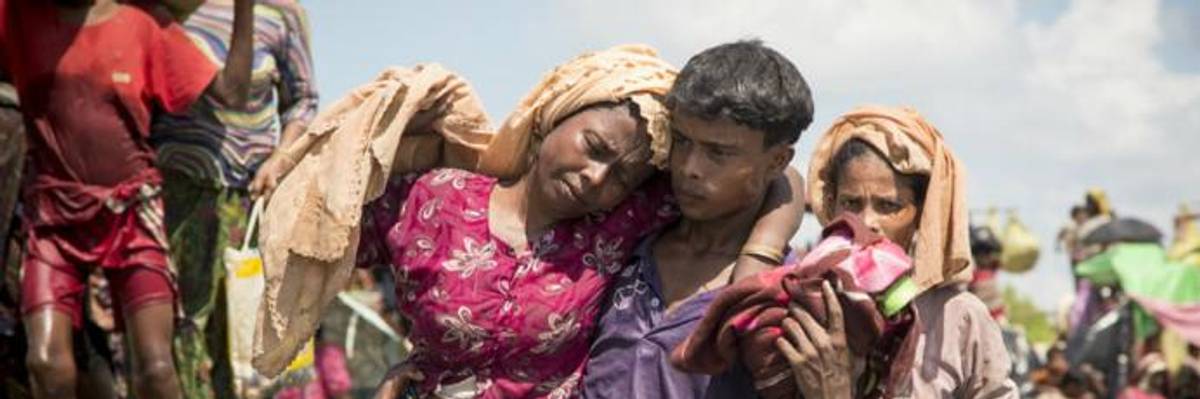
Thousands of new Rohingya refugee arrivals cross the border near Anzuman Para village, Palong Khali, Bangladesh. (Photo: Roger Arnold/UNHCR)
Following a United Nations Human Rights Council fact-finding mission on Myanmar, a damning U.N. report published Monday concludes that the nation's military leaders, including its top commander, should be further investigated and prosecuted for genocide, crimes against humanity, and war crimes committed against Rohingya Muslims in the wake of a violent crackdown last August that forced more than half a million refugees to flee to neighboring Bangladesh.
"The international community, through the United Nations, should use all diplomatic, humanitarian, and other peaceful means to assist Myanmar in meeting its responsibility to protect its people from genocide, crimes against humanity, and war crimes."
--U.N. report"The gross human rights violations and abuses committed in Kachin, Rakhine, and Shan states," which "stem from deep fractures in society and structural problems that have been apparent and unaddressed for decades," the report asserts, "undoubtedly amount to the gravest crimes under international law."
The report (pdf) comes from a yearlong investigation conducted by a three-member panel, which relied on 875 in-depth interviews with victims and eyewitnesses, satellite images, and verified documents, photographs, and videos. It documents crimes including murder, enforced disappearance, enslavement, imprisonment, torture, rape, and sexual slavery.
While the report determines that six leaders of the Myanmar military, or Tatmadaw--most notably Commander-in-Chief Senior-General Min Aung Hlaing--bear the greatest responsibility for such crimes, it also charges that State Counsellor Daw Aung San Suu Kyi, a Nobel Peace Prize laureate, "has not used her de facto position as head of government, nor her moral authority, to stem or prevent the unfolding events in Rakhine State."
Among the report's key recommendations, it declares, "The international community, through the United Nations, should use all diplomatic, humanitarian, and other peaceful means to assist Myanmar in meeting its responsibility to protect its people from genocide, crimes against humanity, and war crimes."
It also urges the U.N. Security Council to "ensure accountability for crimes under international law committed in Myanmar, preferably by referring the situation to the International Criminal Court or alternatively by creating an ad hoc international criminal tribunal," as well as to "adopt targeted individual sanctions, including travel bans and asset freezes, against those who appear most responsible for serious crimes under international law" and to "impose an arms embargo on Myanmar."
Human rights advocates responded to the findings, which bolster previous reports from U.N. officials and international news agencies, with immediate calls for actions.
"The international community has the responsibility to act to ensure justice and accountability. Failing to do so sends a dangerous message that Myanmar's military will not only enjoy impunity but is free to commit such atrocities again."
--Tirana Hassan, Amnesty International
Brad Adams, Asia director at Human Rights Watch, said that the "powerful report and clear recommendations demonstrate the obvious need for concrete steps to advance criminal justice for atrocious crimes, instead of more hollow condemnations and expressions of concern," especially considering that "so far, condemnations without action by U.N. member states have only emboldened a culture of violence and oppression in Myanmar."
Tirana Hassan, director of crisis response at Amnesty International, said the report makes "clear that the Myanmar authorities are incapable of bringing to justice those responsible," which means that "the international community has the responsibility to act to ensure justice and accountability. Failing to do so sends a dangerous message that Myanmar's military will not only enjoy impunity but is free to commit such atrocities again."
The report will "have a big impact internationally, coming from the main U.N.-mandated body investigating the violence against the Rohingya, and also covering armed conflict in Shan, and Kachin states," Richard Horsey, a former U.N. diplomat in Myanmar and longtime Yangon-based analyst, told the Washington Post. "Its specific finding that there is sufficient grounds for investigation and prosecution of military commanders for genocide is likely to have particularly serious diplomatic, not only legal, consequences."
After the report's release, Facebook--according to a company blog post--removed "18 Facebook accounts, one Instagram account, and 52 Facebook Pages, followed by almost 12 million people," specifically banning 20 individuals and organizations, including the commander-in-chief and the military's Myawady television network, "to prevent the spread of hate and misinformation." Reuters noted that the "action means an essential blackout of the military's main channel of public communication."
Dear Common Dreams reader, It’s been nearly 30 years since I co-founded Common Dreams with my late wife, Lina Newhouser. We had the radical notion that journalism should serve the public good, not corporate profits. It was clear to us from the outset what it would take to build such a project. No paid advertisements. No corporate sponsors. No millionaire publisher telling us what to think or do. Many people said we wouldn't last a year, but we proved those doubters wrong. Together with a tremendous team of journalists and dedicated staff, we built an independent media outlet free from the constraints of profits and corporate control. Our mission has always been simple: To inform. To inspire. To ignite change for the common good. Building Common Dreams was not easy. Our survival was never guaranteed. When you take on the most powerful forces—Wall Street greed, fossil fuel industry destruction, Big Tech lobbyists, and uber-rich oligarchs who have spent billions upon billions rigging the economy and democracy in their favor—the only bulwark you have is supporters who believe in your work. But here’s the urgent message from me today. It's never been this bad out there. And it's never been this hard to keep us going. At the very moment Common Dreams is most needed, the threats we face are intensifying. We need your support now more than ever. We don't accept corporate advertising and never will. We don't have a paywall because we don't think people should be blocked from critical news based on their ability to pay. Everything we do is funded by the donations of readers like you. When everyone does the little they can afford, we are strong. But if that support retreats or dries up, so do we. Will you donate now to make sure Common Dreams not only survives but thrives? —Craig Brown, Co-founder |
Following a United Nations Human Rights Council fact-finding mission on Myanmar, a damning U.N. report published Monday concludes that the nation's military leaders, including its top commander, should be further investigated and prosecuted for genocide, crimes against humanity, and war crimes committed against Rohingya Muslims in the wake of a violent crackdown last August that forced more than half a million refugees to flee to neighboring Bangladesh.
"The international community, through the United Nations, should use all diplomatic, humanitarian, and other peaceful means to assist Myanmar in meeting its responsibility to protect its people from genocide, crimes against humanity, and war crimes."
--U.N. report"The gross human rights violations and abuses committed in Kachin, Rakhine, and Shan states," which "stem from deep fractures in society and structural problems that have been apparent and unaddressed for decades," the report asserts, "undoubtedly amount to the gravest crimes under international law."
The report (pdf) comes from a yearlong investigation conducted by a three-member panel, which relied on 875 in-depth interviews with victims and eyewitnesses, satellite images, and verified documents, photographs, and videos. It documents crimes including murder, enforced disappearance, enslavement, imprisonment, torture, rape, and sexual slavery.
While the report determines that six leaders of the Myanmar military, or Tatmadaw--most notably Commander-in-Chief Senior-General Min Aung Hlaing--bear the greatest responsibility for such crimes, it also charges that State Counsellor Daw Aung San Suu Kyi, a Nobel Peace Prize laureate, "has not used her de facto position as head of government, nor her moral authority, to stem or prevent the unfolding events in Rakhine State."
Among the report's key recommendations, it declares, "The international community, through the United Nations, should use all diplomatic, humanitarian, and other peaceful means to assist Myanmar in meeting its responsibility to protect its people from genocide, crimes against humanity, and war crimes."
It also urges the U.N. Security Council to "ensure accountability for crimes under international law committed in Myanmar, preferably by referring the situation to the International Criminal Court or alternatively by creating an ad hoc international criminal tribunal," as well as to "adopt targeted individual sanctions, including travel bans and asset freezes, against those who appear most responsible for serious crimes under international law" and to "impose an arms embargo on Myanmar."
Human rights advocates responded to the findings, which bolster previous reports from U.N. officials and international news agencies, with immediate calls for actions.
"The international community has the responsibility to act to ensure justice and accountability. Failing to do so sends a dangerous message that Myanmar's military will not only enjoy impunity but is free to commit such atrocities again."
--Tirana Hassan, Amnesty International
Brad Adams, Asia director at Human Rights Watch, said that the "powerful report and clear recommendations demonstrate the obvious need for concrete steps to advance criminal justice for atrocious crimes, instead of more hollow condemnations and expressions of concern," especially considering that "so far, condemnations without action by U.N. member states have only emboldened a culture of violence and oppression in Myanmar."
Tirana Hassan, director of crisis response at Amnesty International, said the report makes "clear that the Myanmar authorities are incapable of bringing to justice those responsible," which means that "the international community has the responsibility to act to ensure justice and accountability. Failing to do so sends a dangerous message that Myanmar's military will not only enjoy impunity but is free to commit such atrocities again."
The report will "have a big impact internationally, coming from the main U.N.-mandated body investigating the violence against the Rohingya, and also covering armed conflict in Shan, and Kachin states," Richard Horsey, a former U.N. diplomat in Myanmar and longtime Yangon-based analyst, told the Washington Post. "Its specific finding that there is sufficient grounds for investigation and prosecution of military commanders for genocide is likely to have particularly serious diplomatic, not only legal, consequences."
After the report's release, Facebook--according to a company blog post--removed "18 Facebook accounts, one Instagram account, and 52 Facebook Pages, followed by almost 12 million people," specifically banning 20 individuals and organizations, including the commander-in-chief and the military's Myawady television network, "to prevent the spread of hate and misinformation." Reuters noted that the "action means an essential blackout of the military's main channel of public communication."
Following a United Nations Human Rights Council fact-finding mission on Myanmar, a damning U.N. report published Monday concludes that the nation's military leaders, including its top commander, should be further investigated and prosecuted for genocide, crimes against humanity, and war crimes committed against Rohingya Muslims in the wake of a violent crackdown last August that forced more than half a million refugees to flee to neighboring Bangladesh.
"The international community, through the United Nations, should use all diplomatic, humanitarian, and other peaceful means to assist Myanmar in meeting its responsibility to protect its people from genocide, crimes against humanity, and war crimes."
--U.N. report"The gross human rights violations and abuses committed in Kachin, Rakhine, and Shan states," which "stem from deep fractures in society and structural problems that have been apparent and unaddressed for decades," the report asserts, "undoubtedly amount to the gravest crimes under international law."
The report (pdf) comes from a yearlong investigation conducted by a three-member panel, which relied on 875 in-depth interviews with victims and eyewitnesses, satellite images, and verified documents, photographs, and videos. It documents crimes including murder, enforced disappearance, enslavement, imprisonment, torture, rape, and sexual slavery.
While the report determines that six leaders of the Myanmar military, or Tatmadaw--most notably Commander-in-Chief Senior-General Min Aung Hlaing--bear the greatest responsibility for such crimes, it also charges that State Counsellor Daw Aung San Suu Kyi, a Nobel Peace Prize laureate, "has not used her de facto position as head of government, nor her moral authority, to stem or prevent the unfolding events in Rakhine State."
Among the report's key recommendations, it declares, "The international community, through the United Nations, should use all diplomatic, humanitarian, and other peaceful means to assist Myanmar in meeting its responsibility to protect its people from genocide, crimes against humanity, and war crimes."
It also urges the U.N. Security Council to "ensure accountability for crimes under international law committed in Myanmar, preferably by referring the situation to the International Criminal Court or alternatively by creating an ad hoc international criminal tribunal," as well as to "adopt targeted individual sanctions, including travel bans and asset freezes, against those who appear most responsible for serious crimes under international law" and to "impose an arms embargo on Myanmar."
Human rights advocates responded to the findings, which bolster previous reports from U.N. officials and international news agencies, with immediate calls for actions.
"The international community has the responsibility to act to ensure justice and accountability. Failing to do so sends a dangerous message that Myanmar's military will not only enjoy impunity but is free to commit such atrocities again."
--Tirana Hassan, Amnesty International
Brad Adams, Asia director at Human Rights Watch, said that the "powerful report and clear recommendations demonstrate the obvious need for concrete steps to advance criminal justice for atrocious crimes, instead of more hollow condemnations and expressions of concern," especially considering that "so far, condemnations without action by U.N. member states have only emboldened a culture of violence and oppression in Myanmar."
Tirana Hassan, director of crisis response at Amnesty International, said the report makes "clear that the Myanmar authorities are incapable of bringing to justice those responsible," which means that "the international community has the responsibility to act to ensure justice and accountability. Failing to do so sends a dangerous message that Myanmar's military will not only enjoy impunity but is free to commit such atrocities again."
The report will "have a big impact internationally, coming from the main U.N.-mandated body investigating the violence against the Rohingya, and also covering armed conflict in Shan, and Kachin states," Richard Horsey, a former U.N. diplomat in Myanmar and longtime Yangon-based analyst, told the Washington Post. "Its specific finding that there is sufficient grounds for investigation and prosecution of military commanders for genocide is likely to have particularly serious diplomatic, not only legal, consequences."
After the report's release, Facebook--according to a company blog post--removed "18 Facebook accounts, one Instagram account, and 52 Facebook Pages, followed by almost 12 million people," specifically banning 20 individuals and organizations, including the commander-in-chief and the military's Myawady television network, "to prevent the spread of hate and misinformation." Reuters noted that the "action means an essential blackout of the military's main channel of public communication."