SUBSCRIBE TO OUR FREE NEWSLETTER
Daily news & progressive opinion—funded by the people, not the corporations—delivered straight to your inbox.
5
#000000
#FFFFFF
To donate by check, phone, or other method, see our More Ways to Give page.
Daily news & progressive opinion—funded by the people, not the corporations—delivered straight to your inbox.
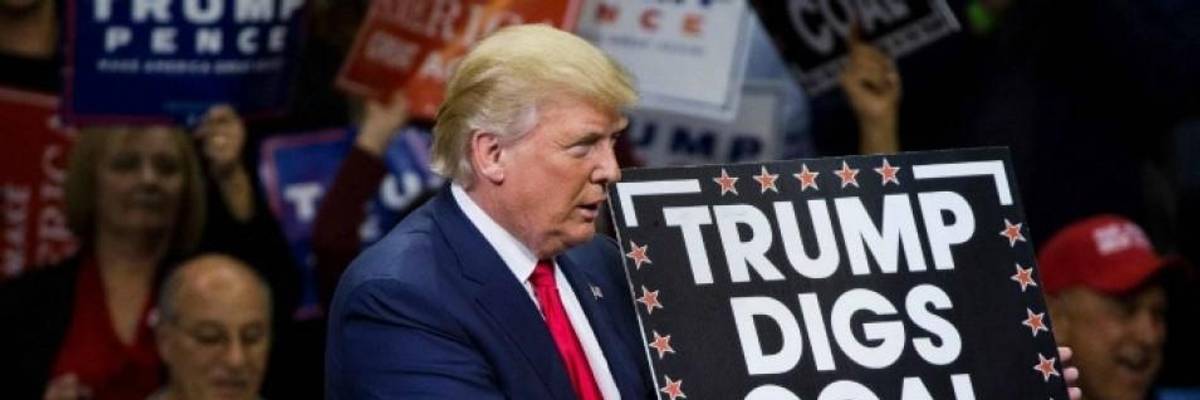
At a rally on Tuesday, President Donald Trump is expected to unveil a plan that would provide notable regulatory relief to the coal industry. (Photo: AFP/Getty Images)
With President Donald Trump expected to unveil a plan on Tuesday that would enable states to decide whether to regulate coal plant emissions, defanging former President Barack Obama's Clean Power Plan, the New York Times on Sunday published a detailed profile of William Wehrum, an ex-lawyer for corporate clients like Koch Industries who now leads air pollution policy at the Environmental Protection Agency (EPA).
With Wehrum's climate-wrecking deregulatory agenda and ethics conflicts so clearly outlined in the report, journalist Jonathan M. Katz warned on Twitter, "Even if the president ends up in prison, we're going to be paying for this era for the rest of our lives."
Wehrum is credited with pushing for the anticipated coal-friendly policy, and numerous other rollbacks of Obama era regulations on big polluters. As Bruce Buckheit, who led the EPA's air enforcement office under the Clinton and George W. Bush administrations, put it, "They basically found the most aggressive and knowledgeable fox and said, 'Here are the keys to the henhouse.'"
While Wehrum told the Times, "I am scrupulously complying with my ethical obligations," the newspaper explains how a former attorney for the coal-burning power, petrochemical, oil, gravel, and brick industries can now craft policy at the government agency charged with regulating those very industries:
Mr. Wehrum has been able to push his deregulatory agenda without running into ethics troubles because of a quirk in federal ethics rules. The rules limit the activities of officials who join the government from industry--but they are less restrictive for lawyers than for officials who had worked as registered lobbyists.
The end result is that the ethics rules generally allow Mr. Wehrum to help oversee the drafting of policies that broadly benefit the industries or clients he represented in recent years.
"It is a failing in the rule," said Norman Eisen, a former Obama administration lawyer who wrote the White House ethics code that creates the division between how ex-lawyers and ex-lobbyists are treated. "One is subject to the tougher lobbying restriction, and the other skates through."
Eisen added on Twitter, "Wehrum is grossly exploiting a loophole in the rules... but contempt for the spirit of the rules defines the Trump [administration]."
"Mr. Wehrum's client list over the last decade is a testament to his clout--and a road map to the potential conflicts as a government official," the Times continues, pointing to his work for the oil baron Koch Brothers, billionaires known for bankrolling GOP political campaigns, as well as "the industry's largest trade associations: the American Petroleum Institute, the American Fuel and Petrochemical Manufacturers, the Brick Industry Association, and the Utility Air Regulatory Group, whose membership list features coal-burning electric utilities."
Especially considering that former coal lobbyist Andrew Wheeler replaced Trump's first disgraced EPA administrator, "Mr. Wehrum's trip through the revolving door is hardly extraordinary in the Trump administration," the Times notes. "But in few cases have the actions pushed by these just-departed industry executives seemed to offer such rapid and far-reaching benefits to ex-clients, and Mr. Wehrum has taken the steps even as he continues at times to meet privately with them despite federal ethics rules intended to limit such interactions."
Considering his ties to big polluters, "reckless" rollbacks, and belief that certain agency restrictions on industry are "unnecessarily complicated and confusing," the Times concludes, "Environmentalists and former EPA officials say they remain concerned that many of the changes Mr. Wehrum is helping to deliver will hurt the public."
This country and this world are at a monumental crossroads. US voters have an opportunity to beat back the forces of fascism and confront the billionaires who are rigging the economy, our media system, and our democracy, making it increasingly impossible for ordinary people to get by. We’re not just talking about the election. We’re talking about what must be done once these fascist elements are vanquished from power. We need a bolder set of solutions than what either major party has so far been willing to offer and a working-class movement ready to fight like hell for it. Trump didn't emerge from nowhere. The conditions that fueled MAGA authoritarianism were created by decades of radical neoliberal economic policies and a corrupt political system dominated by corporate interests. They slashed taxes on the super-rich, promising that the benefits would trickle down. They said giveaways to the corporate titans would make life more affordable for the rest of us. It was all bullshit. And when a bitter, betrayed populace searches for someone to blame, right-wing demagogues have little trouble finding scapegoats. People know when they're being lied to, but you won't hear any of this from the corporate media. Only independent journalism—powered and funded by people who believe in building a better world—can deliver truly trustworthy daily news. If you share our vision, please contribute whatever you can to sustain our work. |
With President Donald Trump expected to unveil a plan on Tuesday that would enable states to decide whether to regulate coal plant emissions, defanging former President Barack Obama's Clean Power Plan, the New York Times on Sunday published a detailed profile of William Wehrum, an ex-lawyer for corporate clients like Koch Industries who now leads air pollution policy at the Environmental Protection Agency (EPA).
With Wehrum's climate-wrecking deregulatory agenda and ethics conflicts so clearly outlined in the report, journalist Jonathan M. Katz warned on Twitter, "Even if the president ends up in prison, we're going to be paying for this era for the rest of our lives."
Wehrum is credited with pushing for the anticipated coal-friendly policy, and numerous other rollbacks of Obama era regulations on big polluters. As Bruce Buckheit, who led the EPA's air enforcement office under the Clinton and George W. Bush administrations, put it, "They basically found the most aggressive and knowledgeable fox and said, 'Here are the keys to the henhouse.'"
While Wehrum told the Times, "I am scrupulously complying with my ethical obligations," the newspaper explains how a former attorney for the coal-burning power, petrochemical, oil, gravel, and brick industries can now craft policy at the government agency charged with regulating those very industries:
Mr. Wehrum has been able to push his deregulatory agenda without running into ethics troubles because of a quirk in federal ethics rules. The rules limit the activities of officials who join the government from industry--but they are less restrictive for lawyers than for officials who had worked as registered lobbyists.
The end result is that the ethics rules generally allow Mr. Wehrum to help oversee the drafting of policies that broadly benefit the industries or clients he represented in recent years.
"It is a failing in the rule," said Norman Eisen, a former Obama administration lawyer who wrote the White House ethics code that creates the division between how ex-lawyers and ex-lobbyists are treated. "One is subject to the tougher lobbying restriction, and the other skates through."
Eisen added on Twitter, "Wehrum is grossly exploiting a loophole in the rules... but contempt for the spirit of the rules defines the Trump [administration]."
"Mr. Wehrum's client list over the last decade is a testament to his clout--and a road map to the potential conflicts as a government official," the Times continues, pointing to his work for the oil baron Koch Brothers, billionaires known for bankrolling GOP political campaigns, as well as "the industry's largest trade associations: the American Petroleum Institute, the American Fuel and Petrochemical Manufacturers, the Brick Industry Association, and the Utility Air Regulatory Group, whose membership list features coal-burning electric utilities."
Especially considering that former coal lobbyist Andrew Wheeler replaced Trump's first disgraced EPA administrator, "Mr. Wehrum's trip through the revolving door is hardly extraordinary in the Trump administration," the Times notes. "But in few cases have the actions pushed by these just-departed industry executives seemed to offer such rapid and far-reaching benefits to ex-clients, and Mr. Wehrum has taken the steps even as he continues at times to meet privately with them despite federal ethics rules intended to limit such interactions."
Considering his ties to big polluters, "reckless" rollbacks, and belief that certain agency restrictions on industry are "unnecessarily complicated and confusing," the Times concludes, "Environmentalists and former EPA officials say they remain concerned that many of the changes Mr. Wehrum is helping to deliver will hurt the public."