

SUBSCRIBE TO OUR FREE NEWSLETTER
Daily news & progressive opinion—funded by the people, not the corporations—delivered straight to your inbox.
5
#000000
#FFFFFF
To donate by check, phone, or other method, see our More Ways to Give page.
Daily news & progressive opinion—funded by the people, not the corporations—delivered straight to your inbox.
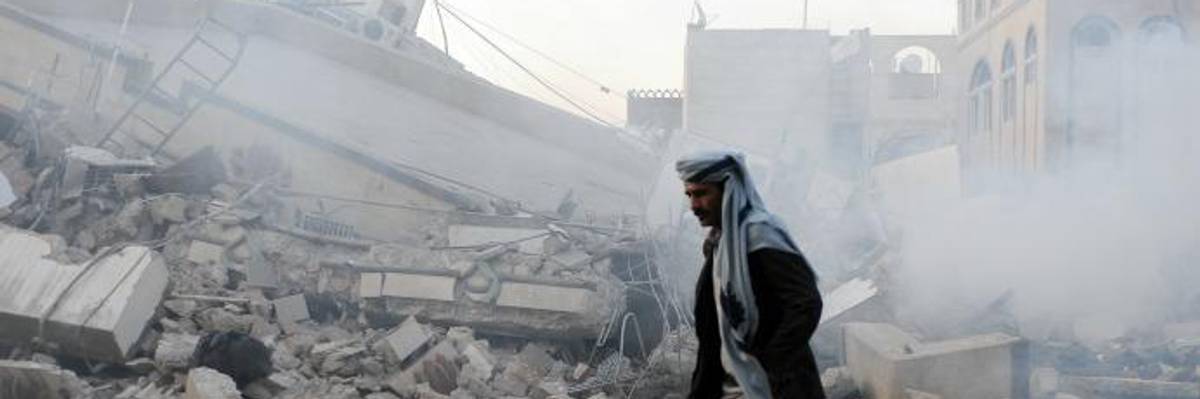
A man walks on rubble of a building destroyed in airstrikes carried out by warplanes of the Saudi-led coalition hours after the UN Special Envoy to Yemen Martin Griffiths departed Sana'a on June 06, 2018 in Sana'a, Yemen. (Photo: Mohammed Hamoud/Getty Images)
As the United States continues to fuel Yemen's worsening humanitarian crisis, and boast that it's targeting al Qaeda in the impoverished nation (AQAP) with airstrikes, new reporting reveals that the U.S.- and U.K-backed Saudi coalition waging a bombing campaign there is recruiting al Qaeda fighters to join its ranks, and paying off the extremists to leave areas.
Soon after the Saudi-led coalition, with the United Arab Emirates being a key partner, began its bombing campaign in Yemen against the Houthi rebels in 2015, it was reported that al Qaeda militants were fighting on the same side as the Saudi militia to defeat the Iran-linked Houthis. The new Associated Press investigation, however, reveals that the coalition has made "secret deals with al-Qaeda fighters, paying some to leave key cities and towns and letting others retreat with weapons, equipment, and wads of looted cash."
Beyond that, the "coalition-backed militias actively recruit al-Qaeda militants," AP found, based on on-the-ground reporting including interviews with members of al Qaeda, tribal mediators, Yemeni security officers, and militia commanders.
The earliest such deal took place in the spring of 2016 when "thousands of al-Qaeda fighters ... pull out[ed] of Mukalla," a port city. From AP:
The militants were guaranteed a safe route out and allowed to keep weapons and cash looted from the city--up to $100 million by some estimates--according to five sources, including military, security, and government officials. [...]
Coalition-backed forces moved in two days later, announcing that hundreds of militants were killed and hailing the capture as "part of joint international efforts to defeat the terrorist organizations in Yemen."
A similar deal took place soon after in the province of Abyan. Again, the fighters would not be targeted with drone strokes as part of the deal, which also included a provision for hundreds of al Qaeda fighters the join the ranks of the UAE-backed Yemeni force there.
"There is no evidence that American money went to AQAP militants," AP reported, yet the U.S. does provide the coalition with key military assistance including air refueling and intelligence.
Responding to new investigation on Twitter, Trita Parsi, president of the National Iranian American Council, said, "This is what the U.S. gets when its foreign policy is not based on its national interest, but driven by transactional deals with Arab allies who in turn have no problem allying with Al-Qaeda. Through Saudi & UAE, the U.S. is now allied with al-Qaeda in Yemen."
Michael Horton, a fellow at the Jamestown Foundation, told AP, "It is now almost impossible to untangle who is AQAP and who is not since so many deals and alliances have been made," and dubbed the coalition's war on al Qaeda largely a "farce."
The latest reporting sheds new light on the failed war on terror, as fighters in what's called al Qaeda's most dangerous branch are leaving areas unscathed and with greater money resources. It also follows Sen. Chris Murphy (D-Conn.) warning last year that, in the eyes of Yemenis, the coalition's anti-Houthi bombing campaign "is seen as a U.S.-Saudi bombing campaign. And so the long-term effect of this is that we are radicalizing potentially millions of Yemenis against the United States."
The plight of Yemenis suffering the catastrophic fallout of the proxy war, meanwhile, remains largely ignored by corporate media and most mainstream outlets.
Dear Common Dreams reader, It’s been nearly 30 years since I co-founded Common Dreams with my late wife, Lina Newhouser. We had the radical notion that journalism should serve the public good, not corporate profits. It was clear to us from the outset what it would take to build such a project. No paid advertisements. No corporate sponsors. No millionaire publisher telling us what to think or do. Many people said we wouldn't last a year, but we proved those doubters wrong. Together with a tremendous team of journalists and dedicated staff, we built an independent media outlet free from the constraints of profits and corporate control. Our mission has always been simple: To inform. To inspire. To ignite change for the common good. Building Common Dreams was not easy. Our survival was never guaranteed. When you take on the most powerful forces—Wall Street greed, fossil fuel industry destruction, Big Tech lobbyists, and uber-rich oligarchs who have spent billions upon billions rigging the economy and democracy in their favor—the only bulwark you have is supporters who believe in your work. But here’s the urgent message from me today. It's never been this bad out there. And it's never been this hard to keep us going. At the very moment Common Dreams is most needed, the threats we face are intensifying. We need your support now more than ever. We don't accept corporate advertising and never will. We don't have a paywall because we don't think people should be blocked from critical news based on their ability to pay. Everything we do is funded by the donations of readers like you. When everyone does the little they can afford, we are strong. But if that support retreats or dries up, so do we. Will you donate now to make sure Common Dreams not only survives but thrives? —Craig Brown, Co-founder |
As the United States continues to fuel Yemen's worsening humanitarian crisis, and boast that it's targeting al Qaeda in the impoverished nation (AQAP) with airstrikes, new reporting reveals that the U.S.- and U.K-backed Saudi coalition waging a bombing campaign there is recruiting al Qaeda fighters to join its ranks, and paying off the extremists to leave areas.
Soon after the Saudi-led coalition, with the United Arab Emirates being a key partner, began its bombing campaign in Yemen against the Houthi rebels in 2015, it was reported that al Qaeda militants were fighting on the same side as the Saudi militia to defeat the Iran-linked Houthis. The new Associated Press investigation, however, reveals that the coalition has made "secret deals with al-Qaeda fighters, paying some to leave key cities and towns and letting others retreat with weapons, equipment, and wads of looted cash."
Beyond that, the "coalition-backed militias actively recruit al-Qaeda militants," AP found, based on on-the-ground reporting including interviews with members of al Qaeda, tribal mediators, Yemeni security officers, and militia commanders.
The earliest such deal took place in the spring of 2016 when "thousands of al-Qaeda fighters ... pull out[ed] of Mukalla," a port city. From AP:
The militants were guaranteed a safe route out and allowed to keep weapons and cash looted from the city--up to $100 million by some estimates--according to five sources, including military, security, and government officials. [...]
Coalition-backed forces moved in two days later, announcing that hundreds of militants were killed and hailing the capture as "part of joint international efforts to defeat the terrorist organizations in Yemen."
A similar deal took place soon after in the province of Abyan. Again, the fighters would not be targeted with drone strokes as part of the deal, which also included a provision for hundreds of al Qaeda fighters the join the ranks of the UAE-backed Yemeni force there.
"There is no evidence that American money went to AQAP militants," AP reported, yet the U.S. does provide the coalition with key military assistance including air refueling and intelligence.
Responding to new investigation on Twitter, Trita Parsi, president of the National Iranian American Council, said, "This is what the U.S. gets when its foreign policy is not based on its national interest, but driven by transactional deals with Arab allies who in turn have no problem allying with Al-Qaeda. Through Saudi & UAE, the U.S. is now allied with al-Qaeda in Yemen."
Michael Horton, a fellow at the Jamestown Foundation, told AP, "It is now almost impossible to untangle who is AQAP and who is not since so many deals and alliances have been made," and dubbed the coalition's war on al Qaeda largely a "farce."
The latest reporting sheds new light on the failed war on terror, as fighters in what's called al Qaeda's most dangerous branch are leaving areas unscathed and with greater money resources. It also follows Sen. Chris Murphy (D-Conn.) warning last year that, in the eyes of Yemenis, the coalition's anti-Houthi bombing campaign "is seen as a U.S.-Saudi bombing campaign. And so the long-term effect of this is that we are radicalizing potentially millions of Yemenis against the United States."
The plight of Yemenis suffering the catastrophic fallout of the proxy war, meanwhile, remains largely ignored by corporate media and most mainstream outlets.
As the United States continues to fuel Yemen's worsening humanitarian crisis, and boast that it's targeting al Qaeda in the impoverished nation (AQAP) with airstrikes, new reporting reveals that the U.S.- and U.K-backed Saudi coalition waging a bombing campaign there is recruiting al Qaeda fighters to join its ranks, and paying off the extremists to leave areas.
Soon after the Saudi-led coalition, with the United Arab Emirates being a key partner, began its bombing campaign in Yemen against the Houthi rebels in 2015, it was reported that al Qaeda militants were fighting on the same side as the Saudi militia to defeat the Iran-linked Houthis. The new Associated Press investigation, however, reveals that the coalition has made "secret deals with al-Qaeda fighters, paying some to leave key cities and towns and letting others retreat with weapons, equipment, and wads of looted cash."
Beyond that, the "coalition-backed militias actively recruit al-Qaeda militants," AP found, based on on-the-ground reporting including interviews with members of al Qaeda, tribal mediators, Yemeni security officers, and militia commanders.
The earliest such deal took place in the spring of 2016 when "thousands of al-Qaeda fighters ... pull out[ed] of Mukalla," a port city. From AP:
The militants were guaranteed a safe route out and allowed to keep weapons and cash looted from the city--up to $100 million by some estimates--according to five sources, including military, security, and government officials. [...]
Coalition-backed forces moved in two days later, announcing that hundreds of militants were killed and hailing the capture as "part of joint international efforts to defeat the terrorist organizations in Yemen."
A similar deal took place soon after in the province of Abyan. Again, the fighters would not be targeted with drone strokes as part of the deal, which also included a provision for hundreds of al Qaeda fighters the join the ranks of the UAE-backed Yemeni force there.
"There is no evidence that American money went to AQAP militants," AP reported, yet the U.S. does provide the coalition with key military assistance including air refueling and intelligence.
Responding to new investigation on Twitter, Trita Parsi, president of the National Iranian American Council, said, "This is what the U.S. gets when its foreign policy is not based on its national interest, but driven by transactional deals with Arab allies who in turn have no problem allying with Al-Qaeda. Through Saudi & UAE, the U.S. is now allied with al-Qaeda in Yemen."
Michael Horton, a fellow at the Jamestown Foundation, told AP, "It is now almost impossible to untangle who is AQAP and who is not since so many deals and alliances have been made," and dubbed the coalition's war on al Qaeda largely a "farce."
The latest reporting sheds new light on the failed war on terror, as fighters in what's called al Qaeda's most dangerous branch are leaving areas unscathed and with greater money resources. It also follows Sen. Chris Murphy (D-Conn.) warning last year that, in the eyes of Yemenis, the coalition's anti-Houthi bombing campaign "is seen as a U.S.-Saudi bombing campaign. And so the long-term effect of this is that we are radicalizing potentially millions of Yemenis against the United States."
The plight of Yemenis suffering the catastrophic fallout of the proxy war, meanwhile, remains largely ignored by corporate media and most mainstream outlets.

