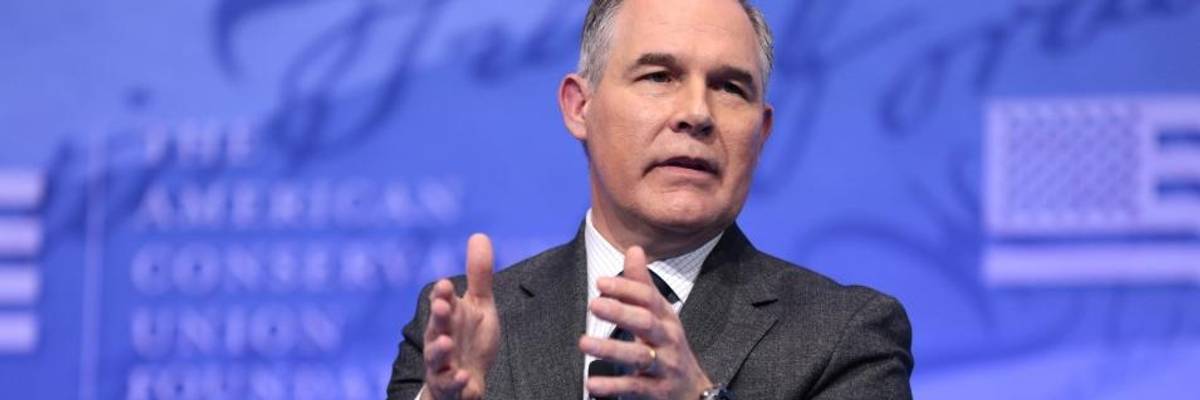
"The clean car standards can limit global warming pollution by six billion tons, save consumers $1.7 trillion dollars in fuel costs, and reduce oil consumption by up to four million barrels every day," Sierra Club's Gina Coplon-Newfield observed. (Photo: Gage Skidmore/Flickr/cc)
'Among Stupidest Policies Yet Proposed,' Trump EPA to Lower Car Emissions Standards
"Weakening clean car standards is bad for the planet, public health, and the auto industry itself."
After more than a year of aggressively lobbying the Trump administration to gut Obama-era fuel efficiency standards aimed at reducing greenhouse gas emmissions, automakers are poised to finally have their wish granted on Sunday, when EPA chief Scott Pruitt is scheduled to officially declare the rules "not appropriate."
"The current iteration of fuel standards are based on sound science, which the EPA should be using to make its decision--not pressure from the auto industry."
--Natalie Nava, Greenpeace USAAs Reuters reports, Pruitt is then planning to deliver a speech on Tuesday celebrating the regulatory rollback from a Chevrolet dealership in Virginia--a fitting location, given that representatives of Chevrolet's parent company General Motors met with Pruitt frequently last year to demand less stringent fuel standards.
Bill McKibben, founder of 350.org, argued that Pruitt's plan to lower emissions standards "ranks high among the stupidest policies yet proposed" by the Trump administration.
"Weakening clean car standards is bad for the planet, public health, and the auto industry itself. Ford Motor Company and other automakers...have been actively fighting the clean car standards and have been instrumental in pushing for this development," Natalie Nava, project leader at Greenpeace USA, added in a statement on Thursday. "The current iteration of fuel standards are based on sound science, which the EPA should be using to make its decision--not pressure from the auto industry."
In a tweet on Friday, Public Citizen similarly accused the EPA of "pandering to auto executives and their Washington lobbyists."
While it is not yet known what specific changes Pruitt plans to make to current fuel efficiency standards, states and environmental groups are already gearing up to challenge what is expected to be a significant rollback in court. Under the current rules, put in place in 2012, automakers would be required to "nearly double the average fuel economy of new cars and trucks to 54.5 miles per gallon by 2025," the New York Times explains.
California Attorney General Xavier Becerra led the opposition to Pruitt's rule changes on Friday, declaring: "California is prepared to take any steps necessary to protect our planet and people."
Though companies like Ford and General Motors have publicly expressed their "commitment to sustainability," Sierra Club's Gina Coplon-Newfield argued in a series of tweets on Thursday that their relentless push for weaker efficiency standards exposes the shallowness of their pro-environment rhetoric.
"The clean car standards can limit global warming pollution by six billion tons, save consumers $1.7 trillion dollars in fuel costs, and reduce oil consumption by up to four million barrels every day," Coplon-Newfield observed. "Ford has been working with Scott Pruitt and Donald Trump to roll these standards back to pollute our communities and increase what people pay at the pump."
We are at a crossroads
This country and this world are at a monumental crossroads. In a few short weeks, US voters will have an opportunity to beat back the forces of fascism and confront the billionaires who are rigging the economy, our media system, and our democracy, making it increasingly impossible for ordinary people to get by. We’re not just talking about the election. We’re talking about what must be done once these fascist elements are vanquished from power. We need a bolder set of solutions than what either major party has so far been willing to offer and a working-class movement ready to fight like hell for it. Trump didn't emerge from nowhere. The conditions that fueled MAGA authoritarianism were created by decades of radical neoliberal economic policies and a corrupt political system dominated by corporate interests. They slashed taxes on the super-rich, promising that the benefits would trickle down. They said giveaways to the corporate titans would make life more affordable for the rest of us. It was all bullshit. And when a bitter, betrayed populace searches for someone to blame, right-wing demagogues have little trouble finding scapegoats. People know when they're being lied to, but you won't hear any of this from the corporate media. Only independent journalism—powered and funded by people who believe in building a better world—can deliver truly trustworthy daily news. Our Fall Campaign is underway, and we need your help. To power our newsroom through the rest of the year, we need to raise $125,000 by midnight on October 31. So if you share our vision, please contribute whatever you can to sustain our work. |
After more than a year of aggressively lobbying the Trump administration to gut Obama-era fuel efficiency standards aimed at reducing greenhouse gas emmissions, automakers are poised to finally have their wish granted on Sunday, when EPA chief Scott Pruitt is scheduled to officially declare the rules "not appropriate."
"The current iteration of fuel standards are based on sound science, which the EPA should be using to make its decision--not pressure from the auto industry."
--Natalie Nava, Greenpeace USAAs Reuters reports, Pruitt is then planning to deliver a speech on Tuesday celebrating the regulatory rollback from a Chevrolet dealership in Virginia--a fitting location, given that representatives of Chevrolet's parent company General Motors met with Pruitt frequently last year to demand less stringent fuel standards.
Bill McKibben, founder of 350.org, argued that Pruitt's plan to lower emissions standards "ranks high among the stupidest policies yet proposed" by the Trump administration.
"Weakening clean car standards is bad for the planet, public health, and the auto industry itself. Ford Motor Company and other automakers...have been actively fighting the clean car standards and have been instrumental in pushing for this development," Natalie Nava, project leader at Greenpeace USA, added in a statement on Thursday. "The current iteration of fuel standards are based on sound science, which the EPA should be using to make its decision--not pressure from the auto industry."
In a tweet on Friday, Public Citizen similarly accused the EPA of "pandering to auto executives and their Washington lobbyists."
While it is not yet known what specific changes Pruitt plans to make to current fuel efficiency standards, states and environmental groups are already gearing up to challenge what is expected to be a significant rollback in court. Under the current rules, put in place in 2012, automakers would be required to "nearly double the average fuel economy of new cars and trucks to 54.5 miles per gallon by 2025," the New York Times explains.
California Attorney General Xavier Becerra led the opposition to Pruitt's rule changes on Friday, declaring: "California is prepared to take any steps necessary to protect our planet and people."
Though companies like Ford and General Motors have publicly expressed their "commitment to sustainability," Sierra Club's Gina Coplon-Newfield argued in a series of tweets on Thursday that their relentless push for weaker efficiency standards exposes the shallowness of their pro-environment rhetoric.
"The clean car standards can limit global warming pollution by six billion tons, save consumers $1.7 trillion dollars in fuel costs, and reduce oil consumption by up to four million barrels every day," Coplon-Newfield observed. "Ford has been working with Scott Pruitt and Donald Trump to roll these standards back to pollute our communities and increase what people pay at the pump."
After more than a year of aggressively lobbying the Trump administration to gut Obama-era fuel efficiency standards aimed at reducing greenhouse gas emmissions, automakers are poised to finally have their wish granted on Sunday, when EPA chief Scott Pruitt is scheduled to officially declare the rules "not appropriate."
"The current iteration of fuel standards are based on sound science, which the EPA should be using to make its decision--not pressure from the auto industry."
--Natalie Nava, Greenpeace USAAs Reuters reports, Pruitt is then planning to deliver a speech on Tuesday celebrating the regulatory rollback from a Chevrolet dealership in Virginia--a fitting location, given that representatives of Chevrolet's parent company General Motors met with Pruitt frequently last year to demand less stringent fuel standards.
Bill McKibben, founder of 350.org, argued that Pruitt's plan to lower emissions standards "ranks high among the stupidest policies yet proposed" by the Trump administration.
"Weakening clean car standards is bad for the planet, public health, and the auto industry itself. Ford Motor Company and other automakers...have been actively fighting the clean car standards and have been instrumental in pushing for this development," Natalie Nava, project leader at Greenpeace USA, added in a statement on Thursday. "The current iteration of fuel standards are based on sound science, which the EPA should be using to make its decision--not pressure from the auto industry."
In a tweet on Friday, Public Citizen similarly accused the EPA of "pandering to auto executives and their Washington lobbyists."
While it is not yet known what specific changes Pruitt plans to make to current fuel efficiency standards, states and environmental groups are already gearing up to challenge what is expected to be a significant rollback in court. Under the current rules, put in place in 2012, automakers would be required to "nearly double the average fuel economy of new cars and trucks to 54.5 miles per gallon by 2025," the New York Times explains.
California Attorney General Xavier Becerra led the opposition to Pruitt's rule changes on Friday, declaring: "California is prepared to take any steps necessary to protect our planet and people."
Though companies like Ford and General Motors have publicly expressed their "commitment to sustainability," Sierra Club's Gina Coplon-Newfield argued in a series of tweets on Thursday that their relentless push for weaker efficiency standards exposes the shallowness of their pro-environment rhetoric.
"The clean car standards can limit global warming pollution by six billion tons, save consumers $1.7 trillion dollars in fuel costs, and reduce oil consumption by up to four million barrels every day," Coplon-Newfield observed. "Ford has been working with Scott Pruitt and Donald Trump to roll these standards back to pollute our communities and increase what people pay at the pump."