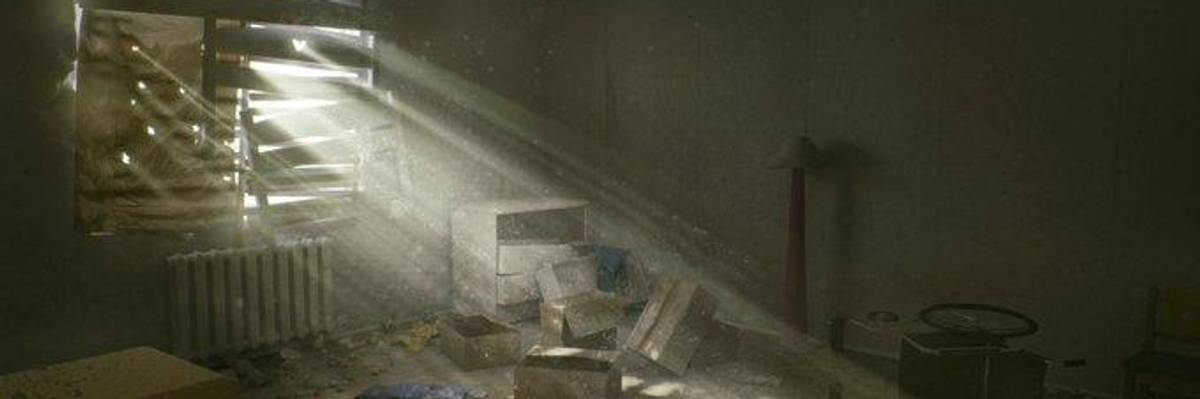
A still from Enter the Room, a new "augmented reality experience" from the International Committee of the Red Cross that puts a spotlight on the human impact of war. (Image: ICRC)
To Give Them Child's Terrifying View, Warmongers Like John Bolton Should Download This App
"For millions of children living in war zones, this isn't augmented reality—it's reality."
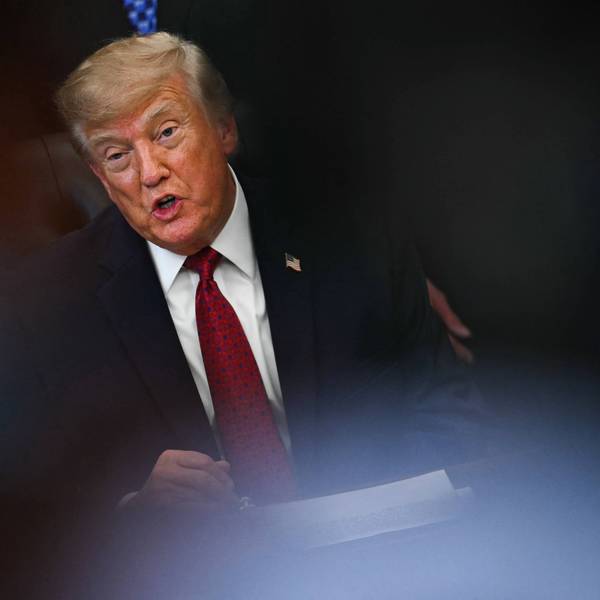
As President Donald Trump continues to assemble a "war cabinet" and further fuel conflict across the globe, a new app from the International Committee of the Red Cross (ICRC) provides a frightening, haunting glimpse of war's impact on children.
Called Enter the Room, the "augmented reality experience" puts users in the bedroom of a young girl, where, over a fast-forwarded four-year span, they can see how brutal conflict in her city transforms the space from being a place of security and joy to one of sadness, and traumatizes her emotionally and physically.
"Conflict has devastating impacts on communities, and especially on children. We hope the story told through this immersive app will give people new insights into the realities of war," Peter Maurer, president of the ICRC said in a press statement. "It is a vivid reminder of how urban warfare destroys children's bedrooms, their homes, and--tragically--their lives."
A 51-second trailer for the app previews the experience:
As the United Nations refugee agency wrote on Twitter: "For millions of children living in war zones, this isn't augmented reality-- it's reality."
Among the chilling details are pictures the child has drawn.
Her depiction of three happy animals in a car hung above her bed is disappears. New drawings appear in the room as the time-span goes on. They portray a tank in the street, bombs overhead, and the wounding or killing of her mother.
Other details show war's destruction. Gone are electricity and running water. A small lantern next to a make-shift hideaway is seen on the floor. Bowls of water appear on the table. The window is destroyed from a blast. Crutches appear next to the bed. And then a wheelchair appears.
The girl is never seen, and at the end, with the room in total tatters, one is left wondering if she joins the ranks of the countless many whose lives are lost to war.
In a tweet promoting the app, the ICRC lists 21 cities across the globe, including Fallujah and Congo's Kasai, and declares "The list goes on... This is what happens when the cities become battlefields:"
The free app, designed by digital innovation agency Nedd, is available on iTunes.
We are at a crossroads
This country and this world are at a monumental crossroads. In a few short weeks, US voters will have an opportunity to beat back the forces of fascism and confront the billionaires who are rigging the economy, our media system, and our democracy, making it increasingly impossible for ordinary people to get by. We’re not just talking about the election. We’re talking about what must be done once these fascist elements are vanquished from power. We need a bolder set of solutions than what either major party has so far been willing to offer and a working-class movement ready to fight like hell for it. Trump didn't emerge from nowhere. The conditions that fueled MAGA authoritarianism were created by decades of radical neoliberal economic policies and a corrupt political system dominated by corporate interests. They slashed taxes on the super-rich, promising that the benefits would trickle down. They said giveaways to the corporate titans would make life more affordable for the rest of us. It was all bullshit. And when a bitter, betrayed populace searches for someone to blame, right-wing demagogues have little trouble finding scapegoats. People know when they're being lied to, but you won't hear any of this from the corporate media. Only independent journalism—powered and funded by people who believe in building a better world—can deliver truly trustworthy daily news. Our Fall Campaign is underway, and we need your help. To power our newsroom through the rest of the year, we need to raise $125,000 by midnight on October 31. So if you share our vision, please contribute whatever you can to sustain our work. |
As President Donald Trump continues to assemble a "war cabinet" and further fuel conflict across the globe, a new app from the International Committee of the Red Cross (ICRC) provides a frightening, haunting glimpse of war's impact on children.
Called Enter the Room, the "augmented reality experience" puts users in the bedroom of a young girl, where, over a fast-forwarded four-year span, they can see how brutal conflict in her city transforms the space from being a place of security and joy to one of sadness, and traumatizes her emotionally and physically.
"Conflict has devastating impacts on communities, and especially on children. We hope the story told through this immersive app will give people new insights into the realities of war," Peter Maurer, president of the ICRC said in a press statement. "It is a vivid reminder of how urban warfare destroys children's bedrooms, their homes, and--tragically--their lives."
A 51-second trailer for the app previews the experience:
As the United Nations refugee agency wrote on Twitter: "For millions of children living in war zones, this isn't augmented reality-- it's reality."
Among the chilling details are pictures the child has drawn.
Her depiction of three happy animals in a car hung above her bed is disappears. New drawings appear in the room as the time-span goes on. They portray a tank in the street, bombs overhead, and the wounding or killing of her mother.
Other details show war's destruction. Gone are electricity and running water. A small lantern next to a make-shift hideaway is seen on the floor. Bowls of water appear on the table. The window is destroyed from a blast. Crutches appear next to the bed. And then a wheelchair appears.
The girl is never seen, and at the end, with the room in total tatters, one is left wondering if she joins the ranks of the countless many whose lives are lost to war.
In a tweet promoting the app, the ICRC lists 21 cities across the globe, including Fallujah and Congo's Kasai, and declares "The list goes on... This is what happens when the cities become battlefields:"
The free app, designed by digital innovation agency Nedd, is available on iTunes.
As President Donald Trump continues to assemble a "war cabinet" and further fuel conflict across the globe, a new app from the International Committee of the Red Cross (ICRC) provides a frightening, haunting glimpse of war's impact on children.
Called Enter the Room, the "augmented reality experience" puts users in the bedroom of a young girl, where, over a fast-forwarded four-year span, they can see how brutal conflict in her city transforms the space from being a place of security and joy to one of sadness, and traumatizes her emotionally and physically.
"Conflict has devastating impacts on communities, and especially on children. We hope the story told through this immersive app will give people new insights into the realities of war," Peter Maurer, president of the ICRC said in a press statement. "It is a vivid reminder of how urban warfare destroys children's bedrooms, their homes, and--tragically--their lives."
A 51-second trailer for the app previews the experience:
As the United Nations refugee agency wrote on Twitter: "For millions of children living in war zones, this isn't augmented reality-- it's reality."
Among the chilling details are pictures the child has drawn.
Her depiction of three happy animals in a car hung above her bed is disappears. New drawings appear in the room as the time-span goes on. They portray a tank in the street, bombs overhead, and the wounding or killing of her mother.
Other details show war's destruction. Gone are electricity and running water. A small lantern next to a make-shift hideaway is seen on the floor. Bowls of water appear on the table. The window is destroyed from a blast. Crutches appear next to the bed. And then a wheelchair appears.
The girl is never seen, and at the end, with the room in total tatters, one is left wondering if she joins the ranks of the countless many whose lives are lost to war.
In a tweet promoting the app, the ICRC lists 21 cities across the globe, including Fallujah and Congo's Kasai, and declares "The list goes on... This is what happens when the cities become battlefields:"
The free app, designed by digital innovation agency Nedd, is available on iTunes.