SUBSCRIBE TO OUR FREE NEWSLETTER
Daily news & progressive opinion—funded by the people, not the corporations—delivered straight to your inbox.
5
#000000
#FFFFFF
To donate by check, phone, or other method, see our More Ways to Give page.
Daily news & progressive opinion—funded by the people, not the corporations—delivered straight to your inbox.
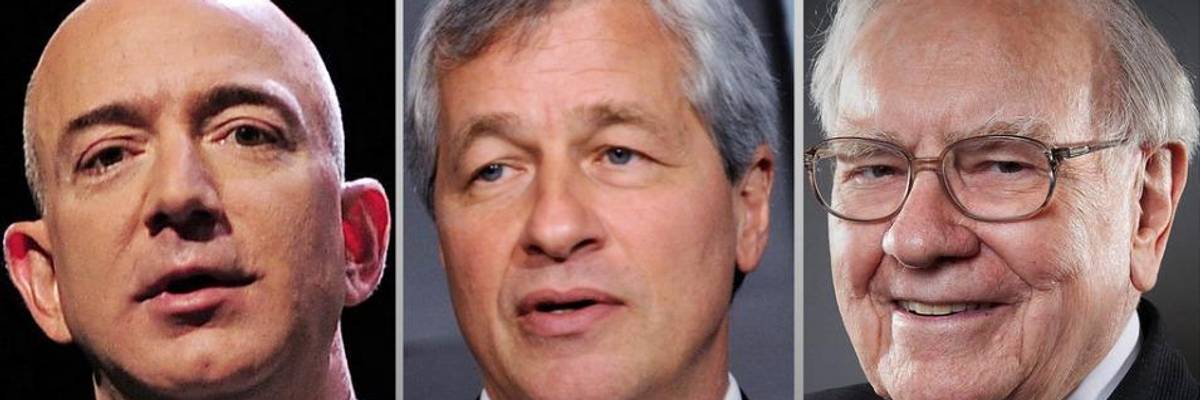
Jeff Bezos of Amazon, Jamie Dimon of J.P. Morgan Chase, and Warren Buffett of Berkshire Hathaway announced they would attempt to "disrupt" the health insurance industry by creating their own independent healthcare company, first serving their employees and potentially other Americans. The plan was met with skepticism from single-payer healthcare advocates. (Photo: NBC News)
A newly-announced plan by three of the most prominent billionaires in the U.S. to "disrupt" the American health insurance industry was met with extreme skepticism from advocates of a government-run healthcare system on Tuesday.
Amazon, Berkshire Hathaway, and J.P. Morgan Chase released a statement saying they would partner to create an independent healthcare company for their employees that would be "free from profit-making incentives and constraints."
"Our goal is to create solutions that benefit our U.S. employees, their families and, potentially, all Americans," said J.P. Morgan Chase CEO Jamie Dimon.
"The ballooning costs of healthcare act as a hungry tapeworm on the American economy," added Berkshire Hathaway CEO Warren Buffett, one of the wealthiest people in the world.
The plan, which is in its early stages, represents a sharp turn away from a single-payer healthcare system which would provide care for all Americans, said critics including the Democratic Socialists of America.
While the three companies appear ready to capitalize on Americans' dissatisfaction with the for-profit health insurance sector by promising an alternative, a growing majority support a government-run or single-payer healthcare system like the ones enjoyed by every other industrialized nation in the world.
Fifty-three percent now support a plan like Sen. Bernie Sanders' (I-Vt.) Medicare for All proposal, up from just 50 percent in 2016.
At Jacobin--in a piece titled "You Can't Trust Capitalists"--Meagan Day and Dustin Guastella warned after Sanders' Town Hall on Medicare for All last week that single-payer advocates should be wary of any attempts by corporations to wade into the national debate over how healthcare should be provided in the U.S.
"When progressive and left-wing politicians and political organizations neglect to keep capitalists at arm's length, the latter's outsize resources give them outsized influence--often resulting in weakened policy and a diluted program," they wrote. "In order to ensure the eventual passage of comprehensive policy that benefits workers, not just employers, proponents of Medicare for All need to walk a fine line, stoking divisions within the capitalist class without giving the business community a seat at the table."
Journalist Natalie Shure argued that the only true "disruption" of the health insurance industry would involve covering every American and rejecting a for-profit model altogether.
Others on social media advocated for a single-payer healthcare system and scoffed at the notion that Amazon CEO Jeff Bezos, Buffett, and Dimon, are qualified to or truly interested in offering a public service.
Dear Common Dreams reader, It’s been nearly 30 years since I co-founded Common Dreams with my late wife, Lina Newhouser. We had the radical notion that journalism should serve the public good, not corporate profits. It was clear to us from the outset what it would take to build such a project. No paid advertisements. No corporate sponsors. No millionaire publisher telling us what to think or do. Many people said we wouldn't last a year, but we proved those doubters wrong. Together with a tremendous team of journalists and dedicated staff, we built an independent media outlet free from the constraints of profits and corporate control. Our mission has always been simple: To inform. To inspire. To ignite change for the common good. Building Common Dreams was not easy. Our survival was never guaranteed. When you take on the most powerful forces—Wall Street greed, fossil fuel industry destruction, Big Tech lobbyists, and uber-rich oligarchs who have spent billions upon billions rigging the economy and democracy in their favor—the only bulwark you have is supporters who believe in your work. But here’s the urgent message from me today. It's never been this bad out there. And it's never been this hard to keep us going. At the very moment Common Dreams is most needed, the threats we face are intensifying. We need your support now more than ever. We don't accept corporate advertising and never will. We don't have a paywall because we don't think people should be blocked from critical news based on their ability to pay. Everything we do is funded by the donations of readers like you. When everyone does the little they can afford, we are strong. But if that support retreats or dries up, so do we. Will you donate now to make sure Common Dreams not only survives but thrives? —Craig Brown, Co-founder |
A newly-announced plan by three of the most prominent billionaires in the U.S. to "disrupt" the American health insurance industry was met with extreme skepticism from advocates of a government-run healthcare system on Tuesday.
Amazon, Berkshire Hathaway, and J.P. Morgan Chase released a statement saying they would partner to create an independent healthcare company for their employees that would be "free from profit-making incentives and constraints."
"Our goal is to create solutions that benefit our U.S. employees, their families and, potentially, all Americans," said J.P. Morgan Chase CEO Jamie Dimon.
"The ballooning costs of healthcare act as a hungry tapeworm on the American economy," added Berkshire Hathaway CEO Warren Buffett, one of the wealthiest people in the world.
The plan, which is in its early stages, represents a sharp turn away from a single-payer healthcare system which would provide care for all Americans, said critics including the Democratic Socialists of America.
While the three companies appear ready to capitalize on Americans' dissatisfaction with the for-profit health insurance sector by promising an alternative, a growing majority support a government-run or single-payer healthcare system like the ones enjoyed by every other industrialized nation in the world.
Fifty-three percent now support a plan like Sen. Bernie Sanders' (I-Vt.) Medicare for All proposal, up from just 50 percent in 2016.
At Jacobin--in a piece titled "You Can't Trust Capitalists"--Meagan Day and Dustin Guastella warned after Sanders' Town Hall on Medicare for All last week that single-payer advocates should be wary of any attempts by corporations to wade into the national debate over how healthcare should be provided in the U.S.
"When progressive and left-wing politicians and political organizations neglect to keep capitalists at arm's length, the latter's outsize resources give them outsized influence--often resulting in weakened policy and a diluted program," they wrote. "In order to ensure the eventual passage of comprehensive policy that benefits workers, not just employers, proponents of Medicare for All need to walk a fine line, stoking divisions within the capitalist class without giving the business community a seat at the table."
Journalist Natalie Shure argued that the only true "disruption" of the health insurance industry would involve covering every American and rejecting a for-profit model altogether.
Others on social media advocated for a single-payer healthcare system and scoffed at the notion that Amazon CEO Jeff Bezos, Buffett, and Dimon, are qualified to or truly interested in offering a public service.
A newly-announced plan by three of the most prominent billionaires in the U.S. to "disrupt" the American health insurance industry was met with extreme skepticism from advocates of a government-run healthcare system on Tuesday.
Amazon, Berkshire Hathaway, and J.P. Morgan Chase released a statement saying they would partner to create an independent healthcare company for their employees that would be "free from profit-making incentives and constraints."
"Our goal is to create solutions that benefit our U.S. employees, their families and, potentially, all Americans," said J.P. Morgan Chase CEO Jamie Dimon.
"The ballooning costs of healthcare act as a hungry tapeworm on the American economy," added Berkshire Hathaway CEO Warren Buffett, one of the wealthiest people in the world.
The plan, which is in its early stages, represents a sharp turn away from a single-payer healthcare system which would provide care for all Americans, said critics including the Democratic Socialists of America.
While the three companies appear ready to capitalize on Americans' dissatisfaction with the for-profit health insurance sector by promising an alternative, a growing majority support a government-run or single-payer healthcare system like the ones enjoyed by every other industrialized nation in the world.
Fifty-three percent now support a plan like Sen. Bernie Sanders' (I-Vt.) Medicare for All proposal, up from just 50 percent in 2016.
At Jacobin--in a piece titled "You Can't Trust Capitalists"--Meagan Day and Dustin Guastella warned after Sanders' Town Hall on Medicare for All last week that single-payer advocates should be wary of any attempts by corporations to wade into the national debate over how healthcare should be provided in the U.S.
"When progressive and left-wing politicians and political organizations neglect to keep capitalists at arm's length, the latter's outsize resources give them outsized influence--often resulting in weakened policy and a diluted program," they wrote. "In order to ensure the eventual passage of comprehensive policy that benefits workers, not just employers, proponents of Medicare for All need to walk a fine line, stoking divisions within the capitalist class without giving the business community a seat at the table."
Journalist Natalie Shure argued that the only true "disruption" of the health insurance industry would involve covering every American and rejecting a for-profit model altogether.
Others on social media advocated for a single-payer healthcare system and scoffed at the notion that Amazon CEO Jeff Bezos, Buffett, and Dimon, are qualified to or truly interested in offering a public service.