SUBSCRIBE TO OUR FREE NEWSLETTER
Daily news & progressive opinion—funded by the people, not the corporations—delivered straight to your inbox.
5
#000000
#FFFFFF
To donate by check, phone, or other method, see our More Ways to Give page.
Daily news & progressive opinion—funded by the people, not the corporations—delivered straight to your inbox.

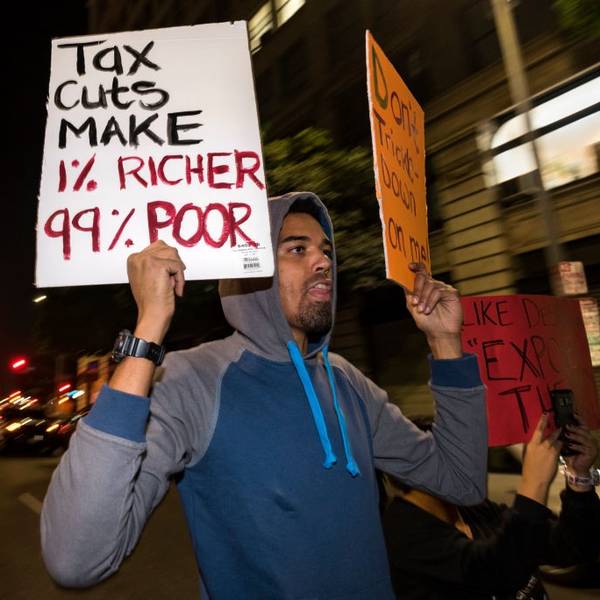
The Trump resistance has argued since the first Republican tax proposals were released that corporations and wealthy Americans would see most of the benefits of tax reform. (Photo: @gail_leiser/Twitter)
Confirming the suspicions of Trump critics and the analyses of the Republican tax plan that have been released by numerous economists, large corporations have admitted that the money they'll save if the plan passes will go towards enriching their wealthy shareholders--not towards strengthening the middle class through job creation.
At Bloomberg on Wednesday, Toluse Olorunnipa reported that executives at Coca-Cola, Pfizer, Amgen, and Cisco have all said in recent weeks that their companies will prioritize increasing dividends or buying back shares from shareholders, before investing their savings in the company by hiring more workers or giving employees raises.
The admission by the country's most powerful corporations runs counter to the narrative the Trump administration and congressional Republicans have pushed, according to Bloomberg:
At a Nov. 14 speech to the Wall Street Journal CEO Council by Trump's top economic adviser, Gary Cohn, the moderator asked business leaders in the audience for a show of hands if they planned to reinvest tax cut proceeds. Few people responded.
"Why aren't the other hands up?" Cohn asked.
Cohn's speech was followed by an appearance by Vice President Mike Pence, who reportedly told the business leaders, "We need all of you to tell this story" of corporate tax cuts leading to higher wages and more jobs for working Americans.
Groups including Americans for Tax Fairness, the Tax Policy Center, and the Center on Budget and Policy Priorities, have all found that the notion of long-term, meaningful benefits for the middle- and lower-classes is indeed just a story.
While corporations' taxes are immediately and permanently cut from 35 percent to 20 percent under the GOP plan, middle-class Americans will owe more in taxes by 2027, even if they see some relief in 2018.
According to the Congressional Budget Office analysis of the Senate plan, taxpayers making up to $30,000 will see their tax burden increase by 2019. By 2021, that extends to those making $40,000 and under.
Not all of corporate America is supportive of the tax plan. The investor John Bogle has called the proposal "a moral abomination," while Warren Buffett and the CEOs of Starbucks, BlackRock Financial Management, and Goldman Sachs have all publicly criticized the Republican plan.
On social media, Sen. Elizabeth Warren (D-Mass.) wrote on Wednesday that "Republicans are handing corporations the tax plan of their dreams. And the rest of us will be paying for their joy ride." Other critics also denounced the new revelations that corporations are already planning to use the tax cuts to their own advantage.
Dear Common Dreams reader, It’s been nearly 30 years since I co-founded Common Dreams with my late wife, Lina Newhouser. We had the radical notion that journalism should serve the public good, not corporate profits. It was clear to us from the outset what it would take to build such a project. No paid advertisements. No corporate sponsors. No millionaire publisher telling us what to think or do. Many people said we wouldn't last a year, but we proved those doubters wrong. Together with a tremendous team of journalists and dedicated staff, we built an independent media outlet free from the constraints of profits and corporate control. Our mission has always been simple: To inform. To inspire. To ignite change for the common good. Building Common Dreams was not easy. Our survival was never guaranteed. When you take on the most powerful forces—Wall Street greed, fossil fuel industry destruction, Big Tech lobbyists, and uber-rich oligarchs who have spent billions upon billions rigging the economy and democracy in their favor—the only bulwark you have is supporters who believe in your work. But here’s the urgent message from me today. It's never been this bad out there. And it's never been this hard to keep us going. At the very moment Common Dreams is most needed, the threats we face are intensifying. We need your support now more than ever. We don't accept corporate advertising and never will. We don't have a paywall because we don't think people should be blocked from critical news based on their ability to pay. Everything we do is funded by the donations of readers like you. When everyone does the little they can afford, we are strong. But if that support retreats or dries up, so do we. Will you donate now to make sure Common Dreams not only survives but thrives? —Craig Brown, Co-founder |
Confirming the suspicions of Trump critics and the analyses of the Republican tax plan that have been released by numerous economists, large corporations have admitted that the money they'll save if the plan passes will go towards enriching their wealthy shareholders--not towards strengthening the middle class through job creation.
At Bloomberg on Wednesday, Toluse Olorunnipa reported that executives at Coca-Cola, Pfizer, Amgen, and Cisco have all said in recent weeks that their companies will prioritize increasing dividends or buying back shares from shareholders, before investing their savings in the company by hiring more workers or giving employees raises.
The admission by the country's most powerful corporations runs counter to the narrative the Trump administration and congressional Republicans have pushed, according to Bloomberg:
At a Nov. 14 speech to the Wall Street Journal CEO Council by Trump's top economic adviser, Gary Cohn, the moderator asked business leaders in the audience for a show of hands if they planned to reinvest tax cut proceeds. Few people responded.
"Why aren't the other hands up?" Cohn asked.
Cohn's speech was followed by an appearance by Vice President Mike Pence, who reportedly told the business leaders, "We need all of you to tell this story" of corporate tax cuts leading to higher wages and more jobs for working Americans.
Groups including Americans for Tax Fairness, the Tax Policy Center, and the Center on Budget and Policy Priorities, have all found that the notion of long-term, meaningful benefits for the middle- and lower-classes is indeed just a story.
While corporations' taxes are immediately and permanently cut from 35 percent to 20 percent under the GOP plan, middle-class Americans will owe more in taxes by 2027, even if they see some relief in 2018.
According to the Congressional Budget Office analysis of the Senate plan, taxpayers making up to $30,000 will see their tax burden increase by 2019. By 2021, that extends to those making $40,000 and under.
Not all of corporate America is supportive of the tax plan. The investor John Bogle has called the proposal "a moral abomination," while Warren Buffett and the CEOs of Starbucks, BlackRock Financial Management, and Goldman Sachs have all publicly criticized the Republican plan.
On social media, Sen. Elizabeth Warren (D-Mass.) wrote on Wednesday that "Republicans are handing corporations the tax plan of their dreams. And the rest of us will be paying for their joy ride." Other critics also denounced the new revelations that corporations are already planning to use the tax cuts to their own advantage.
Confirming the suspicions of Trump critics and the analyses of the Republican tax plan that have been released by numerous economists, large corporations have admitted that the money they'll save if the plan passes will go towards enriching their wealthy shareholders--not towards strengthening the middle class through job creation.
At Bloomberg on Wednesday, Toluse Olorunnipa reported that executives at Coca-Cola, Pfizer, Amgen, and Cisco have all said in recent weeks that their companies will prioritize increasing dividends or buying back shares from shareholders, before investing their savings in the company by hiring more workers or giving employees raises.
The admission by the country's most powerful corporations runs counter to the narrative the Trump administration and congressional Republicans have pushed, according to Bloomberg:
At a Nov. 14 speech to the Wall Street Journal CEO Council by Trump's top economic adviser, Gary Cohn, the moderator asked business leaders in the audience for a show of hands if they planned to reinvest tax cut proceeds. Few people responded.
"Why aren't the other hands up?" Cohn asked.
Cohn's speech was followed by an appearance by Vice President Mike Pence, who reportedly told the business leaders, "We need all of you to tell this story" of corporate tax cuts leading to higher wages and more jobs for working Americans.
Groups including Americans for Tax Fairness, the Tax Policy Center, and the Center on Budget and Policy Priorities, have all found that the notion of long-term, meaningful benefits for the middle- and lower-classes is indeed just a story.
While corporations' taxes are immediately and permanently cut from 35 percent to 20 percent under the GOP plan, middle-class Americans will owe more in taxes by 2027, even if they see some relief in 2018.
According to the Congressional Budget Office analysis of the Senate plan, taxpayers making up to $30,000 will see their tax burden increase by 2019. By 2021, that extends to those making $40,000 and under.
Not all of corporate America is supportive of the tax plan. The investor John Bogle has called the proposal "a moral abomination," while Warren Buffett and the CEOs of Starbucks, BlackRock Financial Management, and Goldman Sachs have all publicly criticized the Republican plan.
On social media, Sen. Elizabeth Warren (D-Mass.) wrote on Wednesday that "Republicans are handing corporations the tax plan of their dreams. And the rest of us will be paying for their joy ride." Other critics also denounced the new revelations that corporations are already planning to use the tax cuts to their own advantage.