SUBSCRIBE TO OUR FREE NEWSLETTER
Daily news & progressive opinion—funded by the people, not the corporations—delivered straight to your inbox.
5
#000000
#FFFFFF
To donate by check, phone, or other method, see our More Ways to Give page.
Daily news & progressive opinion—funded by the people, not the corporations—delivered straight to your inbox.
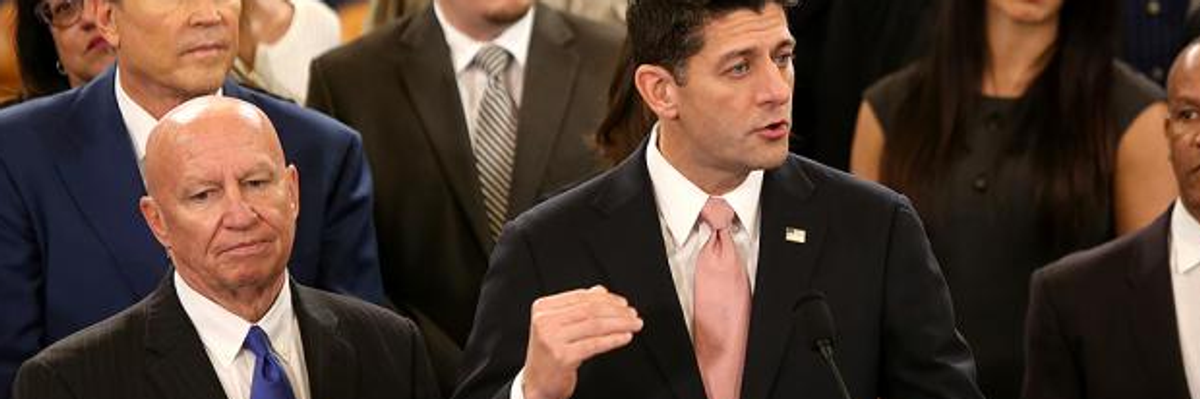
The GOP tax bill, called the Tax Cuts and Jobs Act, would disproportionately benefit the wealthy, and new analysis released Tuesday showed that Medicare would suffer automatic cuts under the legislation. (Photo: @thehill/Twitter)
Progressives on Tuesday urged Trump critics to voice their opposition to the tax bill that House Republicans are hoping to push through, after the Congressional Budget Office (CBO) reported that the legislation could put billions of dollars in Medicare spending in danger.
Because the bill would add an estimated $1.5 trillion to the federal deficit over the next decade, the CBO said in a letter to Congress, the government would be required to automatically cut mandatory spending should the bill pass, under "pay-as-you-go" rules, also known as PAYGO.
To make up for the deficit increase, the government would have to cut $150 billion in spending every year for the next decade.
Under PAYGO, Medicare spending could legally be cut by up to four percent, amounting to $25 billion dollars in cuts next year for the program under which senior citizens are provided with health insurance.
In an interview with the Washington Post, the American Association of Retired Persons (AARP)'s director of financial security said that a tax plan that takes money away from healthcare programs for the elderly would not be sustainable.
"We think having a simpler tax code is a great idea, but we also need a tax code that produces enough revenue to pay for programs, including Medicare and Medicaid," said Cristina Martin Firvida.
The CBO also estimated that an additional $85-90 billion could be cut from other programs including agricultural subsidies and funds linked to the Affordable Care Act and federal student loans.
The House could vote on its tax bill as early as this week, and opponents of the legislation made urgent calls for action from the Trump resistance.
Dear Common Dreams reader, It’s been nearly 30 years since I co-founded Common Dreams with my late wife, Lina Newhouser. We had the radical notion that journalism should serve the public good, not corporate profits. It was clear to us from the outset what it would take to build such a project. No paid advertisements. No corporate sponsors. No millionaire publisher telling us what to think or do. Many people said we wouldn't last a year, but we proved those doubters wrong. Together with a tremendous team of journalists and dedicated staff, we built an independent media outlet free from the constraints of profits and corporate control. Our mission has always been simple: To inform. To inspire. To ignite change for the common good. Building Common Dreams was not easy. Our survival was never guaranteed. When you take on the most powerful forces—Wall Street greed, fossil fuel industry destruction, Big Tech lobbyists, and uber-rich oligarchs who have spent billions upon billions rigging the economy and democracy in their favor—the only bulwark you have is supporters who believe in your work. But here’s the urgent message from me today. It's never been this bad out there. And it's never been this hard to keep us going. At the very moment Common Dreams is most needed, the threats we face are intensifying. We need your support now more than ever. We don't accept corporate advertising and never will. We don't have a paywall because we don't think people should be blocked from critical news based on their ability to pay. Everything we do is funded by the donations of readers like you. When everyone does the little they can afford, we are strong. But if that support retreats or dries up, so do we. Will you donate now to make sure Common Dreams not only survives but thrives? —Craig Brown, Co-founder |
Progressives on Tuesday urged Trump critics to voice their opposition to the tax bill that House Republicans are hoping to push through, after the Congressional Budget Office (CBO) reported that the legislation could put billions of dollars in Medicare spending in danger.
Because the bill would add an estimated $1.5 trillion to the federal deficit over the next decade, the CBO said in a letter to Congress, the government would be required to automatically cut mandatory spending should the bill pass, under "pay-as-you-go" rules, also known as PAYGO.
To make up for the deficit increase, the government would have to cut $150 billion in spending every year for the next decade.
Under PAYGO, Medicare spending could legally be cut by up to four percent, amounting to $25 billion dollars in cuts next year for the program under which senior citizens are provided with health insurance.
In an interview with the Washington Post, the American Association of Retired Persons (AARP)'s director of financial security said that a tax plan that takes money away from healthcare programs for the elderly would not be sustainable.
"We think having a simpler tax code is a great idea, but we also need a tax code that produces enough revenue to pay for programs, including Medicare and Medicaid," said Cristina Martin Firvida.
The CBO also estimated that an additional $85-90 billion could be cut from other programs including agricultural subsidies and funds linked to the Affordable Care Act and federal student loans.
The House could vote on its tax bill as early as this week, and opponents of the legislation made urgent calls for action from the Trump resistance.
Progressives on Tuesday urged Trump critics to voice their opposition to the tax bill that House Republicans are hoping to push through, after the Congressional Budget Office (CBO) reported that the legislation could put billions of dollars in Medicare spending in danger.
Because the bill would add an estimated $1.5 trillion to the federal deficit over the next decade, the CBO said in a letter to Congress, the government would be required to automatically cut mandatory spending should the bill pass, under "pay-as-you-go" rules, also known as PAYGO.
To make up for the deficit increase, the government would have to cut $150 billion in spending every year for the next decade.
Under PAYGO, Medicare spending could legally be cut by up to four percent, amounting to $25 billion dollars in cuts next year for the program under which senior citizens are provided with health insurance.
In an interview with the Washington Post, the American Association of Retired Persons (AARP)'s director of financial security said that a tax plan that takes money away from healthcare programs for the elderly would not be sustainable.
"We think having a simpler tax code is a great idea, but we also need a tax code that produces enough revenue to pay for programs, including Medicare and Medicaid," said Cristina Martin Firvida.
The CBO also estimated that an additional $85-90 billion could be cut from other programs including agricultural subsidies and funds linked to the Affordable Care Act and federal student loans.
The House could vote on its tax bill as early as this week, and opponents of the legislation made urgent calls for action from the Trump resistance.