SUBSCRIBE TO OUR FREE NEWSLETTER
Daily news & progressive opinion—funded by the people, not the corporations—delivered straight to your inbox.
5
#000000
#FFFFFF
To donate by check, phone, or other method, see our More Ways to Give page.
Daily news & progressive opinion—funded by the people, not the corporations—delivered straight to your inbox.
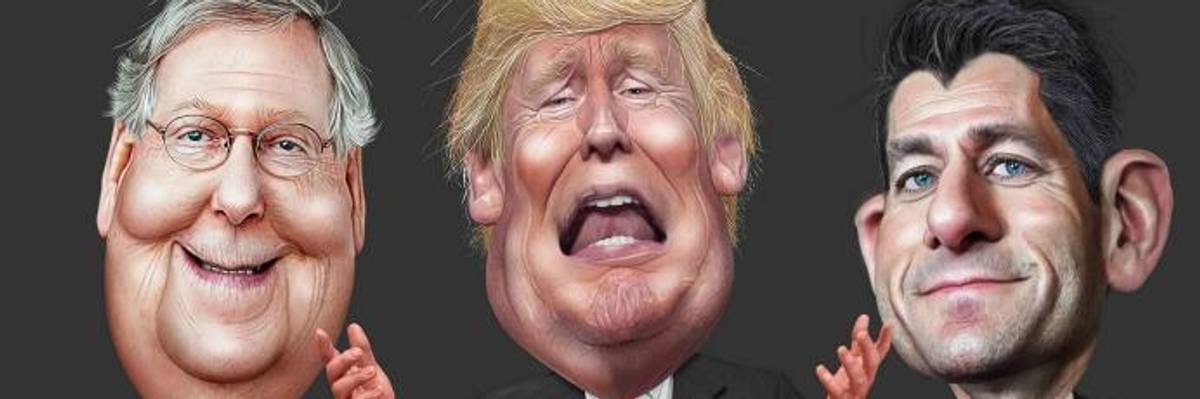
Caricatures of Senate Majority Leader Mitch McConnell, President Donald Trump, and House Speaker Paul Ryan. (Image: DonkeyHotey/flickr/cc)
As the Senate and House make final tweaks to their tax proposals, over 400 of the nation's very rich individuals have penned a letter to the lawmakers with a demand that stands in stark contrast to the plans on the table: don't cut our taxes--raise them.
The letter, organized by Responsible Wealth--a network that describes itself as "beneficiaries of economic policies tilted in their favor"--urges the members of Congress "to oppose any legislation that further exacerbates inequality," and notes that the GOP proposal "would disproportionately benefit wealthy individuals and corporations with provisions including repealing the estate tax, repealing the Alternative Minimum Tax, and slashing the top pass-through tax rate."
"It is neither wise nor just to give wealthy people more tax breaks at the expense of working families, and it would be especially egregious to fund tax cuts for the wealthy by cutting or dismantling programs that help people meet fundamental human needs like healthcare or nutrition assistance," they write.
According to the Washington Post, most of the the signatories, which include Ben & Jerry's Ice Cream founders Ben Cohen and Jerry Greenfield, billionaire hedge fund manager George Soros, and philanthropist Steven Rockefeller, "come from California, New York, and Massachusetts, states that went for Democrat Hillary Clinton in the last election."
Responsible Wealth joined with the Washington, D.C.-based group Voices for Progress in organizing the letter, which according to the Post, will be sent this week. The groups are also asking others who are in the top 5 percent to add their names to the letter.
House Republicans could pass their version this week while the Senate finance committee is still marking up that chamber's version.
They have some differences, but both versions, according to the Center on Budget and Policy Priorities, "would drive up deficits by $1.5 trillion over the next decade and give very large tax cuts to the wealthiest households and profitable corporations but only token help to millions of low-income working families."
Dear Common Dreams reader, It’s been nearly 30 years since I co-founded Common Dreams with my late wife, Lina Newhouser. We had the radical notion that journalism should serve the public good, not corporate profits. It was clear to us from the outset what it would take to build such a project. No paid advertisements. No corporate sponsors. No millionaire publisher telling us what to think or do. Many people said we wouldn't last a year, but we proved those doubters wrong. Together with a tremendous team of journalists and dedicated staff, we built an independent media outlet free from the constraints of profits and corporate control. Our mission has always been simple: To inform. To inspire. To ignite change for the common good. Building Common Dreams was not easy. Our survival was never guaranteed. When you take on the most powerful forces—Wall Street greed, fossil fuel industry destruction, Big Tech lobbyists, and uber-rich oligarchs who have spent billions upon billions rigging the economy and democracy in their favor—the only bulwark you have is supporters who believe in your work. But here’s the urgent message from me today. It's never been this bad out there. And it's never been this hard to keep us going. At the very moment Common Dreams is most needed, the threats we face are intensifying. We need your support now more than ever. We don't accept corporate advertising and never will. We don't have a paywall because we don't think people should be blocked from critical news based on their ability to pay. Everything we do is funded by the donations of readers like you. When everyone does the little they can afford, we are strong. But if that support retreats or dries up, so do we. Will you donate now to make sure Common Dreams not only survives but thrives? —Craig Brown, Co-founder |
As the Senate and House make final tweaks to their tax proposals, over 400 of the nation's very rich individuals have penned a letter to the lawmakers with a demand that stands in stark contrast to the plans on the table: don't cut our taxes--raise them.
The letter, organized by Responsible Wealth--a network that describes itself as "beneficiaries of economic policies tilted in their favor"--urges the members of Congress "to oppose any legislation that further exacerbates inequality," and notes that the GOP proposal "would disproportionately benefit wealthy individuals and corporations with provisions including repealing the estate tax, repealing the Alternative Minimum Tax, and slashing the top pass-through tax rate."
"It is neither wise nor just to give wealthy people more tax breaks at the expense of working families, and it would be especially egregious to fund tax cuts for the wealthy by cutting or dismantling programs that help people meet fundamental human needs like healthcare or nutrition assistance," they write.
According to the Washington Post, most of the the signatories, which include Ben & Jerry's Ice Cream founders Ben Cohen and Jerry Greenfield, billionaire hedge fund manager George Soros, and philanthropist Steven Rockefeller, "come from California, New York, and Massachusetts, states that went for Democrat Hillary Clinton in the last election."
Responsible Wealth joined with the Washington, D.C.-based group Voices for Progress in organizing the letter, which according to the Post, will be sent this week. The groups are also asking others who are in the top 5 percent to add their names to the letter.
House Republicans could pass their version this week while the Senate finance committee is still marking up that chamber's version.
They have some differences, but both versions, according to the Center on Budget and Policy Priorities, "would drive up deficits by $1.5 trillion over the next decade and give very large tax cuts to the wealthiest households and profitable corporations but only token help to millions of low-income working families."
As the Senate and House make final tweaks to their tax proposals, over 400 of the nation's very rich individuals have penned a letter to the lawmakers with a demand that stands in stark contrast to the plans on the table: don't cut our taxes--raise them.
The letter, organized by Responsible Wealth--a network that describes itself as "beneficiaries of economic policies tilted in their favor"--urges the members of Congress "to oppose any legislation that further exacerbates inequality," and notes that the GOP proposal "would disproportionately benefit wealthy individuals and corporations with provisions including repealing the estate tax, repealing the Alternative Minimum Tax, and slashing the top pass-through tax rate."
"It is neither wise nor just to give wealthy people more tax breaks at the expense of working families, and it would be especially egregious to fund tax cuts for the wealthy by cutting or dismantling programs that help people meet fundamental human needs like healthcare or nutrition assistance," they write.
According to the Washington Post, most of the the signatories, which include Ben & Jerry's Ice Cream founders Ben Cohen and Jerry Greenfield, billionaire hedge fund manager George Soros, and philanthropist Steven Rockefeller, "come from California, New York, and Massachusetts, states that went for Democrat Hillary Clinton in the last election."
Responsible Wealth joined with the Washington, D.C.-based group Voices for Progress in organizing the letter, which according to the Post, will be sent this week. The groups are also asking others who are in the top 5 percent to add their names to the letter.
House Republicans could pass their version this week while the Senate finance committee is still marking up that chamber's version.
They have some differences, but both versions, according to the Center on Budget and Policy Priorities, "would drive up deficits by $1.5 trillion over the next decade and give very large tax cuts to the wealthiest households and profitable corporations but only token help to millions of low-income working families."