SUBSCRIBE TO OUR FREE NEWSLETTER
Daily news & progressive opinion—funded by the people, not the corporations—delivered straight to your inbox.
5
#000000
#FFFFFF
To donate by check, phone, or other method, see our More Ways to Give page.
Daily news & progressive opinion—funded by the people, not the corporations—delivered straight to your inbox.
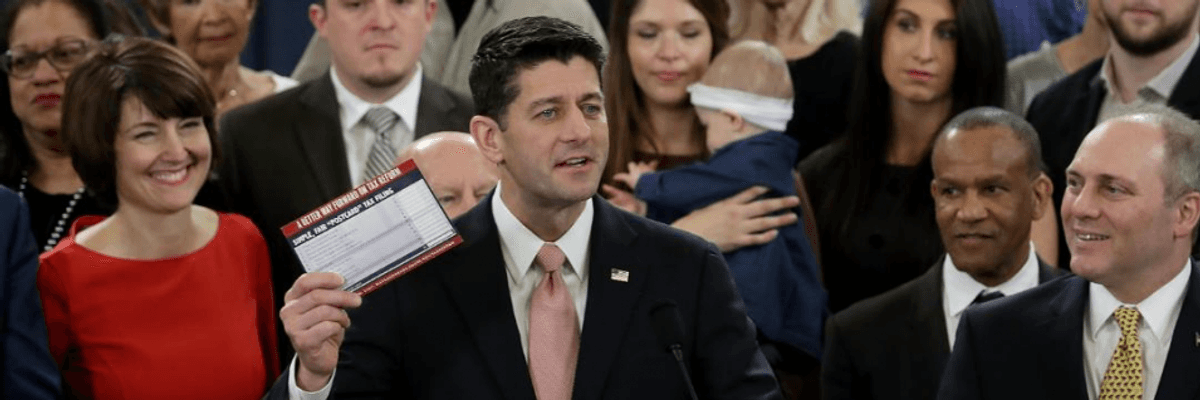
House Speaker Paul Ryan (R-Wis.) heralded the Republican tax plan as a win for the middle class, but spoke little about benefits for lower income Americans and the rich. (Photo: @srbija_eu/Twitter)
Appearing on CNN Thursday, Sen. Elizabeth Warren (D-Mass.) argued that the $1,182 that Republicans spent the day touting as the money average American families will save under their tax plan, is far from what the government could afford to give them--if they weren't spending that money on massive tax cuts for the rich.
As House Leader Paul Ryan (R-Wis.) and his colleagues said in a press conference unveiling some of the proposal's details, "the typical family of four will save $1,182 a year on their taxes."
Most American families would happily accept an extra $1200 per year to help with bills, college funds, and savings--but the estimated sum of $1,182 will only apply to families of four earning $59,000 per year, not lower income households.
Critics were also concerned about the GOP's plans for the Child Tax Credit. As the CBPP explained in September after the Republicans unveiled the framework for their plan, the Party "proposed to make their Child Tax Credit increase non-refundable, meaning that working families with incomes too low to have federal income tax liability would not benefit." A single parent raising two children making minimum wage would be left out of receiving the credit.
Sister Simone Campbell of NETWORK Lobby for Catholic Social Justice also noted that immigrant families would lose out under the plan. The so-called Tax Cuts & Jobs Act "rips the credits away from 5.1 million children whose parents are immigrant taxpayers with an average annual income of $21,000, which is a loss of 8.5% of their annual income. This will directly jeopardize the economic, educational, and developmental outcomes of children living in the U.S."
On social media, Americans expressed doubts that the GOP's tax plan would benefit them in a meaningful way--even if they're in the segment of the population that could receive $1,182 more per year in tax savings--especially compared to the huge tax cut given to corporations under the plan.
Dear Common Dreams reader, It’s been nearly 30 years since I co-founded Common Dreams with my late wife, Lina Newhouser. We had the radical notion that journalism should serve the public good, not corporate profits. It was clear to us from the outset what it would take to build such a project. No paid advertisements. No corporate sponsors. No millionaire publisher telling us what to think or do. Many people said we wouldn't last a year, but we proved those doubters wrong. Together with a tremendous team of journalists and dedicated staff, we built an independent media outlet free from the constraints of profits and corporate control. Our mission has always been simple: To inform. To inspire. To ignite change for the common good. Building Common Dreams was not easy. Our survival was never guaranteed. When you take on the most powerful forces—Wall Street greed, fossil fuel industry destruction, Big Tech lobbyists, and uber-rich oligarchs who have spent billions upon billions rigging the economy and democracy in their favor—the only bulwark you have is supporters who believe in your work. But here’s the urgent message from me today. It's never been this bad out there. And it's never been this hard to keep us going. At the very moment Common Dreams is most needed, the threats we face are intensifying. We need your support now more than ever. We don't accept corporate advertising and never will. We don't have a paywall because we don't think people should be blocked from critical news based on their ability to pay. Everything we do is funded by the donations of readers like you. When everyone does the little they can afford, we are strong. But if that support retreats or dries up, so do we. Will you donate now to make sure Common Dreams not only survives but thrives? —Craig Brown, Co-founder |
Appearing on CNN Thursday, Sen. Elizabeth Warren (D-Mass.) argued that the $1,182 that Republicans spent the day touting as the money average American families will save under their tax plan, is far from what the government could afford to give them--if they weren't spending that money on massive tax cuts for the rich.
As House Leader Paul Ryan (R-Wis.) and his colleagues said in a press conference unveiling some of the proposal's details, "the typical family of four will save $1,182 a year on their taxes."
Most American families would happily accept an extra $1200 per year to help with bills, college funds, and savings--but the estimated sum of $1,182 will only apply to families of four earning $59,000 per year, not lower income households.
Critics were also concerned about the GOP's plans for the Child Tax Credit. As the CBPP explained in September after the Republicans unveiled the framework for their plan, the Party "proposed to make their Child Tax Credit increase non-refundable, meaning that working families with incomes too low to have federal income tax liability would not benefit." A single parent raising two children making minimum wage would be left out of receiving the credit.
Sister Simone Campbell of NETWORK Lobby for Catholic Social Justice also noted that immigrant families would lose out under the plan. The so-called Tax Cuts & Jobs Act "rips the credits away from 5.1 million children whose parents are immigrant taxpayers with an average annual income of $21,000, which is a loss of 8.5% of their annual income. This will directly jeopardize the economic, educational, and developmental outcomes of children living in the U.S."
On social media, Americans expressed doubts that the GOP's tax plan would benefit them in a meaningful way--even if they're in the segment of the population that could receive $1,182 more per year in tax savings--especially compared to the huge tax cut given to corporations under the plan.
Appearing on CNN Thursday, Sen. Elizabeth Warren (D-Mass.) argued that the $1,182 that Republicans spent the day touting as the money average American families will save under their tax plan, is far from what the government could afford to give them--if they weren't spending that money on massive tax cuts for the rich.
As House Leader Paul Ryan (R-Wis.) and his colleagues said in a press conference unveiling some of the proposal's details, "the typical family of four will save $1,182 a year on their taxes."
Most American families would happily accept an extra $1200 per year to help with bills, college funds, and savings--but the estimated sum of $1,182 will only apply to families of four earning $59,000 per year, not lower income households.
Critics were also concerned about the GOP's plans for the Child Tax Credit. As the CBPP explained in September after the Republicans unveiled the framework for their plan, the Party "proposed to make their Child Tax Credit increase non-refundable, meaning that working families with incomes too low to have federal income tax liability would not benefit." A single parent raising two children making minimum wage would be left out of receiving the credit.
Sister Simone Campbell of NETWORK Lobby for Catholic Social Justice also noted that immigrant families would lose out under the plan. The so-called Tax Cuts & Jobs Act "rips the credits away from 5.1 million children whose parents are immigrant taxpayers with an average annual income of $21,000, which is a loss of 8.5% of their annual income. This will directly jeopardize the economic, educational, and developmental outcomes of children living in the U.S."
On social media, Americans expressed doubts that the GOP's tax plan would benefit them in a meaningful way--even if they're in the segment of the population that could receive $1,182 more per year in tax savings--especially compared to the huge tax cut given to corporations under the plan.