SUBSCRIBE TO OUR FREE NEWSLETTER
Daily news & progressive opinion—funded by the people, not the corporations—delivered straight to your inbox.
5
#000000
#FFFFFF
To donate by check, phone, or other method, see our More Ways to Give page.
Daily news & progressive opinion—funded by the people, not the corporations—delivered straight to your inbox.
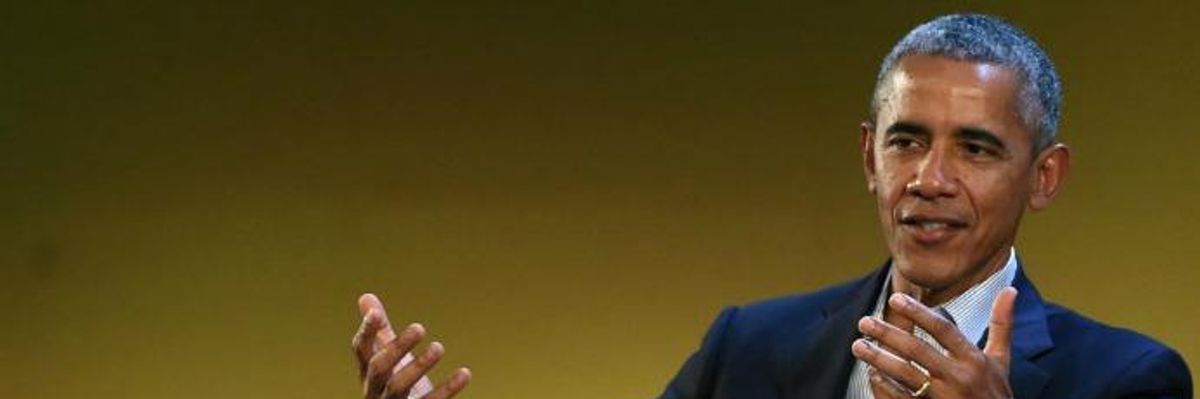
Former U.S. President Barack Obama speaks during the Seeds&Chips Global Food Innovation Summit on May 9, 2017 in Milan, Italy. (Photo: Pier Marco Tacca/Getty Images)
Less than a year has passed since he departed from the White House, and former President Barack Obama has already joined the "well trod and well paid" Wall Street speaking circuit, a decision many argued will negatively impact the Democratic Party's credibility as it attempts to fashion a message around taking on corporate monopolies, tackling income inequality, and loosening the insurance industry's control over the American healthcare system.
"This is a really crappy thing to do to the people who poured their hearts into his campaigns and administration."
--Matt Stoller, Open Markets InstituteAccording to a Bloomberg report published Monday, Obama has in the last month delivered two speeches to massive financial firms--Northern Trust Corp and the Carlyle Group--for around $400,000 a pop, and he is slated to attend a three-day conference hosted by Cantor Fitzgerald next week, for which he will make another $400,000.
Former Secretary of State Hillary Clinton faced a wave of intense criticism following her paid speeches to Wall Street during the 2016 presidential campaign, and later conceded that they weren't politically wise.
Obama, however, doesn't appear to harbor any concerns about the political impact his speeches may have--a fact that could be problematic for the Democratic Party, Bloomberg's Max Abelson notes.
"While he can't run for president, he continues to be an influential voice in a party torn between celebrating and vilifying corporate power," Abelson writes. "His new work with banks might suggest which side of the debate he'll be on."
News of Obama's decision to "cash in" following his eight-year presidency drew significant ire, particularly given his administration's failure to enact sufficient structural changes to the financial system following the worst economic collapse since the Great Depression.
As Abelson observes, Obama's "Justice Department prosecuted no major bankers for their roles in the financial crisis, and he resisted calls to break up the biggest banks, signing a regulatory overhaul that annoyed them with new rules but didn't stop them from pulling in record profits."
Responding to Bloomberg's report, a Twitter user asked Ryan Cooper, national correspondent for The Week, what a person could do in order to receive $400,000 for a single speech.
Cooper responded with a two-step plan:
Others reacted similarly to the former president's lucrative speeches, noting that given Obama's continued power over the direction of the Democratic Party--which was demonstrated in his successful push for former Labor Secretary Tom Perez to become chair of the Democratic National Committee over Rep. Keith Ellison (D-Minn.)--is reason enough for him to abandon the Wall Street circuit.
"This is a really crappy thing to do to the people who poured their hearts into his campaigns and administration," concluded Matt Stoller, a fellow at the Open Markets Institute. "Hillary Clinton publicly talking about why she lost [the 2016 election] is far healthier than private speeches to the Carlyle Group."
For investigative journalist Nomi Prins, Obama's Wall Street speeches are indicative of the deep, inescapable influence the nation's largest financial institutions exert over political discussion and policy in the United States.
"Wall Street knows no party," Prins concluded.
Dear Common Dreams reader, It’s been nearly 30 years since I co-founded Common Dreams with my late wife, Lina Newhouser. We had the radical notion that journalism should serve the public good, not corporate profits. It was clear to us from the outset what it would take to build such a project. No paid advertisements. No corporate sponsors. No millionaire publisher telling us what to think or do. Many people said we wouldn't last a year, but we proved those doubters wrong. Together with a tremendous team of journalists and dedicated staff, we built an independent media outlet free from the constraints of profits and corporate control. Our mission has always been simple: To inform. To inspire. To ignite change for the common good. Building Common Dreams was not easy. Our survival was never guaranteed. When you take on the most powerful forces—Wall Street greed, fossil fuel industry destruction, Big Tech lobbyists, and uber-rich oligarchs who have spent billions upon billions rigging the economy and democracy in their favor—the only bulwark you have is supporters who believe in your work. But here’s the urgent message from me today. It's never been this bad out there. And it's never been this hard to keep us going. At the very moment Common Dreams is most needed, the threats we face are intensifying. We need your support now more than ever. We don't accept corporate advertising and never will. We don't have a paywall because we don't think people should be blocked from critical news based on their ability to pay. Everything we do is funded by the donations of readers like you. When everyone does the little they can afford, we are strong. But if that support retreats or dries up, so do we. Will you donate now to make sure Common Dreams not only survives but thrives? —Craig Brown, Co-founder |
Less than a year has passed since he departed from the White House, and former President Barack Obama has already joined the "well trod and well paid" Wall Street speaking circuit, a decision many argued will negatively impact the Democratic Party's credibility as it attempts to fashion a message around taking on corporate monopolies, tackling income inequality, and loosening the insurance industry's control over the American healthcare system.
"This is a really crappy thing to do to the people who poured their hearts into his campaigns and administration."
--Matt Stoller, Open Markets InstituteAccording to a Bloomberg report published Monday, Obama has in the last month delivered two speeches to massive financial firms--Northern Trust Corp and the Carlyle Group--for around $400,000 a pop, and he is slated to attend a three-day conference hosted by Cantor Fitzgerald next week, for which he will make another $400,000.
Former Secretary of State Hillary Clinton faced a wave of intense criticism following her paid speeches to Wall Street during the 2016 presidential campaign, and later conceded that they weren't politically wise.
Obama, however, doesn't appear to harbor any concerns about the political impact his speeches may have--a fact that could be problematic for the Democratic Party, Bloomberg's Max Abelson notes.
"While he can't run for president, he continues to be an influential voice in a party torn between celebrating and vilifying corporate power," Abelson writes. "His new work with banks might suggest which side of the debate he'll be on."
News of Obama's decision to "cash in" following his eight-year presidency drew significant ire, particularly given his administration's failure to enact sufficient structural changes to the financial system following the worst economic collapse since the Great Depression.
As Abelson observes, Obama's "Justice Department prosecuted no major bankers for their roles in the financial crisis, and he resisted calls to break up the biggest banks, signing a regulatory overhaul that annoyed them with new rules but didn't stop them from pulling in record profits."
Responding to Bloomberg's report, a Twitter user asked Ryan Cooper, national correspondent for The Week, what a person could do in order to receive $400,000 for a single speech.
Cooper responded with a two-step plan:
Others reacted similarly to the former president's lucrative speeches, noting that given Obama's continued power over the direction of the Democratic Party--which was demonstrated in his successful push for former Labor Secretary Tom Perez to become chair of the Democratic National Committee over Rep. Keith Ellison (D-Minn.)--is reason enough for him to abandon the Wall Street circuit.
"This is a really crappy thing to do to the people who poured their hearts into his campaigns and administration," concluded Matt Stoller, a fellow at the Open Markets Institute. "Hillary Clinton publicly talking about why she lost [the 2016 election] is far healthier than private speeches to the Carlyle Group."
For investigative journalist Nomi Prins, Obama's Wall Street speeches are indicative of the deep, inescapable influence the nation's largest financial institutions exert over political discussion and policy in the United States.
"Wall Street knows no party," Prins concluded.
Less than a year has passed since he departed from the White House, and former President Barack Obama has already joined the "well trod and well paid" Wall Street speaking circuit, a decision many argued will negatively impact the Democratic Party's credibility as it attempts to fashion a message around taking on corporate monopolies, tackling income inequality, and loosening the insurance industry's control over the American healthcare system.
"This is a really crappy thing to do to the people who poured their hearts into his campaigns and administration."
--Matt Stoller, Open Markets InstituteAccording to a Bloomberg report published Monday, Obama has in the last month delivered two speeches to massive financial firms--Northern Trust Corp and the Carlyle Group--for around $400,000 a pop, and he is slated to attend a three-day conference hosted by Cantor Fitzgerald next week, for which he will make another $400,000.
Former Secretary of State Hillary Clinton faced a wave of intense criticism following her paid speeches to Wall Street during the 2016 presidential campaign, and later conceded that they weren't politically wise.
Obama, however, doesn't appear to harbor any concerns about the political impact his speeches may have--a fact that could be problematic for the Democratic Party, Bloomberg's Max Abelson notes.
"While he can't run for president, he continues to be an influential voice in a party torn between celebrating and vilifying corporate power," Abelson writes. "His new work with banks might suggest which side of the debate he'll be on."
News of Obama's decision to "cash in" following his eight-year presidency drew significant ire, particularly given his administration's failure to enact sufficient structural changes to the financial system following the worst economic collapse since the Great Depression.
As Abelson observes, Obama's "Justice Department prosecuted no major bankers for their roles in the financial crisis, and he resisted calls to break up the biggest banks, signing a regulatory overhaul that annoyed them with new rules but didn't stop them from pulling in record profits."
Responding to Bloomberg's report, a Twitter user asked Ryan Cooper, national correspondent for The Week, what a person could do in order to receive $400,000 for a single speech.
Cooper responded with a two-step plan:
Others reacted similarly to the former president's lucrative speeches, noting that given Obama's continued power over the direction of the Democratic Party--which was demonstrated in his successful push for former Labor Secretary Tom Perez to become chair of the Democratic National Committee over Rep. Keith Ellison (D-Minn.)--is reason enough for him to abandon the Wall Street circuit.
"This is a really crappy thing to do to the people who poured their hearts into his campaigns and administration," concluded Matt Stoller, a fellow at the Open Markets Institute. "Hillary Clinton publicly talking about why she lost [the 2016 election] is far healthier than private speeches to the Carlyle Group."
For investigative journalist Nomi Prins, Obama's Wall Street speeches are indicative of the deep, inescapable influence the nation's largest financial institutions exert over political discussion and policy in the United States.
"Wall Street knows no party," Prins concluded.