SUBSCRIBE TO OUR FREE NEWSLETTER
Daily news & progressive opinion—funded by the people, not the corporations—delivered straight to your inbox.
5
#000000
#FFFFFF
To donate by check, phone, or other method, see our More Ways to Give page.
Daily news & progressive opinion—funded by the people, not the corporations—delivered straight to your inbox.
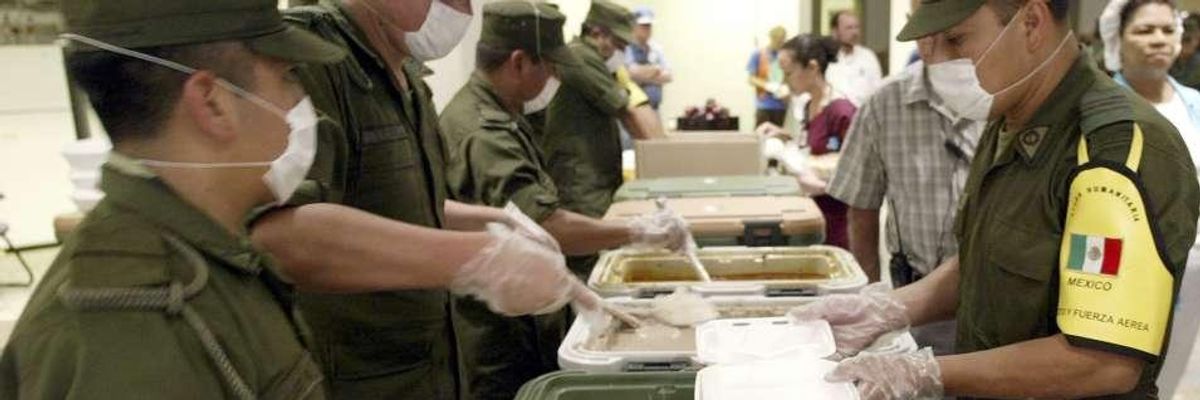
The Mexican Army provided humanitarian relief to Katrina refugees in San Antonio in 2005. On Sunday, Mexico offered aid to the U.S. again as Hurricane Harvey hit Houston. (Photo: Joe Mitchell/Getty Images)
With a clear, diplomatic response, the Mexican Ministry of Foreign Affairs on Sunday quashed President Donald Trump's latest attempt to convince the public that Mexico will pay for the border wall he promised his supporters, and debunked a number of his other repeated claims about the United States' southern neighbor--while offering help to the U.S. as Texas copes with the impact of Hurricane Harvey.
Mexico released its statement after Trump sent the following tweets, as Harvey was bringing catastrophic flooding to Houston on Sunday.
"As the Mexican government has always maintained, our country will not pay, under any circumstances for a wall or physical barrier that is built in US territory along the Mexican border," read the statement. "This determination is not part of a Mexican negotiating strategy, but a principle of national sovereignty and dignity."
The country also addressed the president's assertion that the wall is needed to protect Americans from Mexican criminals, pointing out that drug trafficking is a problem of demand as well as supply:
With regard to the violence generated in Mexico by the illicit traffic in drugs, arms and money between our countries, we reiterate that it is a shared problem that will only end if its root causes are addressed: the high demand for drugs in the United States and the offer from Mexico (and other countries)...Only on the basis of the principles of shared responsibility, teamwork and mutual trust can we overcome this challenge.
The Foreign Ministry took on an almost parental tone to address Trump's tweet about NAFTA and his penchant for discussing foreign relations, trade, and his policy agenda via Twitter, saying, "Mexico will not negotiate NAFTA, nor any other aspect of the bilateral relationship, through social networks or the media."
The statement ended by noting that Mexico has offered support to the U.S. "to deal with the impacts of [Hurricane Harvey], as good neighbors should always do in times of difficulty."
The Foreign Ministry's statement left out the fact that the U.S. has relied heavily on Mexican aid in the recent past. As the Washington Post reported Monday, Mexico provided significant aid to the U.S. in the wake of Hurricane Katrina in 2005.
"Marking the first time that Mexican troops had set foot on U.S. soil since the Mexican-American War in 1846, President Vicente Fox sent an army convoy and a naval vessel laden with food, water and medicine," wrote Max Bearak in the Post. "By the end of their three-week operation in Louisiana and Mississippi, the Mexicans had served 170,000 meals, helped distribute more than 184,000 tons of supplies and conducted more than 500 medical consultations."
On Twitter, commentators also noted the especially poor timing of Trump's latest attack on Mexico, considering the U.S. may need to take Mexico up on its offer of aid in the coming days.
Dear Common Dreams reader, It’s been nearly 30 years since I co-founded Common Dreams with my late wife, Lina Newhouser. We had the radical notion that journalism should serve the public good, not corporate profits. It was clear to us from the outset what it would take to build such a project. No paid advertisements. No corporate sponsors. No millionaire publisher telling us what to think or do. Many people said we wouldn't last a year, but we proved those doubters wrong. Together with a tremendous team of journalists and dedicated staff, we built an independent media outlet free from the constraints of profits and corporate control. Our mission has always been simple: To inform. To inspire. To ignite change for the common good. Building Common Dreams was not easy. Our survival was never guaranteed. When you take on the most powerful forces—Wall Street greed, fossil fuel industry destruction, Big Tech lobbyists, and uber-rich oligarchs who have spent billions upon billions rigging the economy and democracy in their favor—the only bulwark you have is supporters who believe in your work. But here’s the urgent message from me today. It's never been this bad out there. And it's never been this hard to keep us going. At the very moment Common Dreams is most needed, the threats we face are intensifying. We need your support now more than ever. We don't accept corporate advertising and never will. We don't have a paywall because we don't think people should be blocked from critical news based on their ability to pay. Everything we do is funded by the donations of readers like you. When everyone does the little they can afford, we are strong. But if that support retreats or dries up, so do we. Will you donate now to make sure Common Dreams not only survives but thrives? —Craig Brown, Co-founder |
With a clear, diplomatic response, the Mexican Ministry of Foreign Affairs on Sunday quashed President Donald Trump's latest attempt to convince the public that Mexico will pay for the border wall he promised his supporters, and debunked a number of his other repeated claims about the United States' southern neighbor--while offering help to the U.S. as Texas copes with the impact of Hurricane Harvey.
Mexico released its statement after Trump sent the following tweets, as Harvey was bringing catastrophic flooding to Houston on Sunday.
"As the Mexican government has always maintained, our country will not pay, under any circumstances for a wall or physical barrier that is built in US territory along the Mexican border," read the statement. "This determination is not part of a Mexican negotiating strategy, but a principle of national sovereignty and dignity."
The country also addressed the president's assertion that the wall is needed to protect Americans from Mexican criminals, pointing out that drug trafficking is a problem of demand as well as supply:
With regard to the violence generated in Mexico by the illicit traffic in drugs, arms and money between our countries, we reiterate that it is a shared problem that will only end if its root causes are addressed: the high demand for drugs in the United States and the offer from Mexico (and other countries)...Only on the basis of the principles of shared responsibility, teamwork and mutual trust can we overcome this challenge.
The Foreign Ministry took on an almost parental tone to address Trump's tweet about NAFTA and his penchant for discussing foreign relations, trade, and his policy agenda via Twitter, saying, "Mexico will not negotiate NAFTA, nor any other aspect of the bilateral relationship, through social networks or the media."
The statement ended by noting that Mexico has offered support to the U.S. "to deal with the impacts of [Hurricane Harvey], as good neighbors should always do in times of difficulty."
The Foreign Ministry's statement left out the fact that the U.S. has relied heavily on Mexican aid in the recent past. As the Washington Post reported Monday, Mexico provided significant aid to the U.S. in the wake of Hurricane Katrina in 2005.
"Marking the first time that Mexican troops had set foot on U.S. soil since the Mexican-American War in 1846, President Vicente Fox sent an army convoy and a naval vessel laden with food, water and medicine," wrote Max Bearak in the Post. "By the end of their three-week operation in Louisiana and Mississippi, the Mexicans had served 170,000 meals, helped distribute more than 184,000 tons of supplies and conducted more than 500 medical consultations."
On Twitter, commentators also noted the especially poor timing of Trump's latest attack on Mexico, considering the U.S. may need to take Mexico up on its offer of aid in the coming days.
With a clear, diplomatic response, the Mexican Ministry of Foreign Affairs on Sunday quashed President Donald Trump's latest attempt to convince the public that Mexico will pay for the border wall he promised his supporters, and debunked a number of his other repeated claims about the United States' southern neighbor--while offering help to the U.S. as Texas copes with the impact of Hurricane Harvey.
Mexico released its statement after Trump sent the following tweets, as Harvey was bringing catastrophic flooding to Houston on Sunday.
"As the Mexican government has always maintained, our country will not pay, under any circumstances for a wall or physical barrier that is built in US territory along the Mexican border," read the statement. "This determination is not part of a Mexican negotiating strategy, but a principle of national sovereignty and dignity."
The country also addressed the president's assertion that the wall is needed to protect Americans from Mexican criminals, pointing out that drug trafficking is a problem of demand as well as supply:
With regard to the violence generated in Mexico by the illicit traffic in drugs, arms and money between our countries, we reiterate that it is a shared problem that will only end if its root causes are addressed: the high demand for drugs in the United States and the offer from Mexico (and other countries)...Only on the basis of the principles of shared responsibility, teamwork and mutual trust can we overcome this challenge.
The Foreign Ministry took on an almost parental tone to address Trump's tweet about NAFTA and his penchant for discussing foreign relations, trade, and his policy agenda via Twitter, saying, "Mexico will not negotiate NAFTA, nor any other aspect of the bilateral relationship, through social networks or the media."
The statement ended by noting that Mexico has offered support to the U.S. "to deal with the impacts of [Hurricane Harvey], as good neighbors should always do in times of difficulty."
The Foreign Ministry's statement left out the fact that the U.S. has relied heavily on Mexican aid in the recent past. As the Washington Post reported Monday, Mexico provided significant aid to the U.S. in the wake of Hurricane Katrina in 2005.
"Marking the first time that Mexican troops had set foot on U.S. soil since the Mexican-American War in 1846, President Vicente Fox sent an army convoy and a naval vessel laden with food, water and medicine," wrote Max Bearak in the Post. "By the end of their three-week operation in Louisiana and Mississippi, the Mexicans had served 170,000 meals, helped distribute more than 184,000 tons of supplies and conducted more than 500 medical consultations."
On Twitter, commentators also noted the especially poor timing of Trump's latest attack on Mexico, considering the U.S. may need to take Mexico up on its offer of aid in the coming days.