SUBSCRIBE TO OUR FREE NEWSLETTER
Daily news & progressive opinion—funded by the people, not the corporations—delivered straight to your inbox.
5
#000000
#FFFFFF
To donate by check, phone, or other method, see our More Ways to Give page.
Daily news & progressive opinion—funded by the people, not the corporations—delivered straight to your inbox.
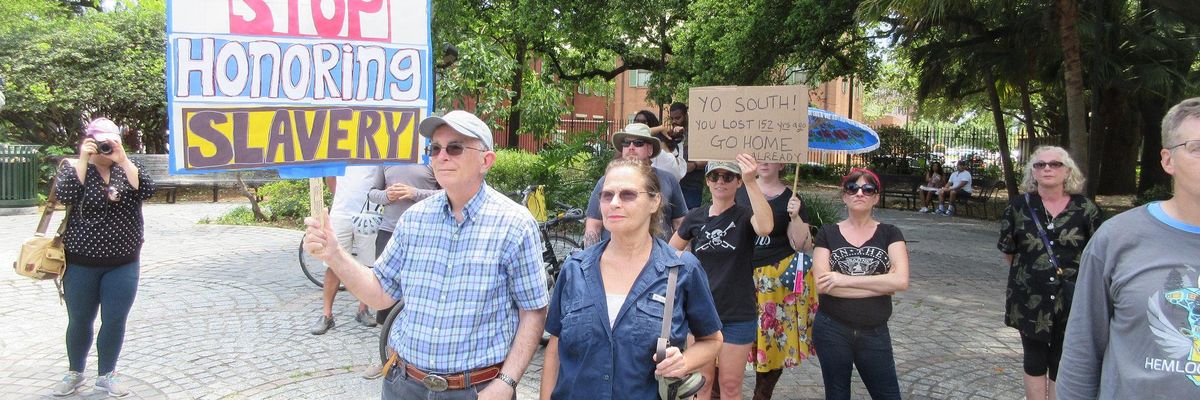
Citizens of southern cities including New Orleans have fought in recent months to have Confederate statues removed. (Photo: Infrogmation of New Orleans/Flickr/cc)
Critics were quick to point out that President Donald Trump has once again put himself on the wrong side of efforts to combat racism and address white supremacy when he defended "beautiful" Confederate monuments in a Thursday morning tweet.
Trump tripled down on his failure to condemn last weekend's white supremacist rally in Charlottesville, Virginia on Thursday, tweeting in support of the protesters' stated cause: to preserve a monument to Confederate General Robert E. Lee. The president argued that the ongoing efforts of states and cities to take down statues of Confederate figures is "foolish" and that the monuments are an irreplaceable reminder of U.S. history.
Since the violent rally in Charlottesville, some cities have begun expediting their efforts to remove statues memorializing Lee, Stonewall Jackson, and other leaders of the Confederacy. Baltimore officials swiftly took down two statues late Tuesday night, while civil rights groups and citizens of Gainesville, Florida and Lexington, Kentucky called for the removal of other Confederate monuments without the delays that have been involved in such decisions in New Orleans, Charlottesville, and other cities.
Proponents of removing the monuments argue that they serve as painful reminders of slavery. As Tyler Zimmer pointed out this week in the socialist magazine Jacobin, Confederate symbols also recall the efforts of wealthy slave owners to recruit southerners into a worldview and a resulting bloody conflict built on the idea that poor white farmers had more in common with rich white landowners than they did with black slaves who had no economic power--a worldview of white supremacy:
In [fighting for the right to own slaves]...these men also betrayed their own class and themselves--all for the sake of protecting the wealth and power of a tiny ruling class who looked upon them with scorn. From the beginning of the Confederacy, the Southern ruling classes fretted over whether they could win over masses of poor, non-slaveowning whites to their cause. This, of course, is the problem every minority ruling class in history has had to face--the problem of how to make the sectional, particular interests of the ruling elite appear to be the universal interests of all.
Those who want the monuments taken down point out the significance of how many were erected decades after the Civil War, calling into question the notion that their sole purpose was to commemorate the lives lost. In a study in 2016, the Southern Poverty Law Center detailed how the vast majority of Confederate monuments were built between 1890 and 1920, around the time that Jim Crow laws came to prominence.
"The argument that the Confederate flag and other displays represent 'heritage, not hate' ignores the near-universal heritage of African Americans whose ancestors were enslaved by the millions in the South," said the report. "It trivializes their pain, their history and their concerns about racism--whether it's the racism of the past or that of today."
On Twitter, many took issue with Trump's statement that the monuments will be "never able to be comparably replaced!"--noting that many Americans have made more positive contributions to the country and the South than Robert E. Lee and other Confederate generals.
Dear Common Dreams reader, It’s been nearly 30 years since I co-founded Common Dreams with my late wife, Lina Newhouser. We had the radical notion that journalism should serve the public good, not corporate profits. It was clear to us from the outset what it would take to build such a project. No paid advertisements. No corporate sponsors. No millionaire publisher telling us what to think or do. Many people said we wouldn't last a year, but we proved those doubters wrong. Together with a tremendous team of journalists and dedicated staff, we built an independent media outlet free from the constraints of profits and corporate control. Our mission has always been simple: To inform. To inspire. To ignite change for the common good. Building Common Dreams was not easy. Our survival was never guaranteed. When you take on the most powerful forces—Wall Street greed, fossil fuel industry destruction, Big Tech lobbyists, and uber-rich oligarchs who have spent billions upon billions rigging the economy and democracy in their favor—the only bulwark you have is supporters who believe in your work. But here’s the urgent message from me today. It's never been this bad out there. And it's never been this hard to keep us going. At the very moment Common Dreams is most needed, the threats we face are intensifying. We need your support now more than ever. We don't accept corporate advertising and never will. We don't have a paywall because we don't think people should be blocked from critical news based on their ability to pay. Everything we do is funded by the donations of readers like you. When everyone does the little they can afford, we are strong. But if that support retreats or dries up, so do we. Will you donate now to make sure Common Dreams not only survives but thrives? —Craig Brown, Co-founder |
Critics were quick to point out that President Donald Trump has once again put himself on the wrong side of efforts to combat racism and address white supremacy when he defended "beautiful" Confederate monuments in a Thursday morning tweet.
Trump tripled down on his failure to condemn last weekend's white supremacist rally in Charlottesville, Virginia on Thursday, tweeting in support of the protesters' stated cause: to preserve a monument to Confederate General Robert E. Lee. The president argued that the ongoing efforts of states and cities to take down statues of Confederate figures is "foolish" and that the monuments are an irreplaceable reminder of U.S. history.
Since the violent rally in Charlottesville, some cities have begun expediting their efforts to remove statues memorializing Lee, Stonewall Jackson, and other leaders of the Confederacy. Baltimore officials swiftly took down two statues late Tuesday night, while civil rights groups and citizens of Gainesville, Florida and Lexington, Kentucky called for the removal of other Confederate monuments without the delays that have been involved in such decisions in New Orleans, Charlottesville, and other cities.
Proponents of removing the monuments argue that they serve as painful reminders of slavery. As Tyler Zimmer pointed out this week in the socialist magazine Jacobin, Confederate symbols also recall the efforts of wealthy slave owners to recruit southerners into a worldview and a resulting bloody conflict built on the idea that poor white farmers had more in common with rich white landowners than they did with black slaves who had no economic power--a worldview of white supremacy:
In [fighting for the right to own slaves]...these men also betrayed their own class and themselves--all for the sake of protecting the wealth and power of a tiny ruling class who looked upon them with scorn. From the beginning of the Confederacy, the Southern ruling classes fretted over whether they could win over masses of poor, non-slaveowning whites to their cause. This, of course, is the problem every minority ruling class in history has had to face--the problem of how to make the sectional, particular interests of the ruling elite appear to be the universal interests of all.
Those who want the monuments taken down point out the significance of how many were erected decades after the Civil War, calling into question the notion that their sole purpose was to commemorate the lives lost. In a study in 2016, the Southern Poverty Law Center detailed how the vast majority of Confederate monuments were built between 1890 and 1920, around the time that Jim Crow laws came to prominence.
"The argument that the Confederate flag and other displays represent 'heritage, not hate' ignores the near-universal heritage of African Americans whose ancestors were enslaved by the millions in the South," said the report. "It trivializes their pain, their history and their concerns about racism--whether it's the racism of the past or that of today."
On Twitter, many took issue with Trump's statement that the monuments will be "never able to be comparably replaced!"--noting that many Americans have made more positive contributions to the country and the South than Robert E. Lee and other Confederate generals.
Critics were quick to point out that President Donald Trump has once again put himself on the wrong side of efforts to combat racism and address white supremacy when he defended "beautiful" Confederate monuments in a Thursday morning tweet.
Trump tripled down on his failure to condemn last weekend's white supremacist rally in Charlottesville, Virginia on Thursday, tweeting in support of the protesters' stated cause: to preserve a monument to Confederate General Robert E. Lee. The president argued that the ongoing efforts of states and cities to take down statues of Confederate figures is "foolish" and that the monuments are an irreplaceable reminder of U.S. history.
Since the violent rally in Charlottesville, some cities have begun expediting their efforts to remove statues memorializing Lee, Stonewall Jackson, and other leaders of the Confederacy. Baltimore officials swiftly took down two statues late Tuesday night, while civil rights groups and citizens of Gainesville, Florida and Lexington, Kentucky called for the removal of other Confederate monuments without the delays that have been involved in such decisions in New Orleans, Charlottesville, and other cities.
Proponents of removing the monuments argue that they serve as painful reminders of slavery. As Tyler Zimmer pointed out this week in the socialist magazine Jacobin, Confederate symbols also recall the efforts of wealthy slave owners to recruit southerners into a worldview and a resulting bloody conflict built on the idea that poor white farmers had more in common with rich white landowners than they did with black slaves who had no economic power--a worldview of white supremacy:
In [fighting for the right to own slaves]...these men also betrayed their own class and themselves--all for the sake of protecting the wealth and power of a tiny ruling class who looked upon them with scorn. From the beginning of the Confederacy, the Southern ruling classes fretted over whether they could win over masses of poor, non-slaveowning whites to their cause. This, of course, is the problem every minority ruling class in history has had to face--the problem of how to make the sectional, particular interests of the ruling elite appear to be the universal interests of all.
Those who want the monuments taken down point out the significance of how many were erected decades after the Civil War, calling into question the notion that their sole purpose was to commemorate the lives lost. In a study in 2016, the Southern Poverty Law Center detailed how the vast majority of Confederate monuments were built between 1890 and 1920, around the time that Jim Crow laws came to prominence.
"The argument that the Confederate flag and other displays represent 'heritage, not hate' ignores the near-universal heritage of African Americans whose ancestors were enslaved by the millions in the South," said the report. "It trivializes their pain, their history and their concerns about racism--whether it's the racism of the past or that of today."
On Twitter, many took issue with Trump's statement that the monuments will be "never able to be comparably replaced!"--noting that many Americans have made more positive contributions to the country and the South than Robert E. Lee and other Confederate generals.