

SUBSCRIBE TO OUR FREE NEWSLETTER
Daily news & progressive opinion—funded by the people, not the corporations—delivered straight to your inbox.
5
#000000
#FFFFFF
To donate by check, phone, or other method, see our More Ways to Give page.
Daily news & progressive opinion—funded by the people, not the corporations—delivered straight to your inbox.
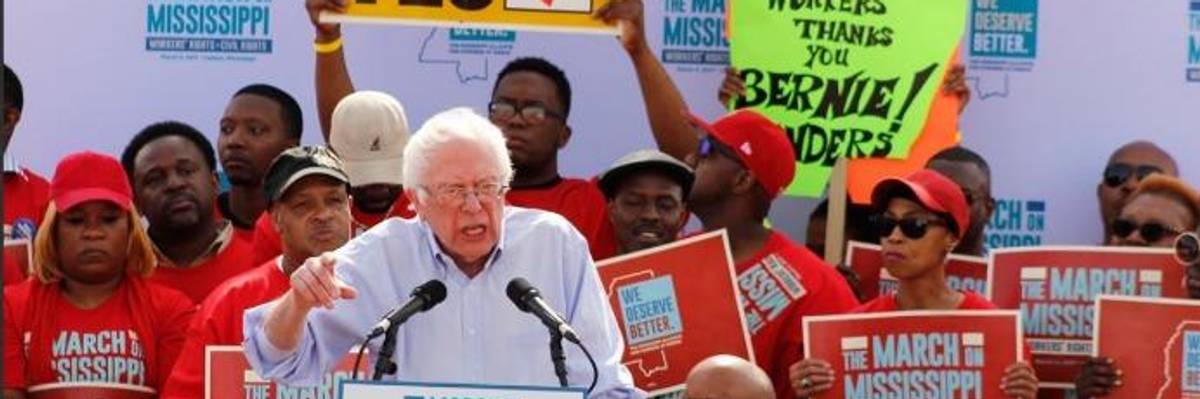
"Nissan is not a poor company. It is not losing money," Sanders writes. (Photo: MoveOn.org/Twitter)
As Nissan workers in Canton, Mississippi are set to begin voting Thursday on whether to form a union in the face of "one of the nastiest anti-union campaigns in modern U.S. history," Sen. Bernie Sanders (I-Vt.) penned an op-ed expressing his support for the workers' effort, linking it to a broader struggle against racial injustice and America's staggering income inequality.
"The truth is Nissan is an all-too-familiar story of how greedy corporations divide and conquer working people."
--Sen. Bernie SandersSanders, writing for The Guardian, begins by invoking the words of Martin Luther King Jr., who wrote in his Letter from a Birmingham Jail, "freedom is never voluntarily given by the oppressor; it must be demanded by the oppressed."
"This week, thousands of courageous workers at a Nissan plant in Canton, Mississippi are doing just that," Sanders writes. "They are voting for the right to join a union, the right to make a living wage, and the right to job security and pensions. And they are doing so by connecting workers' rights with civil rights, as the plant's workforce is over 80 percent African American."
Since the 1970s, union membership in the United States has declined rapidly; as union membership has fallen, research shows, inequality has soared and worker pay has stagnated.
During his 2016 presidential campaign, Sanders brought these themes to the national stage, and in recent weeks he has continued to push legislation that would raise the federal minimum wage to $15 an hour and guarantee healthcare to all Americans.
The struggle of Nissan workers, Sanders argued on Thursday, is connected to struggles of workers across the country fighting for the right to organize and earn a living wage in the face of corporate backlash.
"The truth is Nissan is an all-too-familiar story of how greedy corporations divide and conquer working people," Sanders writes. "The company has brought in large numbers of contract employees and paid them less than they paid full-timers for the same work--an old trick for driving down everyone's wages. The company is also telling those undecided about the union that their pro-union co-workers would cost them their jobs."
Sanders goes on to argue that Nissan's vicious anti-union push is geared entirely toward protecting its "obscene profits," which he suggests "are a direct result of corporations' decades-long assault on workers and their unions."
"We need to build on their courageous efforts, and fight for an economy that works for all of us, not just the top one percent."
--Bernie Sanders"Nissan is not a poor company. It is not losing money," Sanders writes. "Last year, it made a record-breaking $6.6 billion in profits and it gave its CEO more than $9.5 million in total compensation."
Despite the high-minded justifications the company has offered for its campaign against the workers' attempt to unionize--which the National Labor Relations Board argues has violated workers' rights--Nissan "does not want unions in the U.S. South, because unions mean higher wages, safer working conditions, decent healthcare, and a secure retirement," Sanders writes.
No matter what results the vote brings, Sanders concludes, "Nissan workers should be very proud."
"They have exposed the system of racial and economic injustice that corporations like Nissan are perpetrating," Sanders writes. "We need to build on their courageous efforts, and fight for an economy that works for all of us, not just the top one percent."
This country and this world are at a monumental crossroads. US voters have an opportunity to beat back the forces of fascism and confront the billionaires who are rigging the economy, our media system, and our democracy, making it increasingly impossible for ordinary people to get by. We’re not just talking about the election. We’re talking about what must be done once these fascist elements are vanquished from power. We need a bolder set of solutions than what either major party has so far been willing to offer and a working-class movement ready to fight like hell for it. Trump didn't emerge from nowhere. The conditions that fueled MAGA authoritarianism were created by decades of radical neoliberal economic policies and a corrupt political system dominated by corporate interests. They slashed taxes on the super-rich, promising that the benefits would trickle down. They said giveaways to the corporate titans would make life more affordable for the rest of us. It was all bullshit. And when a bitter, betrayed populace searches for someone to blame, right-wing demagogues have little trouble finding scapegoats. People know when they're being lied to, but you won't hear any of this from the corporate media. Only independent journalism—powered and funded by people who believe in building a better world—can deliver truly trustworthy daily news. If you share our vision, please contribute whatever you can to sustain our work. |
As Nissan workers in Canton, Mississippi are set to begin voting Thursday on whether to form a union in the face of "one of the nastiest anti-union campaigns in modern U.S. history," Sen. Bernie Sanders (I-Vt.) penned an op-ed expressing his support for the workers' effort, linking it to a broader struggle against racial injustice and America's staggering income inequality.
"The truth is Nissan is an all-too-familiar story of how greedy corporations divide and conquer working people."
--Sen. Bernie SandersSanders, writing for The Guardian, begins by invoking the words of Martin Luther King Jr., who wrote in his Letter from a Birmingham Jail, "freedom is never voluntarily given by the oppressor; it must be demanded by the oppressed."
"This week, thousands of courageous workers at a Nissan plant in Canton, Mississippi are doing just that," Sanders writes. "They are voting for the right to join a union, the right to make a living wage, and the right to job security and pensions. And they are doing so by connecting workers' rights with civil rights, as the plant's workforce is over 80 percent African American."
Since the 1970s, union membership in the United States has declined rapidly; as union membership has fallen, research shows, inequality has soared and worker pay has stagnated.
During his 2016 presidential campaign, Sanders brought these themes to the national stage, and in recent weeks he has continued to push legislation that would raise the federal minimum wage to $15 an hour and guarantee healthcare to all Americans.
The struggle of Nissan workers, Sanders argued on Thursday, is connected to struggles of workers across the country fighting for the right to organize and earn a living wage in the face of corporate backlash.
"The truth is Nissan is an all-too-familiar story of how greedy corporations divide and conquer working people," Sanders writes. "The company has brought in large numbers of contract employees and paid them less than they paid full-timers for the same work--an old trick for driving down everyone's wages. The company is also telling those undecided about the union that their pro-union co-workers would cost them their jobs."
Sanders goes on to argue that Nissan's vicious anti-union push is geared entirely toward protecting its "obscene profits," which he suggests "are a direct result of corporations' decades-long assault on workers and their unions."
"We need to build on their courageous efforts, and fight for an economy that works for all of us, not just the top one percent."
--Bernie Sanders"Nissan is not a poor company. It is not losing money," Sanders writes. "Last year, it made a record-breaking $6.6 billion in profits and it gave its CEO more than $9.5 million in total compensation."
Despite the high-minded justifications the company has offered for its campaign against the workers' attempt to unionize--which the National Labor Relations Board argues has violated workers' rights--Nissan "does not want unions in the U.S. South, because unions mean higher wages, safer working conditions, decent healthcare, and a secure retirement," Sanders writes.
No matter what results the vote brings, Sanders concludes, "Nissan workers should be very proud."
"They have exposed the system of racial and economic injustice that corporations like Nissan are perpetrating," Sanders writes. "We need to build on their courageous efforts, and fight for an economy that works for all of us, not just the top one percent."

