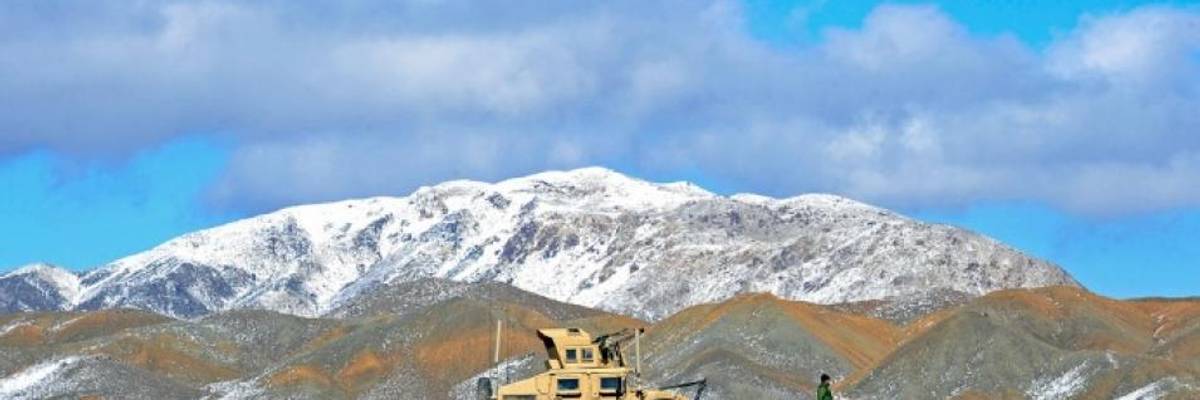
Trump appears committed to the belief that mineral extraction "could be one justification for the United States to stay engaged in" Afghanistan, the New York Times reported. (Photo: DVIDSHUB/Flickr/cc)
Colonialism and Greed: Trump Considers Afghan War Expansion to Exploit Minerals
Trump is reportedly being encouraged by corporate executives to take advantage of Afghanistan's mineral wealth
As the 16th anniversary of the U.S. invasion of Afghanistan approaches, President Donald Trump is reportedly being pressured by a billionaire financier and a chemical executive to extend the scope of the conflict for one simple, greedy reason: to exploit Afghanistan's mineral reserves.
"This is like free PR for the Taliban about U.S. intentions under Trump."
--Laura Rozen, AI Monitor
According to James Risen and Mark Landler of the New York Times, the Trump administration is "considering sending an envoy to Afghanistan to meet with mining officials" as the president is receiving encouragement from Stephen Feinberg, the billionaire head of DynCorp, and Michael Silver, the head of American Elements, a firm that specializes in "extracting rare-earth minerals."
"In 2010, American officials estimated that Afghanistan had untapped mineral deposits worth nearly $1 trillion," Risen and Landler note. This large figure reportedly "caught the attention of" the president, who has in the past argued that the biggest failure of the U.S. in Iraq was not"taking" the country's oil.
Trump is hardly the first president to notice and eagerly examine Afghanistan's mineral reserves.
"In 2006, the George W. Bush administration conducted aerial surveys of the country to map its mineral resources," Risen and Landler note. "Under President Barack Obama, the Pentagon set up a task force to try to build a mining industry in Afghanistan--a challenge that was stymied by rampant corruption, as well as security problems and the lack of roads, bridges or railroads."
Nonetheless, Trump appears to be committed to the belief that mineral extraction "could be one justification for the United States to stay engaged in the country," despite warnings from security analysts that such a strategy could risk further deadly confrontations with the Taliban.
"That sort of habit makes some people rich in the business world, at the expense of making others poor. When you're talking about global politics and terrorism, however, people die, and nations fail."
--Adam Clark Estes, Gizmodo
If Trump moves forward with a mineral extraction plan, Eric Levitz of New York Magazine adds, there is a serious "danger of feeding the Taliban top-notch propaganda. It's hard to win hearts and minds, when you're also trying to win minerals and mines."
But as Gizmodo's Adam Clark Estes observes, such concerns are unlikely to move Trump, whose "greed has led the man to leave a path of destruction behind him on his pursuit of profit and glory."
"That sort of habit makes some people rich in the business world, at the expense of making others poor," Estes writes. "When you're talking about global politics and terrorism, however, people die, and nations fail."
As Common Dreams reported earlier this month, the Trump White House has been consulting with high-profile war profiteers who have argued that the way forward in Afghanistan is to further privatize military operations in the country. White House Chief Strategist Steve Bannon and senior advisor Jared Kushner reportedly "recruited" both Feinberg and Blackwater founder Erik Prince to lay out a war plan for the president.
Critics denounced this development as a step toward "colonialism," and commentators had similar words for Trump's apparent attraction to Afghanistan's mineral wealth.
Law professor and former White House lawyer Andy Wright concluded that the Times report lays bare Trump's "British Empire thinking," which places plunder over "threat-based security."
We are at a crossroads
This country and this world are at a monumental crossroads. In a few short weeks, US voters will have an opportunity to beat back the forces of fascism and confront the billionaires who are rigging the economy, our media system, and our democracy, making it increasingly impossible for ordinary people to get by. We’re not just talking about the election. We’re talking about what must be done once these fascist elements are vanquished from power. We need a bolder set of solutions than what either major party has so far been willing to offer and a working-class movement ready to fight like hell for it. Trump didn't emerge from nowhere. The conditions that fueled MAGA authoritarianism were created by decades of radical neoliberal economic policies and a corrupt political system dominated by corporate interests. They slashed taxes on the super-rich, promising that the benefits would trickle down. They said giveaways to the corporate titans would make life more affordable for the rest of us. It was all bullshit. And when a bitter, betrayed populace searches for someone to blame, right-wing demagogues have little trouble finding scapegoats. People know when they're being lied to, but you won't hear any of this from the corporate media. Only independent journalism—powered and funded by people who believe in building a better world—can deliver truly trustworthy daily news. Our Fall Campaign is underway, and we need your help. To power our newsroom through the rest of the year, we need to raise $125,000 by midnight on October 31. So if you share our vision, please contribute whatever you can to sustain our work. |
As the 16th anniversary of the U.S. invasion of Afghanistan approaches, President Donald Trump is reportedly being pressured by a billionaire financier and a chemical executive to extend the scope of the conflict for one simple, greedy reason: to exploit Afghanistan's mineral reserves.
"This is like free PR for the Taliban about U.S. intentions under Trump."
--Laura Rozen, AI Monitor
According to James Risen and Mark Landler of the New York Times, the Trump administration is "considering sending an envoy to Afghanistan to meet with mining officials" as the president is receiving encouragement from Stephen Feinberg, the billionaire head of DynCorp, and Michael Silver, the head of American Elements, a firm that specializes in "extracting rare-earth minerals."
"In 2010, American officials estimated that Afghanistan had untapped mineral deposits worth nearly $1 trillion," Risen and Landler note. This large figure reportedly "caught the attention of" the president, who has in the past argued that the biggest failure of the U.S. in Iraq was not"taking" the country's oil.
Trump is hardly the first president to notice and eagerly examine Afghanistan's mineral reserves.
"In 2006, the George W. Bush administration conducted aerial surveys of the country to map its mineral resources," Risen and Landler note. "Under President Barack Obama, the Pentagon set up a task force to try to build a mining industry in Afghanistan--a challenge that was stymied by rampant corruption, as well as security problems and the lack of roads, bridges or railroads."
Nonetheless, Trump appears to be committed to the belief that mineral extraction "could be one justification for the United States to stay engaged in the country," despite warnings from security analysts that such a strategy could risk further deadly confrontations with the Taliban.
"That sort of habit makes some people rich in the business world, at the expense of making others poor. When you're talking about global politics and terrorism, however, people die, and nations fail."
--Adam Clark Estes, Gizmodo
If Trump moves forward with a mineral extraction plan, Eric Levitz of New York Magazine adds, there is a serious "danger of feeding the Taliban top-notch propaganda. It's hard to win hearts and minds, when you're also trying to win minerals and mines."
But as Gizmodo's Adam Clark Estes observes, such concerns are unlikely to move Trump, whose "greed has led the man to leave a path of destruction behind him on his pursuit of profit and glory."
"That sort of habit makes some people rich in the business world, at the expense of making others poor," Estes writes. "When you're talking about global politics and terrorism, however, people die, and nations fail."
As Common Dreams reported earlier this month, the Trump White House has been consulting with high-profile war profiteers who have argued that the way forward in Afghanistan is to further privatize military operations in the country. White House Chief Strategist Steve Bannon and senior advisor Jared Kushner reportedly "recruited" both Feinberg and Blackwater founder Erik Prince to lay out a war plan for the president.
Critics denounced this development as a step toward "colonialism," and commentators had similar words for Trump's apparent attraction to Afghanistan's mineral wealth.
Law professor and former White House lawyer Andy Wright concluded that the Times report lays bare Trump's "British Empire thinking," which places plunder over "threat-based security."
As the 16th anniversary of the U.S. invasion of Afghanistan approaches, President Donald Trump is reportedly being pressured by a billionaire financier and a chemical executive to extend the scope of the conflict for one simple, greedy reason: to exploit Afghanistan's mineral reserves.
"This is like free PR for the Taliban about U.S. intentions under Trump."
--Laura Rozen, AI Monitor
According to James Risen and Mark Landler of the New York Times, the Trump administration is "considering sending an envoy to Afghanistan to meet with mining officials" as the president is receiving encouragement from Stephen Feinberg, the billionaire head of DynCorp, and Michael Silver, the head of American Elements, a firm that specializes in "extracting rare-earth minerals."
"In 2010, American officials estimated that Afghanistan had untapped mineral deposits worth nearly $1 trillion," Risen and Landler note. This large figure reportedly "caught the attention of" the president, who has in the past argued that the biggest failure of the U.S. in Iraq was not"taking" the country's oil.
Trump is hardly the first president to notice and eagerly examine Afghanistan's mineral reserves.
"In 2006, the George W. Bush administration conducted aerial surveys of the country to map its mineral resources," Risen and Landler note. "Under President Barack Obama, the Pentagon set up a task force to try to build a mining industry in Afghanistan--a challenge that was stymied by rampant corruption, as well as security problems and the lack of roads, bridges or railroads."
Nonetheless, Trump appears to be committed to the belief that mineral extraction "could be one justification for the United States to stay engaged in the country," despite warnings from security analysts that such a strategy could risk further deadly confrontations with the Taliban.
"That sort of habit makes some people rich in the business world, at the expense of making others poor. When you're talking about global politics and terrorism, however, people die, and nations fail."
--Adam Clark Estes, Gizmodo
If Trump moves forward with a mineral extraction plan, Eric Levitz of New York Magazine adds, there is a serious "danger of feeding the Taliban top-notch propaganda. It's hard to win hearts and minds, when you're also trying to win minerals and mines."
But as Gizmodo's Adam Clark Estes observes, such concerns are unlikely to move Trump, whose "greed has led the man to leave a path of destruction behind him on his pursuit of profit and glory."
"That sort of habit makes some people rich in the business world, at the expense of making others poor," Estes writes. "When you're talking about global politics and terrorism, however, people die, and nations fail."
As Common Dreams reported earlier this month, the Trump White House has been consulting with high-profile war profiteers who have argued that the way forward in Afghanistan is to further privatize military operations in the country. White House Chief Strategist Steve Bannon and senior advisor Jared Kushner reportedly "recruited" both Feinberg and Blackwater founder Erik Prince to lay out a war plan for the president.
Critics denounced this development as a step toward "colonialism," and commentators had similar words for Trump's apparent attraction to Afghanistan's mineral wealth.
Law professor and former White House lawyer Andy Wright concluded that the Times report lays bare Trump's "British Empire thinking," which places plunder over "threat-based security."