SUBSCRIBE TO OUR FREE NEWSLETTER
Daily news & progressive opinion—funded by the people, not the corporations—delivered straight to your inbox.
5
#000000
#FFFFFF
To donate by check, phone, or other method, see our More Ways to Give page.
Daily news & progressive opinion—funded by the people, not the corporations—delivered straight to your inbox.
"Media freedom is under threat now more than ever," Reporters Without Borders said in its latest World Press Freedom Index, adding that these freedoms may now be at "a tipping point."
The updated global indicator of the press freedoms journalists have reveals a grim situation, as almost two-thirds of the list of 180 countries have worsened. The 2017 index "reflects a world in which attacks on the media have become commonplace and strongmen are on the rise," the Paris-based watchdog, which goes by its French acronym RSF, states.
Violating those freedoms is not limited to dictatorships, the group notes.
Take the United States, which sits at 43 on the list--a two-point drop since 2016.
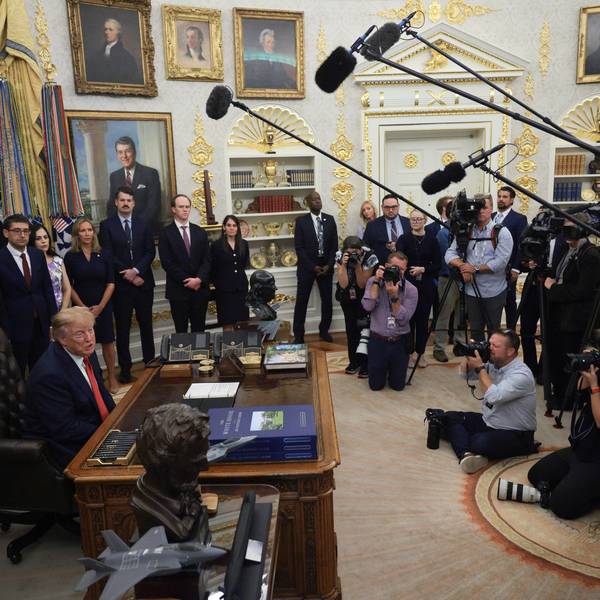
The new report says that President Donald Trump has presented an "obstacle" to press freedom," and "set off a witchhunt against journalists." The group notes that he's called the press an "enemy of the American people" and blocked White House access from major news organizations. RSF also notes that the Trump administration follows one that took an unprecedented attack on whistleblowers.
The U.K. also dropped two points and now comes in at 40. It saw its share of "press bashing" during its so-called Brexit campaign, while the Investigatory Powers Act and proposed new Espionage Act threaten journalists and whistleblowers.
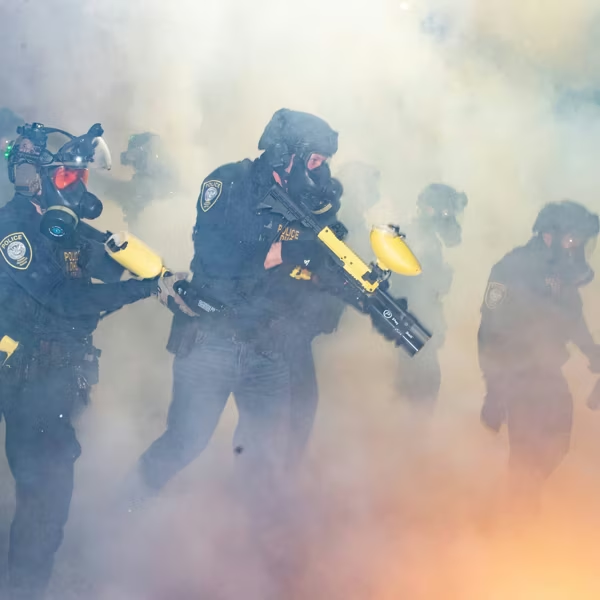
France fares a bit better on the index, coming in at number 39. While that number marks a six-point climb since the 2016 index, RSF says the rise is "deceptive," as it's due to the "bounce-back" effect from the lower rating incurred in 2015 as a result of the Charlie Hebdo attack. The index also notes that "there has been an increase in police violence against reporters covering demonstrations against the labor law and the dismantling of the 'jungle' at Calais. The run-up to the 2017 presidential election has seen growing hostility towards journalists from political parties and the public."
"The democracies that have traditionally regarded media freedom as one of the foundations on which they are built must continue to be a model for the rest of the world, and not the opposite," stated RSF secretary-general Christophe Deloire. "By eroding this fundamental freedom on the grounds of protecting their citizens, the democracies are in danger of losing their souls."
"The rate at which democracies are approaching the tipping point is alarming for all those who understand that, if media freedom is not secure, then none of the other freedoms can be guaranteed," Deloire added. "Where will this downward spiral take us?"
The RSF report also shows a "darker" map, as 21 countries--up three from last year--are now coded black, indicating "very bad" in terms of press freedoms. And 51--up from 49 last year--are now classified as red, meaning the press freedom situation is "bad."
Ranking dead last on the list is North Korea, where the "totalitarian regime continues to keep its citizens in a state of ignorance and fear of being sent to a concentration camp for listening to radio broadcasts from outside the country." Another on the black list is Syria, the deadliest country in the world for journalists. "Professional and citizen-journalists alike are now caught between the various parties to the conflict--both the regime and its allies and the various armed opposition groups including the Kurds and Jihadi fighters such as Islamic State," the press freedom group states.
Nordic countries are at the opposite end of the index, with Norway, Sweden, Denmark, and Finland coming in at the top four spots.
Dear Common Dreams reader, It’s been nearly 30 years since I co-founded Common Dreams with my late wife, Lina Newhouser. We had the radical notion that journalism should serve the public good, not corporate profits. It was clear to us from the outset what it would take to build such a project. No paid advertisements. No corporate sponsors. No millionaire publisher telling us what to think or do. Many people said we wouldn't last a year, but we proved those doubters wrong. Together with a tremendous team of journalists and dedicated staff, we built an independent media outlet free from the constraints of profits and corporate control. Our mission has always been simple: To inform. To inspire. To ignite change for the common good. Building Common Dreams was not easy. Our survival was never guaranteed. When you take on the most powerful forces—Wall Street greed, fossil fuel industry destruction, Big Tech lobbyists, and uber-rich oligarchs who have spent billions upon billions rigging the economy and democracy in their favor—the only bulwark you have is supporters who believe in your work. But here’s the urgent message from me today. It's never been this bad out there. And it's never been this hard to keep us going. At the very moment Common Dreams is most needed, the threats we face are intensifying. We need your support now more than ever. We don't accept corporate advertising and never will. We don't have a paywall because we don't think people should be blocked from critical news based on their ability to pay. Everything we do is funded by the donations of readers like you. When everyone does the little they can afford, we are strong. But if that support retreats or dries up, so do we. Will you donate now to make sure Common Dreams not only survives but thrives? —Craig Brown, Co-founder |
"Media freedom is under threat now more than ever," Reporters Without Borders said in its latest World Press Freedom Index, adding that these freedoms may now be at "a tipping point."
The updated global indicator of the press freedoms journalists have reveals a grim situation, as almost two-thirds of the list of 180 countries have worsened. The 2017 index "reflects a world in which attacks on the media have become commonplace and strongmen are on the rise," the Paris-based watchdog, which goes by its French acronym RSF, states.
Violating those freedoms is not limited to dictatorships, the group notes.
Take the United States, which sits at 43 on the list--a two-point drop since 2016.
The new report says that President Donald Trump has presented an "obstacle" to press freedom," and "set off a witchhunt against journalists." The group notes that he's called the press an "enemy of the American people" and blocked White House access from major news organizations. RSF also notes that the Trump administration follows one that took an unprecedented attack on whistleblowers.
The U.K. also dropped two points and now comes in at 40. It saw its share of "press bashing" during its so-called Brexit campaign, while the Investigatory Powers Act and proposed new Espionage Act threaten journalists and whistleblowers.
France fares a bit better on the index, coming in at number 39. While that number marks a six-point climb since the 2016 index, RSF says the rise is "deceptive," as it's due to the "bounce-back" effect from the lower rating incurred in 2015 as a result of the Charlie Hebdo attack. The index also notes that "there has been an increase in police violence against reporters covering demonstrations against the labor law and the dismantling of the 'jungle' at Calais. The run-up to the 2017 presidential election has seen growing hostility towards journalists from political parties and the public."
"The democracies that have traditionally regarded media freedom as one of the foundations on which they are built must continue to be a model for the rest of the world, and not the opposite," stated RSF secretary-general Christophe Deloire. "By eroding this fundamental freedom on the grounds of protecting their citizens, the democracies are in danger of losing their souls."
"The rate at which democracies are approaching the tipping point is alarming for all those who understand that, if media freedom is not secure, then none of the other freedoms can be guaranteed," Deloire added. "Where will this downward spiral take us?"
The RSF report also shows a "darker" map, as 21 countries--up three from last year--are now coded black, indicating "very bad" in terms of press freedoms. And 51--up from 49 last year--are now classified as red, meaning the press freedom situation is "bad."
Ranking dead last on the list is North Korea, where the "totalitarian regime continues to keep its citizens in a state of ignorance and fear of being sent to a concentration camp for listening to radio broadcasts from outside the country." Another on the black list is Syria, the deadliest country in the world for journalists. "Professional and citizen-journalists alike are now caught between the various parties to the conflict--both the regime and its allies and the various armed opposition groups including the Kurds and Jihadi fighters such as Islamic State," the press freedom group states.
Nordic countries are at the opposite end of the index, with Norway, Sweden, Denmark, and Finland coming in at the top four spots.
"Media freedom is under threat now more than ever," Reporters Without Borders said in its latest World Press Freedom Index, adding that these freedoms may now be at "a tipping point."
The updated global indicator of the press freedoms journalists have reveals a grim situation, as almost two-thirds of the list of 180 countries have worsened. The 2017 index "reflects a world in which attacks on the media have become commonplace and strongmen are on the rise," the Paris-based watchdog, which goes by its French acronym RSF, states.
Violating those freedoms is not limited to dictatorships, the group notes.
Take the United States, which sits at 43 on the list--a two-point drop since 2016.
The new report says that President Donald Trump has presented an "obstacle" to press freedom," and "set off a witchhunt against journalists." The group notes that he's called the press an "enemy of the American people" and blocked White House access from major news organizations. RSF also notes that the Trump administration follows one that took an unprecedented attack on whistleblowers.
The U.K. also dropped two points and now comes in at 40. It saw its share of "press bashing" during its so-called Brexit campaign, while the Investigatory Powers Act and proposed new Espionage Act threaten journalists and whistleblowers.
France fares a bit better on the index, coming in at number 39. While that number marks a six-point climb since the 2016 index, RSF says the rise is "deceptive," as it's due to the "bounce-back" effect from the lower rating incurred in 2015 as a result of the Charlie Hebdo attack. The index also notes that "there has been an increase in police violence against reporters covering demonstrations against the labor law and the dismantling of the 'jungle' at Calais. The run-up to the 2017 presidential election has seen growing hostility towards journalists from political parties and the public."
"The democracies that have traditionally regarded media freedom as one of the foundations on which they are built must continue to be a model for the rest of the world, and not the opposite," stated RSF secretary-general Christophe Deloire. "By eroding this fundamental freedom on the grounds of protecting their citizens, the democracies are in danger of losing their souls."
"The rate at which democracies are approaching the tipping point is alarming for all those who understand that, if media freedom is not secure, then none of the other freedoms can be guaranteed," Deloire added. "Where will this downward spiral take us?"
The RSF report also shows a "darker" map, as 21 countries--up three from last year--are now coded black, indicating "very bad" in terms of press freedoms. And 51--up from 49 last year--are now classified as red, meaning the press freedom situation is "bad."
Ranking dead last on the list is North Korea, where the "totalitarian regime continues to keep its citizens in a state of ignorance and fear of being sent to a concentration camp for listening to radio broadcasts from outside the country." Another on the black list is Syria, the deadliest country in the world for journalists. "Professional and citizen-journalists alike are now caught between the various parties to the conflict--both the regime and its allies and the various armed opposition groups including the Kurds and Jihadi fighters such as Islamic State," the press freedom group states.
Nordic countries are at the opposite end of the index, with Norway, Sweden, Denmark, and Finland coming in at the top four spots.