(Photo: Common Cause NC/Twitter)
With Battles in Multiple States, Fight to End Gerrymandering Heats Up
SCOTUS ruling in Virginia case seen as "yet another blow against GOP's use of racial gerrymandering to artificially inflate their power"
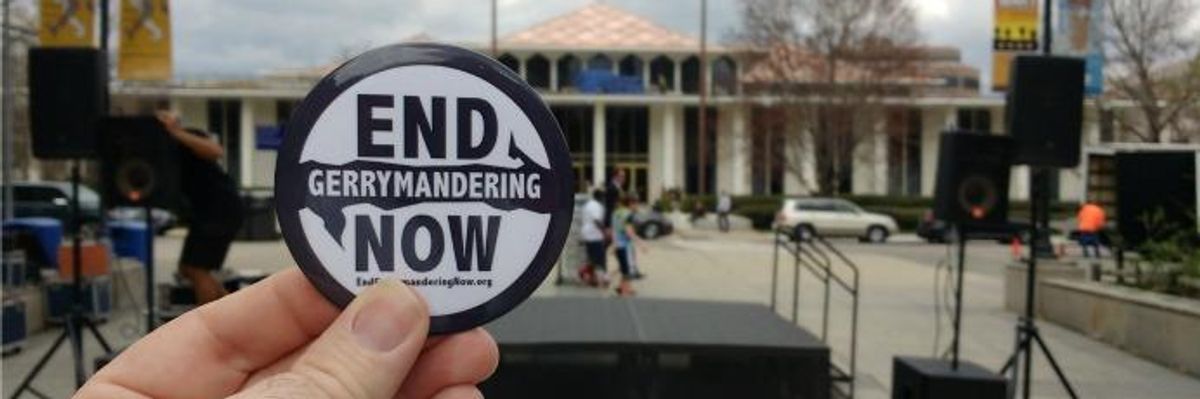
On the same day as the U.S. Supreme Court handed down a major victory in a Virginia gerrymandering case, pro-democracy forces gathered at the North Carolina state capitol building for a day of action opposing the practice.
Wednesday's 7-1 decision (pdf) from the nation's high court "instructed a lower court to reconsider its finding that race was not the dominant factor in drawing 11 General Assembly districts, opening the door to a new political map that could reshape the Republican-controlled state legislature," the Richmond Times-Dispatch reported.
Progress Virginia said the ruling was "a great victory for Virginia voters who want to have a real say in who represents them in Richmond," while the Democratic Legislative Campaign Committee--which works to get Democrats elected at the state level--described it as "[y]et another blow against GOP's use of racial gerrymandering to artificially inflate their power."
If allowed to stand, the lower court's ruling "could have significantly bolstered future attempts to draw gerrymandered districts" nationwide, ThinkProgress justice editor Ian Millhiser wrote in his report.
The Virginia lawsuit was one of two redistricting cases the Supreme Court heard in December. The other, involving North Carolina congressional districts, remains undecided.
But North Carolinians aren't waiting passively for that ruling to come down. On Tuesday, state lawmakers filed a bill that backers say "would take politics out of the redistricting process."
Common Cause NC explained of the legislation: "Instead of lawmakers drawing their own districts for partisan advantage, a nonpartisan legislative staff would create congressional and legislative maps completely blind of any political consideration." The approach has widespread support from voters and advocacy groups alike.
And on Wednesday, following a Citizens Lobby Day at the North Carolina General Assembly, hundreds of people gathered for a rally to end gerrymandering in Raleigh.
South Carolina State Senator Nikki Setzler has also introduced legislation that would take responsibility for drawing district maps away from the General Assembly and give it to an independent commission. On Wednesday, the South Carolina Democratic party praised the Supreme Court's ruling in Virginia, but pointed to efforts like Setzler's as a more permanent solution:
While gerrymandering might be considered wonky to some, the issue is gaining traction as constituents become more engaged in democracy nationwide. A meeting called last week by Fair Districts PA, in Montgomery County, Pennsylvania, drew an audience of more than 600 people.
And just last week, Sen. Bernie Sanders (I-Vt.) listed the fight to end gerrymandering as a key goal of the resistance:
Urgent. It's never been this bad.
Dear Common Dreams reader, It’s been nearly 30 years since I co-founded Common Dreams with my late wife, Lina Newhouser. We had the radical notion that journalism should serve the public good, not corporate profits. It was clear to us from the outset what it would take to build such a project. No paid advertisements. No corporate sponsors. No millionaire publisher telling us what to think or do. Many people said we wouldn't last a year, but we proved those doubters wrong. Together with a tremendous team of journalists and dedicated staff, we built an independent media outlet free from the constraints of profits and corporate control. Our mission from the outset was simple. To inform. To inspire. To ignite change for the common good. Building Common Dreams was not easy. Our survival was never guaranteed. When you take on the most powerful forces—Wall Street greed, fossil fuel industry destruction, Big Tech lobbyists, and uber-rich oligarchs who have spent billions upon billions rigging the economy and democracy in their favor—the only bulwark you have is supporters who believe in your work. But here’s the urgent message from me today. It’s never been this bad out there. And it’s never been this hard to keep us going. At the very moment Common Dreams is most needed and doing some of its best and most important work, the threats we face are intensifying. Right now, with just three days to go in our Spring Campaign, we're falling short of our make-or-break goal. When everyone does the little they can afford, we are strong. But if that support retreats or dries up, so do we. Can you make a gift right now to make sure Common Dreams not only survives but thrives? There is no backup plan or rainy day fund. There is only you. —Craig Brown, Co-founder |
On the same day as the U.S. Supreme Court handed down a major victory in a Virginia gerrymandering case, pro-democracy forces gathered at the North Carolina state capitol building for a day of action opposing the practice.
Wednesday's 7-1 decision (pdf) from the nation's high court "instructed a lower court to reconsider its finding that race was not the dominant factor in drawing 11 General Assembly districts, opening the door to a new political map that could reshape the Republican-controlled state legislature," the Richmond Times-Dispatch reported.
Progress Virginia said the ruling was "a great victory for Virginia voters who want to have a real say in who represents them in Richmond," while the Democratic Legislative Campaign Committee--which works to get Democrats elected at the state level--described it as "[y]et another blow against GOP's use of racial gerrymandering to artificially inflate their power."
If allowed to stand, the lower court's ruling "could have significantly bolstered future attempts to draw gerrymandered districts" nationwide, ThinkProgress justice editor Ian Millhiser wrote in his report.
The Virginia lawsuit was one of two redistricting cases the Supreme Court heard in December. The other, involving North Carolina congressional districts, remains undecided.
But North Carolinians aren't waiting passively for that ruling to come down. On Tuesday, state lawmakers filed a bill that backers say "would take politics out of the redistricting process."
Common Cause NC explained of the legislation: "Instead of lawmakers drawing their own districts for partisan advantage, a nonpartisan legislative staff would create congressional and legislative maps completely blind of any political consideration." The approach has widespread support from voters and advocacy groups alike.
And on Wednesday, following a Citizens Lobby Day at the North Carolina General Assembly, hundreds of people gathered for a rally to end gerrymandering in Raleigh.
South Carolina State Senator Nikki Setzler has also introduced legislation that would take responsibility for drawing district maps away from the General Assembly and give it to an independent commission. On Wednesday, the South Carolina Democratic party praised the Supreme Court's ruling in Virginia, but pointed to efforts like Setzler's as a more permanent solution:
While gerrymandering might be considered wonky to some, the issue is gaining traction as constituents become more engaged in democracy nationwide. A meeting called last week by Fair Districts PA, in Montgomery County, Pennsylvania, drew an audience of more than 600 people.
And just last week, Sen. Bernie Sanders (I-Vt.) listed the fight to end gerrymandering as a key goal of the resistance:
On the same day as the U.S. Supreme Court handed down a major victory in a Virginia gerrymandering case, pro-democracy forces gathered at the North Carolina state capitol building for a day of action opposing the practice.
Wednesday's 7-1 decision (pdf) from the nation's high court "instructed a lower court to reconsider its finding that race was not the dominant factor in drawing 11 General Assembly districts, opening the door to a new political map that could reshape the Republican-controlled state legislature," the Richmond Times-Dispatch reported.
Progress Virginia said the ruling was "a great victory for Virginia voters who want to have a real say in who represents them in Richmond," while the Democratic Legislative Campaign Committee--which works to get Democrats elected at the state level--described it as "[y]et another blow against GOP's use of racial gerrymandering to artificially inflate their power."
If allowed to stand, the lower court's ruling "could have significantly bolstered future attempts to draw gerrymandered districts" nationwide, ThinkProgress justice editor Ian Millhiser wrote in his report.
The Virginia lawsuit was one of two redistricting cases the Supreme Court heard in December. The other, involving North Carolina congressional districts, remains undecided.
But North Carolinians aren't waiting passively for that ruling to come down. On Tuesday, state lawmakers filed a bill that backers say "would take politics out of the redistricting process."
Common Cause NC explained of the legislation: "Instead of lawmakers drawing their own districts for partisan advantage, a nonpartisan legislative staff would create congressional and legislative maps completely blind of any political consideration." The approach has widespread support from voters and advocacy groups alike.
And on Wednesday, following a Citizens Lobby Day at the North Carolina General Assembly, hundreds of people gathered for a rally to end gerrymandering in Raleigh.
South Carolina State Senator Nikki Setzler has also introduced legislation that would take responsibility for drawing district maps away from the General Assembly and give it to an independent commission. On Wednesday, the South Carolina Democratic party praised the Supreme Court's ruling in Virginia, but pointed to efforts like Setzler's as a more permanent solution:
While gerrymandering might be considered wonky to some, the issue is gaining traction as constituents become more engaged in democracy nationwide. A meeting called last week by Fair Districts PA, in Montgomery County, Pennsylvania, drew an audience of more than 600 people.
And just last week, Sen. Bernie Sanders (I-Vt.) listed the fight to end gerrymandering as a key goal of the resistance: