SUBSCRIBE TO OUR FREE NEWSLETTER
Daily news & progressive opinion—funded by the people, not the corporations—delivered straight to your inbox.
5
#000000
#FFFFFF
To donate by check, phone, or other method, see our More Ways to Give page.
Daily news & progressive opinion—funded by the people, not the corporations—delivered straight to your inbox.
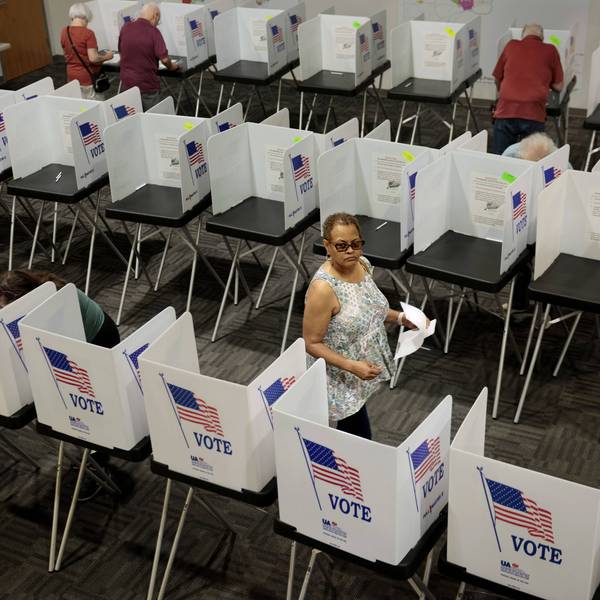
In the first presidential election since the Supreme Court gutted the Voting Rights Act in 2013, voters in many crucial swing states are encountering fewer polling places, longer lines, and in some cases even reporting intimidation.
"There is tremendous disruption at the polls today," Wade Henderson, president of the Leadership Conference on Civil and Human Rights, told USA Today on Tuesday. "This election may be the most chaotic election ... in the last 50 years."
"If you can't afford to stand in a long line, if you can't afford daycare, that's basically a poll tax. It's just not fair."
--Adrian Fontes,
Maricopa County, Arizona
"Long lines caused by polling cutbacks are a form of voter suppression," the NAACP warned its supporters, urging them to document and report instances of hours-long lines to vote.
Voters in Arizona, some of whom suffered through the state's chaotic Democratic primary, are already requesting that the state extend voting hours after encountering hours-long lines at polling stations.
ThinkProgress reported:
Today, Maricopa County will have the exact same number of polling places the county offered in 2012 -- 724 -- despite having added more than 90,000 more voters to the rolls. Many of those precincts' polling places are located in the same building, meaning there are only 640 separate locations. Long lines ensued Tuesday morning, and are expected again when residents get off work in the evening.
Adrian Fontes, who is running to replace [...] the elections administrator for Maricopa County, told ThinkProgress that lines can be a major barrier for low-income voters.
"Let's say you're going to go vote on Tuesday, and you might work two jobs, or you have kids you have to get ready for school," he said. "If you can't afford to stand in a long line, if you can't afford daycare, that's basically a poll tax. It's just not fair."
"This is an election cycle that's just been marked by evidence of the resurgence of voting discrimination."
--Kristen Clarke,
Lawyers' Committee for
Civil Rights Under Law
Intimidation at the polls has also been reported in several states. USA Today wrote:
A coalition of more than 100 civil rights and voting rights groups reported that more than half of the complaints received in the morning about voter intimidation or harassment came from Pennsylvania. Those included voters being asked to provide specific forms of identification that are not required and Hispanic voters finding no Spanish speakers to assist them.
The Washington Post said that multiple reports of intimidation have emerged from the swing state of Florida:
"In Florida we continue to receive a substantial amount of complaints about voter intimidation," said Kristen Clarke, president of the Lawyers' Committee for Civil Rights Under Law, the group running an independent effort to field voter complaints and questions.
Clarke said her group received reports from Miami-Dade County of "yelling, people using megaphones aggressively." In Jacksonville, in the northeast corner of the state, Clarke said, "an unauthorized individual was found inside [a] polling place."
This person was at St. Paul's Methodist Church, a polling precinct in what Clarke described as a part of Jacksonville with predominantly black residents.
"He was asked to leave and refused," she said. "Through our intervention and calls, that individual has been removed. Unauthorized individuals have no place in the polls."
"[G]o to the polls, stand at the polls, stay at the polls, vote at the polls. Do not let anything turn you around. Remember our history and remember what our people did to get us the right to the polls."
--Rev. Dr. William J. Barber
Moreover, in North Carolina--where voting restrictions were found in July to have targeted Democratic African-American voters "with almost surgical precision"--the state GOP appeared to brag in a Sunday memo about reduced early voting among black voters compared with 2012.
On Tuesday, there were problems reported across the key swing state, including machine malfunctions that forced the Durham County Board of Elections to vote unanimously to extend voting in the county by 90 minutes.
In a press conference Tuesday afternoon, North Carolina NAACP president Rev. Dr. William J. Barber urged citizens to "go to the polls, stand at the polls, stay at the polls, vote at the polls. Do not let anything turn you around. Remember our history and remember what our people did to get us the right to the polls."
Other states have seen poll workers illegally asking voters their party preference, poll stations with paper ballots and no pens, and voters being turned away for lack of a voter ID.
"This is an election cycle that's just been marked by evidence of the resurgence of voting discrimination," Clarke told USA Today. "This is a moment when we're seeing first-hand the impact of the Supreme Court's ruling which gutted the Voting Rights Act. And what looms over all of this is the fact that we don't have the Justice Department's federal observers on the ground in the same way that we had in prior presidential election cycles."
Indeed, because of the 2013 ruling, fewer Department of Justice election observers are being stationed at polling places, as Common Dreams reported.
Throughout the day, rights activists have praised voters who have endured long lines in order to cast a vote:
They've also urged voters nationwide to continue to report any irregularities, intimidation, and unusually long lines.
Dear Common Dreams reader, It’s been nearly 30 years since I co-founded Common Dreams with my late wife, Lina Newhouser. We had the radical notion that journalism should serve the public good, not corporate profits. It was clear to us from the outset what it would take to build such a project. No paid advertisements. No corporate sponsors. No millionaire publisher telling us what to think or do. Many people said we wouldn't last a year, but we proved those doubters wrong. Together with a tremendous team of journalists and dedicated staff, we built an independent media outlet free from the constraints of profits and corporate control. Our mission has always been simple: To inform. To inspire. To ignite change for the common good. Building Common Dreams was not easy. Our survival was never guaranteed. When you take on the most powerful forces—Wall Street greed, fossil fuel industry destruction, Big Tech lobbyists, and uber-rich oligarchs who have spent billions upon billions rigging the economy and democracy in their favor—the only bulwark you have is supporters who believe in your work. But here’s the urgent message from me today. It's never been this bad out there. And it's never been this hard to keep us going. At the very moment Common Dreams is most needed, the threats we face are intensifying. We need your support now more than ever. We don't accept corporate advertising and never will. We don't have a paywall because we don't think people should be blocked from critical news based on their ability to pay. Everything we do is funded by the donations of readers like you. When everyone does the little they can afford, we are strong. But if that support retreats or dries up, so do we. Will you donate now to make sure Common Dreams not only survives but thrives? —Craig Brown, Co-founder |
In the first presidential election since the Supreme Court gutted the Voting Rights Act in 2013, voters in many crucial swing states are encountering fewer polling places, longer lines, and in some cases even reporting intimidation.
"There is tremendous disruption at the polls today," Wade Henderson, president of the Leadership Conference on Civil and Human Rights, told USA Today on Tuesday. "This election may be the most chaotic election ... in the last 50 years."
"If you can't afford to stand in a long line, if you can't afford daycare, that's basically a poll tax. It's just not fair."
--Adrian Fontes,
Maricopa County, Arizona
"Long lines caused by polling cutbacks are a form of voter suppression," the NAACP warned its supporters, urging them to document and report instances of hours-long lines to vote.
Voters in Arizona, some of whom suffered through the state's chaotic Democratic primary, are already requesting that the state extend voting hours after encountering hours-long lines at polling stations.
ThinkProgress reported:
Today, Maricopa County will have the exact same number of polling places the county offered in 2012 -- 724 -- despite having added more than 90,000 more voters to the rolls. Many of those precincts' polling places are located in the same building, meaning there are only 640 separate locations. Long lines ensued Tuesday morning, and are expected again when residents get off work in the evening.
Adrian Fontes, who is running to replace [...] the elections administrator for Maricopa County, told ThinkProgress that lines can be a major barrier for low-income voters.
"Let's say you're going to go vote on Tuesday, and you might work two jobs, or you have kids you have to get ready for school," he said. "If you can't afford to stand in a long line, if you can't afford daycare, that's basically a poll tax. It's just not fair."
"This is an election cycle that's just been marked by evidence of the resurgence of voting discrimination."
--Kristen Clarke,
Lawyers' Committee for
Civil Rights Under Law
Intimidation at the polls has also been reported in several states. USA Today wrote:
A coalition of more than 100 civil rights and voting rights groups reported that more than half of the complaints received in the morning about voter intimidation or harassment came from Pennsylvania. Those included voters being asked to provide specific forms of identification that are not required and Hispanic voters finding no Spanish speakers to assist them.
The Washington Post said that multiple reports of intimidation have emerged from the swing state of Florida:
"In Florida we continue to receive a substantial amount of complaints about voter intimidation," said Kristen Clarke, president of the Lawyers' Committee for Civil Rights Under Law, the group running an independent effort to field voter complaints and questions.
Clarke said her group received reports from Miami-Dade County of "yelling, people using megaphones aggressively." In Jacksonville, in the northeast corner of the state, Clarke said, "an unauthorized individual was found inside [a] polling place."
This person was at St. Paul's Methodist Church, a polling precinct in what Clarke described as a part of Jacksonville with predominantly black residents.
"He was asked to leave and refused," she said. "Through our intervention and calls, that individual has been removed. Unauthorized individuals have no place in the polls."
"[G]o to the polls, stand at the polls, stay at the polls, vote at the polls. Do not let anything turn you around. Remember our history and remember what our people did to get us the right to the polls."
--Rev. Dr. William J. Barber
Moreover, in North Carolina--where voting restrictions were found in July to have targeted Democratic African-American voters "with almost surgical precision"--the state GOP appeared to brag in a Sunday memo about reduced early voting among black voters compared with 2012.
On Tuesday, there were problems reported across the key swing state, including machine malfunctions that forced the Durham County Board of Elections to vote unanimously to extend voting in the county by 90 minutes.
In a press conference Tuesday afternoon, North Carolina NAACP president Rev. Dr. William J. Barber urged citizens to "go to the polls, stand at the polls, stay at the polls, vote at the polls. Do not let anything turn you around. Remember our history and remember what our people did to get us the right to the polls."
Other states have seen poll workers illegally asking voters their party preference, poll stations with paper ballots and no pens, and voters being turned away for lack of a voter ID.
"This is an election cycle that's just been marked by evidence of the resurgence of voting discrimination," Clarke told USA Today. "This is a moment when we're seeing first-hand the impact of the Supreme Court's ruling which gutted the Voting Rights Act. And what looms over all of this is the fact that we don't have the Justice Department's federal observers on the ground in the same way that we had in prior presidential election cycles."
Indeed, because of the 2013 ruling, fewer Department of Justice election observers are being stationed at polling places, as Common Dreams reported.
Throughout the day, rights activists have praised voters who have endured long lines in order to cast a vote:
They've also urged voters nationwide to continue to report any irregularities, intimidation, and unusually long lines.
In the first presidential election since the Supreme Court gutted the Voting Rights Act in 2013, voters in many crucial swing states are encountering fewer polling places, longer lines, and in some cases even reporting intimidation.
"There is tremendous disruption at the polls today," Wade Henderson, president of the Leadership Conference on Civil and Human Rights, told USA Today on Tuesday. "This election may be the most chaotic election ... in the last 50 years."
"If you can't afford to stand in a long line, if you can't afford daycare, that's basically a poll tax. It's just not fair."
--Adrian Fontes,
Maricopa County, Arizona
"Long lines caused by polling cutbacks are a form of voter suppression," the NAACP warned its supporters, urging them to document and report instances of hours-long lines to vote.
Voters in Arizona, some of whom suffered through the state's chaotic Democratic primary, are already requesting that the state extend voting hours after encountering hours-long lines at polling stations.
ThinkProgress reported:
Today, Maricopa County will have the exact same number of polling places the county offered in 2012 -- 724 -- despite having added more than 90,000 more voters to the rolls. Many of those precincts' polling places are located in the same building, meaning there are only 640 separate locations. Long lines ensued Tuesday morning, and are expected again when residents get off work in the evening.
Adrian Fontes, who is running to replace [...] the elections administrator for Maricopa County, told ThinkProgress that lines can be a major barrier for low-income voters.
"Let's say you're going to go vote on Tuesday, and you might work two jobs, or you have kids you have to get ready for school," he said. "If you can't afford to stand in a long line, if you can't afford daycare, that's basically a poll tax. It's just not fair."
"This is an election cycle that's just been marked by evidence of the resurgence of voting discrimination."
--Kristen Clarke,
Lawyers' Committee for
Civil Rights Under Law
Intimidation at the polls has also been reported in several states. USA Today wrote:
A coalition of more than 100 civil rights and voting rights groups reported that more than half of the complaints received in the morning about voter intimidation or harassment came from Pennsylvania. Those included voters being asked to provide specific forms of identification that are not required and Hispanic voters finding no Spanish speakers to assist them.
The Washington Post said that multiple reports of intimidation have emerged from the swing state of Florida:
"In Florida we continue to receive a substantial amount of complaints about voter intimidation," said Kristen Clarke, president of the Lawyers' Committee for Civil Rights Under Law, the group running an independent effort to field voter complaints and questions.
Clarke said her group received reports from Miami-Dade County of "yelling, people using megaphones aggressively." In Jacksonville, in the northeast corner of the state, Clarke said, "an unauthorized individual was found inside [a] polling place."
This person was at St. Paul's Methodist Church, a polling precinct in what Clarke described as a part of Jacksonville with predominantly black residents.
"He was asked to leave and refused," she said. "Through our intervention and calls, that individual has been removed. Unauthorized individuals have no place in the polls."
"[G]o to the polls, stand at the polls, stay at the polls, vote at the polls. Do not let anything turn you around. Remember our history and remember what our people did to get us the right to the polls."
--Rev. Dr. William J. Barber
Moreover, in North Carolina--where voting restrictions were found in July to have targeted Democratic African-American voters "with almost surgical precision"--the state GOP appeared to brag in a Sunday memo about reduced early voting among black voters compared with 2012.
On Tuesday, there were problems reported across the key swing state, including machine malfunctions that forced the Durham County Board of Elections to vote unanimously to extend voting in the county by 90 minutes.
In a press conference Tuesday afternoon, North Carolina NAACP president Rev. Dr. William J. Barber urged citizens to "go to the polls, stand at the polls, stay at the polls, vote at the polls. Do not let anything turn you around. Remember our history and remember what our people did to get us the right to the polls."
Other states have seen poll workers illegally asking voters their party preference, poll stations with paper ballots and no pens, and voters being turned away for lack of a voter ID.
"This is an election cycle that's just been marked by evidence of the resurgence of voting discrimination," Clarke told USA Today. "This is a moment when we're seeing first-hand the impact of the Supreme Court's ruling which gutted the Voting Rights Act. And what looms over all of this is the fact that we don't have the Justice Department's federal observers on the ground in the same way that we had in prior presidential election cycles."
Indeed, because of the 2013 ruling, fewer Department of Justice election observers are being stationed at polling places, as Common Dreams reported.
Throughout the day, rights activists have praised voters who have endured long lines in order to cast a vote:
They've also urged voters nationwide to continue to report any irregularities, intimidation, and unusually long lines.