SUBSCRIBE TO OUR FREE NEWSLETTER
Daily news & progressive opinion—funded by the people, not the corporations—delivered straight to your inbox.
5
#000000
#FFFFFF
To donate by check, phone, or other method, see our More Ways to Give page.
Daily news & progressive opinion—funded by the people, not the corporations—delivered straight to your inbox.
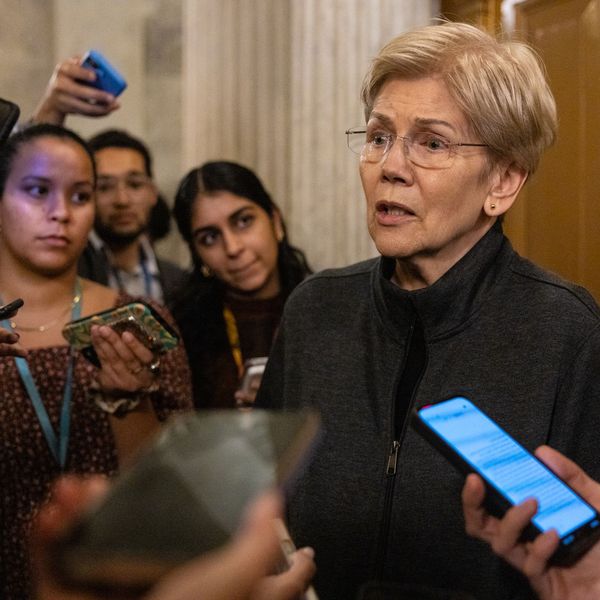
Though President Barack Obama is set to leave office in matter of months, Sen. Elizabeth Warren (D-Mass.) is not willing to let him go without a full explanation as to why his administration refused to jail the Wall Street banksters behind the 2007-2008 financial crisis.
In a letter sent to Department of Justice (DOJ) inspector general Michael Horowitz on Thursday, the progressive firebrand demanded an investigation into why the DOJ refused to file criminal charges against individuals despite "'serious indications of violation[s]' of federal securities and other laws," uncovered by the Financial Crisis Inquiry Commission (FCIC) probe into the causes of the economic crash.
Warren said her staff reviewed thousands of documents recently made public by the FCIC, and identified "11 separate FCIC referrals of individuals or corporations to DOJ in cases where the FCIC found" such evidence. According to Warren, "Nine individuals were implicated in these referrals (two were implicated twice)."
The DOJ, she continued, "has not filed any criminal prosecutions against any of the nine individuals. Not one of the nine has gone to prison or been convicted of a criminal offense. Not a single one has even been indicted or brought to trial."
Further, she notes that her staff review "identified potentially illegal activity at 14 corporations (including five that were implicated in multiple referrals)." Though there were five corporations that reached a settlement with the DOJ, not one was criminally indicted or brought to trial.
Summarizing the letter, financial reporter David Dayen noted that the corporate criminals examined in the FCIC documents included
most of America's largest banks--Citigroup, Goldman Sachs, JPMorgan Chase, Lehman Brothers, Washington Mutual (now part of JPMorgan), and Merrill Lynch (now part of Bank of America)--along with foreign banking giants UBS, Credit Suisse, and Societe Generale, auditor PricewaterhouseCoopers, credit rating agency Moody's, insurance company AIG, and mortgage giants Fannie Mae and Freddie Mac.
The FCIC presented DOJ with evidence that these institutions gave false representations about the loan quality inside mortgage-backed securities; misled credit ratings agencies; overstated assets and earnings in financial disclosures; failed to disclose credit downgrades, subprime exposure and the financial health of their operations to shareholders; and suffered breakdowns in internal company controls. All of these were tied to specific violations of federal law.
And the FCIC named names, specifying nine top-level executives who should be investigated on criminal charges: CEO Daniel Mudd and CFO Stephen Swad of Fannie Mae, CEO Martin Sullivan and CFO Stephen Bensinger of AIG, CEO Stan O'Neal and CFO Jeffrey Edwards of Merrill Lynch, and CEO Chuck Prince, CFO Gary Crittenden and Board Chairman Robert Rubin of Citigroup.
"The DOJ's failure to obtain any criminal convictions of any of the individuals or corporations named in the FCIC referrals suggests that the department has failed to hold the individuals and companies most responsible for the financial crisis and the Great Recession accountable," Warren concludes. "This failure requires an explanations."
Thursday also marks 8 years since Wall Street giant Lehman Brothers filed for bankruptcy. In an interview with Bloomberg Businessweek, Warren said the anniversary is "a good occasion to stop and ask where the real accountability is and get some answers out of the Justice Department about why they haven't prosecuted anyone."
On social media, Warren reiterated that point:
Warren also wrote to James Comey, director of the Federal Bureau of Investigation (FBI), on Thursday asking for his department to release "any and all materials related to the FBI's investigations and prosecutorial decisions regarding" the FCIC referrals, noting that the "additional information may help in the examination of this failure."
In the Comey letter, Warren acknowledges that the FBI "does not typically release internal documents from its investigations," but that the bureau under Comey recently set new precedent for doing so with its disclosure of information pertaining to the investigation of presidential nominee Hillary Clinton's email server.
At the time, Comey said that "making these materials available to the public [was] in the interest of transparency."
"These new standards present a compelling case for public transparency around the fate of the FCIC referrals," Warren writes. "If Secretary Clinton's email server was of sufficient 'interest' to establish a new FBI standard of transparency, then sure the criminal prosecution of those responsible for the 2008 financial crisis should be subject to he same level of transparency."
She concludes: "For the uncounted millions of Americans whose lives were changed forever and for those who are still dealing with the consequences of the crash, I can think of no matter of 'intense public interest' about which 'the American people deserve the details' than the issue of what precisely happened to the criminal referrals that followed the 2008 crash."
Dear Common Dreams reader, It’s been nearly 30 years since I co-founded Common Dreams with my late wife, Lina Newhouser. We had the radical notion that journalism should serve the public good, not corporate profits. It was clear to us from the outset what it would take to build such a project. No paid advertisements. No corporate sponsors. No millionaire publisher telling us what to think or do. Many people said we wouldn't last a year, but we proved those doubters wrong. Together with a tremendous team of journalists and dedicated staff, we built an independent media outlet free from the constraints of profits and corporate control. Our mission has always been simple: To inform. To inspire. To ignite change for the common good. Building Common Dreams was not easy. Our survival was never guaranteed. When you take on the most powerful forces—Wall Street greed, fossil fuel industry destruction, Big Tech lobbyists, and uber-rich oligarchs who have spent billions upon billions rigging the economy and democracy in their favor—the only bulwark you have is supporters who believe in your work. But here’s the urgent message from me today. It's never been this bad out there. And it's never been this hard to keep us going. At the very moment Common Dreams is most needed, the threats we face are intensifying. We need your support now more than ever. We don't accept corporate advertising and never will. We don't have a paywall because we don't think people should be blocked from critical news based on their ability to pay. Everything we do is funded by the donations of readers like you. When everyone does the little they can afford, we are strong. But if that support retreats or dries up, so do we. Will you donate now to make sure Common Dreams not only survives but thrives? —Craig Brown, Co-founder |
Though President Barack Obama is set to leave office in matter of months, Sen. Elizabeth Warren (D-Mass.) is not willing to let him go without a full explanation as to why his administration refused to jail the Wall Street banksters behind the 2007-2008 financial crisis.
In a letter sent to Department of Justice (DOJ) inspector general Michael Horowitz on Thursday, the progressive firebrand demanded an investigation into why the DOJ refused to file criminal charges against individuals despite "'serious indications of violation[s]' of federal securities and other laws," uncovered by the Financial Crisis Inquiry Commission (FCIC) probe into the causes of the economic crash.
Warren said her staff reviewed thousands of documents recently made public by the FCIC, and identified "11 separate FCIC referrals of individuals or corporations to DOJ in cases where the FCIC found" such evidence. According to Warren, "Nine individuals were implicated in these referrals (two were implicated twice)."
The DOJ, she continued, "has not filed any criminal prosecutions against any of the nine individuals. Not one of the nine has gone to prison or been convicted of a criminal offense. Not a single one has even been indicted or brought to trial."
Further, she notes that her staff review "identified potentially illegal activity at 14 corporations (including five that were implicated in multiple referrals)." Though there were five corporations that reached a settlement with the DOJ, not one was criminally indicted or brought to trial.
Summarizing the letter, financial reporter David Dayen noted that the corporate criminals examined in the FCIC documents included
most of America's largest banks--Citigroup, Goldman Sachs, JPMorgan Chase, Lehman Brothers, Washington Mutual (now part of JPMorgan), and Merrill Lynch (now part of Bank of America)--along with foreign banking giants UBS, Credit Suisse, and Societe Generale, auditor PricewaterhouseCoopers, credit rating agency Moody's, insurance company AIG, and mortgage giants Fannie Mae and Freddie Mac.
The FCIC presented DOJ with evidence that these institutions gave false representations about the loan quality inside mortgage-backed securities; misled credit ratings agencies; overstated assets and earnings in financial disclosures; failed to disclose credit downgrades, subprime exposure and the financial health of their operations to shareholders; and suffered breakdowns in internal company controls. All of these were tied to specific violations of federal law.
And the FCIC named names, specifying nine top-level executives who should be investigated on criminal charges: CEO Daniel Mudd and CFO Stephen Swad of Fannie Mae, CEO Martin Sullivan and CFO Stephen Bensinger of AIG, CEO Stan O'Neal and CFO Jeffrey Edwards of Merrill Lynch, and CEO Chuck Prince, CFO Gary Crittenden and Board Chairman Robert Rubin of Citigroup.
"The DOJ's failure to obtain any criminal convictions of any of the individuals or corporations named in the FCIC referrals suggests that the department has failed to hold the individuals and companies most responsible for the financial crisis and the Great Recession accountable," Warren concludes. "This failure requires an explanations."
Thursday also marks 8 years since Wall Street giant Lehman Brothers filed for bankruptcy. In an interview with Bloomberg Businessweek, Warren said the anniversary is "a good occasion to stop and ask where the real accountability is and get some answers out of the Justice Department about why they haven't prosecuted anyone."
On social media, Warren reiterated that point:
Warren also wrote to James Comey, director of the Federal Bureau of Investigation (FBI), on Thursday asking for his department to release "any and all materials related to the FBI's investigations and prosecutorial decisions regarding" the FCIC referrals, noting that the "additional information may help in the examination of this failure."
In the Comey letter, Warren acknowledges that the FBI "does not typically release internal documents from its investigations," but that the bureau under Comey recently set new precedent for doing so with its disclosure of information pertaining to the investigation of presidential nominee Hillary Clinton's email server.
At the time, Comey said that "making these materials available to the public [was] in the interest of transparency."
"These new standards present a compelling case for public transparency around the fate of the FCIC referrals," Warren writes. "If Secretary Clinton's email server was of sufficient 'interest' to establish a new FBI standard of transparency, then sure the criminal prosecution of those responsible for the 2008 financial crisis should be subject to he same level of transparency."
She concludes: "For the uncounted millions of Americans whose lives were changed forever and for those who are still dealing with the consequences of the crash, I can think of no matter of 'intense public interest' about which 'the American people deserve the details' than the issue of what precisely happened to the criminal referrals that followed the 2008 crash."
Though President Barack Obama is set to leave office in matter of months, Sen. Elizabeth Warren (D-Mass.) is not willing to let him go without a full explanation as to why his administration refused to jail the Wall Street banksters behind the 2007-2008 financial crisis.
In a letter sent to Department of Justice (DOJ) inspector general Michael Horowitz on Thursday, the progressive firebrand demanded an investigation into why the DOJ refused to file criminal charges against individuals despite "'serious indications of violation[s]' of federal securities and other laws," uncovered by the Financial Crisis Inquiry Commission (FCIC) probe into the causes of the economic crash.
Warren said her staff reviewed thousands of documents recently made public by the FCIC, and identified "11 separate FCIC referrals of individuals or corporations to DOJ in cases where the FCIC found" such evidence. According to Warren, "Nine individuals were implicated in these referrals (two were implicated twice)."
The DOJ, she continued, "has not filed any criminal prosecutions against any of the nine individuals. Not one of the nine has gone to prison or been convicted of a criminal offense. Not a single one has even been indicted or brought to trial."
Further, she notes that her staff review "identified potentially illegal activity at 14 corporations (including five that were implicated in multiple referrals)." Though there were five corporations that reached a settlement with the DOJ, not one was criminally indicted or brought to trial.
Summarizing the letter, financial reporter David Dayen noted that the corporate criminals examined in the FCIC documents included
most of America's largest banks--Citigroup, Goldman Sachs, JPMorgan Chase, Lehman Brothers, Washington Mutual (now part of JPMorgan), and Merrill Lynch (now part of Bank of America)--along with foreign banking giants UBS, Credit Suisse, and Societe Generale, auditor PricewaterhouseCoopers, credit rating agency Moody's, insurance company AIG, and mortgage giants Fannie Mae and Freddie Mac.
The FCIC presented DOJ with evidence that these institutions gave false representations about the loan quality inside mortgage-backed securities; misled credit ratings agencies; overstated assets and earnings in financial disclosures; failed to disclose credit downgrades, subprime exposure and the financial health of their operations to shareholders; and suffered breakdowns in internal company controls. All of these were tied to specific violations of federal law.
And the FCIC named names, specifying nine top-level executives who should be investigated on criminal charges: CEO Daniel Mudd and CFO Stephen Swad of Fannie Mae, CEO Martin Sullivan and CFO Stephen Bensinger of AIG, CEO Stan O'Neal and CFO Jeffrey Edwards of Merrill Lynch, and CEO Chuck Prince, CFO Gary Crittenden and Board Chairman Robert Rubin of Citigroup.
"The DOJ's failure to obtain any criminal convictions of any of the individuals or corporations named in the FCIC referrals suggests that the department has failed to hold the individuals and companies most responsible for the financial crisis and the Great Recession accountable," Warren concludes. "This failure requires an explanations."
Thursday also marks 8 years since Wall Street giant Lehman Brothers filed for bankruptcy. In an interview with Bloomberg Businessweek, Warren said the anniversary is "a good occasion to stop and ask where the real accountability is and get some answers out of the Justice Department about why they haven't prosecuted anyone."
On social media, Warren reiterated that point:
Warren also wrote to James Comey, director of the Federal Bureau of Investigation (FBI), on Thursday asking for his department to release "any and all materials related to the FBI's investigations and prosecutorial decisions regarding" the FCIC referrals, noting that the "additional information may help in the examination of this failure."
In the Comey letter, Warren acknowledges that the FBI "does not typically release internal documents from its investigations," but that the bureau under Comey recently set new precedent for doing so with its disclosure of information pertaining to the investigation of presidential nominee Hillary Clinton's email server.
At the time, Comey said that "making these materials available to the public [was] in the interest of transparency."
"These new standards present a compelling case for public transparency around the fate of the FCIC referrals," Warren writes. "If Secretary Clinton's email server was of sufficient 'interest' to establish a new FBI standard of transparency, then sure the criminal prosecution of those responsible for the 2008 financial crisis should be subject to he same level of transparency."
She concludes: "For the uncounted millions of Americans whose lives were changed forever and for those who are still dealing with the consequences of the crash, I can think of no matter of 'intense public interest' about which 'the American people deserve the details' than the issue of what precisely happened to the criminal referrals that followed the 2008 crash."