

SUBSCRIBE TO OUR FREE NEWSLETTER
Daily news & progressive opinion—funded by the people, not the corporations—delivered straight to your inbox.
5
#000000
#FFFFFF
To donate by check, phone, or other method, see our More Ways to Give page.
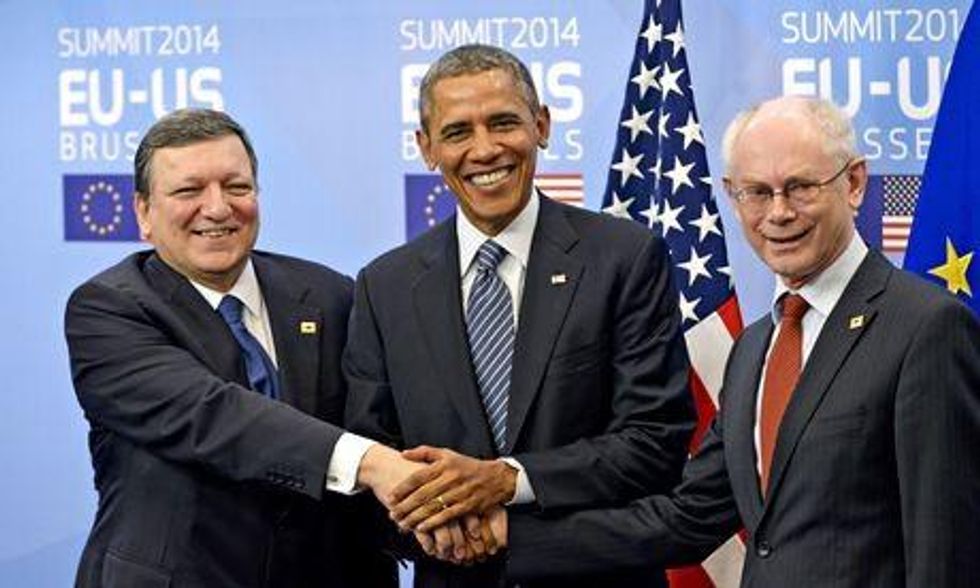
"Once we have a trade agreement in place," Obama said at a news conference in Brussels in reference to the Transatlantic Trade and Investment Partnership deal currently in the works, "export licenses for projects for liquefied natural gas destined to Europe would be much easier, something that is obviously relevant in today's geopolitical environment."
European Council President Herman Van Rompuy and European Commission President Jose Manuel Barroso reportedly pressed Obama during Wednesday's meeting to ease current restrictions on U.S. gas exports, claiming fears over the future of Russian gas imports, which make up a quarter of EU gas supplies.
While insisting that U.S gas exports could be done sometime in the future, Obama used more candid language to suggest EU leaders should first open up their own shale gas reserves to fracking--amongst other energy options such as increased nuclear power.
"I think it is useful for Europe to look at its own energy assets, as well as how the United States can supply additional energy assets," Obama said. "Because the truth of the matter is, is that just as there's no easy, free, simple way to defend ourselves, there's no perfect, free, ideal, cheap energy sources. Every possible energy source has some inconveniences or downsides. And I think that Europe collectively is going to need to examine, in light of what's happened, their energy policies to find are there additional ways that they can diversify and accelerate energy independence."
He added: "The United States as a source of energy is one possibility, and we've been blessed by some incredible resources. But we're also making choices and taking on some of the difficulties and challenges of energy development, and Europe is going to have to go through some of those same conversations as well."
The comments came, Reuters reports, as "a clear reference to opposition in parts of the EU on environmental grounds to nuclear power and the extraction of shale gas."
France and Bulgaria currently ban the controversial drilling practice, which has been known to contaminate ground water supplies and pollute the air, while countries such as Britain and Poland have faced protests against ongoing fracking exploration, as Reuters reports.
Since the onset of the Ukraine crisis has sparked conversations regarding EU energy concerns, environmentalists have warned that the fossil fuel industry and fossil fuel friendly leaders are using the crisis to push through energy policies they have wanted all along--particularly having to do with the production and export of unconventional fossil fuels such as Canada's tar sands and the U.S's shale gas. As Stewart Trew writes at the Council of Canadian's blog today:
Now Canada, political voices in the United States, and the European Commission for that matter, are trying to leverage the political crisis in Ukraine to make a case for more (not less) North American imports of the dirty stuff: tar sands from Alberta and fracked gas from North America's "boom" in unconventional shale production. The first puts pressure on Obama to approve the Keystone XL pipeline, which would bring bitumen from Canada to refineries on the Gulf Coast before shipping the final product to Europe and Asia. (The Energy East pipeline would do the same in Canada.)
The second (fracked gas) would require the U.S. to approve new LNG plants and remove energy export restrictions, which the EU is trying to do through trade and investment negotiations with the United States. David Cameron's government in the UK is also using the crisis to justify a European shale gas boom that environmental groups and the general public strongly opposes.
"Fossil fuels should not be used as a geopolitical bargaining chip, nor should giant oil and gas corporations write our foreign policy," Wenonah Hauter, executive director of Food & Water Watch also recently noted. "The hypocrisy of the call for exports is highlighted by the fact that it will take years for our export facilities to be able to process the volumes of gas proposed for overseas sales."
"There's been a lot of talk about fast tracking and streamlining" the approval process, Mike Tidwell, Executive Director of the Chesapeake Climate Action Network, recently told Common Dreams in reference to natural gas export plans and a proposed LNG export terminal in Cove Point, Maryland. "People need to understand that what they are talking about is cutting corners on processes put in place to protect people and the environment."
______________________
"Once we have a trade agreement in place," Obama said at a news conference in Brussels in reference to the Transatlantic Trade and Investment Partnership deal currently in the works, "export licenses for projects for liquefied natural gas destined to Europe would be much easier, something that is obviously relevant in today's geopolitical environment."
European Council President Herman Van Rompuy and European Commission President Jose Manuel Barroso reportedly pressed Obama during Wednesday's meeting to ease current restrictions on U.S. gas exports, claiming fears over the future of Russian gas imports, which make up a quarter of EU gas supplies.
While insisting that U.S gas exports could be done sometime in the future, Obama used more candid language to suggest EU leaders should first open up their own shale gas reserves to fracking--amongst other energy options such as increased nuclear power.
"I think it is useful for Europe to look at its own energy assets, as well as how the United States can supply additional energy assets," Obama said. "Because the truth of the matter is, is that just as there's no easy, free, simple way to defend ourselves, there's no perfect, free, ideal, cheap energy sources. Every possible energy source has some inconveniences or downsides. And I think that Europe collectively is going to need to examine, in light of what's happened, their energy policies to find are there additional ways that they can diversify and accelerate energy independence."
He added: "The United States as a source of energy is one possibility, and we've been blessed by some incredible resources. But we're also making choices and taking on some of the difficulties and challenges of energy development, and Europe is going to have to go through some of those same conversations as well."
The comments came, Reuters reports, as "a clear reference to opposition in parts of the EU on environmental grounds to nuclear power and the extraction of shale gas."
France and Bulgaria currently ban the controversial drilling practice, which has been known to contaminate ground water supplies and pollute the air, while countries such as Britain and Poland have faced protests against ongoing fracking exploration, as Reuters reports.
Since the onset of the Ukraine crisis has sparked conversations regarding EU energy concerns, environmentalists have warned that the fossil fuel industry and fossil fuel friendly leaders are using the crisis to push through energy policies they have wanted all along--particularly having to do with the production and export of unconventional fossil fuels such as Canada's tar sands and the U.S's shale gas. As Stewart Trew writes at the Council of Canadian's blog today:
Now Canada, political voices in the United States, and the European Commission for that matter, are trying to leverage the political crisis in Ukraine to make a case for more (not less) North American imports of the dirty stuff: tar sands from Alberta and fracked gas from North America's "boom" in unconventional shale production. The first puts pressure on Obama to approve the Keystone XL pipeline, which would bring bitumen from Canada to refineries on the Gulf Coast before shipping the final product to Europe and Asia. (The Energy East pipeline would do the same in Canada.)
The second (fracked gas) would require the U.S. to approve new LNG plants and remove energy export restrictions, which the EU is trying to do through trade and investment negotiations with the United States. David Cameron's government in the UK is also using the crisis to justify a European shale gas boom that environmental groups and the general public strongly opposes.
"Fossil fuels should not be used as a geopolitical bargaining chip, nor should giant oil and gas corporations write our foreign policy," Wenonah Hauter, executive director of Food & Water Watch also recently noted. "The hypocrisy of the call for exports is highlighted by the fact that it will take years for our export facilities to be able to process the volumes of gas proposed for overseas sales."
"There's been a lot of talk about fast tracking and streamlining" the approval process, Mike Tidwell, Executive Director of the Chesapeake Climate Action Network, recently told Common Dreams in reference to natural gas export plans and a proposed LNG export terminal in Cove Point, Maryland. "People need to understand that what they are talking about is cutting corners on processes put in place to protect people and the environment."
______________________
"Once we have a trade agreement in place," Obama said at a news conference in Brussels in reference to the Transatlantic Trade and Investment Partnership deal currently in the works, "export licenses for projects for liquefied natural gas destined to Europe would be much easier, something that is obviously relevant in today's geopolitical environment."
European Council President Herman Van Rompuy and European Commission President Jose Manuel Barroso reportedly pressed Obama during Wednesday's meeting to ease current restrictions on U.S. gas exports, claiming fears over the future of Russian gas imports, which make up a quarter of EU gas supplies.
While insisting that U.S gas exports could be done sometime in the future, Obama used more candid language to suggest EU leaders should first open up their own shale gas reserves to fracking--amongst other energy options such as increased nuclear power.
"I think it is useful for Europe to look at its own energy assets, as well as how the United States can supply additional energy assets," Obama said. "Because the truth of the matter is, is that just as there's no easy, free, simple way to defend ourselves, there's no perfect, free, ideal, cheap energy sources. Every possible energy source has some inconveniences or downsides. And I think that Europe collectively is going to need to examine, in light of what's happened, their energy policies to find are there additional ways that they can diversify and accelerate energy independence."
He added: "The United States as a source of energy is one possibility, and we've been blessed by some incredible resources. But we're also making choices and taking on some of the difficulties and challenges of energy development, and Europe is going to have to go through some of those same conversations as well."
The comments came, Reuters reports, as "a clear reference to opposition in parts of the EU on environmental grounds to nuclear power and the extraction of shale gas."
France and Bulgaria currently ban the controversial drilling practice, which has been known to contaminate ground water supplies and pollute the air, while countries such as Britain and Poland have faced protests against ongoing fracking exploration, as Reuters reports.
Since the onset of the Ukraine crisis has sparked conversations regarding EU energy concerns, environmentalists have warned that the fossil fuel industry and fossil fuel friendly leaders are using the crisis to push through energy policies they have wanted all along--particularly having to do with the production and export of unconventional fossil fuels such as Canada's tar sands and the U.S's shale gas. As Stewart Trew writes at the Council of Canadian's blog today:
Now Canada, political voices in the United States, and the European Commission for that matter, are trying to leverage the political crisis in Ukraine to make a case for more (not less) North American imports of the dirty stuff: tar sands from Alberta and fracked gas from North America's "boom" in unconventional shale production. The first puts pressure on Obama to approve the Keystone XL pipeline, which would bring bitumen from Canada to refineries on the Gulf Coast before shipping the final product to Europe and Asia. (The Energy East pipeline would do the same in Canada.)
The second (fracked gas) would require the U.S. to approve new LNG plants and remove energy export restrictions, which the EU is trying to do through trade and investment negotiations with the United States. David Cameron's government in the UK is also using the crisis to justify a European shale gas boom that environmental groups and the general public strongly opposes.
"Fossil fuels should not be used as a geopolitical bargaining chip, nor should giant oil and gas corporations write our foreign policy," Wenonah Hauter, executive director of Food & Water Watch also recently noted. "The hypocrisy of the call for exports is highlighted by the fact that it will take years for our export facilities to be able to process the volumes of gas proposed for overseas sales."
"There's been a lot of talk about fast tracking and streamlining" the approval process, Mike Tidwell, Executive Director of the Chesapeake Climate Action Network, recently told Common Dreams in reference to natural gas export plans and a proposed LNG export terminal in Cove Point, Maryland. "People need to understand that what they are talking about is cutting corners on processes put in place to protect people and the environment."
______________________

