SUBSCRIBE TO OUR FREE NEWSLETTER
Daily news & progressive opinion—funded by the people, not the corporations—delivered straight to your inbox.
5
#000000
#FFFFFF
To donate by check, phone, or other method, see our More Ways to Give page.
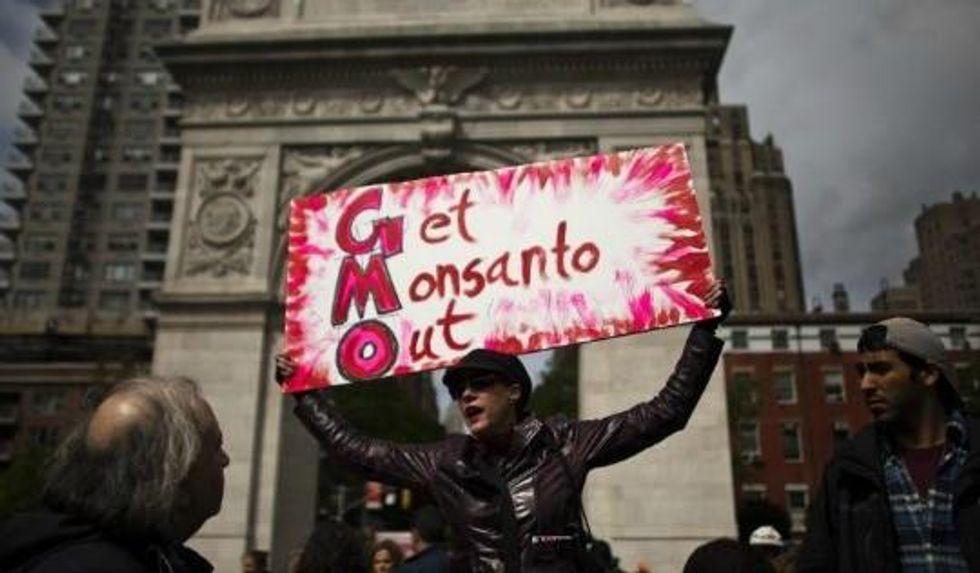
Thousands, if not millions, of people are expected to take to the streets across the world on Saturday in the second "March Against Monsanto" to protest the biotech giant.
Organizers say demonstrations have been scheduled for Saturday, October 12 in six continents, 52 countries and over 500 cities to call for the permanent boycott of genetically modified organisms (GMOs) and harmful agro-chemicals.
Last spring an estimated two million people joined in over 436 cities in 52 countries during the first March Against Monsanto, which was originally only expected to draw 3,000.
MAM founder Tami Monroe Canal, who started the movement last May, has stated, "Monsanto's predatory business and corporate agricultural practices threatens their generation's health, fertility and longevity. MAM supports a sustainable food production system. We must act now to stop GMOs and harmful pesticides."
Roberta Gogos, MAM organizer in Athens, Greece, said Monsanto has had a drastic impact on austerity-hit Europe. "Monsanto is working very hard to overturn EU regulation on obligatory labeling where enforcement is already lax. Greece is in a precarious position right now, and Greece's farmers are positioned to follow the same perilous fate as farmers in countries such as Colombia and Mexico."
Josh Castro, MAM organizer for Quito, Ecuador's march stated:
Ecuador is such a beautiful place, with the richest biodiversity in the world. We will not allow this Garden of Eden to be compromised by the destructive practices of multinational corporations like Monsanto. Biotechnology is not the solution to world hunger. Agroecology is. Monsanto's harmful practices are causing soil infertility, mono-cropping, loss of biodiversity, habitat destruction, and contributing to beehive collapse. GMO crops cross pollinate with traditional crops, risking peasant farmers' livelihood.
Follow Twitter hashtags #MAM and #MarchOct12 and check back on Common Dreams for news of the day as it unfolds.
Food justice expert activist Vandana Shiva spoke recently about the problems with Monsanto and a need for a larger organic food movement ahead of Saturday's march and in correlation with Shiva's "Food Freedom Fornight" series of food justice actions:
Vandana Shiva - Real Food Heroes & the Seed Freedom Fortnight, 2-16 October 2013Charlie Mgee interviews Vandana Shiva about the Seed Freedom Fortnight 2013 at the National Heirloom Expo, California.
Thousands, if not millions, of people are expected to take to the streets across the world on Saturday in the second "March Against Monsanto" to protest the biotech giant.
Organizers say demonstrations have been scheduled for Saturday, October 12 in six continents, 52 countries and over 500 cities to call for the permanent boycott of genetically modified organisms (GMOs) and harmful agro-chemicals.
Last spring an estimated two million people joined in over 436 cities in 52 countries during the first March Against Monsanto, which was originally only expected to draw 3,000.
MAM founder Tami Monroe Canal, who started the movement last May, has stated, "Monsanto's predatory business and corporate agricultural practices threatens their generation's health, fertility and longevity. MAM supports a sustainable food production system. We must act now to stop GMOs and harmful pesticides."
Roberta Gogos, MAM organizer in Athens, Greece, said Monsanto has had a drastic impact on austerity-hit Europe. "Monsanto is working very hard to overturn EU regulation on obligatory labeling where enforcement is already lax. Greece is in a precarious position right now, and Greece's farmers are positioned to follow the same perilous fate as farmers in countries such as Colombia and Mexico."
Josh Castro, MAM organizer for Quito, Ecuador's march stated:
Ecuador is such a beautiful place, with the richest biodiversity in the world. We will not allow this Garden of Eden to be compromised by the destructive practices of multinational corporations like Monsanto. Biotechnology is not the solution to world hunger. Agroecology is. Monsanto's harmful practices are causing soil infertility, mono-cropping, loss of biodiversity, habitat destruction, and contributing to beehive collapse. GMO crops cross pollinate with traditional crops, risking peasant farmers' livelihood.
Follow Twitter hashtags #MAM and #MarchOct12 and check back on Common Dreams for news of the day as it unfolds.
Food justice expert activist Vandana Shiva spoke recently about the problems with Monsanto and a need for a larger organic food movement ahead of Saturday's march and in correlation with Shiva's "Food Freedom Fornight" series of food justice actions:
Vandana Shiva - Real Food Heroes & the Seed Freedom Fortnight, 2-16 October 2013Charlie Mgee interviews Vandana Shiva about the Seed Freedom Fortnight 2013 at the National Heirloom Expo, California.
Thousands, if not millions, of people are expected to take to the streets across the world on Saturday in the second "March Against Monsanto" to protest the biotech giant.
Organizers say demonstrations have been scheduled for Saturday, October 12 in six continents, 52 countries and over 500 cities to call for the permanent boycott of genetically modified organisms (GMOs) and harmful agro-chemicals.
Last spring an estimated two million people joined in over 436 cities in 52 countries during the first March Against Monsanto, which was originally only expected to draw 3,000.
MAM founder Tami Monroe Canal, who started the movement last May, has stated, "Monsanto's predatory business and corporate agricultural practices threatens their generation's health, fertility and longevity. MAM supports a sustainable food production system. We must act now to stop GMOs and harmful pesticides."
Roberta Gogos, MAM organizer in Athens, Greece, said Monsanto has had a drastic impact on austerity-hit Europe. "Monsanto is working very hard to overturn EU regulation on obligatory labeling where enforcement is already lax. Greece is in a precarious position right now, and Greece's farmers are positioned to follow the same perilous fate as farmers in countries such as Colombia and Mexico."
Josh Castro, MAM organizer for Quito, Ecuador's march stated:
Ecuador is such a beautiful place, with the richest biodiversity in the world. We will not allow this Garden of Eden to be compromised by the destructive practices of multinational corporations like Monsanto. Biotechnology is not the solution to world hunger. Agroecology is. Monsanto's harmful practices are causing soil infertility, mono-cropping, loss of biodiversity, habitat destruction, and contributing to beehive collapse. GMO crops cross pollinate with traditional crops, risking peasant farmers' livelihood.
Follow Twitter hashtags #MAM and #MarchOct12 and check back on Common Dreams for news of the day as it unfolds.
Food justice expert activist Vandana Shiva spoke recently about the problems with Monsanto and a need for a larger organic food movement ahead of Saturday's march and in correlation with Shiva's "Food Freedom Fornight" series of food justice actions:
Vandana Shiva - Real Food Heroes & the Seed Freedom Fortnight, 2-16 October 2013Charlie Mgee interviews Vandana Shiva about the Seed Freedom Fortnight 2013 at the National Heirloom Expo, California.