

SUBSCRIBE TO OUR FREE NEWSLETTER
Daily news & progressive opinion—funded by the people, not the corporations—delivered straight to your inbox.
5
#000000
#FFFFFF
To donate by check, phone, or other method, see our More Ways to Give page.
Daily news & progressive opinion—funded by the people, not the corporations—delivered straight to your inbox.
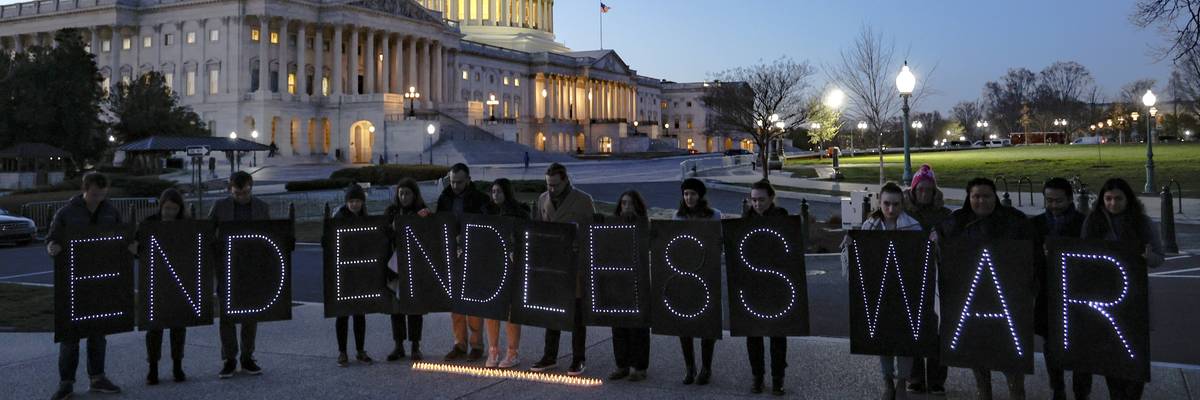
Activists hold up panels spelling out "End Endless War" during a demonstration outside of the U.S. Capitol building to commemorate the 20th anniversary of the Iraq War on March 15, 2023.
"Repeal of these authorizations would have no impact on current U.S. military operations and would support this administration's commitment to a strong and comprehensive relationship with our Iraqi partners."
As the U.S. Senate on Thursday teed up a vote to end the congressional authorizations for the Gulf and Iraq wars, President Joe Biden formally backed the bipartisan bill.
The progress on finally repealing the 1991 and 2002 authorizations for use of military force (AUMFs) comes just ahead of the 20th anniversary of the George W. Bush administration's costly and devastating invasion of Iraq.
The bill ( S. 316/H.R. 932) was reintroduced in February by Sens. Tim Kaine (D-Va.) and Barbara Lee (D-Calif.), and has GOP co-sponsors in both chambers. On Thursday, 19 Republican senators joined with all Democrats present to advance the measure.
The legislation has not yet been approved by the House of Representatives, which is narrowly controlled by the GOP. However, if it reaches the president's desk, he supports it, according to the statement of administration policy released Thursday.
While former Presidents Barack Obama and Donald Trump used the 2002 authorization to justify strikes against Islamic State in Iraq and Syria and Iranian Gen. Qasem Soleimani, respectively, the new Biden administration document notes that "the United States conducts no ongoing military activities that rely primarily on the 2002 AUMF, and no ongoing military activities that rely on the 1991 AUMF, as a domestic legal basis."
"Repeal of these authorizations would have no impact on current U.S. military operations and would support this administration's commitment to a strong and comprehensive relationship with our Iraqi partners," that policy statement adds. "President Biden remains committed to working with the Congress to ensure that outdated authorizations for the use of military force are replaced with a narrow and specific framework more appropriate to protecting Americans from modern terrorist threats."
Demand Progress Education Fund policy adviser Cavan Kharrazian said in a statement that "we are glad President Biden is supportive of getting these outdated AUMFs off the books, and that he is committed to work with Congress on presumably replacing the 2001 AUMF with a narrower framework."
"However, any serious attempt by President Biden to work with Congress on war powers reforms requires the administration to halt unauthorized participation of U.S. armed forces in hostilities that contravene the War Powers Act," Kharrazian stressed. "This includes ending U.S. support for the Saudi-led coalition's war on Yemen, ceasing the use of U.S. forces to protect Syrian oil fields and battling Iranian-backed militias, and putting an end to legally dubious military operations in the Horn of Africa."
The campaigner continued:
Moreover, the administration must commit to full legal transparency regarding the use of military force. Both this administration and previous administrations have failed to provide Congress with timely reporting on the 2001 AUMF, as required by 50 U.S. Code § 1550. Additionally, President Biden has failed to respond to lawmakers' inquiries about the administration's legal justifications for the expansive use of the 2001 AUMF and Article 2 authorities. Without such transparency, Congress is unable to fully exercise its oversight and legislative duties over war and peace.
It's encouraging to see an administration committed to addressing outdated AUMFs. However, a genuine commitment will involve respecting congressional authority over war by proactively ending unauthorized military activities and implementing comprehensive transparency measures.
In a series of tweets, the Quaker advocacy group Friends Committee on National Legislation (FCNL) welcomed the administration's position and highlighted fresh comments from Kaine and Sen. Todd Young (R-Ind.), a co-sponsor, who gathered outside the U.S. Capitol on Thursday with members of the American Legion.
"There's no reason—none—to have a war authorization against a strategic partner, and so that's the first reason why we need to do this," Kaine said of Iraq, adding that the repeal must also occur to honor U.S. service members.
Kaine called out previous failures by Congress to end the AUMFs, and noted that leaving them in place enables abuse. While confirming he has not spoken with House Speaker Kevin McCarthy (R-Calif.) about the bill, the senator expressed optimism that it will pass—saying of the lower chamber, "there's a wonderful bipartisan coalition there as well."
Dear Common Dreams reader, It’s been nearly 30 years since I co-founded Common Dreams with my late wife, Lina Newhouser. We had the radical notion that journalism should serve the public good, not corporate profits. It was clear to us from the outset what it would take to build such a project. No paid advertisements. No corporate sponsors. No millionaire publisher telling us what to think or do. Many people said we wouldn't last a year, but we proved those doubters wrong. Together with a tremendous team of journalists and dedicated staff, we built an independent media outlet free from the constraints of profits and corporate control. Our mission has always been simple: To inform. To inspire. To ignite change for the common good. Building Common Dreams was not easy. Our survival was never guaranteed. When you take on the most powerful forces—Wall Street greed, fossil fuel industry destruction, Big Tech lobbyists, and uber-rich oligarchs who have spent billions upon billions rigging the economy and democracy in their favor—the only bulwark you have is supporters who believe in your work. But here’s the urgent message from me today. It's never been this bad out there. And it's never been this hard to keep us going. At the very moment Common Dreams is most needed, the threats we face are intensifying. We need your support now more than ever. We don't accept corporate advertising and never will. We don't have a paywall because we don't think people should be blocked from critical news based on their ability to pay. Everything we do is funded by the donations of readers like you. When everyone does the little they can afford, we are strong. But if that support retreats or dries up, so do we. Will you donate now to make sure Common Dreams not only survives but thrives? —Craig Brown, Co-founder |
As the U.S. Senate on Thursday teed up a vote to end the congressional authorizations for the Gulf and Iraq wars, President Joe Biden formally backed the bipartisan bill.
The progress on finally repealing the 1991 and 2002 authorizations for use of military force (AUMFs) comes just ahead of the 20th anniversary of the George W. Bush administration's costly and devastating invasion of Iraq.
The bill ( S. 316/H.R. 932) was reintroduced in February by Sens. Tim Kaine (D-Va.) and Barbara Lee (D-Calif.), and has GOP co-sponsors in both chambers. On Thursday, 19 Republican senators joined with all Democrats present to advance the measure.
The legislation has not yet been approved by the House of Representatives, which is narrowly controlled by the GOP. However, if it reaches the president's desk, he supports it, according to the statement of administration policy released Thursday.
While former Presidents Barack Obama and Donald Trump used the 2002 authorization to justify strikes against Islamic State in Iraq and Syria and Iranian Gen. Qasem Soleimani, respectively, the new Biden administration document notes that "the United States conducts no ongoing military activities that rely primarily on the 2002 AUMF, and no ongoing military activities that rely on the 1991 AUMF, as a domestic legal basis."
"Repeal of these authorizations would have no impact on current U.S. military operations and would support this administration's commitment to a strong and comprehensive relationship with our Iraqi partners," that policy statement adds. "President Biden remains committed to working with the Congress to ensure that outdated authorizations for the use of military force are replaced with a narrow and specific framework more appropriate to protecting Americans from modern terrorist threats."
Demand Progress Education Fund policy adviser Cavan Kharrazian said in a statement that "we are glad President Biden is supportive of getting these outdated AUMFs off the books, and that he is committed to work with Congress on presumably replacing the 2001 AUMF with a narrower framework."
"However, any serious attempt by President Biden to work with Congress on war powers reforms requires the administration to halt unauthorized participation of U.S. armed forces in hostilities that contravene the War Powers Act," Kharrazian stressed. "This includes ending U.S. support for the Saudi-led coalition's war on Yemen, ceasing the use of U.S. forces to protect Syrian oil fields and battling Iranian-backed militias, and putting an end to legally dubious military operations in the Horn of Africa."
The campaigner continued:
Moreover, the administration must commit to full legal transparency regarding the use of military force. Both this administration and previous administrations have failed to provide Congress with timely reporting on the 2001 AUMF, as required by 50 U.S. Code § 1550. Additionally, President Biden has failed to respond to lawmakers' inquiries about the administration's legal justifications for the expansive use of the 2001 AUMF and Article 2 authorities. Without such transparency, Congress is unable to fully exercise its oversight and legislative duties over war and peace.
It's encouraging to see an administration committed to addressing outdated AUMFs. However, a genuine commitment will involve respecting congressional authority over war by proactively ending unauthorized military activities and implementing comprehensive transparency measures.
In a series of tweets, the Quaker advocacy group Friends Committee on National Legislation (FCNL) welcomed the administration's position and highlighted fresh comments from Kaine and Sen. Todd Young (R-Ind.), a co-sponsor, who gathered outside the U.S. Capitol on Thursday with members of the American Legion.
"There's no reason—none—to have a war authorization against a strategic partner, and so that's the first reason why we need to do this," Kaine said of Iraq, adding that the repeal must also occur to honor U.S. service members.
Kaine called out previous failures by Congress to end the AUMFs, and noted that leaving them in place enables abuse. While confirming he has not spoken with House Speaker Kevin McCarthy (R-Calif.) about the bill, the senator expressed optimism that it will pass—saying of the lower chamber, "there's a wonderful bipartisan coalition there as well."
As the U.S. Senate on Thursday teed up a vote to end the congressional authorizations for the Gulf and Iraq wars, President Joe Biden formally backed the bipartisan bill.
The progress on finally repealing the 1991 and 2002 authorizations for use of military force (AUMFs) comes just ahead of the 20th anniversary of the George W. Bush administration's costly and devastating invasion of Iraq.
The bill ( S. 316/H.R. 932) was reintroduced in February by Sens. Tim Kaine (D-Va.) and Barbara Lee (D-Calif.), and has GOP co-sponsors in both chambers. On Thursday, 19 Republican senators joined with all Democrats present to advance the measure.
The legislation has not yet been approved by the House of Representatives, which is narrowly controlled by the GOP. However, if it reaches the president's desk, he supports it, according to the statement of administration policy released Thursday.
While former Presidents Barack Obama and Donald Trump used the 2002 authorization to justify strikes against Islamic State in Iraq and Syria and Iranian Gen. Qasem Soleimani, respectively, the new Biden administration document notes that "the United States conducts no ongoing military activities that rely primarily on the 2002 AUMF, and no ongoing military activities that rely on the 1991 AUMF, as a domestic legal basis."
"Repeal of these authorizations would have no impact on current U.S. military operations and would support this administration's commitment to a strong and comprehensive relationship with our Iraqi partners," that policy statement adds. "President Biden remains committed to working with the Congress to ensure that outdated authorizations for the use of military force are replaced with a narrow and specific framework more appropriate to protecting Americans from modern terrorist threats."
Demand Progress Education Fund policy adviser Cavan Kharrazian said in a statement that "we are glad President Biden is supportive of getting these outdated AUMFs off the books, and that he is committed to work with Congress on presumably replacing the 2001 AUMF with a narrower framework."
"However, any serious attempt by President Biden to work with Congress on war powers reforms requires the administration to halt unauthorized participation of U.S. armed forces in hostilities that contravene the War Powers Act," Kharrazian stressed. "This includes ending U.S. support for the Saudi-led coalition's war on Yemen, ceasing the use of U.S. forces to protect Syrian oil fields and battling Iranian-backed militias, and putting an end to legally dubious military operations in the Horn of Africa."
The campaigner continued:
Moreover, the administration must commit to full legal transparency regarding the use of military force. Both this administration and previous administrations have failed to provide Congress with timely reporting on the 2001 AUMF, as required by 50 U.S. Code § 1550. Additionally, President Biden has failed to respond to lawmakers' inquiries about the administration's legal justifications for the expansive use of the 2001 AUMF and Article 2 authorities. Without such transparency, Congress is unable to fully exercise its oversight and legislative duties over war and peace.
It's encouraging to see an administration committed to addressing outdated AUMFs. However, a genuine commitment will involve respecting congressional authority over war by proactively ending unauthorized military activities and implementing comprehensive transparency measures.
In a series of tweets, the Quaker advocacy group Friends Committee on National Legislation (FCNL) welcomed the administration's position and highlighted fresh comments from Kaine and Sen. Todd Young (R-Ind.), a co-sponsor, who gathered outside the U.S. Capitol on Thursday with members of the American Legion.
"There's no reason—none—to have a war authorization against a strategic partner, and so that's the first reason why we need to do this," Kaine said of Iraq, adding that the repeal must also occur to honor U.S. service members.
Kaine called out previous failures by Congress to end the AUMFs, and noted that leaving them in place enables abuse. While confirming he has not spoken with House Speaker Kevin McCarthy (R-Calif.) about the bill, the senator expressed optimism that it will pass—saying of the lower chamber, "there's a wonderful bipartisan coalition there as well."

