SUBSCRIBE TO OUR FREE NEWSLETTER
Daily news & progressive opinion—funded by the people, not the corporations—delivered straight to your inbox.
5
#000000
#FFFFFF
To donate by check, phone, or other method, see our More Ways to Give page.
Daily news & progressive opinion—funded by the people, not the corporations—delivered straight to your inbox.
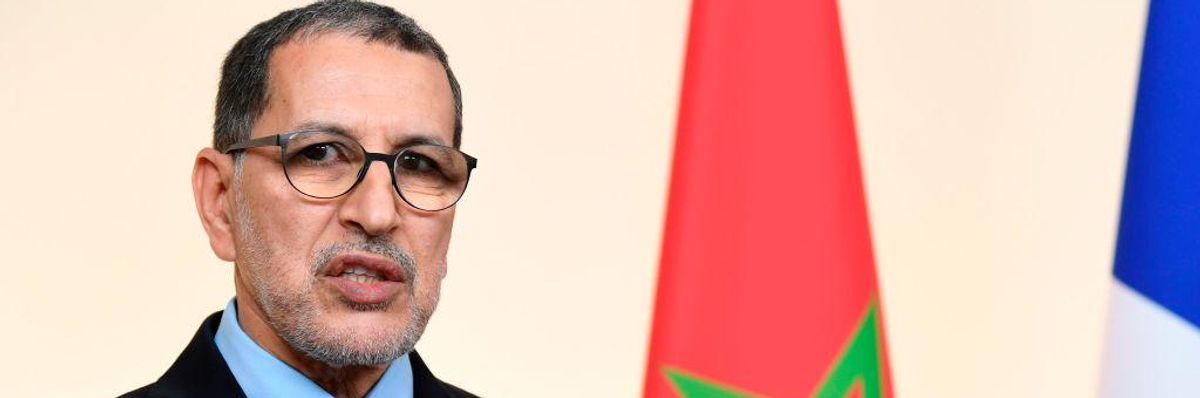
Morocco's Prime Minister Saad-Eddine El Othmani. (Photo by BERTRAND GUAY/AFP via Getty Images)
Reports that Morocco would be willing to follow the United Arab Emirates and Bahrain in normalizing relations with Israel in exchange for U.S. recognition of Moroccan control of Western Sahara are deeply concerning.
The United States has a responsibility to uphold international law, including the U.S.-supported referendum that would give Western Saharans a voice in deciding their future. Giving all that away just to score political points before the U.S. general election would be shameful and a stain on American foreign policy.
This radical shift in U.S. policy would set a dangerous precedent and call into question the integrity of the United States and its commitment to international efforts to find multilateral political solutions.
While largely off the radar for Western audiences, the 45-year-long conflict between the Polisario -- a local Sahrawi independence movement -- and Morocco over Western Sahara, a region bounded by Mauritania, Morocco, and the Atlantic Ocean, has pitted regional powers against each other and challenged policymakers and diplomats searching for a solution.
The conflict over Western Sahara, a former Spanish colony rich in natural resources, began in earnest after Spain withdrew from the region in 1975 and Morocco took the opportunity to occupy much of the disputed territory. Despite a ceasefire declared in 1991, the conflict over Sahrawi independence has continued to simmer, with Morocco claiming de facto sovereignty over 70 percent of the land that many locals view as the foundation of a future state.
As a result, Western Sahara is frequently considered to be the "last colony in Africa" and remains classified by the United Nations as a "Non-Self Governing Territory." Since the ceasefire, the U.N. has been working to organize a referendum to allow Western Saharans a vote on their future. To date the conflict has forced more than 90,000 Sahrawi refugees to flee into makeshift camps in the southern Algerian desert where most rely on the U.N. for nearly all basic necessities. Meanwhile, the Sahrawis who remain in Morocco-controlled Western Sahara have been subject to widely-reported human rights abuses.
A decision to recognize Moroccan sovereignty over Western Sahara may, on its face, seem an appealing way to end the conflict. But in reality, U.S. recognition of Moroccan claims to Western Sahara would preempt any opportunity for Western Saharans to determine their own political future and would delegitimize the work of the U.N., whose primary mandate in Western Sahara is to "organize and ensure a free and fair referendum."
This mandate is supported by a landmark advisory opinion issued by the International Court of Justice as well as repeated affirmations by the U.N. General Assembly. A decision by the United States to override these efforts would undermine the ability of the U.N. to play a constructive role in any conflict elsewhere.
Such a decision would also be a repudiation of Washington's own long-sought goals for the region. The United States has played a key role in helping to build support for a mutually agreeable political resolution to the conflict. This radical shift in U.S. policy would set a dangerous precedent and call into question the integrity of the United States and its commitment to international efforts to find multilateral political solutions.
With such a decision, the United States, and the world at large, would face serious repercussions -- the erosion of international norms regarding the right to self-determination, the weakening of the U.N.'s ability to resolve conflicts, as well as the diminished ability of the United States to play a leadership role internationally.
Whether the people of Western Sahara choose greater autonomy under Moroccan leadership or independence, it should be their choice, not something bargained away in hopes of boosting the current U.S. president's domestic political chances.
Dear Common Dreams reader, It’s been nearly 30 years since I co-founded Common Dreams with my late wife, Lina Newhouser. We had the radical notion that journalism should serve the public good, not corporate profits. It was clear to us from the outset what it would take to build such a project. No paid advertisements. No corporate sponsors. No millionaire publisher telling us what to think or do. Many people said we wouldn't last a year, but we proved those doubters wrong. Together with a tremendous team of journalists and dedicated staff, we built an independent media outlet free from the constraints of profits and corporate control. Our mission has always been simple: To inform. To inspire. To ignite change for the common good. Building Common Dreams was not easy. Our survival was never guaranteed. When you take on the most powerful forces—Wall Street greed, fossil fuel industry destruction, Big Tech lobbyists, and uber-rich oligarchs who have spent billions upon billions rigging the economy and democracy in their favor—the only bulwark you have is supporters who believe in your work. But here’s the urgent message from me today. It's never been this bad out there. And it's never been this hard to keep us going. At the very moment Common Dreams is most needed, the threats we face are intensifying. We need your support now more than ever. We don't accept corporate advertising and never will. We don't have a paywall because we don't think people should be blocked from critical news based on their ability to pay. Everything we do is funded by the donations of readers like you. When everyone does the little they can afford, we are strong. But if that support retreats or dries up, so do we. Will you donate now to make sure Common Dreams not only survives but thrives? —Craig Brown, Co-founder |
Reports that Morocco would be willing to follow the United Arab Emirates and Bahrain in normalizing relations with Israel in exchange for U.S. recognition of Moroccan control of Western Sahara are deeply concerning.
The United States has a responsibility to uphold international law, including the U.S.-supported referendum that would give Western Saharans a voice in deciding their future. Giving all that away just to score political points before the U.S. general election would be shameful and a stain on American foreign policy.
This radical shift in U.S. policy would set a dangerous precedent and call into question the integrity of the United States and its commitment to international efforts to find multilateral political solutions.
While largely off the radar for Western audiences, the 45-year-long conflict between the Polisario -- a local Sahrawi independence movement -- and Morocco over Western Sahara, a region bounded by Mauritania, Morocco, and the Atlantic Ocean, has pitted regional powers against each other and challenged policymakers and diplomats searching for a solution.
The conflict over Western Sahara, a former Spanish colony rich in natural resources, began in earnest after Spain withdrew from the region in 1975 and Morocco took the opportunity to occupy much of the disputed territory. Despite a ceasefire declared in 1991, the conflict over Sahrawi independence has continued to simmer, with Morocco claiming de facto sovereignty over 70 percent of the land that many locals view as the foundation of a future state.
As a result, Western Sahara is frequently considered to be the "last colony in Africa" and remains classified by the United Nations as a "Non-Self Governing Territory." Since the ceasefire, the U.N. has been working to organize a referendum to allow Western Saharans a vote on their future. To date the conflict has forced more than 90,000 Sahrawi refugees to flee into makeshift camps in the southern Algerian desert where most rely on the U.N. for nearly all basic necessities. Meanwhile, the Sahrawis who remain in Morocco-controlled Western Sahara have been subject to widely-reported human rights abuses.
A decision to recognize Moroccan sovereignty over Western Sahara may, on its face, seem an appealing way to end the conflict. But in reality, U.S. recognition of Moroccan claims to Western Sahara would preempt any opportunity for Western Saharans to determine their own political future and would delegitimize the work of the U.N., whose primary mandate in Western Sahara is to "organize and ensure a free and fair referendum."
This mandate is supported by a landmark advisory opinion issued by the International Court of Justice as well as repeated affirmations by the U.N. General Assembly. A decision by the United States to override these efforts would undermine the ability of the U.N. to play a constructive role in any conflict elsewhere.
Such a decision would also be a repudiation of Washington's own long-sought goals for the region. The United States has played a key role in helping to build support for a mutually agreeable political resolution to the conflict. This radical shift in U.S. policy would set a dangerous precedent and call into question the integrity of the United States and its commitment to international efforts to find multilateral political solutions.
With such a decision, the United States, and the world at large, would face serious repercussions -- the erosion of international norms regarding the right to self-determination, the weakening of the U.N.'s ability to resolve conflicts, as well as the diminished ability of the United States to play a leadership role internationally.
Whether the people of Western Sahara choose greater autonomy under Moroccan leadership or independence, it should be their choice, not something bargained away in hopes of boosting the current U.S. president's domestic political chances.
Reports that Morocco would be willing to follow the United Arab Emirates and Bahrain in normalizing relations with Israel in exchange for U.S. recognition of Moroccan control of Western Sahara are deeply concerning.
The United States has a responsibility to uphold international law, including the U.S.-supported referendum that would give Western Saharans a voice in deciding their future. Giving all that away just to score political points before the U.S. general election would be shameful and a stain on American foreign policy.
This radical shift in U.S. policy would set a dangerous precedent and call into question the integrity of the United States and its commitment to international efforts to find multilateral political solutions.
While largely off the radar for Western audiences, the 45-year-long conflict between the Polisario -- a local Sahrawi independence movement -- and Morocco over Western Sahara, a region bounded by Mauritania, Morocco, and the Atlantic Ocean, has pitted regional powers against each other and challenged policymakers and diplomats searching for a solution.
The conflict over Western Sahara, a former Spanish colony rich in natural resources, began in earnest after Spain withdrew from the region in 1975 and Morocco took the opportunity to occupy much of the disputed territory. Despite a ceasefire declared in 1991, the conflict over Sahrawi independence has continued to simmer, with Morocco claiming de facto sovereignty over 70 percent of the land that many locals view as the foundation of a future state.
As a result, Western Sahara is frequently considered to be the "last colony in Africa" and remains classified by the United Nations as a "Non-Self Governing Territory." Since the ceasefire, the U.N. has been working to organize a referendum to allow Western Saharans a vote on their future. To date the conflict has forced more than 90,000 Sahrawi refugees to flee into makeshift camps in the southern Algerian desert where most rely on the U.N. for nearly all basic necessities. Meanwhile, the Sahrawis who remain in Morocco-controlled Western Sahara have been subject to widely-reported human rights abuses.
A decision to recognize Moroccan sovereignty over Western Sahara may, on its face, seem an appealing way to end the conflict. But in reality, U.S. recognition of Moroccan claims to Western Sahara would preempt any opportunity for Western Saharans to determine their own political future and would delegitimize the work of the U.N., whose primary mandate in Western Sahara is to "organize and ensure a free and fair referendum."
This mandate is supported by a landmark advisory opinion issued by the International Court of Justice as well as repeated affirmations by the U.N. General Assembly. A decision by the United States to override these efforts would undermine the ability of the U.N. to play a constructive role in any conflict elsewhere.
Such a decision would also be a repudiation of Washington's own long-sought goals for the region. The United States has played a key role in helping to build support for a mutually agreeable political resolution to the conflict. This radical shift in U.S. policy would set a dangerous precedent and call into question the integrity of the United States and its commitment to international efforts to find multilateral political solutions.
With such a decision, the United States, and the world at large, would face serious repercussions -- the erosion of international norms regarding the right to self-determination, the weakening of the U.N.'s ability to resolve conflicts, as well as the diminished ability of the United States to play a leadership role internationally.
Whether the people of Western Sahara choose greater autonomy under Moroccan leadership or independence, it should be their choice, not something bargained away in hopes of boosting the current U.S. president's domestic political chances.