SUBSCRIBE TO OUR FREE NEWSLETTER
Daily news & progressive opinion—funded by the people, not the corporations—delivered straight to your inbox.
5
#000000
#FFFFFF
To donate by check, phone, or other method, see our More Ways to Give page.
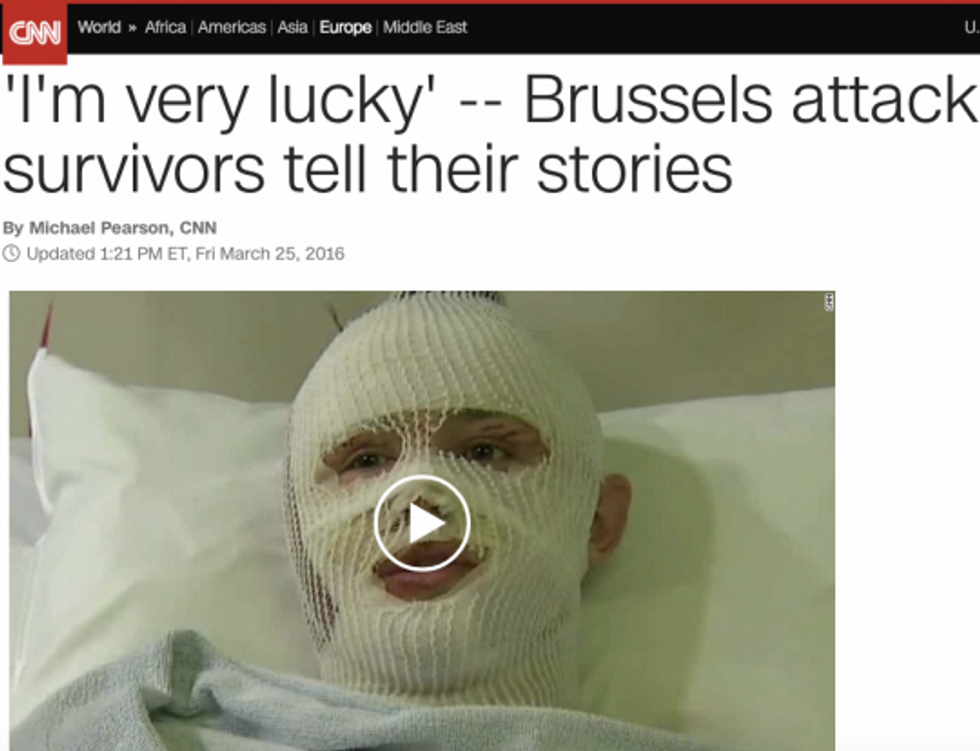
For days now, American cable news has broadcast non-stop coverage of the horrific attack in Brussels. Viewers repeatedly heard from witnesses and from the wounded. Video was shown in a loop of the terror and panic when the bombs exploded. Networks dispatched their TV stars to Brussels, where they remain. NPR profiled the lives of several of the airport victims. CNN showed a moving interview of a wounded, bandage-wrapped Mormon American teenager speaking from his Belgium hospital bed.
All of that is how it should be: that's news. And it's important to understand on a visceral level the human cost from this type of violence. But that's also the same reason it's so unjustifiable, and so propagandistic, that this type of coverage is accorded only to western victims of violence, but almost never to the non-western victims of the west's own violence.
A little more than a week ago, as Mohammed Ali Kalfood reported in The Intercept, "fighter jets from a Saudi-led [US and UK-supported] coalition bombed a market in Mastaba, in Yemen's northern province of Hajjah. The latest count indicates that about 120 people were killed, including more than 20 children, and 80 were wounded in the strikes." Kalfood interviewed 21-year-old Yemeni Khaled Hassan Mohammadi who said that "we saw airstrikes on a market last Ramadan, not far from here, but this attack was the deadliest." Over the past several years, the U.S. has launched hideous civilian-slaughtering strikes in Yemen, Pakistan, Afghanistan, Syria, Somalia, Libya and Iraq. Last July, The Intercept published a photo essay by Alex Potter of Yemeni victims of one of 2015's deadliest Saudi-led, US/UK-armed strikes.
You'll almost never hear any of those victims' names on CNN, NPR, or most other large U.S. media outlets. No famous American TV correspondents will be sent to the places where those people have their lives ended by the bombs of the U.S. and its allies. At most, you'll hear small, clinical news stories briefly and coldly describing what happened - usually accompanied by a justifying claim from U.S. officials, uncritically conveyed, about why the bombing was noble - but, even in those rare cases where such attacks are covered at all, everything will be avoided that would cause you to have any visceral or emotional connection to the victims. You'll never know anything about them - not even their names, let alone hear about their extinguished life aspirations or hear from their grieving survivors - and will therefore have no ability to feel anything for them. As a result, their existence will barely register.
That's by design. It's because U.S. media outlets love to dramatize and endlessly highlight western victims of violence, while rendering almost completely invisible the victims of their own side's violence.
Read the full article at The Intercept.
For days now, American cable news has broadcast non-stop coverage of the horrific attack in Brussels. Viewers repeatedly heard from witnesses and from the wounded. Video was shown in a loop of the terror and panic when the bombs exploded. Networks dispatched their TV stars to Brussels, where they remain. NPR profiled the lives of several of the airport victims. CNN showed a moving interview of a wounded, bandage-wrapped Mormon American teenager speaking from his Belgium hospital bed.
All of that is how it should be: that's news. And it's important to understand on a visceral level the human cost from this type of violence. But that's also the same reason it's so unjustifiable, and so propagandistic, that this type of coverage is accorded only to western victims of violence, but almost never to the non-western victims of the west's own violence.
A little more than a week ago, as Mohammed Ali Kalfood reported in The Intercept, "fighter jets from a Saudi-led [US and UK-supported] coalition bombed a market in Mastaba, in Yemen's northern province of Hajjah. The latest count indicates that about 120 people were killed, including more than 20 children, and 80 were wounded in the strikes." Kalfood interviewed 21-year-old Yemeni Khaled Hassan Mohammadi who said that "we saw airstrikes on a market last Ramadan, not far from here, but this attack was the deadliest." Over the past several years, the U.S. has launched hideous civilian-slaughtering strikes in Yemen, Pakistan, Afghanistan, Syria, Somalia, Libya and Iraq. Last July, The Intercept published a photo essay by Alex Potter of Yemeni victims of one of 2015's deadliest Saudi-led, US/UK-armed strikes.
You'll almost never hear any of those victims' names on CNN, NPR, or most other large U.S. media outlets. No famous American TV correspondents will be sent to the places where those people have their lives ended by the bombs of the U.S. and its allies. At most, you'll hear small, clinical news stories briefly and coldly describing what happened - usually accompanied by a justifying claim from U.S. officials, uncritically conveyed, about why the bombing was noble - but, even in those rare cases where such attacks are covered at all, everything will be avoided that would cause you to have any visceral or emotional connection to the victims. You'll never know anything about them - not even their names, let alone hear about their extinguished life aspirations or hear from their grieving survivors - and will therefore have no ability to feel anything for them. As a result, their existence will barely register.
That's by design. It's because U.S. media outlets love to dramatize and endlessly highlight western victims of violence, while rendering almost completely invisible the victims of their own side's violence.
Read the full article at The Intercept.
For days now, American cable news has broadcast non-stop coverage of the horrific attack in Brussels. Viewers repeatedly heard from witnesses and from the wounded. Video was shown in a loop of the terror and panic when the bombs exploded. Networks dispatched their TV stars to Brussels, where they remain. NPR profiled the lives of several of the airport victims. CNN showed a moving interview of a wounded, bandage-wrapped Mormon American teenager speaking from his Belgium hospital bed.
All of that is how it should be: that's news. And it's important to understand on a visceral level the human cost from this type of violence. But that's also the same reason it's so unjustifiable, and so propagandistic, that this type of coverage is accorded only to western victims of violence, but almost never to the non-western victims of the west's own violence.
A little more than a week ago, as Mohammed Ali Kalfood reported in The Intercept, "fighter jets from a Saudi-led [US and UK-supported] coalition bombed a market in Mastaba, in Yemen's northern province of Hajjah. The latest count indicates that about 120 people were killed, including more than 20 children, and 80 were wounded in the strikes." Kalfood interviewed 21-year-old Yemeni Khaled Hassan Mohammadi who said that "we saw airstrikes on a market last Ramadan, not far from here, but this attack was the deadliest." Over the past several years, the U.S. has launched hideous civilian-slaughtering strikes in Yemen, Pakistan, Afghanistan, Syria, Somalia, Libya and Iraq. Last July, The Intercept published a photo essay by Alex Potter of Yemeni victims of one of 2015's deadliest Saudi-led, US/UK-armed strikes.
You'll almost never hear any of those victims' names on CNN, NPR, or most other large U.S. media outlets. No famous American TV correspondents will be sent to the places where those people have their lives ended by the bombs of the U.S. and its allies. At most, you'll hear small, clinical news stories briefly and coldly describing what happened - usually accompanied by a justifying claim from U.S. officials, uncritically conveyed, about why the bombing was noble - but, even in those rare cases where such attacks are covered at all, everything will be avoided that would cause you to have any visceral or emotional connection to the victims. You'll never know anything about them - not even their names, let alone hear about their extinguished life aspirations or hear from their grieving survivors - and will therefore have no ability to feel anything for them. As a result, their existence will barely register.
That's by design. It's because U.S. media outlets love to dramatize and endlessly highlight western victims of violence, while rendering almost completely invisible the victims of their own side's violence.
Read the full article at The Intercept.