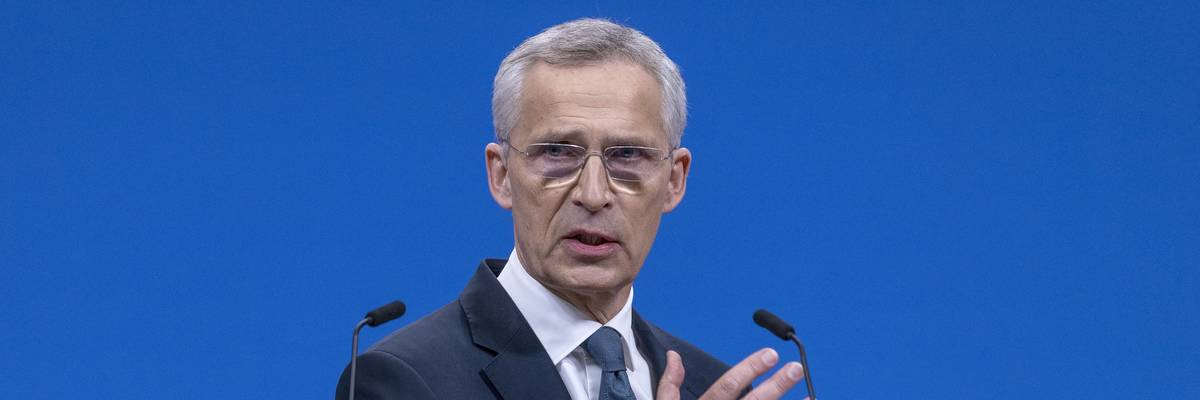
NATO Secretary-General Jens Stoltenberg holds a press conference on June 14, 2024 in Brussels, Belgium.
Campaigners Decry 'Dangerous Escalation' as NATO Chief Floats Nuclear Deployment
The International Campaign to Abolish Nuclear Weapons said both NATO and Russia must "reverse course" and end their nuclear brinkmanship.
Nuclear disarmament campaigners on Monday implored NATO and Russia to step back from the brink after the head of the Western military alliance said its members are considering deploying additional atomic weapons to counter Moscow and Beijing.
"This is the dangerous escalation inherent to the deterrence doctrine," the International Campaign to Abolish Nuclear Weapons (ICAN) wrote on social media, referring to the notion that the threat of catastrophic nuclear retaliation prevents nations from using atomic weaponry.
The U.S., which spent more on its atomic weapons arsenal than every other nuclear-armed nation combined last year, currently has nukes deployed in five NATO countries—Italy, Germany, Turkey, Belgium, and the Netherlands. Russia, meanwhile, recently deployed nuclear weapons to Belarus, which said earlier this month that it would join Moscow's nuclear exercises.
ICAN said Monday that "it's time for both to reverse course."
"NATO countries hosting U.S. nuclear weapons should admit to their citizens they have weapons of mass destruction on their soil with no public say," ICAN added. "But neither Belarus nor NATO allies should flaunt being prepared to indiscriminately kill millions of people."
"The risk of nuclear weapons use, and public attention to this danger, is at an all-time high."
The group's warning came after NATO Secretary-General Jens Stoltenberg told The Telegraph on Sunday that members of the military alliance are in the process of deliberating over "how many nuclear warheads should be operational and which should be stored."
"NATO's aim is, of course, a world without nuclear weapons, but as long as nuclear weapons exist, we will remain a nuclear alliance, because a world where Russia, China, and North Korea have nuclear weapons, and NATO does not, is a more dangerous world," Stoltenberg continued.
The NATO chief's remarks drew a swift response from Moscow. Dmitry Peskov, a spokesperson for the Kremlin, condemned Stoltenberg's comments as "nothing else but an escalation" and claimed that whenever Russian President Vladimir Putin "comments on the issue of nuclear arms, he does so taking someone's questions or questions from reporters, including foreign ones."
A report published Monday by the Stockholm International Peace Research Institute (SIPRI) found that "nearly all" of the world's 2,100 deployed nuclear warheads that were "kept in a state of high operational alert" as of January 2024 belonged to the U.S. or Russia.
Separately, ICAN released an analysis Monday showing that the U.S., Russia, and China were the world's largest spenders on nuclear weapons last year. The U.S. and Russia control about 90% of the world's arsenal of atomic weapons. According to experts, a nuclear conflict between the two countries would likely kill tens of millions of people within hours and set off a devastating global famine.
"The risk of nuclear weapons use, and public attention to this danger, is at an all-time high," ICAN's new report warns. "Explicit and implicit threats to use nuclear weapons, including in the context of ongoing conflicts in Ukraine and Gaza, combined with the Oppenheimer blockbuster, Fallout TV show (and possible video game reboot), and bestselling book 'Nuclear War: A Scenario,' mean the world is talking about the bomb."
Urgent. It's never been this bad.
Dear Common Dreams reader, It’s been nearly 30 years since I co-founded Common Dreams with my late wife, Lina Newhouser. We had the radical notion that journalism should serve the public good, not corporate profits. It was clear to us from the outset what it would take to build such a project. No paid advertisements. No corporate sponsors. No millionaire publisher telling us what to think or do. Many people said we wouldn't last a year, but we proved those doubters wrong. Together with a tremendous team of journalists and dedicated staff, we built an independent media outlet free from the constraints of profits and corporate control. Our mission from the outset was simple. To inform. To inspire. To ignite change for the common good. Building Common Dreams was not easy. Our survival was never guaranteed. When you take on the most powerful forces—Wall Street greed, fossil fuel industry destruction, Big Tech lobbyists, and uber-rich oligarchs who have spent billions upon billions rigging the economy and democracy in their favor—the only bulwark you have is supporters who believe in your work. But here’s the urgent message from me today. It’s never been this bad out there. And it’s never been this hard to keep us going. At the very moment Common Dreams is most needed and doing some of its best and most important work, the threats we face are intensifying. Right now, with just four days to go in our Spring Campaign, we are not even halfway to our goal. When everyone does the little they can afford, we are strong. But if that support retreats or dries up, so do we. Can you make a gift right now to make sure Common Dreams not only survives but thrives? There is no backup plan or rainy day fund. There is only you. —Craig Brown, Co-founder |
Nuclear disarmament campaigners on Monday implored NATO and Russia to step back from the brink after the head of the Western military alliance said its members are considering deploying additional atomic weapons to counter Moscow and Beijing.
"This is the dangerous escalation inherent to the deterrence doctrine," the International Campaign to Abolish Nuclear Weapons (ICAN) wrote on social media, referring to the notion that the threat of catastrophic nuclear retaliation prevents nations from using atomic weaponry.
The U.S., which spent more on its atomic weapons arsenal than every other nuclear-armed nation combined last year, currently has nukes deployed in five NATO countries—Italy, Germany, Turkey, Belgium, and the Netherlands. Russia, meanwhile, recently deployed nuclear weapons to Belarus, which said earlier this month that it would join Moscow's nuclear exercises.
ICAN said Monday that "it's time for both to reverse course."
"NATO countries hosting U.S. nuclear weapons should admit to their citizens they have weapons of mass destruction on their soil with no public say," ICAN added. "But neither Belarus nor NATO allies should flaunt being prepared to indiscriminately kill millions of people."
"The risk of nuclear weapons use, and public attention to this danger, is at an all-time high."
The group's warning came after NATO Secretary-General Jens Stoltenberg told The Telegraph on Sunday that members of the military alliance are in the process of deliberating over "how many nuclear warheads should be operational and which should be stored."
"NATO's aim is, of course, a world without nuclear weapons, but as long as nuclear weapons exist, we will remain a nuclear alliance, because a world where Russia, China, and North Korea have nuclear weapons, and NATO does not, is a more dangerous world," Stoltenberg continued.
The NATO chief's remarks drew a swift response from Moscow. Dmitry Peskov, a spokesperson for the Kremlin, condemned Stoltenberg's comments as "nothing else but an escalation" and claimed that whenever Russian President Vladimir Putin "comments on the issue of nuclear arms, he does so taking someone's questions or questions from reporters, including foreign ones."
A report published Monday by the Stockholm International Peace Research Institute (SIPRI) found that "nearly all" of the world's 2,100 deployed nuclear warheads that were "kept in a state of high operational alert" as of January 2024 belonged to the U.S. or Russia.
Separately, ICAN released an analysis Monday showing that the U.S., Russia, and China were the world's largest spenders on nuclear weapons last year. The U.S. and Russia control about 90% of the world's arsenal of atomic weapons. According to experts, a nuclear conflict between the two countries would likely kill tens of millions of people within hours and set off a devastating global famine.
"The risk of nuclear weapons use, and public attention to this danger, is at an all-time high," ICAN's new report warns. "Explicit and implicit threats to use nuclear weapons, including in the context of ongoing conflicts in Ukraine and Gaza, combined with the Oppenheimer blockbuster, Fallout TV show (and possible video game reboot), and bestselling book 'Nuclear War: A Scenario,' mean the world is talking about the bomb."
Nuclear disarmament campaigners on Monday implored NATO and Russia to step back from the brink after the head of the Western military alliance said its members are considering deploying additional atomic weapons to counter Moscow and Beijing.
"This is the dangerous escalation inherent to the deterrence doctrine," the International Campaign to Abolish Nuclear Weapons (ICAN) wrote on social media, referring to the notion that the threat of catastrophic nuclear retaliation prevents nations from using atomic weaponry.
The U.S., which spent more on its atomic weapons arsenal than every other nuclear-armed nation combined last year, currently has nukes deployed in five NATO countries—Italy, Germany, Turkey, Belgium, and the Netherlands. Russia, meanwhile, recently deployed nuclear weapons to Belarus, which said earlier this month that it would join Moscow's nuclear exercises.
ICAN said Monday that "it's time for both to reverse course."
"NATO countries hosting U.S. nuclear weapons should admit to their citizens they have weapons of mass destruction on their soil with no public say," ICAN added. "But neither Belarus nor NATO allies should flaunt being prepared to indiscriminately kill millions of people."
"The risk of nuclear weapons use, and public attention to this danger, is at an all-time high."
The group's warning came after NATO Secretary-General Jens Stoltenberg told The Telegraph on Sunday that members of the military alliance are in the process of deliberating over "how many nuclear warheads should be operational and which should be stored."
"NATO's aim is, of course, a world without nuclear weapons, but as long as nuclear weapons exist, we will remain a nuclear alliance, because a world where Russia, China, and North Korea have nuclear weapons, and NATO does not, is a more dangerous world," Stoltenberg continued.
The NATO chief's remarks drew a swift response from Moscow. Dmitry Peskov, a spokesperson for the Kremlin, condemned Stoltenberg's comments as "nothing else but an escalation" and claimed that whenever Russian President Vladimir Putin "comments on the issue of nuclear arms, he does so taking someone's questions or questions from reporters, including foreign ones."
A report published Monday by the Stockholm International Peace Research Institute (SIPRI) found that "nearly all" of the world's 2,100 deployed nuclear warheads that were "kept in a state of high operational alert" as of January 2024 belonged to the U.S. or Russia.
Separately, ICAN released an analysis Monday showing that the U.S., Russia, and China were the world's largest spenders on nuclear weapons last year. The U.S. and Russia control about 90% of the world's arsenal of atomic weapons. According to experts, a nuclear conflict between the two countries would likely kill tens of millions of people within hours and set off a devastating global famine.
"The risk of nuclear weapons use, and public attention to this danger, is at an all-time high," ICAN's new report warns. "Explicit and implicit threats to use nuclear weapons, including in the context of ongoing conflicts in Ukraine and Gaza, combined with the Oppenheimer blockbuster, Fallout TV show (and possible video game reboot), and bestselling book 'Nuclear War: A Scenario,' mean the world is talking about the bomb."