SUBSCRIBE TO OUR FREE NEWSLETTER
Daily news & progressive opinion—funded by the people, not the corporations—delivered straight to your inbox.
5
#000000
#FFFFFF
To donate by check, phone, or other method, see our More Ways to Give page.
Daily news & progressive opinion—funded by the people, not the corporations—delivered straight to your inbox.
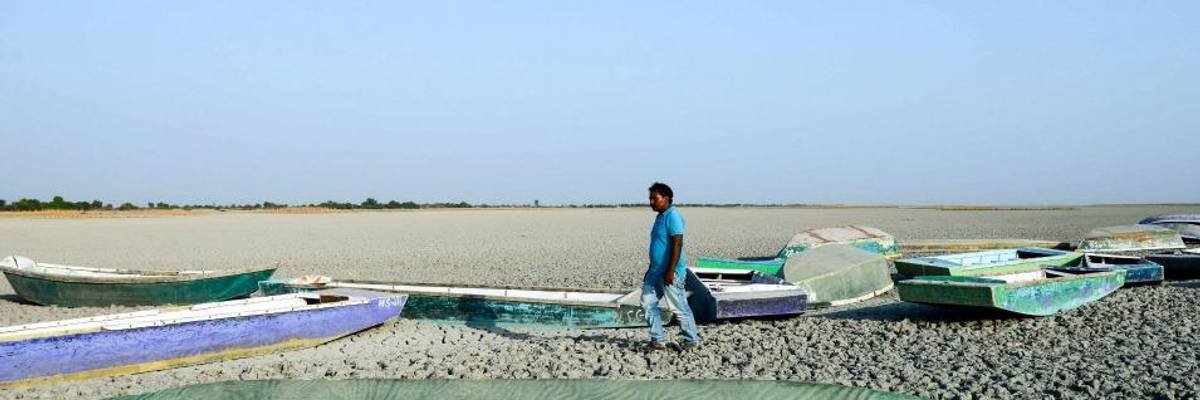
In this picture taken on June 4, 2019, an Indian boatman walks amid boats on the dried bed of a lake at Nalsarovar Bird Sanctuary, on the eve of World Environment Day. (Photo: Sam Panthaky/AFP/Getty Images)
Nearly 50 people died on Saturday in one Indian state as record-breaking heatwaves across the country have caused an increasingly desperate situation.
Officials in Bihar reported that as of Monday, 76 people in total had died of heat-related conditions as temperatures in the region hovered around 113 degrees Fahrenheit. Hospitals have increasingly overflowed with patients reporting heatstroke since the heatwave began in early June.
Across the country in the city of Aurangabad, India Today reported, 22 died just on Saturday. The death toll that day in the northern city of Gaya was 20.
About two-thirds of India is facing the heatwaves at the same time that roughly half of the country is struggling through its worst drought in six decades.
Officials on Sunday asked Bihar's 100 million people to stay inside Monday as fears of more fatalities grew.
In 2015, a prolonged heatwave killed more than 3,500 in India and Pakistan.
More than 1,000 miles south of Bihar, The Guardian reported, residents in Tamil Nadu have also been ordered to stay indoors between 11:00am and 4:00pm.
June's heatwave is already one of the longest India has ever seen. While temperatures tend to rise in the country ahead of monsoon season, the deadly heatwaves have caused alarm among climate campaigners and Indian authorities.
Thermometers registered 118 degrees in Dehli last week, while in Rajasthan, residents suffered through a 122-degree day last week.
The Australian organization Climate Council tweeted that human activity and the climate crisis are fueling the record-breaking rise in temperatures and drought, while Business Insider reporter Eliza Relman suggested that such heatwaves may represent a new normal for India and other parts of the world.
The Times in the U.K. reported that tens of thousands of residents in northern states have fled their homes in recent days, escaping communities where police have begun guarding water supplies as fighting has broken out over resources.
But as one observer, British Green Party politician Alex Armitage, pointed out, Indians who are able to flee their homes in search of cooler temperatures are likely in the minority and most will be forced to wait out the heatwave. Bihar, where many of the weekend's deaths were recorded, is one of the poorest states in the country.
"The climate is no longer safe for people in India," wrote Armitage. "Richer Indians will be able to migrate to cooler parts of the world. Poorer Indians will have to stay put."
Dear Common Dreams reader, It’s been nearly 30 years since I co-founded Common Dreams with my late wife, Lina Newhouser. We had the radical notion that journalism should serve the public good, not corporate profits. It was clear to us from the outset what it would take to build such a project. No paid advertisements. No corporate sponsors. No millionaire publisher telling us what to think or do. Many people said we wouldn't last a year, but we proved those doubters wrong. Together with a tremendous team of journalists and dedicated staff, we built an independent media outlet free from the constraints of profits and corporate control. Our mission has always been simple: To inform. To inspire. To ignite change for the common good. Building Common Dreams was not easy. Our survival was never guaranteed. When you take on the most powerful forces—Wall Street greed, fossil fuel industry destruction, Big Tech lobbyists, and uber-rich oligarchs who have spent billions upon billions rigging the economy and democracy in their favor—the only bulwark you have is supporters who believe in your work. But here’s the urgent message from me today. It's never been this bad out there. And it's never been this hard to keep us going. At the very moment Common Dreams is most needed, the threats we face are intensifying. We need your support now more than ever. We don't accept corporate advertising and never will. We don't have a paywall because we don't think people should be blocked from critical news based on their ability to pay. Everything we do is funded by the donations of readers like you. When everyone does the little they can afford, we are strong. But if that support retreats or dries up, so do we. Will you donate now to make sure Common Dreams not only survives but thrives? —Craig Brown, Co-founder |
Nearly 50 people died on Saturday in one Indian state as record-breaking heatwaves across the country have caused an increasingly desperate situation.
Officials in Bihar reported that as of Monday, 76 people in total had died of heat-related conditions as temperatures in the region hovered around 113 degrees Fahrenheit. Hospitals have increasingly overflowed with patients reporting heatstroke since the heatwave began in early June.
Across the country in the city of Aurangabad, India Today reported, 22 died just on Saturday. The death toll that day in the northern city of Gaya was 20.
About two-thirds of India is facing the heatwaves at the same time that roughly half of the country is struggling through its worst drought in six decades.
Officials on Sunday asked Bihar's 100 million people to stay inside Monday as fears of more fatalities grew.
In 2015, a prolonged heatwave killed more than 3,500 in India and Pakistan.
More than 1,000 miles south of Bihar, The Guardian reported, residents in Tamil Nadu have also been ordered to stay indoors between 11:00am and 4:00pm.
June's heatwave is already one of the longest India has ever seen. While temperatures tend to rise in the country ahead of monsoon season, the deadly heatwaves have caused alarm among climate campaigners and Indian authorities.
Thermometers registered 118 degrees in Dehli last week, while in Rajasthan, residents suffered through a 122-degree day last week.
The Australian organization Climate Council tweeted that human activity and the climate crisis are fueling the record-breaking rise in temperatures and drought, while Business Insider reporter Eliza Relman suggested that such heatwaves may represent a new normal for India and other parts of the world.
The Times in the U.K. reported that tens of thousands of residents in northern states have fled their homes in recent days, escaping communities where police have begun guarding water supplies as fighting has broken out over resources.
But as one observer, British Green Party politician Alex Armitage, pointed out, Indians who are able to flee their homes in search of cooler temperatures are likely in the minority and most will be forced to wait out the heatwave. Bihar, where many of the weekend's deaths were recorded, is one of the poorest states in the country.
"The climate is no longer safe for people in India," wrote Armitage. "Richer Indians will be able to migrate to cooler parts of the world. Poorer Indians will have to stay put."
Nearly 50 people died on Saturday in one Indian state as record-breaking heatwaves across the country have caused an increasingly desperate situation.
Officials in Bihar reported that as of Monday, 76 people in total had died of heat-related conditions as temperatures in the region hovered around 113 degrees Fahrenheit. Hospitals have increasingly overflowed with patients reporting heatstroke since the heatwave began in early June.
Across the country in the city of Aurangabad, India Today reported, 22 died just on Saturday. The death toll that day in the northern city of Gaya was 20.
About two-thirds of India is facing the heatwaves at the same time that roughly half of the country is struggling through its worst drought in six decades.
Officials on Sunday asked Bihar's 100 million people to stay inside Monday as fears of more fatalities grew.
In 2015, a prolonged heatwave killed more than 3,500 in India and Pakistan.
More than 1,000 miles south of Bihar, The Guardian reported, residents in Tamil Nadu have also been ordered to stay indoors between 11:00am and 4:00pm.
June's heatwave is already one of the longest India has ever seen. While temperatures tend to rise in the country ahead of monsoon season, the deadly heatwaves have caused alarm among climate campaigners and Indian authorities.
Thermometers registered 118 degrees in Dehli last week, while in Rajasthan, residents suffered through a 122-degree day last week.
The Australian organization Climate Council tweeted that human activity and the climate crisis are fueling the record-breaking rise in temperatures and drought, while Business Insider reporter Eliza Relman suggested that such heatwaves may represent a new normal for India and other parts of the world.
The Times in the U.K. reported that tens of thousands of residents in northern states have fled their homes in recent days, escaping communities where police have begun guarding water supplies as fighting has broken out over resources.
But as one observer, British Green Party politician Alex Armitage, pointed out, Indians who are able to flee their homes in search of cooler temperatures are likely in the minority and most will be forced to wait out the heatwave. Bihar, where many of the weekend's deaths were recorded, is one of the poorest states in the country.
"The climate is no longer safe for people in India," wrote Armitage. "Richer Indians will be able to migrate to cooler parts of the world. Poorer Indians will have to stay put."