SUBSCRIBE TO OUR FREE NEWSLETTER
Daily news & progressive opinion—funded by the people, not the corporations—delivered straight to your inbox.
5
#000000
#FFFFFF
To donate by check, phone, or other method, see our More Ways to Give page.
Daily news & progressive opinion—funded by the people, not the corporations—delivered straight to your inbox.
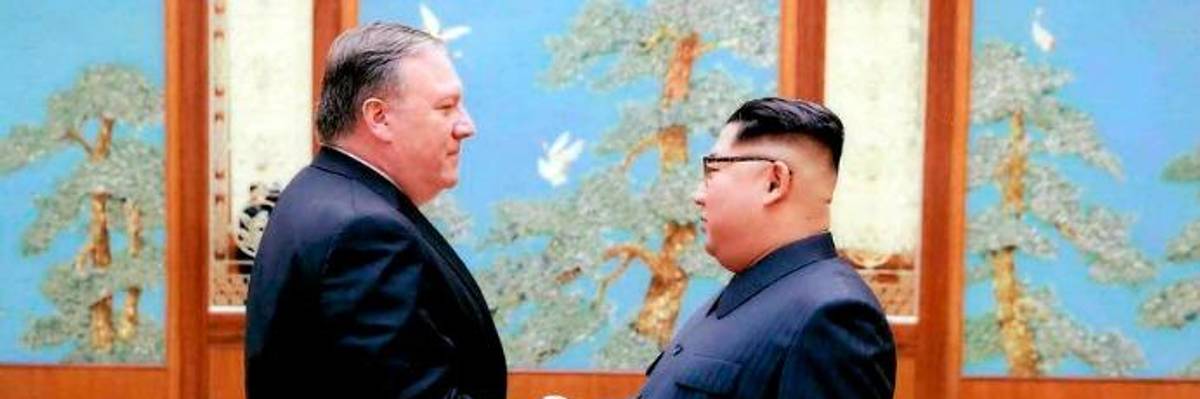
Mike Pompeo shakes hands with North Korean leader Kim Jong Un in Pyongyang, North Korea, during a 2018 East weekend trip. (Photo: White House via AP)
In a move that triggered fresh recognition of the power President Donald Trump possesses to ratchet up tensions--or even start a war--with a foreign adversary in order to distract from the "legal hurricane" that now engulfs his administration, Trump announced on Friday that Secretary of State Mike Pompeo will not be visiting North Korea for scheduled high-level talks.
"I have asked Secretary of State Mike Pompeo not to go to North Korea, at this time, because I feel we are not making sufficient progress with respect to the denuclearization of the Korean Peninsula," Trump wrote on Twitter.
Trump's last-minute cancellation of a major diplomatic trip comes at the close of a week that saw his former "fixer" Michael Cohen implicate him in a criminal conspiracy and his former campaign manager Paul Manafort convicted on eight counts of bank and tax fraud.
"If criminal investigations surrounding Trump tighten to the point that his political base starts to show signs of cracking, then he may decide that the time has come to try that ultimate diversionary tactic."
--Paul Pillar
Lawmakers and legal experts say these momentous developments--combined with reports that some of Trump's closest business and media allies have flipped on him and are now cooperating with federal prosecutors in exchange for immunity--indicate that the walls are closing in on the president.
If Trump's legal troubles continue to intensify--and if Special Counsel Robert Mueller's investigation continues to reach deeper into his sprawling business empire--analysts are warning that the president could try to use his substantial executive authority to launch a military conflict overseas in an effort to divert media and public attention from his countless domestic scandals.
In a piece for The Lobe Log on Thursday, former CIA analyst and Georgetown University visiting professor Paul Pillar argued that Trump's most "likely adversary" for a "diversionary war" is Iran, particularly given that Trump's cabinet is full of Iran hawks like Pompeo and national security adviser John Bolton, who would "welcome a war with Iran."
"If criminal investigations surrounding Trump tighten to the point that his political base starts to show signs of cracking, then he may decide that the time has come to try that ultimate diversionary tactic," Pillar wrote.
"For two reasons, Trump is even more likely to go that route than other presidents under similar pressures would be. One is that Trump already has shown a strong inclination to rely on destructive diversion, mostly through tweets and oral statements," Pillar wrote. "The other reason is that Trump is always tactically focused on whatever immediately affects his personal standing and support, and he shows little sign of thinking strategically about what is in the larger and longer-term interests of the nation."
While investigative journalist and Korea expert Tim Shorrock noted that he was not "unduly concerned" about the cancellation of Pompeo's trip, he also stated his belief that Trump's swirling controversies at home likely played a role in Friday's announcement.
Dear Common Dreams reader, It’s been nearly 30 years since I co-founded Common Dreams with my late wife, Lina Newhouser. We had the radical notion that journalism should serve the public good, not corporate profits. It was clear to us from the outset what it would take to build such a project. No paid advertisements. No corporate sponsors. No millionaire publisher telling us what to think or do. Many people said we wouldn't last a year, but we proved those doubters wrong. Together with a tremendous team of journalists and dedicated staff, we built an independent media outlet free from the constraints of profits and corporate control. Our mission has always been simple: To inform. To inspire. To ignite change for the common good. Building Common Dreams was not easy. Our survival was never guaranteed. When you take on the most powerful forces—Wall Street greed, fossil fuel industry destruction, Big Tech lobbyists, and uber-rich oligarchs who have spent billions upon billions rigging the economy and democracy in their favor—the only bulwark you have is supporters who believe in your work. But here’s the urgent message from me today. It's never been this bad out there. And it's never been this hard to keep us going. At the very moment Common Dreams is most needed, the threats we face are intensifying. We need your support now more than ever. We don't accept corporate advertising and never will. We don't have a paywall because we don't think people should be blocked from critical news based on their ability to pay. Everything we do is funded by the donations of readers like you. When everyone does the little they can afford, we are strong. But if that support retreats or dries up, so do we. Will you donate now to make sure Common Dreams not only survives but thrives? —Craig Brown, Co-founder |
In a move that triggered fresh recognition of the power President Donald Trump possesses to ratchet up tensions--or even start a war--with a foreign adversary in order to distract from the "legal hurricane" that now engulfs his administration, Trump announced on Friday that Secretary of State Mike Pompeo will not be visiting North Korea for scheduled high-level talks.
"I have asked Secretary of State Mike Pompeo not to go to North Korea, at this time, because I feel we are not making sufficient progress with respect to the denuclearization of the Korean Peninsula," Trump wrote on Twitter.
Trump's last-minute cancellation of a major diplomatic trip comes at the close of a week that saw his former "fixer" Michael Cohen implicate him in a criminal conspiracy and his former campaign manager Paul Manafort convicted on eight counts of bank and tax fraud.
"If criminal investigations surrounding Trump tighten to the point that his political base starts to show signs of cracking, then he may decide that the time has come to try that ultimate diversionary tactic."
--Paul Pillar
Lawmakers and legal experts say these momentous developments--combined with reports that some of Trump's closest business and media allies have flipped on him and are now cooperating with federal prosecutors in exchange for immunity--indicate that the walls are closing in on the president.
If Trump's legal troubles continue to intensify--and if Special Counsel Robert Mueller's investigation continues to reach deeper into his sprawling business empire--analysts are warning that the president could try to use his substantial executive authority to launch a military conflict overseas in an effort to divert media and public attention from his countless domestic scandals.
In a piece for The Lobe Log on Thursday, former CIA analyst and Georgetown University visiting professor Paul Pillar argued that Trump's most "likely adversary" for a "diversionary war" is Iran, particularly given that Trump's cabinet is full of Iran hawks like Pompeo and national security adviser John Bolton, who would "welcome a war with Iran."
"If criminal investigations surrounding Trump tighten to the point that his political base starts to show signs of cracking, then he may decide that the time has come to try that ultimate diversionary tactic," Pillar wrote.
"For two reasons, Trump is even more likely to go that route than other presidents under similar pressures would be. One is that Trump already has shown a strong inclination to rely on destructive diversion, mostly through tweets and oral statements," Pillar wrote. "The other reason is that Trump is always tactically focused on whatever immediately affects his personal standing and support, and he shows little sign of thinking strategically about what is in the larger and longer-term interests of the nation."
While investigative journalist and Korea expert Tim Shorrock noted that he was not "unduly concerned" about the cancellation of Pompeo's trip, he also stated his belief that Trump's swirling controversies at home likely played a role in Friday's announcement.
In a move that triggered fresh recognition of the power President Donald Trump possesses to ratchet up tensions--or even start a war--with a foreign adversary in order to distract from the "legal hurricane" that now engulfs his administration, Trump announced on Friday that Secretary of State Mike Pompeo will not be visiting North Korea for scheduled high-level talks.
"I have asked Secretary of State Mike Pompeo not to go to North Korea, at this time, because I feel we are not making sufficient progress with respect to the denuclearization of the Korean Peninsula," Trump wrote on Twitter.
Trump's last-minute cancellation of a major diplomatic trip comes at the close of a week that saw his former "fixer" Michael Cohen implicate him in a criminal conspiracy and his former campaign manager Paul Manafort convicted on eight counts of bank and tax fraud.
"If criminal investigations surrounding Trump tighten to the point that his political base starts to show signs of cracking, then he may decide that the time has come to try that ultimate diversionary tactic."
--Paul Pillar
Lawmakers and legal experts say these momentous developments--combined with reports that some of Trump's closest business and media allies have flipped on him and are now cooperating with federal prosecutors in exchange for immunity--indicate that the walls are closing in on the president.
If Trump's legal troubles continue to intensify--and if Special Counsel Robert Mueller's investigation continues to reach deeper into his sprawling business empire--analysts are warning that the president could try to use his substantial executive authority to launch a military conflict overseas in an effort to divert media and public attention from his countless domestic scandals.
In a piece for The Lobe Log on Thursday, former CIA analyst and Georgetown University visiting professor Paul Pillar argued that Trump's most "likely adversary" for a "diversionary war" is Iran, particularly given that Trump's cabinet is full of Iran hawks like Pompeo and national security adviser John Bolton, who would "welcome a war with Iran."
"If criminal investigations surrounding Trump tighten to the point that his political base starts to show signs of cracking, then he may decide that the time has come to try that ultimate diversionary tactic," Pillar wrote.
"For two reasons, Trump is even more likely to go that route than other presidents under similar pressures would be. One is that Trump already has shown a strong inclination to rely on destructive diversion, mostly through tweets and oral statements," Pillar wrote. "The other reason is that Trump is always tactically focused on whatever immediately affects his personal standing and support, and he shows little sign of thinking strategically about what is in the larger and longer-term interests of the nation."
While investigative journalist and Korea expert Tim Shorrock noted that he was not "unduly concerned" about the cancellation of Pompeo's trip, he also stated his belief that Trump's swirling controversies at home likely played a role in Friday's announcement.