
SUBSCRIBE TO OUR FREE NEWSLETTER
Daily news & progressive opinion—funded by the people, not the corporations—delivered straight to your inbox.
5
#000000
#FFFFFF
To donate by check, phone, or other method, see our More Ways to Give page.


Daily news & progressive opinion—funded by the people, not the corporations—delivered straight to your inbox.
To effectively counter MAGA, it must be accurately framed, not as an embodiment of American exceptionalism, but as part of a global populist strategy.
U.S. President Donald Trump's early actions in his second term under the "Make America Great Again," or MAGA, banner prioritized populist rhetoric over national interests. Withdrawing from the Paris climate agreement and the World Health Organization further isolated the United States and eroded its global leadership. Domestically, policies like federal hiring freezes, attempts to redefine birthright citizenship, and pardons for January 6 participants deepened national divisions and hindered effective governance. Meanwhile, rolling back protections against discrimination based on sexual orientation and gender identity or removing resources like the reproductiverights.gov website directly targeted "unworthy" groups of Americans. Although these actions energized his base, they sacrificed long-term stability and progress for short-term political gains. Beneath the "America First" rhetoric, these divisive policies weakened the country both at home and abroad.
The MAGA movement, championed by Trump during his 2016 campaign, is often framed as a uniquely American phenomenon. With promises to restore manufacturing jobs, secure borders, and challenge global elites, MAGA tapped into deep-seated grievances within the American electorate. However, while its slogans and imagery evoke American exceptionalism, its ideological and strategic foundations are not exclusive to the United States. Instead, MAGA represents a chapter in the global populist playbook that has been refined and exported across borders in recent decades.
To effectively counter MAGA, it must be accurately framed, not as an embodiment of American exceptionalism, but as part of a global populist strategy. Democrats and other opponents have struggled to expose its true nature, allowing it to masquerade as a grassroots response to American grievances. In reality, MAGA draws heavily from international populist tactics, employing nationalism, scapegoating, and anti-globalist conspiracy theories to consolidate. This is not about a secret "populist cabal" but about recognizing the shared strategies of political programs to counter them effectively. This challenge extends to all activists and policymakers working to counter MAGA's agenda of racism, xenophobia, and authoritarianism.
By recognizing MAGA as part of this global trend, its origins, contradictions, and vulnerabilities become clearer, providing a critical framework for countering its divisive agenda.
Recognizing MAGA's universal nature highlights its contradictions. While claiming to champion "the people," it advances policies that benefit elites, marginalize vulnerable communities, and undermine protections for workers and the environment. Situating MAGA within the broader context of global populism dismantles its American exceptionalist narrative, exposing its rhetoric as hollow and manipulative. This reframing is essential to addressing the systemic issues MAGA exploits and protecting democracy from its corrosive impact.
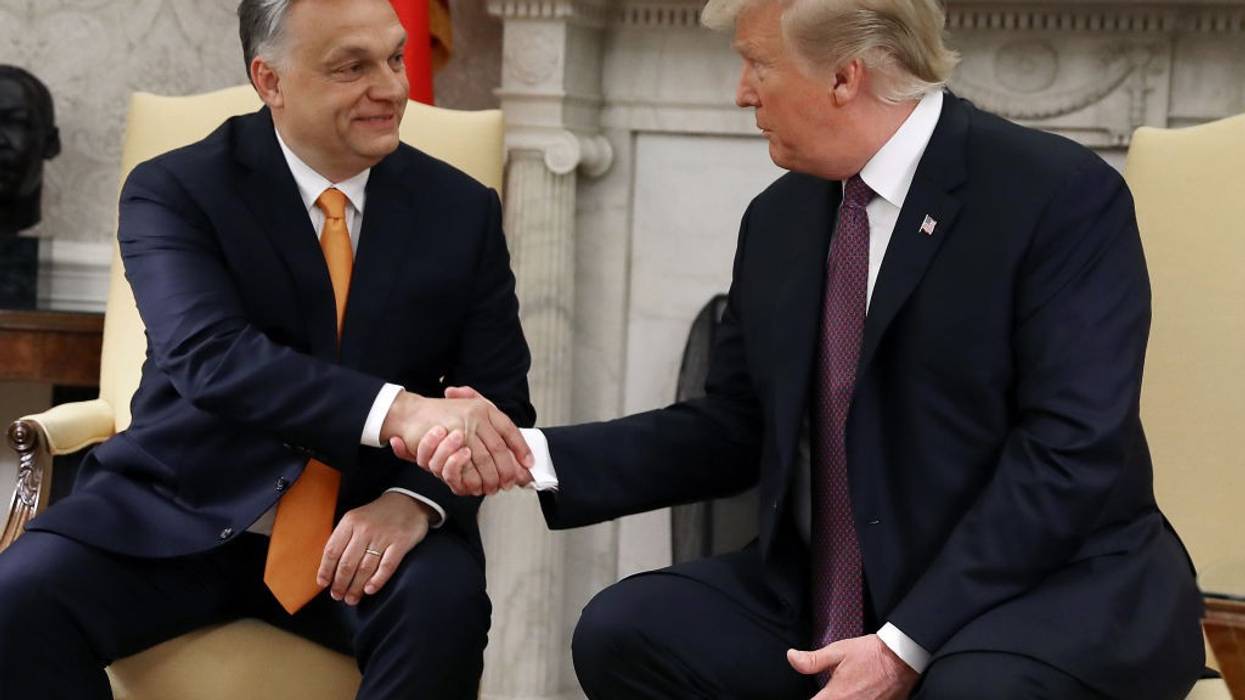
At its core, MAGA embodies a classic populist framework, dividing society into two opposing groups: the "pure" people and the "corrupt" elites or perceived enemies. While rooted in American political history, its binary "us vs. them" rhetoric mirrors strategies employed by populist leaders worldwide. MAGA's blend of nationalism, anti-immigration policies, economic protectionism, and cultural grievances aligns with populist campaigns in regions as diverse as Europe and Latin America. From Viktor Orbán's nationalist agenda in Hungary to Marine Le Pen's rebranding of far-right politics in France, the tools and messaging of modern populism have become strikingly uniform across borders. Far from an organic response to collective grievances, it is a calculated political strategy tailored to the cultural and domestic contexts of each country.
Much of MAGA's populist DNA can be traced to the political consulting work of Paul Manafort, a pivotal figure in Donald Trump's 2016 campaign. Before working with Trump, Manafort refined his strategies in Ukraine, where he advised pro-Russian leader Viktor Yanukovych, who was later deposed following the Maidan protests and the Revolution of Dignity. Yanukovych's campaigns relied on nationalism, cultural division, and anti-elite rhetoric to consolidate power. These were tactics Manafort later brought to Trump's campaign, including the use of disinformation, targeted messaging, and framing Trump as an outsider fighting entrenched elites.
Manafort first entered Ukrainian politics during the Orange Revolution of 2004, when widespread protests erupted over electoral fraud favoring Yanukovych in a contentious runoff election. Following massive demonstrations, Ukraine's Supreme Court annulled the results and ordered a revote, which resulted in a decisive victory for Yanukovych's opponent, Viktor Yushchenko. While Manafort's initial efforts failed, his subsequent tenure as a campaign consultant for Yanukovych and the Party of Regions proved more successful.
Manafort is widely credited with shaping the Party of Regions' slogans and political rhetoric, emphasizing themes like the "threat of NATO" and the "suppression of the Russian language in Ukraine." These strategies deepened cultural and linguistic divisions within Ukraine, particularly alienating Russian-speaking communities in the country's east. He also crafted slogans appealing to national pride and promises of immediate improvement, such as "Improving Your Life Already Today" (Ukrainian: "Покращення життя вже сьогодні"). This approach sought to resonate with citizens' desire for swift change while portraying Yanukovych as the champion of "Ukraine first" policies in contrast to his rival, then-Prime Minister Yulia Tymoshenko.
The Party of Regions portrayed Tymoshenko's pro-European integration agenda as a threat to Ukraine's sovereignty and traditional values. Their rhetoric suggested that closer ties with NATO and the E.U. would usher in liberal policies, including those supporting LGBTQ rights, which they argued would undermine Ukraine's cultural identity. By framing Western institutions as cultural aggressors, the Party of Regions positioned itself as a defender of national values, effectively galvanizing conservative segments of the population against perceived external threats.
Manafort also orchestrated sophisticated disinformation campaigns to undermine Tymoshenko and then-U.S. Secretary of State Hillary Clinton. This included creating a fake think tank to spread negative narratives through media outlets and manipulating online platforms to disseminate false information. Tymoshenko, like Yushchenko before her, was branded as a pro-American radical who prioritized foreign interests over Ukraine's well-being. These tactics, honed in Ukraine's politically fractured environment, were later adapted to resonate with the grievances and cultural divides of the American electorate.
While Manafort's role in shaping Trump's campaign was significant, his strategies are part of a broader international trend. MAGA's populism is not a spontaneous eruption of uniquely American discontent but a chapter in the global populist playbook. From exploiting cultural divisions to leveraging "anti-globalist" conspiracy theories, these methods have been employed, refined, and exported by populist leaders worldwide.
Understanding MAGA within this international context underscores the interconnected nature of modern politics, where ideas and strategies transcend national boundaries to influence movements across diverse cultural and political landscapes. By recognizing MAGA as part of this global trend, its origins, contradictions, and vulnerabilities become clearer, providing a critical framework for countering its divisive agenda.
Thousands of miles away from the U.S., a supporter of Romanian far-right candidate Călin Georgescu, who campaigned under a "Romania First" slogan, starkly declared: "She [Elena Lasconi] will pass a law on marriage between two men, I cannot accept such a thing," while asserting that Romania needed "a capable man to lead us, not a woman." Statements like these exploit cultural anxieties to galvanize conservative support, a hallmark of global populist movements.
The early 2000s marked the rise of a powerful wave of populism across Europe, fueled by economic stagnation, cultural insecurities, and widespread disillusionment with traditional political elites. This period saw far-right movements rebranding themselves as defenders of the "ordinary citizen" against globalist, technocratic, and multicultural agendas. Leaders such as Marine Le Pen in France, Geert Wilders in the Netherlands, and Matteo Salvini in Italy capitalized on these dynamics, reshaping the political landscape through nationalist rhetoric and anti-immigrant sentiment.
Marine Le Pen's leadership of the National Front (later renamed National Rally) exemplified the far-right's strategic makeover. While her father, Jean-Marie Le Pen, had built the party on overt racism and xenophobia, Marine sought to soften its image without abandoning its core nationalist message. She framed immigration—particularly from Muslim-majority countries—as a threat to French identity and values, tapping into fears of cultural erosion.
Le Pen also embraced Euroscepticism, portraying the European Union as a bureaucratic overreach that undermined France's sovereignty. By combining economic protectionism with cultural grievance, she expanded the party's appeal beyond far-right fringes, positioning it as a populist alternative to the French political establishment.
In the Netherlands, Geert Wilders' Party for Freedom adopted an equally divisive platform. Wilders presented himself as a staunch defender of Dutch culture, depicting immigration and multiculturalism as existential threats. His rhetoric painted Islam as incompatible with Western values, using inflammatory language to link immigration with terrorism.
Wilders also criticized the European Union, framing it as an elitist institution disconnected from ordinary citizens. Like Le Pen, he weaponized nationalist sentiments to challenge liberal democratic norms, portraying his movement as a bulwark against an overly accommodating political elite.
In Southern Europe, populism took on a more authoritarian tone under leaders like Matteo Salvini. As head of the League (formerly the Northern League), Salvini shifted the party's focus from regional separatism to a nationalist agenda. He vilified immigrants, often blaming them for economic hardship and cultural decline.
Salvini's rhetoric resonated deeply with Italian voters grappling with the aftershocks of the 2008 financial crisis. His rise to prominence illustrated how economic grievances and cultural fears could be weaponized to undermine establishment parties. Salvini also positioned himself as a critic of European integration, calling for stronger national sovereignty and rejecting E.U.-imposed policies.
Across the Atlantic, Trump's 2016 campaign borrowed heavily from the European populist playbook. Trump frequently employed anti-Muslim rhetoric, framing Muslim communities as security threats and proposing a "total and complete shutdown" of Muslims entering the United States. This culminated in the so-called Muslim Ban, a series of executive orders restricting travel from several predominantly Muslim countries.
Trump justified these policies as necessary for national security, leveraging fear and xenophobia to energize his base. Simultaneously, he criticized global institutions like the United Nations, portraying it as an encroachment on American sovereignty. This "America First" rhetoric closely mirrored themes seen in Viktor Yanukovych's pro-Russian campaigns in Ukraine, where nationalism and cultural division were used to consolidate power.
Trump's populist appeal also pitted him against establishment Republicans, a trend that had gained momentum during the Tea Party movement. By labeling establishment figures as "Republicans in Name Only" (RINOs), Trump positioned himself as the voice of disenfranchised Americans battling entrenched elites.
The European populist wave demonstrated a remarkable ability to adapt its messaging to local contexts while drawing on common themes of nationalism, anti-globalization, and cultural conservatism. Leaders like Le Pen, Wilders, and Salvini pioneered tactics that not only reshaped their own political landscapes but also provided a blueprint for populist movements worldwide.
The modern American populist movement that evolved into MAGA traces its roots to the Tea Party, a movement that rose to prominence in the late 2000s with significant backing from the Koch network. Many of Trump's staunchest supporters within the Republican Party have roots in the Tea Party, highlighting a continuity of populist sentiment. Studies have shown that individuals who supported the Tea Party in the early 2010s were more likely to align with Trump's agenda in subsequent years, demonstrating the movement's lasting influence on the Republican Party's ideological trajectory.
A key figure in this transition was Steve Bannon, the co-founder of Breitbart News and later the CEO of Trump's 2016 campaign. Breitbart News played a pivotal role in promoting Tea Party ideas and candidates, amplifying the movement's anti-establishment and nationalist messaging. By the mid-2010s, Bannon was leveraging the momentum of the Tea Party to advance a more explicitly nationalist agenda, aligning himself with Trump and broadening the scope of American populism.
Bannon's strategic vision extended beyond the United States. He actively sought to unify and strengthen populist movements in Europe, forging connections with right-wing parties and leaders. His efforts aimed to create a global network of populist movements united by shared principles of nationalism, anti-globalism, and opposition to progressive international institutions. By fostering these alliances, Bannon sought to build a cohesive international populist front that could challenge the global liberal order.
By understanding its connections to international populism, it becomes clear that MAGA is a calculated political construct rather than a genuine grassroots movement.
The transition from the Tea Party to MAGA underscores the evolution of modern American populism. While the Tea Party emphasized economic grievances and a distrust of government, MAGA expanded its appeal through cultural and nationalist rhetoric, effectively reshaping the Republican Party's identity. Bannon's role as a bridge between these movements highlights the deliberate efforts to harness and repurpose the Tea Party's energy for a broader populist agenda.
By situating MAGA within this lineage and connecting it to international populist trends, it becomes clear that modern populism is neither a spontaneous phenomenon nor a uniquely American one. Instead, it reflects a calculated and evolving strategy that draws from shared grievances and ideological frameworks to build power both domestically and globally.
Alexander Dugin, the Russian political philosopher and architect of Eurasianism, has played a significant role in shaping contemporary populist ideology. His Fourth Political Theory rejects the supremacy of liberal democracy, offering an alternative that combines traditionalism with elements of socialism and nationalism. This framework provides ideological backing for populist leaders seeking to distance themselves from Western liberal values, advocating a return to traditional cultural and religious norms.
A similar narrative has emerged in the United States, where "liberal values" are portrayed as an external, malevolent force threatening Western traditions. This narrative creates a shared ideological foundation among global populist movements, highlighting their interconnected strategies while adapting to different cultural contexts.
The convergence of these ideologies highlights a broader trend in modern populism: the collaboration and exchange of ideas among populist leaders worldwide. This interconnectedness has enabled the rapid dissemination of populist rhetoric and strategies, strengthening the global populist movement. Parallel populist victories in Europe and the rise of MAGA in the United States underscore the growing international reach and influence of these movements.
Modern populism also facilitates and normalizes the presence of far-right radical groups. In the United States, MAGA exhibits subtle overlaps with Third Position politics in its emphasis on "America First" nationalism and critiques of globalism. Trump's appeal to the working class, paired with his anti-elite and protectionist economic rhetoric, reflects a syncretic approach. Like the Third Position's rejection of both capitalist elites and socialist internationalism, MAGA positions itself as a champion of the "forgotten" American worker while opposing progressive social movements.
This fusion of cultural conservatism and economic populism resonates with a wide range of disillusioned voters, blurring traditional ideological lines. While MAGA remains distinct from historical Third Position movements, its hybridization of nationalism, economic populism, and anti-elite rhetoric demonstrates how these ideologies evolve within contemporary populist frameworks.
The authoritarian undertones of populist movements are increasingly evident. Trump's actions on the first day of his second term, such as the swift pardoning of January 6 insurrectionists, including Proud Boys and Oath Keepers leaders, signal solidarity with violent actors. This move not only rehabilitates these groups but also reinforces their alignment with MAGA.
Globally, similar ties between populist movements and extremist groups are evident. In Germany, the Alternative für Deutschland (AfD) has connections with far-right groups like the Identitarian Movement and neo-Nazi networks, using nationalist rhetoric to intimidate opponents. Hungary's Fidesz party, under Viktor Orbán, benefits from the support of groups like the Hungarian Guard, known for targeting Roma communities and promoting anti-immigrant sentiment. Italy's Lega, led by Matteo Salvini, is linked to far-right factions such as CasaPound, which employ neo-fascist rhetoric and violence to advance nationalist themes.
Brazil's Jair Bolsonaro has relied on paramilitary militias to target leftist politicians and activists, while India's Bharatiya Janata Party (BJP), under Narendra Modi, maintains close ties with the Rashtriya Swayamsevak Sangh (RSS), a paramilitary group accused of inciting violence against minorities. These movements use nationalist and anti-globalist rhetoric to consolidate power, suppress dissent, and perpetuate divisions.
The global populist movement is further bolstered by influential figures like Elon Musk, who recently expressed support for the AfD via X. Musk's involvement in Trump's administration underscores the deepening connections between global populist leaders.
Modern populism has created a volatile political landscape, not only undermining liberal democratic norms but also fostering syncretic alliances that blur traditional ideological boundaries. These movements often build connections with extremist groups, activist organizations, and unconventional political networks, drawing strength from shared grievances and interconnected strategies. This convergence amplifies their influence and extends their reach beyond government institutions into civil society. Addressing the global nature of populism, and its ability to co-opt diverse political and activist frameworks, is essential to countering its divisive and authoritarian tendencies while safeguarding democratic principles and inclusive social movements.
MAGA is not a uniquely American movement but part of a global populist strategy that exploits cultural anxieties, nationalism, and anti-globalist rhetoric to consolidate power. By understanding its connections to international populism, it becomes clear that MAGA is a calculated political construct rather than a genuine grassroots movement. Recognizing these global parallels and shared tactics is essential to countering its corrosive impact on democracy and fostering a more inclusive political dialogue. Exposing MAGA as part of a broader authoritarian trend is not just a defense of American values but a necessary step in protecting democracy worldwide.
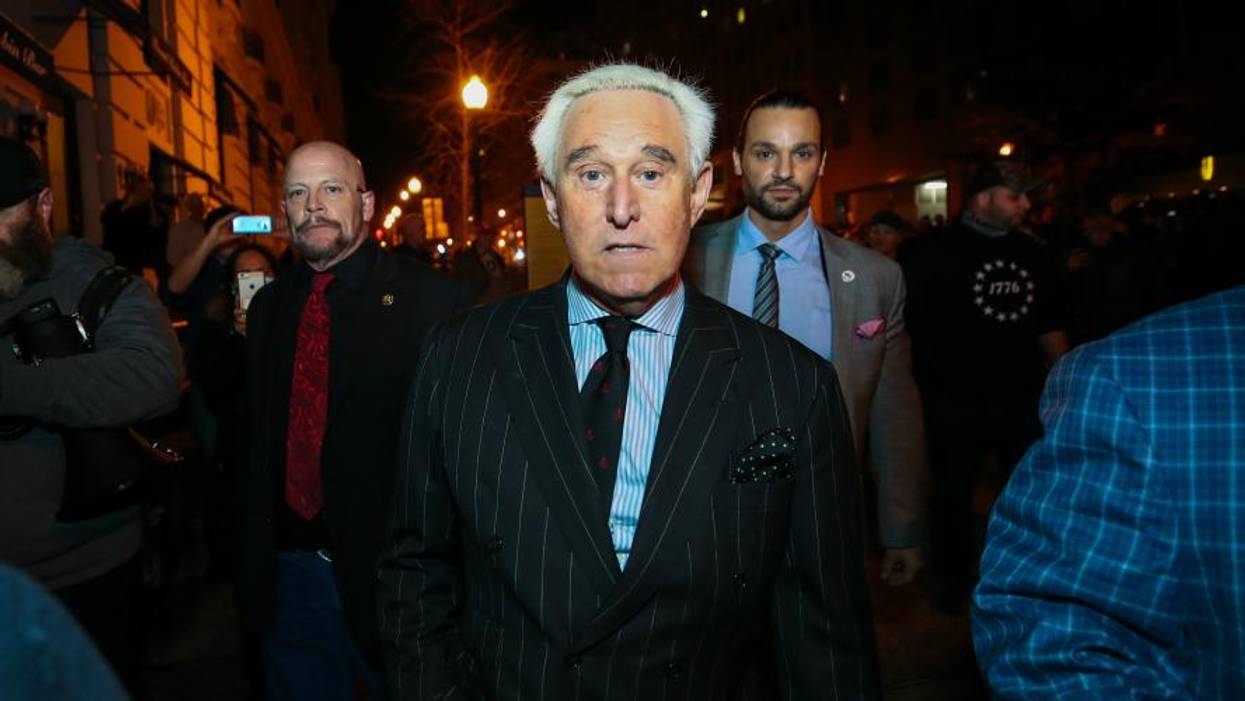
Throwing the deeply unequal nature of the U.S. criminal justice system into sharp relief, President Donald Trump late Wednesday issued another wave of pardons for his wealthy political and personal allies as his administration continues its unprecedented lame-duck spree of executions--a punishment almost exclusively reserved for the poor and marginalized.
Just 24 hours after issuing full pardons or commutations for two Republican loyalists, four former Blackwater mercenaries jailed for massacring Iraqi civilians, a Medicare fraudster, and others, Trump rolled out an additional list of pardons that includes longtime adviser Roger Stone, former campaign chairman Paul Manafort, and Charles Kushner, a wealthy New Jersey real estate developer and father of the president's son-in-law, Jared Kushner.
"A flow of pardons for the wealthy and corrupt, yet Brandon Bernard was left to die when his own jurors and prosecutor begged for mercy."
--Rep. Alexandria Ocasio-Cortez
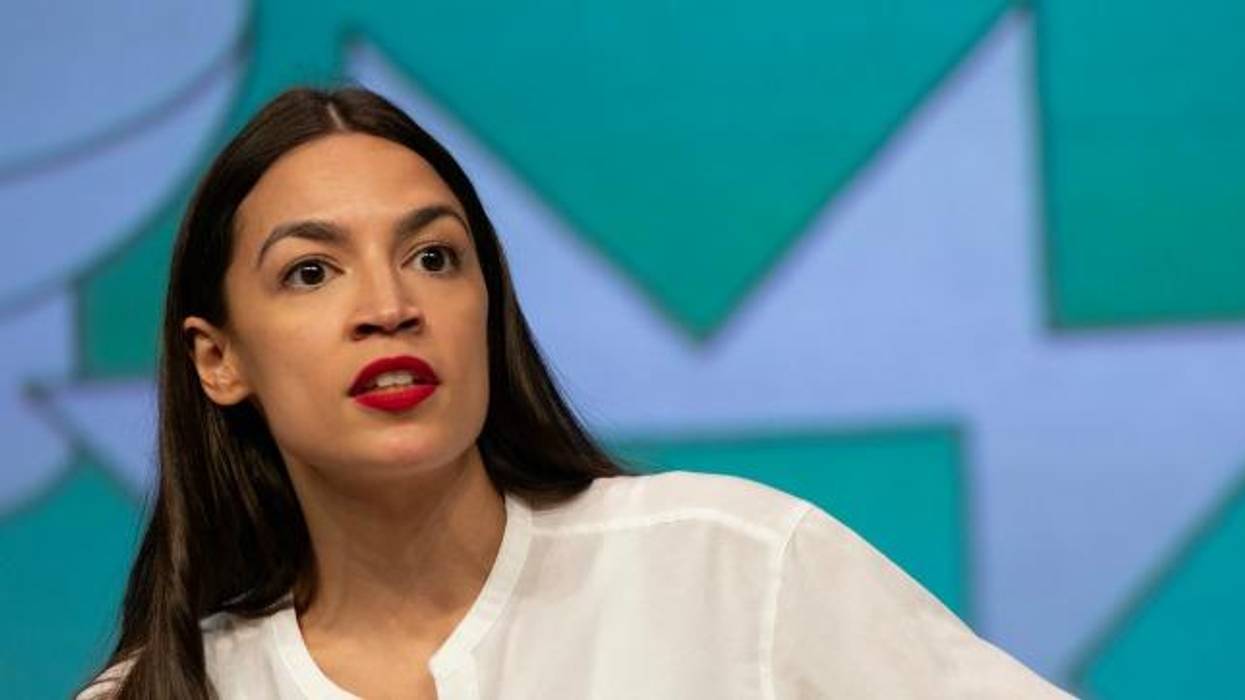
"A flow of pardons for the wealthy and corrupt, yet Brandon Bernard was left to die when his own jurors and prosecutor begged for mercy," Rep. Alexandria Ocasio-Cortez (D-N.Y.) said late Wednesday, referring to the 40-year-old Black man the Trump Justice Department killed earlier this month for a crime he committed at the age of 18. "Our carceral system laid bare for the world to see."
Rep.-elect Cori Bush (D-Mo.) tweeted that the combination of Trump's wave of pardons for the well-connected and last-minute rush of executions amounts to "mercy for the rich and state-sanctioned murder for the poor."
"Trump is pardoning his political allies while he's executing people on death row at an unprecedented rate," said Bush. "His deeds are unconscionable."
According to the Pew Research Center, the outgoing president "has used his clemency power less often than any president in modern history," and many of his "clemency recipients have had a 'personal or political connection to the president.'"
"The only modern president who granted clemency almost as infrequently as Trump is George H.W. Bush, who granted 77 pardons and commutations in his single term," the research outfit noted. "Trump has granted clemency to less than half of 1% of the more than 10,000 people who petitioned him for it through the end of the 2020 fiscal year (which ended Sept. 30), according to the Justice Department."
Kyle Herrig, president of watchdog group Accountable.US, said in a statement Wednesday that the president's lame-duck pardons "are just the latest example of Trump's longstanding pattern of promoting cronyism and corruption in his administration at all costs."
"As millions of Americans are suffering and afraid of losing their homes and livelihoods, all Trump has time for is handing out political favors to his friends and allies," said Herrig. "There's little more we can expect from a president who has held ethics in low regard and ignored the struggles of everyday Americans for his entire four-year term."
The Trump administration's execution spree, meanwhile, appears on track to continue as the Justice Department--which resumed federal executions in July after a 17-year hiatus--aims to execute three additional people before President-elect Joe Biden, an opponent of the death penalty, takes office next month.
Attorneys representing the three federal inmates set to be executed--Corey Johnson, Dustin John Higgs, and Lisa Montgomery--have asked Trump to commute their sentences to life without parole. Johnson and Higgs have both tested positive for the coronavirus as it sweeps through the federal penitentiary in Terre Haute, Indiana.
In a letter (pdf) on Monday, a group of Democratic senators and Sen. Bernie Sanders (I-Vt.) demanded that the Justice Department inspector general investigate the Trump administration's execution spree, which the lawmakers described as "a break with both modern history and decades-old practice."
"The federal government had not executed a federal prisoner since 2003 and had only executed three people in the previous 50 years," the senators wrote. "The executions that have already taken place since November 3, 2020, and those scheduled to occur in January 2021, are 'the first executions under a lame-duck president in over 100 years.'"
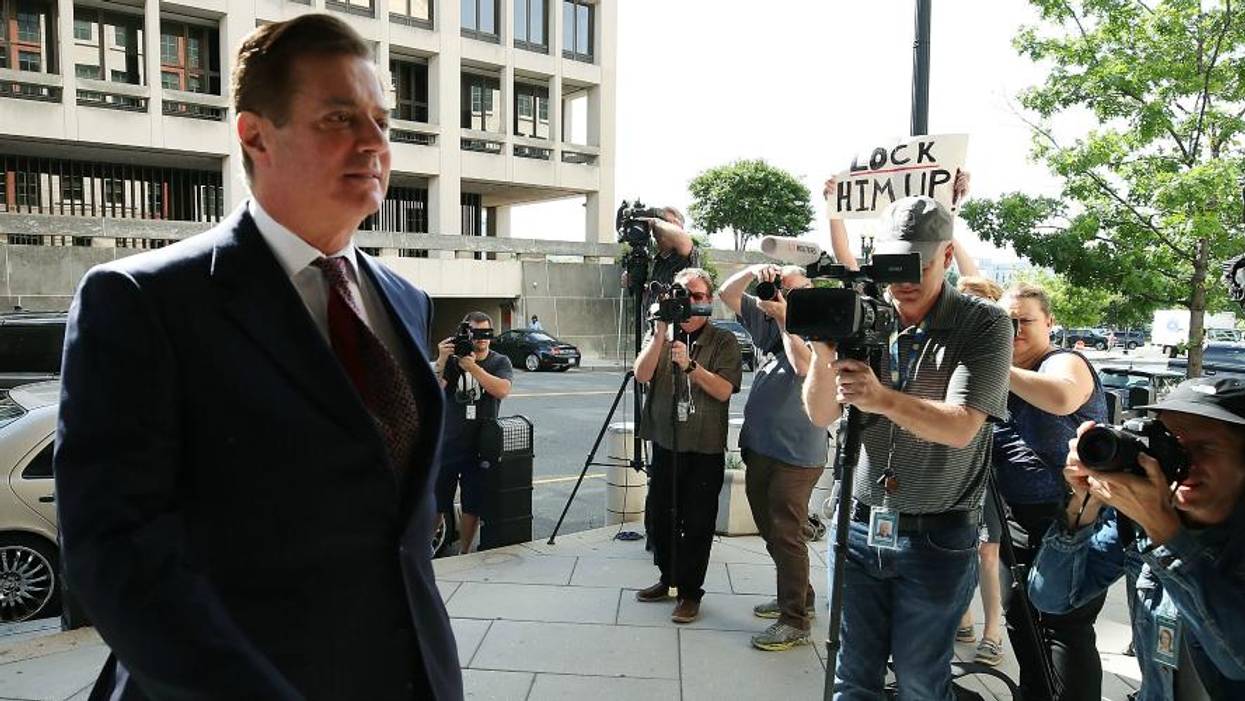
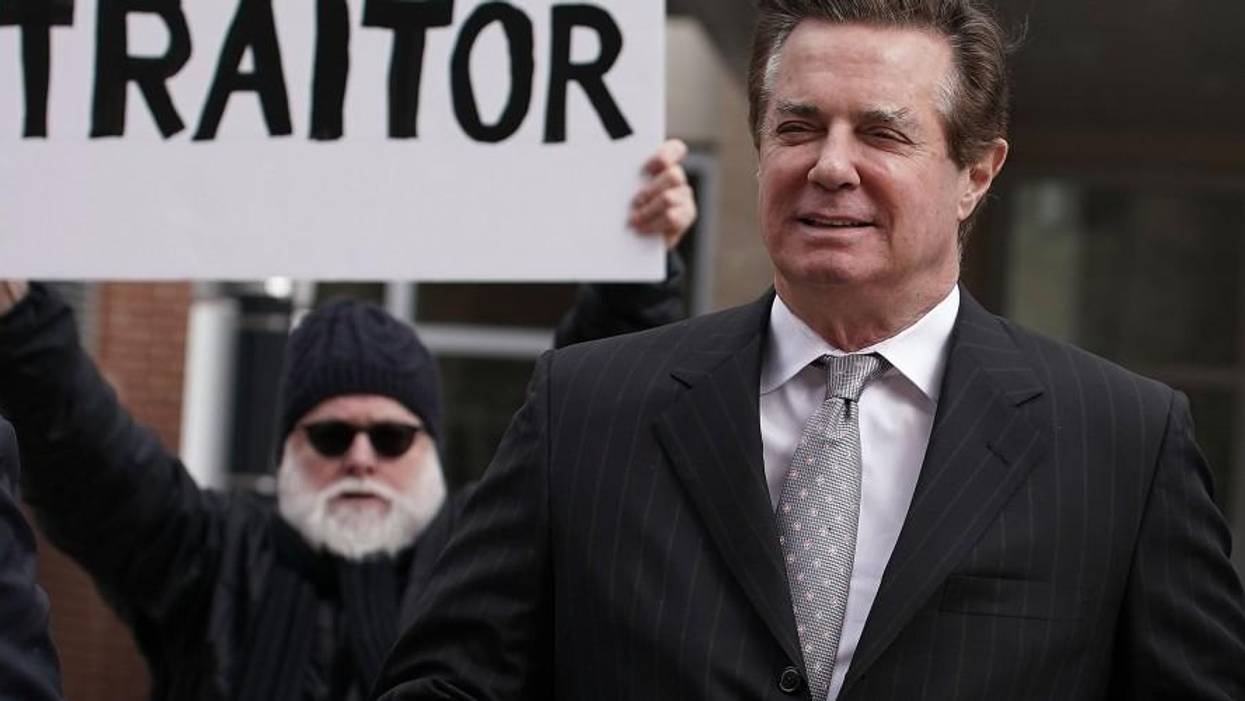
The release of President Donald Trump's former campaign chairman Paul Manafort from prison Wednesday morning spurred immediate denunciations of the unequal treatment of prisoners in the U.S. criminal justice system in which the wealthy and well-connected are spared while millions of others are forced to face the spreading coronavirus pandemic with little or no hope of release.
As the Daily Beast reports:
Manafort has been serving out his seven-and-a-half year sentence at FCI Loretto in central Pennsylvania on charges related to Special Sounsel Robert Mueller's investigation. He was found guilty of tax fraud and conspiracy and was sentenced in March 2019. He wasn't due to be released from prison until November 2024.
At the age of 71, Manafort is considered to be at particular risk from the disease, which hits harder among older people. His lawyer, Kevin Downing, requested Manafort's early release from prison due to coronavirus-related health fears last month, saying that he'd been suffering health problems including high blood pressure, liver disease, and respiratory issues for years.
But whether Manafort was "at particular risk," was an issue of debate for some.
Law professor and MSNBC contributor Joyce Vance was among those asserting that Manafort's premature release "raises real fairness concerns," especially as hundreds of thousands of other prisoners in the U.S--including those with arguably much more dire circumstances--have not been released.
"Manafort doesn't qualify for compassionate release," Vance tweeted. "Did he get special treatment ahead of others who do? People in facilities with outbreaks or closer to the end of their sentence? Did Trump's friend get preferential treatment under the guise of appropriate releases to protect BOP inmates? Releases make sense but there must be a process based on objective criteria. Michael Cohen, much closer to the end of his sentence, was denied release after news he would be was made public."
In addition to the perception that Manafort was the clear recipient of special treatment due to his political connections to Trump, the larger issue for many remained the glaring example of inequality endemic to the U.S. criminal justice system.
Referenced by Professor Eddie Glaude Jr. of Princeton University, Tiffany Mofield was a 43-year-old woman who died of coronavirus complications in a New Jersey prison on April 29. As reporting by The Intercept's Alice Speri details, "Mofield's death underscores the devastating impact the coronavirus is having as it spreads through prisons and jails, where the health of incarcerated people was often neglected before the current crisis."
In a thread on Twitter posted in response to Wednesday's developments, defense attorney and prison reform advocate Scott Hechinger detailed the cases of many inmates who--unlike Manafort--continued to languish in prison even as the virus threatens.
Listing the names of individual inmates--including Anthony Swain, Sue Farrell, Charles Hobbs, Jody Hill, and Andrew Pete--Hechinger wrote: "I'm not upset Paul Manafort was released. As always, I'm upset that people who aren't rich, white, & connected (nearly everyone of the millions currently caged) aren't treated with the same care, consideration, or humanity."
With no nationwide urgency showed by prison officials or lawmakers for the release of most inmates, despire the growing risks to them, Hechinger said the Manafort case only highlights deep and grave injustices that have long existed.
"Right now, imagine how scared you are about contracting this virus. The precautions you take," he wrote. "Then think about how, right now, millions are trapped in close quarters. No ability to distance. To protect themselves. People are terrified and upset. And we should be too."
Since the Covid-19 pandemic touched off earlier this year, criminal justice reform advocates have been raising the alarm over just how vulnerable prison and jail populations are to the spread of the virus.
"This peril is immediate and pressing," wrote veteran civil rights leader Jesse Jackson in an op-ed in March. "There are 2.2 million Americans locked up at any one time, but over 11 million go through prison or jail gates in any one year."
Writing on the subject again last month, Jackson warned that "if the pandemic continues to spread through prisons, the toll in lives will soar."
Rep. Alexandria Ocasio-Cortez on Wednesday reiterated her stance that solitary confinement is a violation of human rights and "government torture" and called for all people--including President Donald Trump's former campaign chairman Paul Manafort, should he be subjected to it--to be spared from such an abusive detention practice.
The comments began in morning tweet in which the New York Democrat responded to a New York Times tweet that said that Manafort, who's currently serving a federal sentence in Pennsylvania, would soon be heading to Rikers Island, "where he is likely to face solitary confinement." Ocasio-Cortez's 14th congressional district contains the notorious Rikers Island.
"A prison sentence is not a license for gov torture and human rights violations," Ocasio-Cortez wrote. "That's what solitary confinement is."
Manafort, the Times reported, "is expected to be transferred within the next few weeks to the Rikers Island jail complex in New York City, where he will most likely be held in isolation while facing state [mortgage] fraud charges." On the island, he would likely be housed in a former prison hospital; inmates there don't spend their day locked in cells, the reporting noted.
NBC News reported following Ocasio-Cortez's tweet, citing the New York City Department of Corrections, that "Manafort may be held in isolation for protective reasons, but that would not carry the same conditions as being held in solitary confinement, which is a punitive designation."
In follow-up tweet, Ocasio-Cortez said it was the Times's wording on social media--"where he is likely to face solitary confinement"--that triggered her first comment, and that the "protective custody" Manafort faces doesn't necessarily preclude solitary confinement.
But, Ocasio-Cortez added: "If he is in fact not being held in solitary, great. Release everyone else from it too."
It's not the first time this year Ocasio-Cortez called for banning solitary confinement.
In April, she commented on the solitary that U.S. Army whistleblower Chelsea Manning was subjected to, most recently for refusing to answer a grand jury's questions.
"Solitary confinement is torture," Ocasio-Cortez said at the time. "Chelsea is being tortured for whistleblowing, she should be released on bail, and we should ban extended solitary in the U.S."
More than 400 former federal prosecutors asserted in a statement published on Medium Monday that President Donald Trump would face multiple felony charges for obstruction of justice if he did not hold his current office.
"We recognize that prosecuting obstruction of justice cases is critical because unchecked obstruction... puts our whole system of justice at risk."
--Ex-prosecutors
The statement comes in response to Special Council Robert Mueller's final report on his investigation into allegations of election meddling by Russian agents as well as potential collusion or obstruction efforts by members of the Trump campaign or administration, including the president.
Attorney General William Barr--who could be found in contempt of Congress later this week for his refusal to hand over the unredacted version of the Mueller report to House lawmakers--released a summary in late March that critics called a "whitewash," followed by a redacted version of the report in mid-April.
Based on the redacted version, the former prosecutors wrote Monday:
The Mueller report describes several acts that satisfy all of the elements for an obstruction charge: conduct that obstructed or attempted to obstruct the truth-finding process, as to which the evidence of corrupt intent and connection to pending proceedings is overwhelming. These include:
The statement highlights some examples of obstruction detailed in the report, including Trump: directing then-White House Counsel Don McGahn to fire Mueller; pressuring then-Attorney General Jeff Sessions to reverse his legally-mandated decision to recuse himself from the probe; and trying to influence his former fixer Michael Cohen and former campaign chairman Paul Manafort to refuse to cooperate with investigators.
The only reason Trump has not been charged with multiple felonies, according to the ex-prosecutors' statement, is because of the Office of Legal Counsel (OLC) policy against indicting a sitting president.
"As former federal prosecutors, we recognize that prosecuting obstruction of justice cases is critical because unchecked obstruction--which allows intentional interference with criminal investigations to go unpunished--puts our whole system of justice at risk," they wrote. "We believe strongly that, but for the OLC memo, the overwhelming weight of professional judgment would come down in favor of prosecution for the conduct outlined in the Mueller report."
The special council's redacted report does not explicitly call for the president to be charged for obstructing justice, but it also does not exonerate him--contrary to Trump's repeated claims since Mueller's investigation concluded.
"[I]f we had confidence after a thorough investigation of the facts that the president clearly did not commit obstruction of justice, we would so state," the Mueller report says. "Based on the facts and the applicable legal standards, we are unable to reach that judgment. Accordingly, while this report does not conclude that the president committed a crime, it also does not exonerate him."
The ex-officials who signed on to the statement Monday served under both Republican and Democratic administrations as line attorneys, supervisors, special prosecutors, U.S. attorneys, and senior officials at the Justice Department.
Justin Vail of the nonprofit Protect Democracy told the Washington Post that his organization started collecting signatures in support of the statement after being contacted by some former prosecutors last week. The group continued to collect signatures on Monday.
"We strongly believe that Americans deserve to hear from the men and women who spent their careers weighing evidence and making decisions about whether it was sufficient to justify prosecution, so we agreed to send out a call for signatories," Vail said. "The response was overwhelming. This effort reflects the voices of former prosecutors who have served at DOJ and signed the statement."
Read the full statement below:
We are former federal prosecutors. We served under both Republican and Democratic administrations at different levels of the federal system: as line attorneys, supervisors, special prosecutors, United States Attorneys, and senior officials at the Department of Justice. The offices in which we served were small, medium, and large; urban, suburban, and rural; and located in all parts of our country.
Each of us believes that the conduct of President Trump described in Special Counsel Robert Mueller's report would, in the case of any other person not covered by the Office of Legal Counsel policy against indicting a sitting President, result in multiple felony charges for obstruction of justice.
The Mueller report describes several acts that satisfy all of the elements for an obstruction charge: conduct that obstructed or attempted to obstruct the truth-finding process, as to which the evidence of corrupt intent and connection to pending proceedings is overwhelming. These include:
Attempts to fire Mueller and then create false evidence
Despite being advised by then-White House Counsel Don McGahn that he could face legal jeopardy for doing so, Trump directed McGahn on multiple occasions to fire Mueller or to gin up false conflicts of interest as a pretext for getting rid of the Special Counsel. When these acts began to come into public view, Trump made "repeated efforts to have McGahn deny the story"--going so far as to tell McGahn to write a letter "for our files" falsely denying that Trump had directed Mueller's termination.
Firing Mueller would have seriously impeded the investigation of the President and his associates--obstruction in its most literal sense. Directing the creation of false government records in order to prevent or discredit truthful testimony is similarly unlawful. The Special Counsel's report states: "Substantial evidence indicates that in repeatedly urging McGahn to dispute that he was ordered to have the Special Counsel terminated, the President acted for the purpose of influencing McGahn's account in order to deflect or prevent scrutiny of the President's conduct toward the investigation."
Attempts to limit the Mueller investigation
The report describes multiple efforts by the president to curtail the scope of the Special Counsel's investigation.
First, the President repeatedly pressured then-Attorney General Jeff Sessions to reverse his legally-mandated decision to recuse himself from the investigation. The President's stated reason was that he wanted an attorney general who would "protect" him, including from the Special Counsel investigation. He also directed then-White House Chief of Staff Reince Priebus to fire Sessions and Priebus refused.
Second, after McGahn told the President that he could not contact Sessions himself to discuss the investigation, Trump went outside the White House, instructing his former campaign manager, Corey Lewandowski, to carry a demand to Sessions to direct Mueller to confine his investigation to future elections. Lewandowski tried and failed to contact Sessions in private. After a second meeting with Trump, Lewandowski passed Trump's message to senior White House official Rick Dearborn, who Lewandowski thought would be a better messenger because of his prior relationship with Sessions. Dearborn did not pass along Trump's message.
As the report explains, "[s]ubstantial evidence indicates that the President's effort to have Sessions limit the scope of the Special Counsel's investigation to future election interference was intended to prevent further investigative scrutiny of the President's and his campaign's conduct"--in other words, the President employed a private citizen to try to get the Attorney General to limit the scope of an ongoing investigation into the President and his associates.
All of this conduct--trying to control and impede the investigation against the President by leveraging his authority over others--is similar to conduct we have seen charged against other public officials and people in powerful positions.
Witness tampering and intimidation
The Special Counsel's report establishes that the President tried to influence the decisions of both Michael Cohen and Paul Manafort with regard to cooperating with investigators. Some of this tampering and intimidation, including the dangling of pardons, was done in plain sight via tweets and public statements; other such behavior was done via private messages through private attorneys, such as Trump counsel Rudy Giuliani's message to Cohen's lawyer that Cohen should "[s]leep well tonight[], you have friends in high places."
Of course, these aren't the only acts of potential obstruction detailed by the Special Counsel. It would be well within the purview of normal prosecutorial judgment also to charge other acts detailed in the report.
We emphasize that these are not matters of close professional judgment. Of course, there are potential defenses or arguments that could be raised in response to an indictment of the nature we describe here. In our system, every accused person is presumed innocent and it is always the government's burden to prove its case beyond a reasonable doubt. But, to look at these facts and say that a prosecutor could not probably sustain a conviction for obstruction of justice--the standard set out in Principles of Federal Prosecution--runs counter to logic and our experience.
As former federal prosecutors, we recognize that prosecuting obstruction of justice cases is critical because unchecked obstruction--which allows intentional interference with criminal investigations to go unpunished--puts our whole system of justice at risk. We believe strongly that, but for the OLC memo, the overwhelming weight of professional judgment would come down in favor of prosecution for the conduct outlined in the Mueller Report.
If you are a former federal prosecutor and would like to add your name below, click here. Protect Democracy will update this list daily with new signatories.
After President Donald Trump's former campaign chairman Paul Manafort was sentenced on Thursday to less than four years in prison for financial fraud--a far lighter punishment than the recommended 19-24 years--Rep. Alexandria Ocasio-Cortez (D-N.Y.) was among those noting the case exemplifies the gross inequities at the core of the U.S. criminal justice system.
"In our current broken system, 'justice' isn't blind. It's bought."
--Rep. Alexandria Ocasio-Cortez
"Paul Manafort getting such little jail time for such serious crimes lays out for the world how it's almost impossible for rich people to go to jail for the same amount of time as someone who is lower income," Ocasio-Cortez declared. "In our current broken system, 'justice' isn't blind. It's bought."
Experts agreed with Ocasio-Cortez's characterization of Manafort's 47-month sentence as extremely lenient given the severity of his conviction, which included bank fraud, tax fraud, and failure to report foreign assets.
"Young, poor, minority defendants receive stiffer sentences for minor drug crimes."
--Glenn Kirschner, NBC News
"It's atrociously low," Barbara McQuade, law professor at the University of Michigan and former U.S. attorney, told the New York Times.
While "many judges do sentence leniently in white-collar cases," she added, "dropping all the way from 19 years to four years is absurd."
McQuade expanded on her criticism of Manafort's sentence in an interview with MSNBC's Rachel Maddow, saying the lenient prison term "suggests that the wealthy and the powerful do better in court than many other defendants do, and I think it is an attack on the legitimacy of the criminal justice system."
While handing down Manfort's sentence, Judge T. S. Ellis III of the U.S. District Court in Alexandria, Va. slammed the recommended 20-year sentence as excessive and claimed that the former Trump campaign chair "has lived an otherwise blameless life"--a remark that elicited disgust from critics.
"Weird how some people suddenly decide the criminal justice system is excessively punitive the moment a rich white guy gets convicted," tweeted Adam Serwer, staff writer for The Atlantic.
"This was not equal justice today," declared NBC News legal analyst and former federal prosector Glenn Kirschner, Young, poor, minority defendants receive stiffer sentences for minor drug crimes. Judge Ellis imposed an unjust sentence that undermines confidence in our criminal justice system. This judge let America down today."
While observers noted the gross and pervasive disparities the Manafort sentence seemed to exemplify, other criminal justice reform advocates warned against pushing the narrative that simply demanding higher sentences for convicted white collar or wealthy criminals is the way to reform the criminal justice system:
Manafort is set to be sentenced for a second set of crimes--two counts of conspiracy--next week by U.S. District Judge Amy Berman Jackson of Washington, D.C. The charges carry a maximum prison sentence of five years.
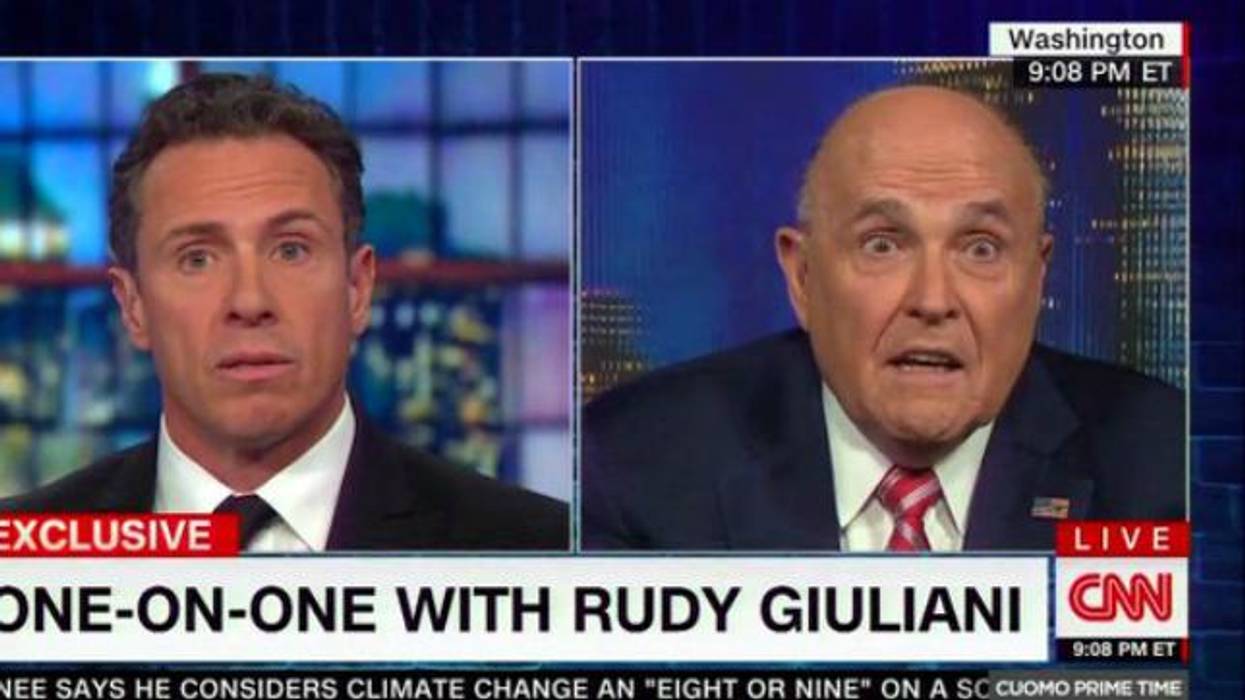
In a Wednesday night interview with CNN's Chris Cuomo, President Donald Trump's attorney Rudy Giuliani claimed he's never said there wasn't collusion between the president's campaign and Russia--only that Trump himself did not collude--sparking an immediate public discussion of both his and Trump's past public remarks to the contrary.
"I never said there was no collusion between the campaign, or between people in the campaign," Giuliani told Cuomo, who pushed back with a puzzled expression and said, "yes, you have."
Doubling down, Giuliani continued: "I have not. I said the president of the United States. There is not a single bit of evidence the president of the United States committed the only crime you can commit here: conspired with the Russians to hack the DNC."
The Daily Beast responded to the exchange on Twitter with a video clip of a previous Fox News interview in which Giuliani was asked, "Is it still the position of you and your client that there was no collusion with the Russians whatsoever on behalf of the Trump campaign?" Giuliani simply responded, "Correct."
Others quickly pointed to Giuliani's various comments on Special Counsel Robert Mueller's investigation into allegations of Russian election interference and any potential collusion or obstruction of justice by Trump, his campaign, or his administration:
Giuliani previously garnered attention last summer, when he said during interviews that he's not even convinced collusion with a foreign government that is trying to influence a U.S. presidential election is actually a crime.
Trump, for his part, has called Mueller's probe a "witch hunt." The president has also tweeted: "Russian Collusion with the Trump Campaign, one of the most successful in history, is a TOTAL HOAX" and "The Trump campaign did nothing wrong - no collusion!"
Giuliani's interview comes after a court filing revealed last week that Trump's former campaign chairman Paul Manafort gave 2016 presidential campaign polling data to Konstantin Kilimnik, a Russian political consultant who was previously an interpreter for his country's military and is said to have ties to its intelligence services.
The interview also comes amid speculation about when Mueller's report will finally arrive and who will get to see it. Trump's legal team reportedly may try to block it from being released to Congress and the public, but Giuliani denied that to Cuomo on Wednesday, claiming the president's lawyers just want the opportunity to see it first and respond.
A plea deal that Paul Manafort, President Donald Trump's former campaign chairman, had arranged with the office of Special Counsel Robert Mueller is void because Manafort repeatedly lied to federal investigators, Mueller's team outlined in a Friday court filing, expanding on earlier allegations.
"Contrary to the president's claim that all of this 'totally clears' him, the danger to Mr. Trump, his business, and his campaign has compounded significantly."
--Legal and ethics experts
Although Manafort had agreed to fully cooperate with Mueller, who is investigating alleged Russian interference in the 2016 election and any coordination with the Trump campaign or administration, the memo alleges that in his interviews with Mueller's team and the FBI, "Manafort told multiple discernible lies--these were not instances of mere memory lapses."
According to the Special Counsel's Office (SCO), Manafort--who was convicted of eight counts of financial fraud earlier this year and is scheduled to be sentenced on March 5--met with federal investigators 12 times and appeared before a grand jury twice.
The partly-redacted memo (pdf) to Judge Amy Berman Jackson of United States District Court for the District of Columbia accuses him of lying about five key topics, including his contacts with Trump administration officials as well as people with ties to Russian intelligence, a payment made through a political action committee, and details of an investigation unrelated to Mueller's probe.
The news about Manafort came as Mueller and federal prosecutors released pair of memos regarding Trump's longtime fixer Michael Cohen--who is set to be sentenced next week after pleading guilty to lying to Congress and various financial crimes, including campaign finance violations he allegedly made at the direction of Trump to influence the 2016 election.
While some experts said that the prosecutors' memo means that "New York federal prosecutors concluded that the President of the United States committed a felony," Trump seemed to disagree. In a tweet posted after the Cohen and Manafort memos started making headlines, Trump declared: "Totally clears the President. Thank you!"
The watchdog group Citizens for Responsibility and Ethics in Washington (CREW) responded on Twitter:
White House press secretary Sarah Huckabee Sanders later said in a statement that "the government's filings in Mr. Cohen's case tell us nothing of value that wasn't already known. Mr. Cohen has repeatedly lied and as the prosecution has pointed out to the court, Mr. Cohen is no hero." She added: "The government's filing in Mr. Manafort's case says absolutely nothing about the president. It says even less about collusion and is devoted almost entirely to lobbying-related issues."
On Saturday morning, Trump took a broader swing at the special counsel's probe, which he frequently refers to as a "witch hunt," tweeting:
In a New York Times op-ed by white collar criminal defense attorney Barry Berke, CREW executive director Noah Bookbinder, and Norman Eisen, a senior fellow at the Brookings Institution and chairman of CREW, the trio suggested that Friday's memos could signal "the beginning of the end for Trump."
"Contrary to the president's claim that all of this 'totally clears' him, the danger to Mr. Trump, his business, and his campaign has compounded significantly," they wrote. "For all these reasons, the president is unlikely to have a restful, tweet-free weekend--or a calm 2019, for that matter."
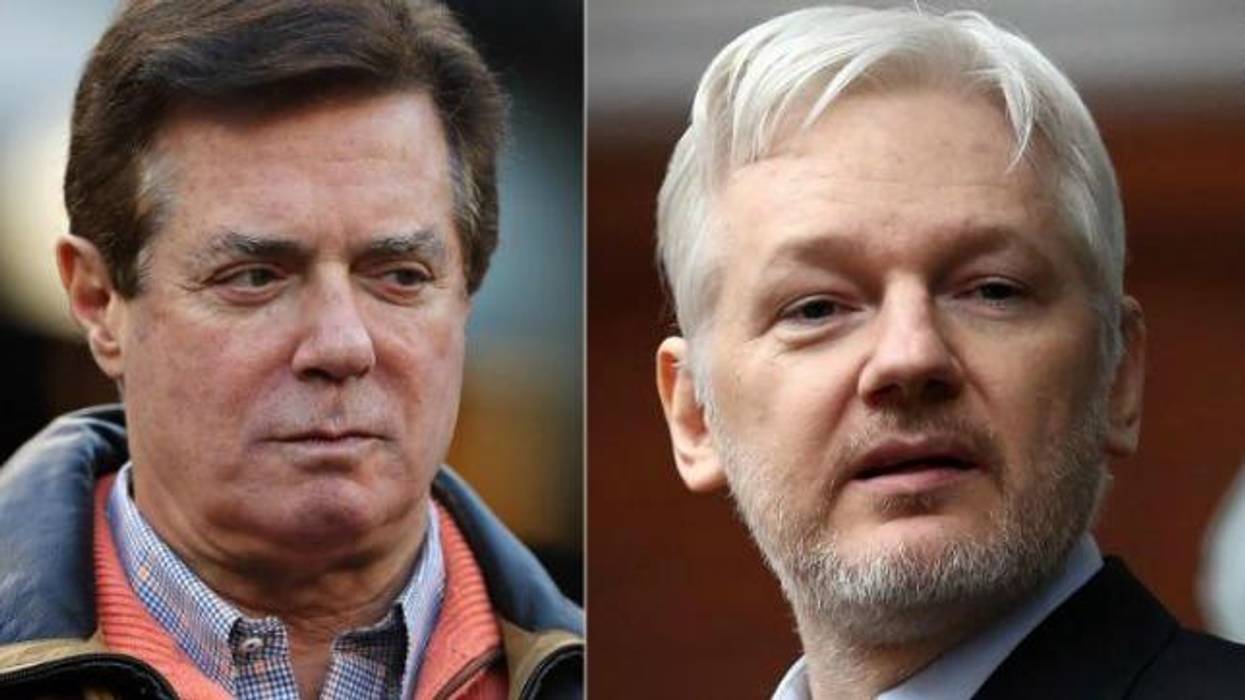
After the Guardian sent the punditry into a frenzy on Tuesday by publishing a bombshell report alleging that former Trump campaign manager Paul Manafort secretly met with WikiLeaks founder and editor Julian Assange in the Ecuadorian embassy in London during the 2016 presidential race, journalists and critics were quick to warn against blindly accepting the claims made in the piece due to the story's scant material evidence, anonymous sources, and explosive political implications.
As independent national security journalist Marcy Wheeler wrote on Twitter, "skepticism" about the Guardian's reporting--which was quickly picked up by corporate outlets--"couldn't be more broad-based" as it brought together journalists and legal experts from an array of political persuasions and opposing views.
While some commentators simply withheld judgment on the report's veracity in the absence of further corroboration, others argued that there are plenty of reasons to doubt that the story's central claims are accurate--such as its heavy reliance on anonymous Ecuadorian intelligence officials who may have political motives and an unverified internal document written by Ecuador's National Intelligence Secretariat (SENAIN), which claims "Paul Manaford [sic]" and "Russians" were well-known guests of the embassy.
As whistleblower advocate Naomi Colvin and others pointed out, official Ecuadorian embassy visitor logs make no mention of any Manafort appearances, let alone the three separate appearances reported by the Guardian.
Instead of citing official logs, the Guardian's latest reporting relies heavily on SENAIN's document, which critics argued is questionable at best given that SENAIN may have political motivations to discredit WikiLeaks for publishing secret agency documents in the past.
"There are genuine grounds to be cautious about the report," argued The New Republic's Jeet Heer. "It is based on anonymous sources, some of whom are connected with Ecuadorian intelligence. The logs of the embassy show no such meetings. The information about the most newsworthy meeting (in the spring of 2016) is vaguely worded, suggesting a lack of certitude."
"There are so many weird aspects to the Guardian story beyond the fact that it doesn't describe its sources or show any evidence. But nobody cares. People will claim it's true or not based solely on whether they want it to be."
-- Glenn Greenwald, The Intercept
As the Guardian reports, "It is unclear why Manafort would have wanted to see Assange and what was discussed." The only specific details offered are related to the length of the alleged 2016 meeting--"about 40 minutes"--and Manafort's alleged attire--"sandy-colored chinos, a cardigan, and a light-colored shirt."
For its part, WikiLeaks strongly denied the explosive report on Twitter and said it is "willing to bet the Guardian a million dollars and its editor's head that Manafort never met Assange."
The publication also announced on Tuesday that it has launched a "legal fund to sue the Guardian for publishing [an] entirely fabricated story."
If true, the Guardian's report could have major implications for Special Counsel Robert Mueller's Russia probe, a fact that may explain some of the reactive acceptance of the story by a segment of high-profile analysts, including cable news regulars like Malcolm Nance, who treated the thinly-reported story as a smoking gun:
The alleged 2016 meeting between Manafort and Assange, the Guardian notes, may "come under scrutiny and could interest Robert Mueller... A well-placed source has told the Guardian that Manafort went to see Assange around March 2016. Months later WikiLeaks released a stash of Democratic emails stolen by Russian intelligence officers."
But the vagueness of the sourcing left many journalists extremely wary of running with such a politically charged story without corroboration beyond an unnamed but supposedly "well-placed" source, an unverified intelligence document, and other anonymous officials.
"There are so many weird aspects to the Guardian story beyond the fact that it doesn't describe its sources or show any evidence. But nobody cares. People will claim it's true or not based solely on whether they want it to be," wrote The Intercept's Glenn Greenwald on Twitter.
"Which is true? The Guardian's anonymous claims or WikiLeaks' vehement denials?" Greenwald asked. "You can pick which to believe based on which one most advances your political narrative, or refrain from forming judgments until evidence is available. I'm going to opt for the latter course."
Now that Paul Manafort, Donald Trump's former campaign manager, has entered into a cooperation agreement with special counsel Robert Mueller, the question on nearly every observer's mind is, "What comes next?"
The answer depends, of course, on whether you're Manafort, Mueller or Trump. Although there are numerous Rumsfeldian "unknowns" in the mix, this much appears clear for each member of the trio:
If you're Paul Manafort, your days as a nattily attired Washington lobbyist and power broker are long gone. No more ostrich jackets. No more $21,000 watches. For the foreseeable future, they'll be replaced, as they have been for months now, by orange jumpsuits and wristband IDs.
By pleading guilty in a D.C. courtroom Friday to charges of federal conspiracy related to your long and corrupt record as a lobbyist for the government of Ukraine, and obstruction of justice for attempted witness-tampering to cover up that record, you face 10 years behind bars, on top of the potential sentence you may receive as a result of your conviction on eight counts of tax evasion and bank fraud in a Virginia courtroom last month.
Your co-conspirators were your former business partner, Richard Gates, who has been cooperating with Mueller since February, and Russian-Ukrainian political consultant Konstantin Kilimnik, who was separately indicted by Mueller in June.
And it gets worse. In accepting the cooperation agreement, you also admitted your guilt on the other 10 counts alleged against you in the Virginia case, on which the jury was unable to reach a unanimous verdict. You've also waived your appeal rights and any affirmative defenses based on otherwise applicable statutes of limitations that your lawyers might invoke to block future prosecutions.
And it gets worse. Under the terms of your cooperation agreement, you will forfeit an estimated $46 million in cash and real estate, including your home in the Hamptons, your condo in Trump Tower and another property in Brooklyn.
And it gets worse still. The cooperation agreement requires you to submit to debriefings with Mueller's team, to turn over requested documents and other materials, and to testify "at any proceeding in the District of Columbia or elsewhere as requested by the Government."
At a minimum, Mueller is going to want to know every last detail you can 'fess up to on the nature of the June 2016 Trump Tower meeting with Russian nationals; the reasons why, after joining the Trump campaign, you promised to provide Russian oligarch Oleg Deripaska with private briefings; and whether Trump has ever offered to pardon you for your many federal crimes.
Speaking of pardons, whatever Trump has told you or signaled, "forgettaboutit." Now that you've flipped on him, you're going to experience the full force of his malignant narcissism. I'm not talking about Trump's boorish personality or his childlike use of superlatives to describe himself and his accomplishments. I'm talking about a genuine mental disorder defined as an amalgam of narcissism, anti-social personality disorder, paranoia and sadism--which many leading experts insist the president exhibits.
Trump is going to turn his back on you. And even if he relents, a pardon for federal crimes won't save you from state prosecutions for tax fraud in New York or bank fraud in California, among other serious charges.
If--but only if--you fulfill the conditions of your agreement, Mueller will move to dismiss the outstanding criminal charges against you in both Virginia and D.C. Otherwise, they will all get reinstated, and you'll likely remain in prison for the rest of your life.
You must be kicking yourself for not reaching out to Mueller sooner.
If you're the special prosecutor, you've flexed your muscles again. You've proven yourself to be a masterful legal architect who runs a multilayered operation without press leaks or appearances on cable news. And, unlike the president, your public approval rating is rising. Nothing succeeds in America like success.
To date, you and your team have convicted seven individuals, including Manafort and Michael Flynn, Trump's first director of national security. You've also filed two lengthy and detailed indictments against 25 Russians and three Russian companies, charging them with conspiracies to defraud the United States during the 2016 election.
In addition, you're investigating Trump for obstruction of justice. That aspect of the inquiry includes the May 2017 firing of former FBI Director James Comey; Trump's attempt in July 2017 to rewrite Donald Jr.'s false account of the Trump Tower confab; and the president's ongoing threats to fire both you and your immediate supervisor, Deputy Attorney General Rod Rosenstein.
Long before bagging Manafort, you referred an investigation of Michael Cohen, Trump's longtime consigliere and personal fixer, to the U.S. Attorney for the Southern District of New York. On Aug. 21, Cohen admitted to committing two campaign finance felonies stemming from hush-money payments to former Playboy model Karen McDougal and adult film star Stormy Daniels in the fall of 2016. As Cohen stated in open court, the money was doled out "in coordination with and at the direction of" Trump, in an attempt to influence the election. In effect, Cohen's plea rendered the president an unindicted co-conspirator, a la Richard Nixon circa 1974.
Going forward, there is no reason for you to let up. You still need to close the deal around the core allegations of the Russia probe and let the rest of us know whether there is hard evidence that proves Trump or any of his aides and associates conspired with Russian interests to sway the election. The Trump Tower assignation comes close, but there's likely much more.
You have two basic vehicles for delivering the knockout punch: new indictments, and your final report to Rosenstein, due at the conclusion of your work. Although your next move is impossible to predict (a "known unknown"), I'm betting on a fresh round of charges, before or after the midterms. If I were Jared Kushner, Donnie Jr. or Roger Stone, I'd have trouble sleeping.
Whomever you target next, I don't think your investigation is anywhere near over, Rudy Giuliani's Fox News apoplexy notwithstanding. Compared with other special counsel investigations, you're actually moving at a brisk clip. The average length of special counsel probes dating back to Watergate is 2.5 years. Yours, which is more complex than most, has another year to go before reaching that vintage.
And then there is the madman in the high castle, aka the 45th president of the United States. Perhaps you've already decided whether you'll subpoena him to testify before the grand jury you've convened in D.C. You know he'll never volunteer to speak to you or members of your team face to face under oath. He hasn't got the spine, or the guile. Beneath the bombast, he's actually the biggest snowflake ever to occupy the Oval Office. Maybe, in the end, you'll conclude a subpoena won't be needed to prove obstruction, or that the protracted court battle a subpoena could trigger would be an unnecessary distraction.
In any event, we'll be watching.
If you are the president, and it's true that you're a malignant narcissist, then you are your own worst enemy and a danger to others. One thing is for sure: As I predicted (no great feat) in a Truthdig column way back in May 2017--in the pre-Guiliani days, when it seemed you would assemble a crack legal defense team--you would turn out to be a nightmare of a client.
If anything, you've exceeded expectations.
If only you had held your paranoia in check, not fired Comey and stayed away from Twitter, "the Russia thing" might have blown over by now. But you can't control yourself, and you can't stop lying about the neo-McCarthy "witch hunt" that's out to get you.
Now that Mueller has hunted down seven witches and counting, you find yourself increasingly isolated. In addition to those already convicted, David Pecker--publisher of the National Enquirer, who helped bury your tryst with McDougal--has been granted immunity in Cohen's case and is cooperating with prosecutors. Same goes for Allen Weisselberg, the chief financial officer of your very own Trump Organization. You also have a whistleblower to contend with in the high-ranking official who penned the anonymous New York Times op-ed published Sept. 5, titled "I Am Part of the Resistance Inside the Trump Administration."
What, then, are your options?
Do you make good on your threats and fire Rosenstein and Mueller? Do you issue pre-emptive pardons for yourself and your family members? Wouldn't that risk impeachment? Even worse, wouldn't doing so make you look weak to the dwindling numbers of true believers who still buy the snake-oil white nativism you peddle?
Your best option may be to sit back and let others, like Manafort and, in the coming months, maybe Stone and Kushner, "twist slowly in the wind" while you take shelter in the long-standing Justice Department policy that precludes the indictment of a sitting president. Just remember: That policy has never been tested in court.
This isn't reality TV, Mr. President. It's reality, and it's coming for you.