SUBSCRIBE TO OUR FREE NEWSLETTER
Daily news & progressive opinion—funded by the people, not the corporations—delivered straight to your inbox.
5
#000000
#FFFFFF
To donate by check, phone, or other method, see our More Ways to Give page.
Daily news & progressive opinion—funded by the people, not the corporations—delivered straight to your inbox.
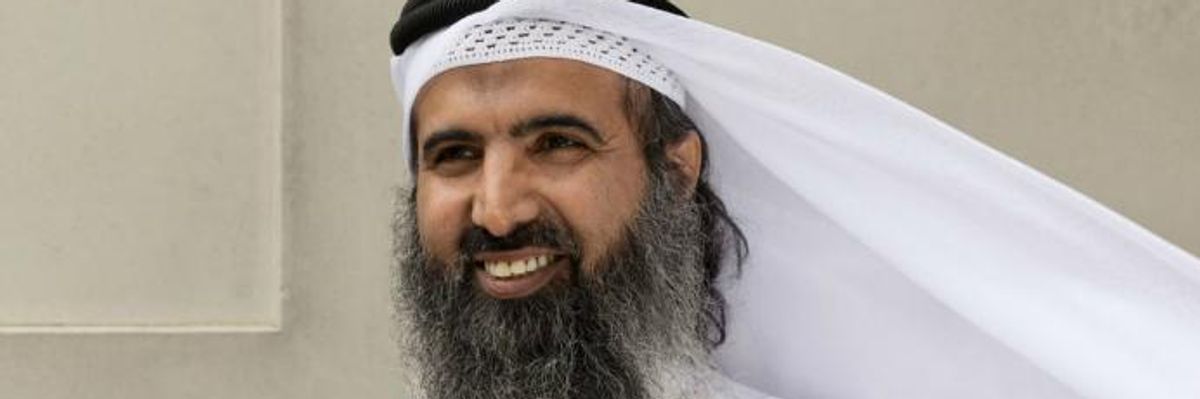
Ali Salah Kehlah al-Marri, who faced abuse and torture while he was incarcerated for 13 years in the United States, says he pleaded guilty to get home and is demanding justice for his treatment. (Photo: CAGE)
As the U.S. government faces renewed criticism for its history of torture amid Gina Haspel's nomination to head the CIA, a Qatari man who says he was tortured on U.S. soil before accepting a plea deal is maintaining his innocence and demanding that his interrogators face justice.
Ali Salah Kehlah al-Marri, who was incarcerated for 13 years--more than seven of which came before a trial for him was approved in 2009--told the Guardian he ultimately pleaded guilty to get home. "Everything in that plea bargain that has to do with al-Qaida and terror is 100 percent false," he said. "My battery was at 1 percent."
He arrived in the United States with his family on Sept. 10, 2001 with plans to conduct research for banking operations. The very next day, terrorism attacks rattle the nation and resulted in widespread Islamophobia that garnered early public support for the so-called War on Terror.
In the months that followed, al-Marri was approached twice by FBI agents, then arrested in December on allegations that he was funding al-Qaida and had been in contact with those who had conducted the attacks. He was held in New York City and Peoria, Illinois before former President George W. Bush named him an "enemy combatant" and he was sent to the Charleston Naval Brig in South Carolina.
There, he was abused and tortured, according to the Torture in America (pdf) report by the U.K.-based group CAGE, which is supporting al-Marri's quest for justice. CAGE obtained and published a dossier of 35,000 documents to support his allegations, which are summarized in the report, and has produced a series of videos in which al-Marri describes his time in U.S. custody:
"The experience of Ali Saleh Kahlah al-Marri, by all international standards of law, constituted torture," the CAGE report declares. "As a result, all those involved in his solitary confinement, in the use of behavioral science to harm him, in enforcing isolation, in instigating religious and cultural abuse, in perpetrating physical abuse, and in making threats against his family are to be included in any allegations of torture."
In South Carolina, al-Marri was deprived of the ability to engage in Muslim prayer time and ritual cleansing; threatened with violence against him and his family; forced to sleep in a freezing cell on a bare metal rack; deprived of sleep and socialization; and repeatedly interrogated. The interrogations included "dry-boarding," a practice that involved stuffing socks in his mouth and taping it shut.
"I was choking, I was dying," al-Marri said about being dry-boarded while he was shackled to the floor. Recalling his incarceration, al-Marri told the Guardian:
The suffering, you taste the pain, you taste it. Threatening to sodomize me, threatening to rape my wife, threatening to bring in my kids, that's torture. Threatening to send me to a black site, to become a military lab rat, choking me to near death. This is torture...
I knew I had no rights, I was down the rabbit hole. It was dark times. My cell was six steps one way and, to lay down the other way, I'd have to bend my knees. I cannot see if it's day or night. I felt as though I was buried in a concrete grave.
"Nobody has been held accountable," noted al-Marri, who returned to Qatar following his release three years ago. "There are people who admit they have done this and people who deny it. I do not need apologies, I need accountability. What they said and did to me was torture."
Dear Common Dreams reader, It’s been nearly 30 years since I co-founded Common Dreams with my late wife, Lina Newhouser. We had the radical notion that journalism should serve the public good, not corporate profits. It was clear to us from the outset what it would take to build such a project. No paid advertisements. No corporate sponsors. No millionaire publisher telling us what to think or do. Many people said we wouldn't last a year, but we proved those doubters wrong. Together with a tremendous team of journalists and dedicated staff, we built an independent media outlet free from the constraints of profits and corporate control. Our mission has always been simple: To inform. To inspire. To ignite change for the common good. Building Common Dreams was not easy. Our survival was never guaranteed. When you take on the most powerful forces—Wall Street greed, fossil fuel industry destruction, Big Tech lobbyists, and uber-rich oligarchs who have spent billions upon billions rigging the economy and democracy in their favor—the only bulwark you have is supporters who believe in your work. But here’s the urgent message from me today. It's never been this bad out there. And it's never been this hard to keep us going. At the very moment Common Dreams is most needed, the threats we face are intensifying. We need your support now more than ever. We don't accept corporate advertising and never will. We don't have a paywall because we don't think people should be blocked from critical news based on their ability to pay. Everything we do is funded by the donations of readers like you. When everyone does the little they can afford, we are strong. But if that support retreats or dries up, so do we. Will you donate now to make sure Common Dreams not only survives but thrives? —Craig Brown, Co-founder |
As the U.S. government faces renewed criticism for its history of torture amid Gina Haspel's nomination to head the CIA, a Qatari man who says he was tortured on U.S. soil before accepting a plea deal is maintaining his innocence and demanding that his interrogators face justice.
Ali Salah Kehlah al-Marri, who was incarcerated for 13 years--more than seven of which came before a trial for him was approved in 2009--told the Guardian he ultimately pleaded guilty to get home. "Everything in that plea bargain that has to do with al-Qaida and terror is 100 percent false," he said. "My battery was at 1 percent."
He arrived in the United States with his family on Sept. 10, 2001 with plans to conduct research for banking operations. The very next day, terrorism attacks rattle the nation and resulted in widespread Islamophobia that garnered early public support for the so-called War on Terror.
In the months that followed, al-Marri was approached twice by FBI agents, then arrested in December on allegations that he was funding al-Qaida and had been in contact with those who had conducted the attacks. He was held in New York City and Peoria, Illinois before former President George W. Bush named him an "enemy combatant" and he was sent to the Charleston Naval Brig in South Carolina.
There, he was abused and tortured, according to the Torture in America (pdf) report by the U.K.-based group CAGE, which is supporting al-Marri's quest for justice. CAGE obtained and published a dossier of 35,000 documents to support his allegations, which are summarized in the report, and has produced a series of videos in which al-Marri describes his time in U.S. custody:
"The experience of Ali Saleh Kahlah al-Marri, by all international standards of law, constituted torture," the CAGE report declares. "As a result, all those involved in his solitary confinement, in the use of behavioral science to harm him, in enforcing isolation, in instigating religious and cultural abuse, in perpetrating physical abuse, and in making threats against his family are to be included in any allegations of torture."
In South Carolina, al-Marri was deprived of the ability to engage in Muslim prayer time and ritual cleansing; threatened with violence against him and his family; forced to sleep in a freezing cell on a bare metal rack; deprived of sleep and socialization; and repeatedly interrogated. The interrogations included "dry-boarding," a practice that involved stuffing socks in his mouth and taping it shut.
"I was choking, I was dying," al-Marri said about being dry-boarded while he was shackled to the floor. Recalling his incarceration, al-Marri told the Guardian:
The suffering, you taste the pain, you taste it. Threatening to sodomize me, threatening to rape my wife, threatening to bring in my kids, that's torture. Threatening to send me to a black site, to become a military lab rat, choking me to near death. This is torture...
I knew I had no rights, I was down the rabbit hole. It was dark times. My cell was six steps one way and, to lay down the other way, I'd have to bend my knees. I cannot see if it's day or night. I felt as though I was buried in a concrete grave.
"Nobody has been held accountable," noted al-Marri, who returned to Qatar following his release three years ago. "There are people who admit they have done this and people who deny it. I do not need apologies, I need accountability. What they said and did to me was torture."
As the U.S. government faces renewed criticism for its history of torture amid Gina Haspel's nomination to head the CIA, a Qatari man who says he was tortured on U.S. soil before accepting a plea deal is maintaining his innocence and demanding that his interrogators face justice.
Ali Salah Kehlah al-Marri, who was incarcerated for 13 years--more than seven of which came before a trial for him was approved in 2009--told the Guardian he ultimately pleaded guilty to get home. "Everything in that plea bargain that has to do with al-Qaida and terror is 100 percent false," he said. "My battery was at 1 percent."
He arrived in the United States with his family on Sept. 10, 2001 with plans to conduct research for banking operations. The very next day, terrorism attacks rattle the nation and resulted in widespread Islamophobia that garnered early public support for the so-called War on Terror.
In the months that followed, al-Marri was approached twice by FBI agents, then arrested in December on allegations that he was funding al-Qaida and had been in contact with those who had conducted the attacks. He was held in New York City and Peoria, Illinois before former President George W. Bush named him an "enemy combatant" and he was sent to the Charleston Naval Brig in South Carolina.
There, he was abused and tortured, according to the Torture in America (pdf) report by the U.K.-based group CAGE, which is supporting al-Marri's quest for justice. CAGE obtained and published a dossier of 35,000 documents to support his allegations, which are summarized in the report, and has produced a series of videos in which al-Marri describes his time in U.S. custody:
"The experience of Ali Saleh Kahlah al-Marri, by all international standards of law, constituted torture," the CAGE report declares. "As a result, all those involved in his solitary confinement, in the use of behavioral science to harm him, in enforcing isolation, in instigating religious and cultural abuse, in perpetrating physical abuse, and in making threats against his family are to be included in any allegations of torture."
In South Carolina, al-Marri was deprived of the ability to engage in Muslim prayer time and ritual cleansing; threatened with violence against him and his family; forced to sleep in a freezing cell on a bare metal rack; deprived of sleep and socialization; and repeatedly interrogated. The interrogations included "dry-boarding," a practice that involved stuffing socks in his mouth and taping it shut.
"I was choking, I was dying," al-Marri said about being dry-boarded while he was shackled to the floor. Recalling his incarceration, al-Marri told the Guardian:
The suffering, you taste the pain, you taste it. Threatening to sodomize me, threatening to rape my wife, threatening to bring in my kids, that's torture. Threatening to send me to a black site, to become a military lab rat, choking me to near death. This is torture...
I knew I had no rights, I was down the rabbit hole. It was dark times. My cell was six steps one way and, to lay down the other way, I'd have to bend my knees. I cannot see if it's day or night. I felt as though I was buried in a concrete grave.
"Nobody has been held accountable," noted al-Marri, who returned to Qatar following his release three years ago. "There are people who admit they have done this and people who deny it. I do not need apologies, I need accountability. What they said and did to me was torture."