SUBSCRIBE TO OUR FREE NEWSLETTER
Daily news & progressive opinion—funded by the people, not the corporations—delivered straight to your inbox.
5
#000000
#FFFFFF
To donate by check, phone, or other method, see our More Ways to Give page.
Daily news & progressive opinion—funded by the people, not the corporations—delivered straight to your inbox.
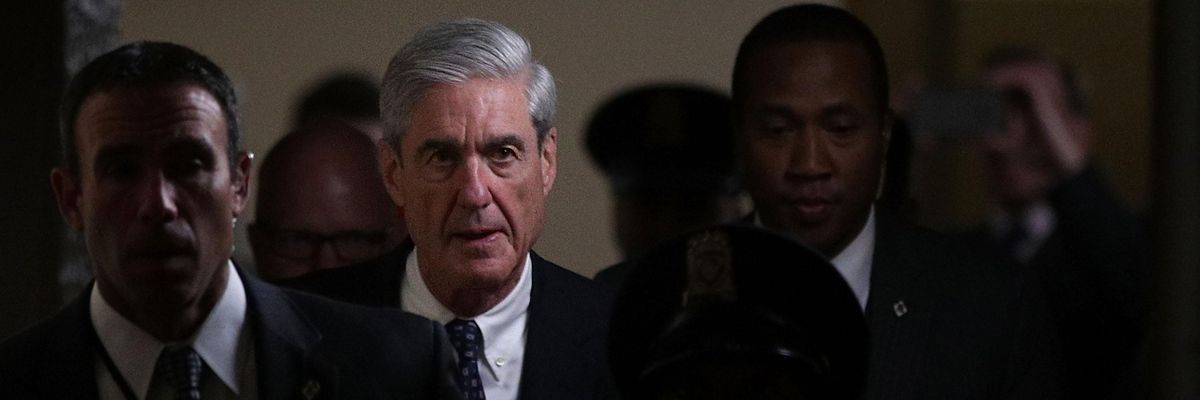
President Donald Trump indicated in a tweet on Thursday that he could fire Special Counsel Robert Mueller if he were so inclined--despite little legal evidence supporting the statement. (Photo: Alex Wong/Getty Images)
In an early morning tweet, President Donald Trump suggested Thursday that he is legally able to fire Special Counsel Robert Mueller--despite an understanding among legal experts that he does not have this authority.
Earlier this week, White House Press Secretary Sarah Huckabee Sanders also stated that the president "certainly has the power" to dismiss Mueller, who has been conducting an investigation into Trump's 2016 campaign since the president fired former FBI Director James Comey last May.
In at least two Supreme Court cases, the nation's top judges have ruled that the president cannot legally remove employees of a government agency--an authority that lies with the heads of each department.
In an 1839 decision, the Supreme Court said "the president has certainly no power to remove" officials, while current Chief Justice John G. Roberts found just eight years ago that "it is ordinarily the department head, rather than the president, who enjoys the power of removal."
Critics and Democratic leaders have warned that any move by Trump to fire Mueller or Deputy Attorney General Rod Rosenstein--undermining or ending the Justice Department's investigation into his campaign's contacts with Russia--would throw the nation into a constitutional crisis and spark calls for impeachment proceedings.
More than 300,000 Americans have prepared to revolt in the event of such an incident, with MoveOn.org and other groups planning more than 800 demonstrations in all 50 states, as well as Puerto Rico and the U.S. Virgin Islands.
"We can't have the highest office of the land exempt from abiding by the law," Erich Picha, president of Friends of the Earth U.S., told Reuters on Wednesday.
Dear Common Dreams reader, It’s been nearly 30 years since I co-founded Common Dreams with my late wife, Lina Newhouser. We had the radical notion that journalism should serve the public good, not corporate profits. It was clear to us from the outset what it would take to build such a project. No paid advertisements. No corporate sponsors. No millionaire publisher telling us what to think or do. Many people said we wouldn't last a year, but we proved those doubters wrong. Together with a tremendous team of journalists and dedicated staff, we built an independent media outlet free from the constraints of profits and corporate control. Our mission has always been simple: To inform. To inspire. To ignite change for the common good. Building Common Dreams was not easy. Our survival was never guaranteed. When you take on the most powerful forces—Wall Street greed, fossil fuel industry destruction, Big Tech lobbyists, and uber-rich oligarchs who have spent billions upon billions rigging the economy and democracy in their favor—the only bulwark you have is supporters who believe in your work. But here’s the urgent message from me today. It's never been this bad out there. And it's never been this hard to keep us going. At the very moment Common Dreams is most needed, the threats we face are intensifying. We need your support now more than ever. We don't accept corporate advertising and never will. We don't have a paywall because we don't think people should be blocked from critical news based on their ability to pay. Everything we do is funded by the donations of readers like you. When everyone does the little they can afford, we are strong. But if that support retreats or dries up, so do we. Will you donate now to make sure Common Dreams not only survives but thrives? —Craig Brown, Co-founder |
In an early morning tweet, President Donald Trump suggested Thursday that he is legally able to fire Special Counsel Robert Mueller--despite an understanding among legal experts that he does not have this authority.
Earlier this week, White House Press Secretary Sarah Huckabee Sanders also stated that the president "certainly has the power" to dismiss Mueller, who has been conducting an investigation into Trump's 2016 campaign since the president fired former FBI Director James Comey last May.
In at least two Supreme Court cases, the nation's top judges have ruled that the president cannot legally remove employees of a government agency--an authority that lies with the heads of each department.
In an 1839 decision, the Supreme Court said "the president has certainly no power to remove" officials, while current Chief Justice John G. Roberts found just eight years ago that "it is ordinarily the department head, rather than the president, who enjoys the power of removal."
Critics and Democratic leaders have warned that any move by Trump to fire Mueller or Deputy Attorney General Rod Rosenstein--undermining or ending the Justice Department's investigation into his campaign's contacts with Russia--would throw the nation into a constitutional crisis and spark calls for impeachment proceedings.
More than 300,000 Americans have prepared to revolt in the event of such an incident, with MoveOn.org and other groups planning more than 800 demonstrations in all 50 states, as well as Puerto Rico and the U.S. Virgin Islands.
"We can't have the highest office of the land exempt from abiding by the law," Erich Picha, president of Friends of the Earth U.S., told Reuters on Wednesday.
In an early morning tweet, President Donald Trump suggested Thursday that he is legally able to fire Special Counsel Robert Mueller--despite an understanding among legal experts that he does not have this authority.
Earlier this week, White House Press Secretary Sarah Huckabee Sanders also stated that the president "certainly has the power" to dismiss Mueller, who has been conducting an investigation into Trump's 2016 campaign since the president fired former FBI Director James Comey last May.
In at least two Supreme Court cases, the nation's top judges have ruled that the president cannot legally remove employees of a government agency--an authority that lies with the heads of each department.
In an 1839 decision, the Supreme Court said "the president has certainly no power to remove" officials, while current Chief Justice John G. Roberts found just eight years ago that "it is ordinarily the department head, rather than the president, who enjoys the power of removal."
Critics and Democratic leaders have warned that any move by Trump to fire Mueller or Deputy Attorney General Rod Rosenstein--undermining or ending the Justice Department's investigation into his campaign's contacts with Russia--would throw the nation into a constitutional crisis and spark calls for impeachment proceedings.
More than 300,000 Americans have prepared to revolt in the event of such an incident, with MoveOn.org and other groups planning more than 800 demonstrations in all 50 states, as well as Puerto Rico and the U.S. Virgin Islands.
"We can't have the highest office of the land exempt from abiding by the law," Erich Picha, president of Friends of the Earth U.S., told Reuters on Wednesday.