SUBSCRIBE TO OUR FREE NEWSLETTER
Daily news & progressive opinion—funded by the people, not the corporations—delivered straight to your inbox.
5
#000000
#FFFFFF
To donate by check, phone, or other method, see our More Ways to Give page.
Daily news & progressive opinion—funded by the people, not the corporations—delivered straight to your inbox.
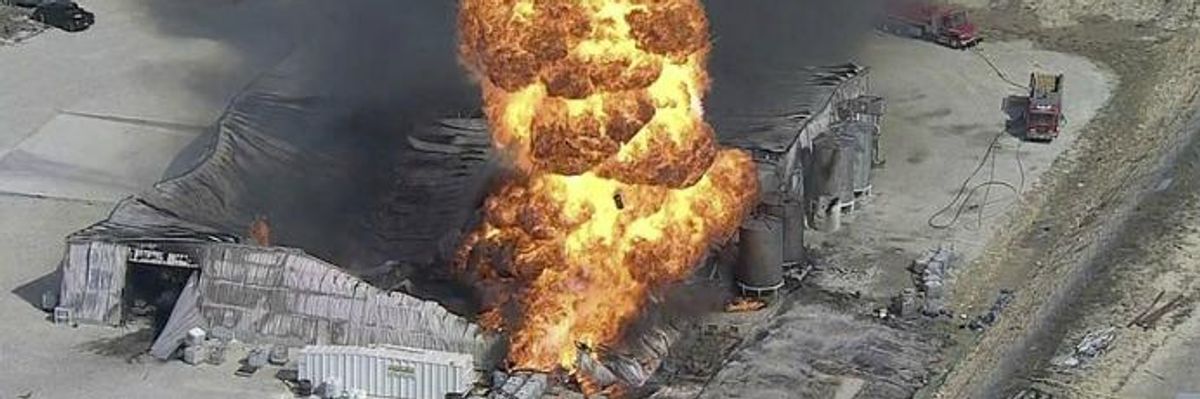
A fire burns at the Tri-Chem Industries plan in Cresson, Texas on Thursday March 15, 2018. (Photo: KDFW/screenshot)
While the Trump administration continues its push to stymie and roll back federal regulations by fighting in court to uphold a delay of the Chemical Disaster Rule, hazardous materials crews are searching for a worker presumed dead after an explosion at a Texas chemical plant.
Two other workers were injured Thursday in the blast at the Tri-Chem Industries plant in Cresson, which is about 50 miles southwest of Dallas. Efforts to battle the blaze were temporarily halted by concerns about exposure to toxic fumes and the subsequent explosions.
Cresson Mayor Bob Cornett told The Associated Press that the plant "mixes chemicals that are primarily used by the oil and gas industry to drill disposal wells," though he didn't know the specifics.
A spokesman for the Texas Commission on Environmental Quality refused a request by AP to provide a list of the plant's chemicals, telling the journalist to file an official public information request.
"Texas leaders have made it increasingly difficult for the public to find out about the chemicals manufactured and stored at such plants," the AP noted. Following a 2013 explosion that killed 15 people at a fertilizer plant in West, Texas, the state deemed that agencies could withhold hazardous chemical information because of "ongoing terroristic activity."
A few months after the West, Texas explosion, then-President Barack Obama signed an executive order that aimed to improve chemical safety at facilities across the country. In response to the order, a final rule (pdf) to strengthen the federal Risk Management Program regulations was published in January 2017, just a week before President Donald Trump took office.
Though the rule was scheduled to take effect March 14, 2017, it was blocked by the Trump administration. In June, Scott Pruitt, the man appointed by Trump to run the Environmental Protection Agency (EPA), delayed implementation of the Chemical Disaster Rule until February 2019.
Air Alliance Houston, backed by multiple national groups, is suing the EPA to challenge Pruitt's delay. Arguments were live streamed during a hearing on Friday morning at the D.C. Circuit Court.
As Maya L. Kapoor noted at High Country News, discussing smog pollution rules, delayed implementation "has become a common strategy at Scott Pruitt's EPA: When it comes to enacting new environmental regulations, the agency stalls."
Mustafa Santiago Ali, senior vice president of the Hip Hop Caucus, said in a tweet that Thursday's explosion is just the latest example of "why we need a strong EPA."
As ThinkProgress noted, the explosion on Thursday "also follows multiple attempts by the Trump administration to eliminate the U.S. Chemical Safety Board. The agency is responsible for investigating major chemical fires, explosions, leaks, and other accidents."
Earlier this year, the Environmental Working Group published a list of additional moves by the administration that show how "Trump has wreaked devastating damage on public health protections against hazardous chemicals." Actions have included reversing chemical bans, slashing the EPA's budget, and appointing chemical industry insiders to key government positions.
Dear Common Dreams reader, It’s been nearly 30 years since I co-founded Common Dreams with my late wife, Lina Newhouser. We had the radical notion that journalism should serve the public good, not corporate profits. It was clear to us from the outset what it would take to build such a project. No paid advertisements. No corporate sponsors. No millionaire publisher telling us what to think or do. Many people said we wouldn't last a year, but we proved those doubters wrong. Together with a tremendous team of journalists and dedicated staff, we built an independent media outlet free from the constraints of profits and corporate control. Our mission has always been simple: To inform. To inspire. To ignite change for the common good. Building Common Dreams was not easy. Our survival was never guaranteed. When you take on the most powerful forces—Wall Street greed, fossil fuel industry destruction, Big Tech lobbyists, and uber-rich oligarchs who have spent billions upon billions rigging the economy and democracy in their favor—the only bulwark you have is supporters who believe in your work. But here’s the urgent message from me today. It's never been this bad out there. And it's never been this hard to keep us going. At the very moment Common Dreams is most needed, the threats we face are intensifying. We need your support now more than ever. We don't accept corporate advertising and never will. We don't have a paywall because we don't think people should be blocked from critical news based on their ability to pay. Everything we do is funded by the donations of readers like you. When everyone does the little they can afford, we are strong. But if that support retreats or dries up, so do we. Will you donate now to make sure Common Dreams not only survives but thrives? —Craig Brown, Co-founder |
While the Trump administration continues its push to stymie and roll back federal regulations by fighting in court to uphold a delay of the Chemical Disaster Rule, hazardous materials crews are searching for a worker presumed dead after an explosion at a Texas chemical plant.
Two other workers were injured Thursday in the blast at the Tri-Chem Industries plant in Cresson, which is about 50 miles southwest of Dallas. Efforts to battle the blaze were temporarily halted by concerns about exposure to toxic fumes and the subsequent explosions.
Cresson Mayor Bob Cornett told The Associated Press that the plant "mixes chemicals that are primarily used by the oil and gas industry to drill disposal wells," though he didn't know the specifics.
A spokesman for the Texas Commission on Environmental Quality refused a request by AP to provide a list of the plant's chemicals, telling the journalist to file an official public information request.
"Texas leaders have made it increasingly difficult for the public to find out about the chemicals manufactured and stored at such plants," the AP noted. Following a 2013 explosion that killed 15 people at a fertilizer plant in West, Texas, the state deemed that agencies could withhold hazardous chemical information because of "ongoing terroristic activity."
A few months after the West, Texas explosion, then-President Barack Obama signed an executive order that aimed to improve chemical safety at facilities across the country. In response to the order, a final rule (pdf) to strengthen the federal Risk Management Program regulations was published in January 2017, just a week before President Donald Trump took office.
Though the rule was scheduled to take effect March 14, 2017, it was blocked by the Trump administration. In June, Scott Pruitt, the man appointed by Trump to run the Environmental Protection Agency (EPA), delayed implementation of the Chemical Disaster Rule until February 2019.
Air Alliance Houston, backed by multiple national groups, is suing the EPA to challenge Pruitt's delay. Arguments were live streamed during a hearing on Friday morning at the D.C. Circuit Court.
As Maya L. Kapoor noted at High Country News, discussing smog pollution rules, delayed implementation "has become a common strategy at Scott Pruitt's EPA: When it comes to enacting new environmental regulations, the agency stalls."
Mustafa Santiago Ali, senior vice president of the Hip Hop Caucus, said in a tweet that Thursday's explosion is just the latest example of "why we need a strong EPA."
As ThinkProgress noted, the explosion on Thursday "also follows multiple attempts by the Trump administration to eliminate the U.S. Chemical Safety Board. The agency is responsible for investigating major chemical fires, explosions, leaks, and other accidents."
Earlier this year, the Environmental Working Group published a list of additional moves by the administration that show how "Trump has wreaked devastating damage on public health protections against hazardous chemicals." Actions have included reversing chemical bans, slashing the EPA's budget, and appointing chemical industry insiders to key government positions.
While the Trump administration continues its push to stymie and roll back federal regulations by fighting in court to uphold a delay of the Chemical Disaster Rule, hazardous materials crews are searching for a worker presumed dead after an explosion at a Texas chemical plant.
Two other workers were injured Thursday in the blast at the Tri-Chem Industries plant in Cresson, which is about 50 miles southwest of Dallas. Efforts to battle the blaze were temporarily halted by concerns about exposure to toxic fumes and the subsequent explosions.
Cresson Mayor Bob Cornett told The Associated Press that the plant "mixes chemicals that are primarily used by the oil and gas industry to drill disposal wells," though he didn't know the specifics.
A spokesman for the Texas Commission on Environmental Quality refused a request by AP to provide a list of the plant's chemicals, telling the journalist to file an official public information request.
"Texas leaders have made it increasingly difficult for the public to find out about the chemicals manufactured and stored at such plants," the AP noted. Following a 2013 explosion that killed 15 people at a fertilizer plant in West, Texas, the state deemed that agencies could withhold hazardous chemical information because of "ongoing terroristic activity."
A few months after the West, Texas explosion, then-President Barack Obama signed an executive order that aimed to improve chemical safety at facilities across the country. In response to the order, a final rule (pdf) to strengthen the federal Risk Management Program regulations was published in January 2017, just a week before President Donald Trump took office.
Though the rule was scheduled to take effect March 14, 2017, it was blocked by the Trump administration. In June, Scott Pruitt, the man appointed by Trump to run the Environmental Protection Agency (EPA), delayed implementation of the Chemical Disaster Rule until February 2019.
Air Alliance Houston, backed by multiple national groups, is suing the EPA to challenge Pruitt's delay. Arguments were live streamed during a hearing on Friday morning at the D.C. Circuit Court.
As Maya L. Kapoor noted at High Country News, discussing smog pollution rules, delayed implementation "has become a common strategy at Scott Pruitt's EPA: When it comes to enacting new environmental regulations, the agency stalls."
Mustafa Santiago Ali, senior vice president of the Hip Hop Caucus, said in a tweet that Thursday's explosion is just the latest example of "why we need a strong EPA."
As ThinkProgress noted, the explosion on Thursday "also follows multiple attempts by the Trump administration to eliminate the U.S. Chemical Safety Board. The agency is responsible for investigating major chemical fires, explosions, leaks, and other accidents."
Earlier this year, the Environmental Working Group published a list of additional moves by the administration that show how "Trump has wreaked devastating damage on public health protections against hazardous chemicals." Actions have included reversing chemical bans, slashing the EPA's budget, and appointing chemical industry insiders to key government positions.