SUBSCRIBE TO OUR FREE NEWSLETTER
Daily news & progressive opinion—funded by the people, not the corporations—delivered straight to your inbox.
5
#000000
#FFFFFF
To donate by check, phone, or other method, see our More Ways to Give page.
Daily news & progressive opinion—funded by the people, not the corporations—delivered straight to your inbox.
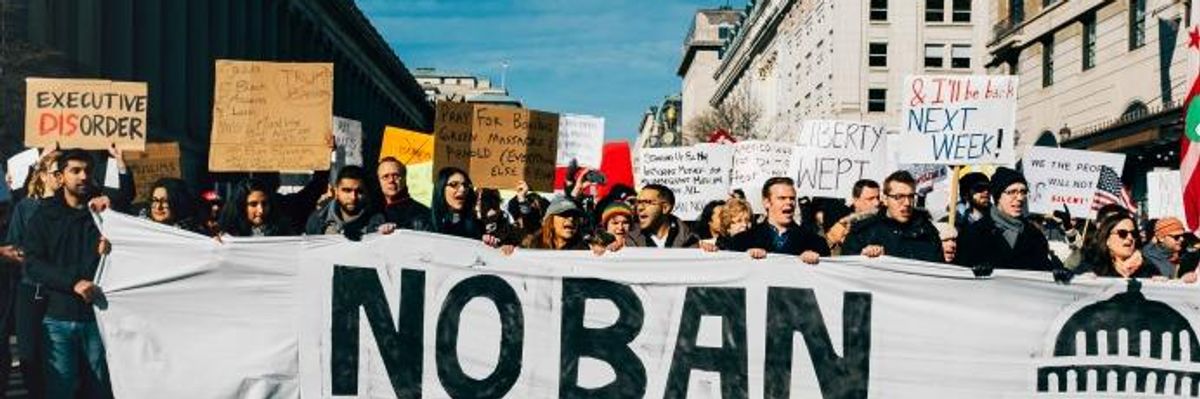
U.S. President Donald Trump issued a third travel ban on Sunday aimed at restricting travel from multiple Muslim-majority countries as well as North Korea and Venezuela. (Photo: Masha George/Flickr/cc)
"Six of President Trump's targeted countries are Muslim," said ACLU executive director Anthony Romero. "The fact that Trump has added North Korea--with few visitors to the U.S.--and a few government officials from Venezuela doesn't obfuscate the real fact that the administration's order is still a Muslim ban. President Trump's original sin of targeting Muslims cannot be cured by throwing other countries onto his enemies list."
The ACLU is part of a coalition of legal groups and states challenging the president's second travel ban in court, with arguments scheduled for October 10, 2017. The first version, issued in January, was aimed at suppressing the flow of refugees and barred visitors from seven Muslim-majority nations; the second, issued in March, restricted travelers from six of those countries, and after a series of legal battles, temporarily took effect this summer.
The new ban--which Trump issued just as existing restrictions were set to expire--will take effect October 18, 2017, and still bars most visitors from Iran, Libya, Somalia, Syria, and Yemen. While the new measure adds restrictions for travel from Chad, North Korea, and Venezuela, it no longer bars Sudanese citizens and only subjects Iraqis to "additional scrutiny." Unlike past versions, which were temporary, this ban is indefinite.
The National Iranian American Council expressed alarm over the permanence of the new restrictions, and warned that "absent additional intervention from the courts, and a long-overdue intervention from the Republican-controlled Congress, the Trump administration will cement a racist and discriminatory campaign promise into official U.S. policy."
"We are confident that the courts will see through this disingenuous tactic of expanding the ban in order to dilute its clearly discriminatory motive," the council added in its statement. "Casting a wider net only validates what we and others have always maintained, which is that the Muslim ban was but the first step in a wider initiative to implement Islamophobic, racist, and xenophobic policies that pander to the desires of Trump's white supremacist base."
The president took to Twitter Sunday night to claim the new ban targets those who the government "cannot safely vet":
Opponents point to a rigorous 20-step vetting process that is already in place for refugees, which can take up to two years. Refugees from Syria face additional security checks.
"At a time when the entire world is facing the largest refugee crisis since World War II, the U.S. government should not be taking actions that may encourage other countries to institute even more sweeping bans on top of already onerous vetting processes that will slam more doors on desperate people seeking safety," said Naureen Shah, senior campaigns director for Amnesty International USA. "This ban must not stand in any form."
Many have noted the new ban will likely shift legal arguments, because the additions include nations that do not have a majority of Muslim citizens, but rights advocates have vowed to continue fighting against the president's attempts to implement sweeping travel restrictions.
"No matter how many times the administration tries to repackage and sell it, President Trump's Muslim travel ban remains hateful, discriminatory, and xenophobic."
--Vanita Gupta, the Leadership Conference on Civil and Human Rights
"Just because the original ban was especially outrageous does not mean we should stand for yet another version of government-sanctioned discrimination," said Shah. "It is senseless and cruel to ban whole nationalities of people who are often fleeing the very same violence that the U.S. government wishes to keep out."
"Let us not be fooled by the administration's attempted tricks and semantics, this is still the same Muslim ban," Johnathan Smith, legal director of Muslim Advocates told the Guardian. "The administration is once again making cosmetic adjustments to the Muslim ban in hopes that it will pass the barest possible definition of anything else; but they've failed again."
"No matter how many times the administration tries to repackage and sell it, President Trump's Muslim travel ban remains hateful, discriminatory, and xenophobic," said Vanita Gupta, president and CEO of the Leadership Conference on Civil and Human Rights. "The addition of North Korea and Venezuela doesn't make this any less of a Muslim ban. While Trump continues to try and fulfill his campaign promise to ban Muslims, this latest version will continue to harm families and degrade our values."
Politicians, progressive groups, and others were also quick to condemn the president's latest travel ban:
Dear Common Dreams reader, It’s been nearly 30 years since I co-founded Common Dreams with my late wife, Lina Newhouser. We had the radical notion that journalism should serve the public good, not corporate profits. It was clear to us from the outset what it would take to build such a project. No paid advertisements. No corporate sponsors. No millionaire publisher telling us what to think or do. Many people said we wouldn't last a year, but we proved those doubters wrong. Together with a tremendous team of journalists and dedicated staff, we built an independent media outlet free from the constraints of profits and corporate control. Our mission has always been simple: To inform. To inspire. To ignite change for the common good. Building Common Dreams was not easy. Our survival was never guaranteed. When you take on the most powerful forces—Wall Street greed, fossil fuel industry destruction, Big Tech lobbyists, and uber-rich oligarchs who have spent billions upon billions rigging the economy and democracy in their favor—the only bulwark you have is supporters who believe in your work. But here’s the urgent message from me today. It's never been this bad out there. And it's never been this hard to keep us going. At the very moment Common Dreams is most needed, the threats we face are intensifying. We need your support now more than ever. We don't accept corporate advertising and never will. We don't have a paywall because we don't think people should be blocked from critical news based on their ability to pay. Everything we do is funded by the donations of readers like you. When everyone does the little they can afford, we are strong. But if that support retreats or dries up, so do we. Will you donate now to make sure Common Dreams not only survives but thrives? —Craig Brown, Co-founder |
"Six of President Trump's targeted countries are Muslim," said ACLU executive director Anthony Romero. "The fact that Trump has added North Korea--with few visitors to the U.S.--and a few government officials from Venezuela doesn't obfuscate the real fact that the administration's order is still a Muslim ban. President Trump's original sin of targeting Muslims cannot be cured by throwing other countries onto his enemies list."
The ACLU is part of a coalition of legal groups and states challenging the president's second travel ban in court, with arguments scheduled for October 10, 2017. The first version, issued in January, was aimed at suppressing the flow of refugees and barred visitors from seven Muslim-majority nations; the second, issued in March, restricted travelers from six of those countries, and after a series of legal battles, temporarily took effect this summer.
The new ban--which Trump issued just as existing restrictions were set to expire--will take effect October 18, 2017, and still bars most visitors from Iran, Libya, Somalia, Syria, and Yemen. While the new measure adds restrictions for travel from Chad, North Korea, and Venezuela, it no longer bars Sudanese citizens and only subjects Iraqis to "additional scrutiny." Unlike past versions, which were temporary, this ban is indefinite.
The National Iranian American Council expressed alarm over the permanence of the new restrictions, and warned that "absent additional intervention from the courts, and a long-overdue intervention from the Republican-controlled Congress, the Trump administration will cement a racist and discriminatory campaign promise into official U.S. policy."
"We are confident that the courts will see through this disingenuous tactic of expanding the ban in order to dilute its clearly discriminatory motive," the council added in its statement. "Casting a wider net only validates what we and others have always maintained, which is that the Muslim ban was but the first step in a wider initiative to implement Islamophobic, racist, and xenophobic policies that pander to the desires of Trump's white supremacist base."
The president took to Twitter Sunday night to claim the new ban targets those who the government "cannot safely vet":
Opponents point to a rigorous 20-step vetting process that is already in place for refugees, which can take up to two years. Refugees from Syria face additional security checks.
"At a time when the entire world is facing the largest refugee crisis since World War II, the U.S. government should not be taking actions that may encourage other countries to institute even more sweeping bans on top of already onerous vetting processes that will slam more doors on desperate people seeking safety," said Naureen Shah, senior campaigns director for Amnesty International USA. "This ban must not stand in any form."
Many have noted the new ban will likely shift legal arguments, because the additions include nations that do not have a majority of Muslim citizens, but rights advocates have vowed to continue fighting against the president's attempts to implement sweeping travel restrictions.
"No matter how many times the administration tries to repackage and sell it, President Trump's Muslim travel ban remains hateful, discriminatory, and xenophobic."
--Vanita Gupta, the Leadership Conference on Civil and Human Rights
"Just because the original ban was especially outrageous does not mean we should stand for yet another version of government-sanctioned discrimination," said Shah. "It is senseless and cruel to ban whole nationalities of people who are often fleeing the very same violence that the U.S. government wishes to keep out."
"Let us not be fooled by the administration's attempted tricks and semantics, this is still the same Muslim ban," Johnathan Smith, legal director of Muslim Advocates told the Guardian. "The administration is once again making cosmetic adjustments to the Muslim ban in hopes that it will pass the barest possible definition of anything else; but they've failed again."
"No matter how many times the administration tries to repackage and sell it, President Trump's Muslim travel ban remains hateful, discriminatory, and xenophobic," said Vanita Gupta, president and CEO of the Leadership Conference on Civil and Human Rights. "The addition of North Korea and Venezuela doesn't make this any less of a Muslim ban. While Trump continues to try and fulfill his campaign promise to ban Muslims, this latest version will continue to harm families and degrade our values."
Politicians, progressive groups, and others were also quick to condemn the president's latest travel ban:
"Six of President Trump's targeted countries are Muslim," said ACLU executive director Anthony Romero. "The fact that Trump has added North Korea--with few visitors to the U.S.--and a few government officials from Venezuela doesn't obfuscate the real fact that the administration's order is still a Muslim ban. President Trump's original sin of targeting Muslims cannot be cured by throwing other countries onto his enemies list."
The ACLU is part of a coalition of legal groups and states challenging the president's second travel ban in court, with arguments scheduled for October 10, 2017. The first version, issued in January, was aimed at suppressing the flow of refugees and barred visitors from seven Muslim-majority nations; the second, issued in March, restricted travelers from six of those countries, and after a series of legal battles, temporarily took effect this summer.
The new ban--which Trump issued just as existing restrictions were set to expire--will take effect October 18, 2017, and still bars most visitors from Iran, Libya, Somalia, Syria, and Yemen. While the new measure adds restrictions for travel from Chad, North Korea, and Venezuela, it no longer bars Sudanese citizens and only subjects Iraqis to "additional scrutiny." Unlike past versions, which were temporary, this ban is indefinite.
The National Iranian American Council expressed alarm over the permanence of the new restrictions, and warned that "absent additional intervention from the courts, and a long-overdue intervention from the Republican-controlled Congress, the Trump administration will cement a racist and discriminatory campaign promise into official U.S. policy."
"We are confident that the courts will see through this disingenuous tactic of expanding the ban in order to dilute its clearly discriminatory motive," the council added in its statement. "Casting a wider net only validates what we and others have always maintained, which is that the Muslim ban was but the first step in a wider initiative to implement Islamophobic, racist, and xenophobic policies that pander to the desires of Trump's white supremacist base."
The president took to Twitter Sunday night to claim the new ban targets those who the government "cannot safely vet":
Opponents point to a rigorous 20-step vetting process that is already in place for refugees, which can take up to two years. Refugees from Syria face additional security checks.
"At a time when the entire world is facing the largest refugee crisis since World War II, the U.S. government should not be taking actions that may encourage other countries to institute even more sweeping bans on top of already onerous vetting processes that will slam more doors on desperate people seeking safety," said Naureen Shah, senior campaigns director for Amnesty International USA. "This ban must not stand in any form."
Many have noted the new ban will likely shift legal arguments, because the additions include nations that do not have a majority of Muslim citizens, but rights advocates have vowed to continue fighting against the president's attempts to implement sweeping travel restrictions.
"No matter how many times the administration tries to repackage and sell it, President Trump's Muslim travel ban remains hateful, discriminatory, and xenophobic."
--Vanita Gupta, the Leadership Conference on Civil and Human Rights
"Just because the original ban was especially outrageous does not mean we should stand for yet another version of government-sanctioned discrimination," said Shah. "It is senseless and cruel to ban whole nationalities of people who are often fleeing the very same violence that the U.S. government wishes to keep out."
"Let us not be fooled by the administration's attempted tricks and semantics, this is still the same Muslim ban," Johnathan Smith, legal director of Muslim Advocates told the Guardian. "The administration is once again making cosmetic adjustments to the Muslim ban in hopes that it will pass the barest possible definition of anything else; but they've failed again."
"No matter how many times the administration tries to repackage and sell it, President Trump's Muslim travel ban remains hateful, discriminatory, and xenophobic," said Vanita Gupta, president and CEO of the Leadership Conference on Civil and Human Rights. "The addition of North Korea and Venezuela doesn't make this any less of a Muslim ban. While Trump continues to try and fulfill his campaign promise to ban Muslims, this latest version will continue to harm families and degrade our values."
Politicians, progressive groups, and others were also quick to condemn the president's latest travel ban: