SUBSCRIBE TO OUR FREE NEWSLETTER
Daily news & progressive opinion—funded by the people, not the corporations—delivered straight to your inbox.
5
#000000
#FFFFFF
To donate by check, phone, or other method, see our More Ways to Give page.
"Megadroughts" that last for decades are threatening to strike already parched Western U.S. states by the end of the century, a new study finds, with one model predicting that a drought lasting about 35 years may be a "near certainty."
A megadrought would bring back the devastating dustbowl conditions of the 1930s to California, Utah, Nevada, New Mexico, and Colorado, but would last for a much longer period of time, according to the study published Wednesday in the journal Science Advances.
"Using a combination of temperature and precipitation models," the Guardian reports, "the study predicts a 70 percent chance of a megadrought by the end of the century, should rainfall levels remain the same, with a 90 percent chance of an elongated drought should rainfall decrease, as most climate models forecast."
"We can't rule out there could be a 99.9 percent chance of a megadrought, which makes it virtually certain," Toby Ault, a scientist at Cornell University and lead author of the study, told the Guardian.
"Historically, megadroughts were extremely rare phenomena occurring only once or twice per millennium," the study observes. "According to our analysis of modeled responses to increased [greenhouse gas emissions], these events could become commonplace if climate change goes unabated."
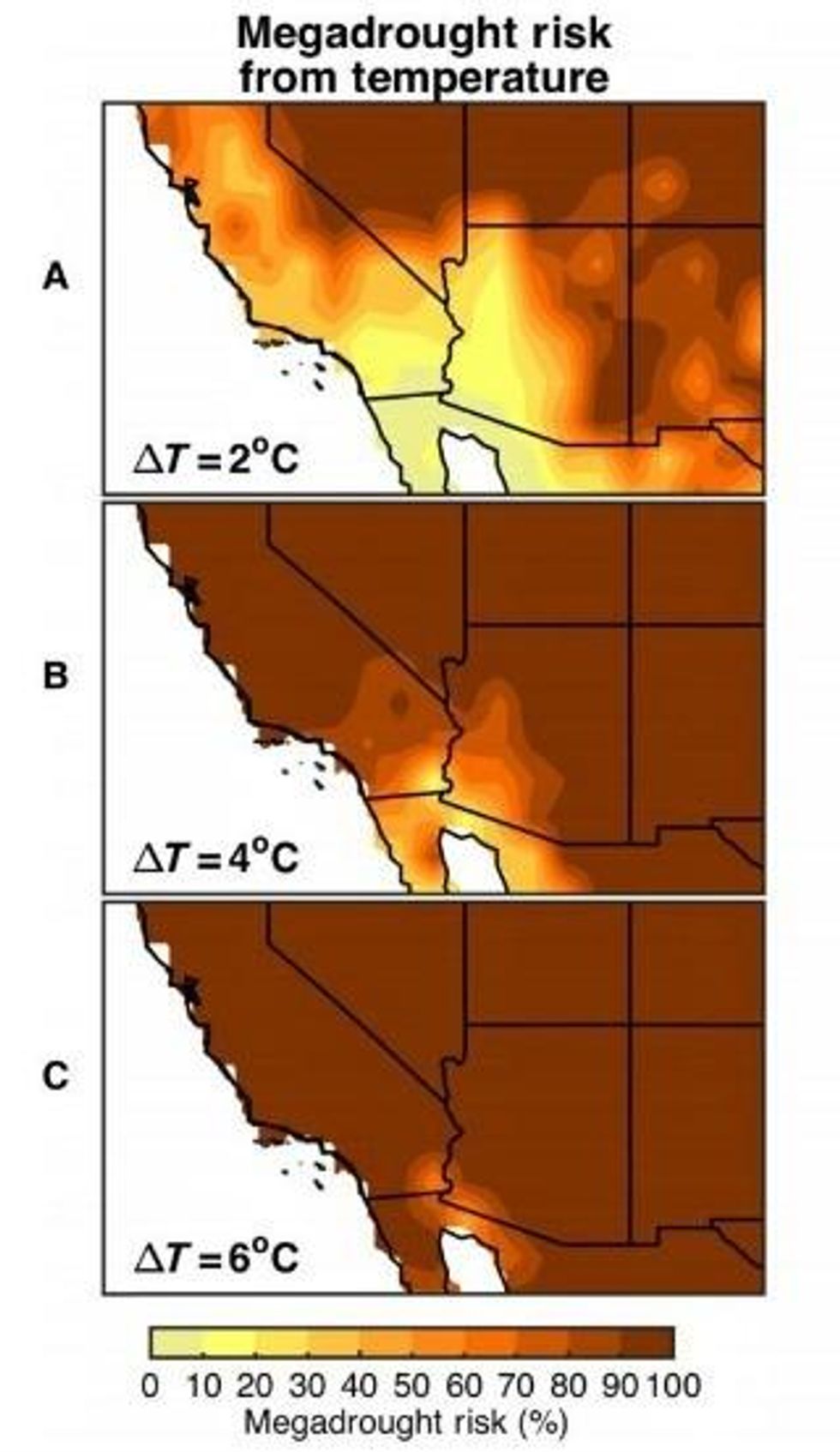
"With 4 degrees of warming, which is the rate the planet is currently heading for, megadroughts are almost a certainty," EcoWatch notes.
"A megadrought occurring again in the Southwest in the coming decades would impose unprecedented stresses on water resources of the region, and recent studies have shown that they are far more likely to occur this century because of climate change compared to past centuries," write the study authors, scientists from Cornell University, the Lamont-Doherty Earth Observatory of Columbia University, and the NASA Goddard Institute for Space Studies.
Indeed, California's six-year-long drought has already changed the landscape, according to the Guardian: "Areas of the Sierras have burned a few times and the forests aren't recruiting back, they are turning into grasslands and bush lands," Mark Schwartz, professor of environmental science at the University of California, told the newspaper.
"Water availability is a deep issue for people living in the arid south-west," Schwartz added. "Megadroughts have the ability to dry up Lake Mead [which supplies water to Las Vegas] and hamper crops in southern California. We are doing a relatively poor job of allocating water efficiently. We need to get better at that."
"The new report does proffer a crumb of hope," the Guardian writes, "if greenhouse gas emissions are radically cut then the risk of megadrought will reduce by half, giving a roughly 50:50 chance that a multi-decade stretch of below-average rainfall would occur this century. But the research found that the emissions cuts would have to be far steeper than those agreed to by nations in Paris last year, where a 2C limit on warming was pledged."
"We would need a much more aggressive approach than proposed at Paris," Ault told the newspaper. "It's not too late to do this but the train is leaving the station as we speak."
"Megadroughts" that last for decades are threatening to strike already parched Western U.S. states by the end of the century, a new study finds, with one model predicting that a drought lasting about 35 years may be a "near certainty."
A megadrought would bring back the devastating dustbowl conditions of the 1930s to California, Utah, Nevada, New Mexico, and Colorado, but would last for a much longer period of time, according to the study published Wednesday in the journal Science Advances.
"Using a combination of temperature and precipitation models," the Guardian reports, "the study predicts a 70 percent chance of a megadrought by the end of the century, should rainfall levels remain the same, with a 90 percent chance of an elongated drought should rainfall decrease, as most climate models forecast."
"We can't rule out there could be a 99.9 percent chance of a megadrought, which makes it virtually certain," Toby Ault, a scientist at Cornell University and lead author of the study, told the Guardian.
"Historically, megadroughts were extremely rare phenomena occurring only once or twice per millennium," the study observes. "According to our analysis of modeled responses to increased [greenhouse gas emissions], these events could become commonplace if climate change goes unabated."
"With 4 degrees of warming, which is the rate the planet is currently heading for, megadroughts are almost a certainty," EcoWatch notes.
"A megadrought occurring again in the Southwest in the coming decades would impose unprecedented stresses on water resources of the region, and recent studies have shown that they are far more likely to occur this century because of climate change compared to past centuries," write the study authors, scientists from Cornell University, the Lamont-Doherty Earth Observatory of Columbia University, and the NASA Goddard Institute for Space Studies.
Indeed, California's six-year-long drought has already changed the landscape, according to the Guardian: "Areas of the Sierras have burned a few times and the forests aren't recruiting back, they are turning into grasslands and bush lands," Mark Schwartz, professor of environmental science at the University of California, told the newspaper.
"Water availability is a deep issue for people living in the arid south-west," Schwartz added. "Megadroughts have the ability to dry up Lake Mead [which supplies water to Las Vegas] and hamper crops in southern California. We are doing a relatively poor job of allocating water efficiently. We need to get better at that."
"The new report does proffer a crumb of hope," the Guardian writes, "if greenhouse gas emissions are radically cut then the risk of megadrought will reduce by half, giving a roughly 50:50 chance that a multi-decade stretch of below-average rainfall would occur this century. But the research found that the emissions cuts would have to be far steeper than those agreed to by nations in Paris last year, where a 2C limit on warming was pledged."
"We would need a much more aggressive approach than proposed at Paris," Ault told the newspaper. "It's not too late to do this but the train is leaving the station as we speak."
"Megadroughts" that last for decades are threatening to strike already parched Western U.S. states by the end of the century, a new study finds, with one model predicting that a drought lasting about 35 years may be a "near certainty."
A megadrought would bring back the devastating dustbowl conditions of the 1930s to California, Utah, Nevada, New Mexico, and Colorado, but would last for a much longer period of time, according to the study published Wednesday in the journal Science Advances.
"Using a combination of temperature and precipitation models," the Guardian reports, "the study predicts a 70 percent chance of a megadrought by the end of the century, should rainfall levels remain the same, with a 90 percent chance of an elongated drought should rainfall decrease, as most climate models forecast."
"We can't rule out there could be a 99.9 percent chance of a megadrought, which makes it virtually certain," Toby Ault, a scientist at Cornell University and lead author of the study, told the Guardian.
"Historically, megadroughts were extremely rare phenomena occurring only once or twice per millennium," the study observes. "According to our analysis of modeled responses to increased [greenhouse gas emissions], these events could become commonplace if climate change goes unabated."
"With 4 degrees of warming, which is the rate the planet is currently heading for, megadroughts are almost a certainty," EcoWatch notes.
"A megadrought occurring again in the Southwest in the coming decades would impose unprecedented stresses on water resources of the region, and recent studies have shown that they are far more likely to occur this century because of climate change compared to past centuries," write the study authors, scientists from Cornell University, the Lamont-Doherty Earth Observatory of Columbia University, and the NASA Goddard Institute for Space Studies.
Indeed, California's six-year-long drought has already changed the landscape, according to the Guardian: "Areas of the Sierras have burned a few times and the forests aren't recruiting back, they are turning into grasslands and bush lands," Mark Schwartz, professor of environmental science at the University of California, told the newspaper.
"Water availability is a deep issue for people living in the arid south-west," Schwartz added. "Megadroughts have the ability to dry up Lake Mead [which supplies water to Las Vegas] and hamper crops in southern California. We are doing a relatively poor job of allocating water efficiently. We need to get better at that."
"The new report does proffer a crumb of hope," the Guardian writes, "if greenhouse gas emissions are radically cut then the risk of megadrought will reduce by half, giving a roughly 50:50 chance that a multi-decade stretch of below-average rainfall would occur this century. But the research found that the emissions cuts would have to be far steeper than those agreed to by nations in Paris last year, where a 2C limit on warming was pledged."
"We would need a much more aggressive approach than proposed at Paris," Ault told the newspaper. "It's not too late to do this but the train is leaving the station as we speak."