SUBSCRIBE TO OUR FREE NEWSLETTER
Daily news & progressive opinion—funded by the people, not the corporations—delivered straight to your inbox.
5
#000000
#FFFFFF
To donate by check, phone, or other method, see our More Ways to Give page.
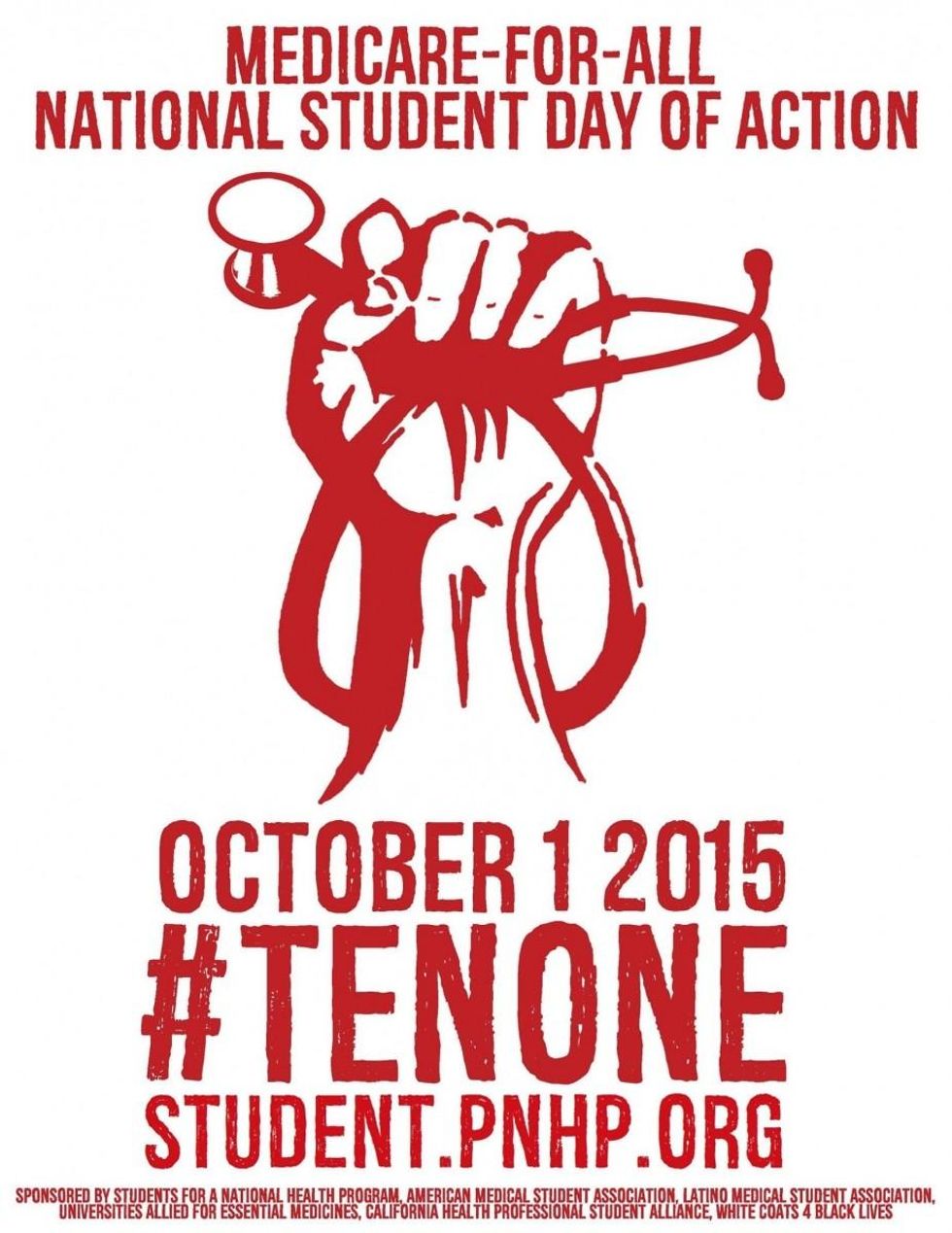
Taking a stand for the future of their profession and the healthcare needs of the nation, medical students across the U.S. are holding rallies and demonstrations on Thursday demanding the creation of a non-profit, publicly financed, single-payer system--a solution, they say, that is long overdue.
Led by the Students for a National Health Program (SNaHP), the student arm of Physicians for a National Health Program (PNHP), and working in coalition with numerous other groups--including the American Medical Student Association, WhiteCoats4BlackLives, the Latino Medical Student Association, Universities Allied for Essential Medicine, California Health Professional Student Alliance, and Pre-Health Dreamers--the future doctors and their supporters are holding teach-ins, rallies, and candlelight vigils at dozens of med school campuses and public venues throughout the day and evening as they call attention to "the millions of people in the U.S. who remain uninsured, underinsured and underserved" by the nation's current, for-profit healthcare system.
With actions happening nationwide, organizers and participants are using the #tenone hashtag on social media to chronicle the day's numerous events:
In an op-ed published by Common Dreams last week, Vanessa Van Doren, co-founder of SNaHP and a second-year medical student at Case Western Reserve University School of Medicine, explained that the driving force behind Thursday's action are the contradictions young doctors are confronted with when they match their earnest desire to serve and treat patients with the inequities embedded in the existing system.
"Very early in our medical careers - on the wards and in the classroom - we learn that inequality, preventable illness, and death are an inherent part of our current private, for-profit-oriented health insurance system," she wrote. "We see patients receive preventable amputations due to untreated diabetes. We see people permanently disabled by stroke because they were unable to afford their medications. College funds emptied out to pay for $100,000-a-year cancer treatments. Families bankrupted and lives destroyed."
That simply doesn't make sense, says Van Doren, when the United States is one of the wealthiest countries on earth. And just as the problem is self-evident, she argues, so is the solution that she and her young colleagues are now calling for. She continued:
There is an excellent model for universal health care - one that covers everyone, leads to better health outcomes, and costs taxpayers far less than the current U.S. system - implemented in dozens of countries around the world, including our next door neighbor, Canada. This model is called single-payer health care.
Implementing a single-payer system in the United States would be far from revolutionary. As part of its fragmented, multi-payer system, the U.S. also has a single-payer-like subdivision, which we call Medicare. It is efficient, cost-effective, and has stood the test of time, providing health insurance to all American seniors for the past 50 years.
By improving and expanding Medicare to cover all Americans, we can use this existing infrastructure to achieve universal coverage, better health outcomes, and better physician working conditions.
Taking a stand for the future of their profession and the healthcare needs of the nation, medical students across the U.S. are holding rallies and demonstrations on Thursday demanding the creation of a non-profit, publicly financed, single-payer system--a solution, they say, that is long overdue.
Led by the Students for a National Health Program (SNaHP), the student arm of Physicians for a National Health Program (PNHP), and working in coalition with numerous other groups--including the American Medical Student Association, WhiteCoats4BlackLives, the Latino Medical Student Association, Universities Allied for Essential Medicine, California Health Professional Student Alliance, and Pre-Health Dreamers--the future doctors and their supporters are holding teach-ins, rallies, and candlelight vigils at dozens of med school campuses and public venues throughout the day and evening as they call attention to "the millions of people in the U.S. who remain uninsured, underinsured and underserved" by the nation's current, for-profit healthcare system.
With actions happening nationwide, organizers and participants are using the #tenone hashtag on social media to chronicle the day's numerous events:
In an op-ed published by Common Dreams last week, Vanessa Van Doren, co-founder of SNaHP and a second-year medical student at Case Western Reserve University School of Medicine, explained that the driving force behind Thursday's action are the contradictions young doctors are confronted with when they match their earnest desire to serve and treat patients with the inequities embedded in the existing system.
"Very early in our medical careers - on the wards and in the classroom - we learn that inequality, preventable illness, and death are an inherent part of our current private, for-profit-oriented health insurance system," she wrote. "We see patients receive preventable amputations due to untreated diabetes. We see people permanently disabled by stroke because they were unable to afford their medications. College funds emptied out to pay for $100,000-a-year cancer treatments. Families bankrupted and lives destroyed."
That simply doesn't make sense, says Van Doren, when the United States is one of the wealthiest countries on earth. And just as the problem is self-evident, she argues, so is the solution that she and her young colleagues are now calling for. She continued:
There is an excellent model for universal health care - one that covers everyone, leads to better health outcomes, and costs taxpayers far less than the current U.S. system - implemented in dozens of countries around the world, including our next door neighbor, Canada. This model is called single-payer health care.
Implementing a single-payer system in the United States would be far from revolutionary. As part of its fragmented, multi-payer system, the U.S. also has a single-payer-like subdivision, which we call Medicare. It is efficient, cost-effective, and has stood the test of time, providing health insurance to all American seniors for the past 50 years.
By improving and expanding Medicare to cover all Americans, we can use this existing infrastructure to achieve universal coverage, better health outcomes, and better physician working conditions.
Taking a stand for the future of their profession and the healthcare needs of the nation, medical students across the U.S. are holding rallies and demonstrations on Thursday demanding the creation of a non-profit, publicly financed, single-payer system--a solution, they say, that is long overdue.
Led by the Students for a National Health Program (SNaHP), the student arm of Physicians for a National Health Program (PNHP), and working in coalition with numerous other groups--including the American Medical Student Association, WhiteCoats4BlackLives, the Latino Medical Student Association, Universities Allied for Essential Medicine, California Health Professional Student Alliance, and Pre-Health Dreamers--the future doctors and their supporters are holding teach-ins, rallies, and candlelight vigils at dozens of med school campuses and public venues throughout the day and evening as they call attention to "the millions of people in the U.S. who remain uninsured, underinsured and underserved" by the nation's current, for-profit healthcare system.
With actions happening nationwide, organizers and participants are using the #tenone hashtag on social media to chronicle the day's numerous events:
In an op-ed published by Common Dreams last week, Vanessa Van Doren, co-founder of SNaHP and a second-year medical student at Case Western Reserve University School of Medicine, explained that the driving force behind Thursday's action are the contradictions young doctors are confronted with when they match their earnest desire to serve and treat patients with the inequities embedded in the existing system.
"Very early in our medical careers - on the wards and in the classroom - we learn that inequality, preventable illness, and death are an inherent part of our current private, for-profit-oriented health insurance system," she wrote. "We see patients receive preventable amputations due to untreated diabetes. We see people permanently disabled by stroke because they were unable to afford their medications. College funds emptied out to pay for $100,000-a-year cancer treatments. Families bankrupted and lives destroyed."
That simply doesn't make sense, says Van Doren, when the United States is one of the wealthiest countries on earth. And just as the problem is self-evident, she argues, so is the solution that she and her young colleagues are now calling for. She continued:
There is an excellent model for universal health care - one that covers everyone, leads to better health outcomes, and costs taxpayers far less than the current U.S. system - implemented in dozens of countries around the world, including our next door neighbor, Canada. This model is called single-payer health care.
Implementing a single-payer system in the United States would be far from revolutionary. As part of its fragmented, multi-payer system, the U.S. also has a single-payer-like subdivision, which we call Medicare. It is efficient, cost-effective, and has stood the test of time, providing health insurance to all American seniors for the past 50 years.
By improving and expanding Medicare to cover all Americans, we can use this existing infrastructure to achieve universal coverage, better health outcomes, and better physician working conditions.