SUBSCRIBE TO OUR FREE NEWSLETTER
Daily news & progressive opinion—funded by the people, not the corporations—delivered straight to your inbox.
5
#000000
#FFFFFF
To donate by check, phone, or other method, see our More Ways to Give page.
Alongside Palestinian children and their family members on Monday, several hundred employees of the UN Relief and Works Agency (UNRWA) in the Gaza Strip rallied against announced cuts to the agency's budget and services, especially regarding education, which have resulted in the delay of the school term for many students.
"To think that we would commit $4.5 billion in military aid to Israel this year, while a fraction of that would guarantee a basic level of care for Palestinian children still living and learning in the rubble from last year's bombardment, is heartbreaking and tragic."
--Danny Muller, Middle East Children's AllianceAs the workers and their supporters marched in Gaza, people held signs reading "Education is a red line" and "I deserve to live in dignity."
In a speech at the protest, Suhail Hindi, the chairman of the union of Arab employees at the UNRWA in Gaza, said the agency's "decision to reduce its services to Palestinian refugees is unacceptable" and that its impact would be "catastrophic" for young Palestinians.
In June, UNRWA announced that impacts of austerity and budget constraints would force it cut 85 percent of its international staff operating in Jordan, Lebanon, Syria, and the Occupied Territories of the West Bank and Gaza.
Subsequently, according to Al-Jazeera:
The agency announced earlier in August that it had funding only until the end of this month, when the school year was due to start in the Palestinian territories and Jordan.
The agency requires $100m to begin the 2015-2016 academic year in some 700 UN-run schools for half a million students across the Middle East.
More than a $1bn has been pledged by governments by the end of 2014, and the UNRWA urged donors, many of whom have still not fulfilled their commitments, to act immediately.
Ban Ki-moon, the UN secretary-general, called on all donors to urgently ensure adequate and sustainable financing for vital services as soon as possible.
The agency also said it only had enough money to maintain its services to protect public health - including immunizations for children, primary healthcare, sanitation and some emergency programs - through to the end of 2015.
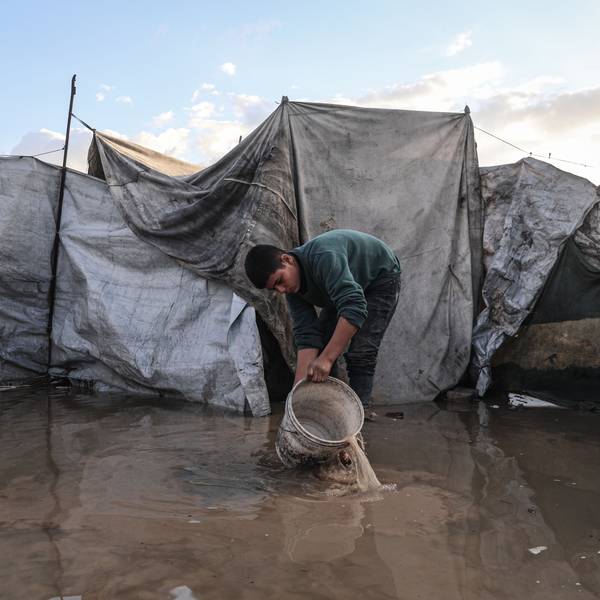
Barely a year after the deadly assault by the Israeli military on Gaza known as "Operation Protective Edge"--which left an estimated 2,134 Palestinians dead and thousands more wounded--international aid groups and the UN continue to warn that all Gazans remain in extreme crisis, suffering from lack of water, basic health supplies, and access to adequate shelter.
Danny Muller, a coordinator with the Middle East Children's Alliance, said it is unconscionable that there remain shortages of international aid money for Palestinian children living under occupation when there continues to be seemingly endless funds coming from the United States for Israel's military. Though in recent years the U.S. has supplied Israel with roughly $3 billion in annual military aid, the Obama administration, in the wake of securing a historic nuclear agreement with Iran, announced that it was increasing this year's package by a full 50 percent.
"It is revolting and unpardonable that as the United States plans to gift an additional $1.5 billion in military aid to Israel, hundreds of thousands of children are being denied the right to education," Muller said. "These weapons gifted by the U.S. are the same ones that Israel used to bomb schools and hospitals in Gaza. To think that we would commit $4.5 billion in military aid to Israel this year, while a fraction of that would guarantee a basic level of care for Palestinian children still living and learning in the rubble from last year's bombardment, is heartbreaking and tragic."
Alongside Palestinian children and their family members on Monday, several hundred employees of the UN Relief and Works Agency (UNRWA) in the Gaza Strip rallied against announced cuts to the agency's budget and services, especially regarding education, which have resulted in the delay of the school term for many students.
"To think that we would commit $4.5 billion in military aid to Israel this year, while a fraction of that would guarantee a basic level of care for Palestinian children still living and learning in the rubble from last year's bombardment, is heartbreaking and tragic."
--Danny Muller, Middle East Children's AllianceAs the workers and their supporters marched in Gaza, people held signs reading "Education is a red line" and "I deserve to live in dignity."
In a speech at the protest, Suhail Hindi, the chairman of the union of Arab employees at the UNRWA in Gaza, said the agency's "decision to reduce its services to Palestinian refugees is unacceptable" and that its impact would be "catastrophic" for young Palestinians.
In June, UNRWA announced that impacts of austerity and budget constraints would force it cut 85 percent of its international staff operating in Jordan, Lebanon, Syria, and the Occupied Territories of the West Bank and Gaza.
Subsequently, according to Al-Jazeera:
The agency announced earlier in August that it had funding only until the end of this month, when the school year was due to start in the Palestinian territories and Jordan.
The agency requires $100m to begin the 2015-2016 academic year in some 700 UN-run schools for half a million students across the Middle East.
More than a $1bn has been pledged by governments by the end of 2014, and the UNRWA urged donors, many of whom have still not fulfilled their commitments, to act immediately.
Ban Ki-moon, the UN secretary-general, called on all donors to urgently ensure adequate and sustainable financing for vital services as soon as possible.
The agency also said it only had enough money to maintain its services to protect public health - including immunizations for children, primary healthcare, sanitation and some emergency programs - through to the end of 2015.
Barely a year after the deadly assault by the Israeli military on Gaza known as "Operation Protective Edge"--which left an estimated 2,134 Palestinians dead and thousands more wounded--international aid groups and the UN continue to warn that all Gazans remain in extreme crisis, suffering from lack of water, basic health supplies, and access to adequate shelter.
Danny Muller, a coordinator with the Middle East Children's Alliance, said it is unconscionable that there remain shortages of international aid money for Palestinian children living under occupation when there continues to be seemingly endless funds coming from the United States for Israel's military. Though in recent years the U.S. has supplied Israel with roughly $3 billion in annual military aid, the Obama administration, in the wake of securing a historic nuclear agreement with Iran, announced that it was increasing this year's package by a full 50 percent.
"It is revolting and unpardonable that as the United States plans to gift an additional $1.5 billion in military aid to Israel, hundreds of thousands of children are being denied the right to education," Muller said. "These weapons gifted by the U.S. are the same ones that Israel used to bomb schools and hospitals in Gaza. To think that we would commit $4.5 billion in military aid to Israel this year, while a fraction of that would guarantee a basic level of care for Palestinian children still living and learning in the rubble from last year's bombardment, is heartbreaking and tragic."
Alongside Palestinian children and their family members on Monday, several hundred employees of the UN Relief and Works Agency (UNRWA) in the Gaza Strip rallied against announced cuts to the agency's budget and services, especially regarding education, which have resulted in the delay of the school term for many students.
"To think that we would commit $4.5 billion in military aid to Israel this year, while a fraction of that would guarantee a basic level of care for Palestinian children still living and learning in the rubble from last year's bombardment, is heartbreaking and tragic."
--Danny Muller, Middle East Children's AllianceAs the workers and their supporters marched in Gaza, people held signs reading "Education is a red line" and "I deserve to live in dignity."
In a speech at the protest, Suhail Hindi, the chairman of the union of Arab employees at the UNRWA in Gaza, said the agency's "decision to reduce its services to Palestinian refugees is unacceptable" and that its impact would be "catastrophic" for young Palestinians.
In June, UNRWA announced that impacts of austerity and budget constraints would force it cut 85 percent of its international staff operating in Jordan, Lebanon, Syria, and the Occupied Territories of the West Bank and Gaza.
Subsequently, according to Al-Jazeera:
The agency announced earlier in August that it had funding only until the end of this month, when the school year was due to start in the Palestinian territories and Jordan.
The agency requires $100m to begin the 2015-2016 academic year in some 700 UN-run schools for half a million students across the Middle East.
More than a $1bn has been pledged by governments by the end of 2014, and the UNRWA urged donors, many of whom have still not fulfilled their commitments, to act immediately.
Ban Ki-moon, the UN secretary-general, called on all donors to urgently ensure adequate and sustainable financing for vital services as soon as possible.
The agency also said it only had enough money to maintain its services to protect public health - including immunizations for children, primary healthcare, sanitation and some emergency programs - through to the end of 2015.
Barely a year after the deadly assault by the Israeli military on Gaza known as "Operation Protective Edge"--which left an estimated 2,134 Palestinians dead and thousands more wounded--international aid groups and the UN continue to warn that all Gazans remain in extreme crisis, suffering from lack of water, basic health supplies, and access to adequate shelter.
Danny Muller, a coordinator with the Middle East Children's Alliance, said it is unconscionable that there remain shortages of international aid money for Palestinian children living under occupation when there continues to be seemingly endless funds coming from the United States for Israel's military. Though in recent years the U.S. has supplied Israel with roughly $3 billion in annual military aid, the Obama administration, in the wake of securing a historic nuclear agreement with Iran, announced that it was increasing this year's package by a full 50 percent.
"It is revolting and unpardonable that as the United States plans to gift an additional $1.5 billion in military aid to Israel, hundreds of thousands of children are being denied the right to education," Muller said. "These weapons gifted by the U.S. are the same ones that Israel used to bomb schools and hospitals in Gaza. To think that we would commit $4.5 billion in military aid to Israel this year, while a fraction of that would guarantee a basic level of care for Palestinian children still living and learning in the rubble from last year's bombardment, is heartbreaking and tragic."